February 2017 Global Temperature Report – Contiguous U.S. has warmest February in past 39 Years
Notes on data released March 2, 2017:
The 2015-16 El Niño Pacific Ocean warming event has faded into history, but the globe still saw its fourth warmest February in the satellite global temperature record, including the warmest February in that time for the contiguous 48 U.S. states, according to Dr. John Christy, director of the Earth System Science Center at The University of Alabama in Huntsville. The average temperature over the U.S. was 2.1 Celsius (about 3.78 degrees Fahrenheit) warmer than seasonal norms in February 2017.
February anomalies
U.S. 48 contiguous states
1. 2017 +2.10 C
2. 1991 +1.69 C
3. 2003 +1.58 C
4. 2001 +1.32 C
5. 1998 +1.12 C
6. 1997 +0.80 C
7. 1985 +0.62 C
8. 2007 +0.61 C
9. 1994 +0.52 C
10. 2008 +0.46 C
Compared to seasonal norms, the warmest spot on the globe in February was over Warrensburg, Missouri, with an average temperature that was 4.06 C (about 7.31 degrees Fahrenheit) warmer than seasonal norms.
Compared to seasonal norms, the coolest average temperature on Earth in February was near the town of Penny in central British Columbia, Canada. February temperatures there averaged 2.51 C (about 4.52 degrees F) cooler than seasonal norms.


Global climate trend since Nov. 16, 1978: +0.12 C per decade
February temperatures (preliminary)
Global composite temp.: +0.35 C (about 0.63 degrees Fahrenheit) above 30-year average for February.
Northern Hemisphere: +0.54 C (about 0.97 degrees Fahrenheit) above 30-year average for February.
Southern Hemisphere: +0.15 C (about 0.27 degrees Fahrenheit) above 30-year average for February.
Tropics: +0.05 C (about 0.09 degrees Fahrenheit) above 30-year average for February.
January temperatures (revised):
Global Composite: +0.30 C above 30-year average
Northern Hemisphere: +0.27 C above 30-year average
Southern Hemisphere: +0.33 C above 30-year average
Tropics: +0.07 C above 30-year average
(All temperature anomalies are based on a 30-year average (1981-2010) for the month reported.)
The complete version 6 lower troposphere dataset is available here:
http://www.nsstc.uah.edu/data/msu/v6.0/tlt/uahncdc_lt_6.0.txt
Archived color maps of local temperature anomalies are available on-line at:
As part of an ongoing joint project between UAH, NOAA and NASA, Christy and Dr. Roy Spencer, an ESSC principal scientist, use data gathered by advanced microwave sounding units on NOAA and NASA satellites to get accurate temperature readings for almost all regions of the Earth. This includes remote desert, ocean and rain forest areas where reliable climate data are not otherwise available.
The satellite-based instruments measure the temperature of the atmosphere from the surface up to an altitude of about eight kilometers above sea level. Once the monthly temperature data are collected and processed, they are placed in a “public” computer file for immediate access by atmospheric scientists in the U.S. and abroad.
Neither Christy nor Spencer receives any research support or funding from oil, coal or industrial companies or organizations, or from any private or special interest groups. All of their climate research funding comes from federal and state grants or contracts.
— 30 —
The average over two months is 0.325 which would rank in fourth place if it stayed this way. This is a ranking that would be expected in an El Nino year. The weak La Nina at the end of 2016 seems to have been impotent so far.
By some measures (BOM), it was not a La Nina. Certainly was not La Nina in the East Pacific. Also keep in mind the AMO influences winter temperatures the most. That is why the NH values are driving the slightly higher anomaly.
I keep sayin it over and over. We are at the top of an interstadial. It is supposed to be warm. Enjoy it and hope it stays around. Colder is miserable.
Do interstadials happen during interglacials?
Interstadials are more visible when there is an underlying long term cooling trend.They are very visible during the glaciation period.
Thanks sunset, so looking at the general trend it maybe the last Holocene interstadial.
Repeating something does not make it true. All the Holocene graphs, like the one below, seem to show that the “top” of the interstadial was probably 6-8,000ya and that there has been a steady if somewhat bumpy decline since then.
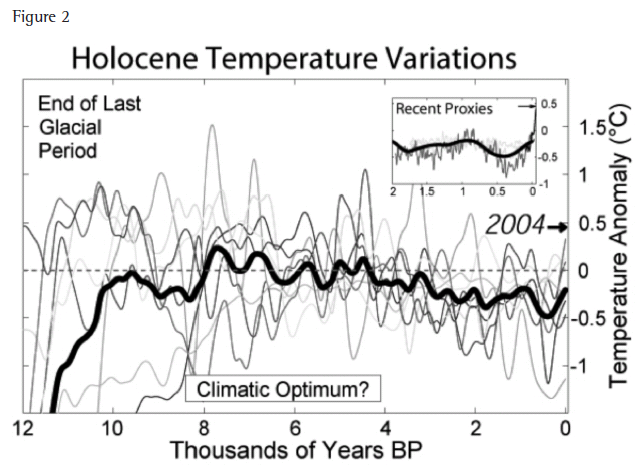
In other words the global temperature should, if anything, be heading down. Up to you whether you keep repeating it. And btw colder might be more miserable where you live, it certainly isn’t where I am.
Fake Holocene graphs don’t count for anything except baseless propaganda, McClod.
Blame co2islife, it’s one of his.
co2islife January 23, 2016 at 4:01 pm
This chart shows that over the past 8000 years, temperatures changed by 0.8°C, with very little variation of the actual temperature….
You’re a fake.
Tony,
See those little “bumps”? Those are on the order of 100 or more years in length. We are in the middle of an upward bump now. But just like all the others in that chart, this one will end and temps will go down again. At that time the people who are around (and it probably won’t be us) will wonder how we could have been so stupid to ignore the real long term (8000 year) trend. If mankind is lucky the downward bump will only last a hundred years and will not be the bottom falling out as the ice sheets start advancing again.
Tony, ignore the dark black line,look at the lighter ones instead,with those big up and down swings,those are the ones showing small interstadials. They are larger swings during glaciation period.
I vote for a squiggly line going in the other direction.
[I mean that is basically how it was done in the first place. There had to be a show of hands at some point].
That graph shows the current warming started 400+ years ago. And it’s from Wikipedia, so you know it’s trustworthy.
rea
Looks like Robert Rohde of Berkeley Earth is the original artist.
Do over
 #mw-jump-to-license
Interstadials have indeed repeated themselves several times. That kind of regularity must be driven by something powerful. Tony believes that the anthropogenic portion alone of global CO2 will overwhelm that substantial driver and keep us warm. I actually prefer to stay warm. So if I suspend my own intellect for a moment I vote for some magical amplification device that when coupled with anthropogenic CO2, we all get to stay moist and warm. If Tony contends we will be DRY and warm I refer him back to a 5th grade text on the water cycle.
Tony, take a read of this:
http://citeseerx.ist.psu.edu/viewdoc/download?doi=10.1.1.732.130&rep=rep1&type=pdf
And this a problem requiring our concern and attention- how?
Glad to see the adjustments worked 😉
UAH are in on it too now, eh Matt? Et tu Roy!
If it’s Roy it’s good enough for me.
“So what is so special about Februaries?”
_________________
Maybe the fact that the report is referring specifically to the February temperature update. Not much point referencing it against past March or December values, is there?
What month do you suggest February temperatures should be compared against Forrest?
Now, what can we tell about the climate?

The last 38 Years temperature went up by 0.45 °C, which is 1.2 °C per Century
Land data are showing a higher trend: about 0.7 °C for 38 Years or 1.7 per Century.
Roughly said, Surface data measurement adds 50% to temperature due to UHT and Method. Or one third of Temp rise in surface data is bias.
If we apply this to the surface data, we get a warming of about 0.6°C since 1850.
Ending a trend right after a super El Nino is pretty silly unless you are not looking for the truth.
Whereas starting a trend right after one is what, Richard?
Well below the minimum .20C per decade warming projection and the average of .30C as published by the amazing IPCC. reports.Where they get so many things wrong over time.
naturbaumeister on March 3, 2017 at 3:45 am
Germans love to explain it complicated where in fact it goes so simple:
http://fs5.directupload.net/images/170303/2l4cssaf.png
Feels good. The daffodils are out but it been cool enough that the snowdrops are still in abundance.
OT…
XOM witch hunt update:
http://dailycaller.com/2017/03/02/dem-ags-stonewall-gop-efforts-to-subpoena-anti-exxon-crusade/?utm_campaign=atdailycaller&utm_source=Twitter&utm_medium=Social
To wit…
That’s very good news here in the US central Appalachians — heating and electric bills are down considerably. Road departments are well within budgets for snow/ice control. The list goes on. Much better than the frigid Feb 2015 temps.
newbie question: Considering how much fossil fuels are burned worldwide every year, has anyone done a calculation on exactly how much direct heat energy that adds daily/monthly/yearly to our atmosphere? I don’t seem to ever see that number in any of the charts. And with an ever increasing worldwide population, I would imagine it’s also a value that’s continually increasing.
The estimates for CO2 warming of the atmosphere range from less than 1C up to 4.5C, depending on who you ask.
This doesn’t take into account the possible negative feedbacks which might negate any warming from human-caused CO2.
To date, there is no firm evidence that human-caused CO2 is warming the atmosphere. The CO2 signal is lost in the natural variabilty of the climate.
Pete on March 3, 2017 at 7:01 am
The total world yearly energy consumption is about 500 Exajoule, the yearly incoming solar energy may go up to 50,000 Exajoule. Taking the average gives you thus roughly that thermic energy induced by fossil burning is about 1 % of that we receive from the Sun.
And above all it could be even less than the energy added into the atmosphere by the fact that the increasing CO2 (resulting from burning the fossil part of the energy sources) absorbs and uniformly reemits longwave radiation (IR) emitted by the Earth’s surface in response to solar shortwave radiation.
I actually have no exact data source for the energy yearly accumulated in the atmosphere and the oceans due to IR radiation prevented from escaping off the Earth.
This spatially uniform reemission of IR (instead of a direct transmission to outer space from the ground level) has two consequences:
– it slightly warms the lower atmosphere, what results in an increased acceptance for water vapor which does the IR absorption / reemission job far better than CO2;
– it reduces the ability of heat evacuation, because the higher the final reemission to outer space, the less efficient it is.
I think most people silently agree to that. But all have a different meaning about the consequences for the next 100 years.
Finally the church of antropogenic global warming has spoken. The mum of the projection and the dad of Scenarios told ya so. Yumm, nothing to do with natural cycles, these were masked by the IPCC to the unrecognizable. And only the models, miracles of beauty and perfection. And now this evolutionary step in AGW theory. Not the middel troposphere is heated up most rapidly, but by back-radiation it warms itself due to greater possibility of warm air to bind moisture, the layer from the ground to 10 meters (the location of the climatic stations) this area much stronger, which brings also the adjustments of the surface Stations ( eG 10 Meter Stations) again In the right direction. Wait a minute, I’m completely knotted in the brain. How was this again with the AGW theory: A pure doubling of the CO2 content in the air heats the same by 1 -1.2 C. If now the CO2 doubles, the temperature increases in steps because the CO2 does not turn up once again doubled by this margin. But because it gets warmer, the amount of water vapor rises in the air, which, in turn, increases the atmosphere to the required 6 degrees for the climatic alarm, but only the atmosphere in the layer up to the level of the climate stations ( 10 meters). For, oh wonder in the middle atmosphere, this modeling effect is not to be observed at all. Neither by satellite measurements nor by balloon ascents. This is the great breakthrough of AGW theory. The floor layer heating model. -Sarcasm out and I go to bed –
Hans-Georg on March 3, 2017 at 4:54 pm
Was für eine lächerliche Prosa! Typisch deutsch.
For, oh wonder in the middle atmosphere, this modeling effect is not to be observed at all. Neither by satellite measurements nor by balloon ascents.
I guess you never have seen nor a fortiori processed even one balloon dataset. Not one!
Forrest Gardener on March 3, 2017 at 3:40 pm
Bindi, I am quick to criticise you when you troll…
Don’t you overestimate yourself a bit here?
Wasn’t there supposed to be a hot spot somewhere in the atmosphere by now? Has it materialised?
Which part of the atmosphere? No idea what you mean.
I’m interested in facts, and in nothing else. One of these facts is that in the (more or less) lower troposphere, the poles aren’t cooling that much when you look at trends over valuable periods.
http://fs5.directupload.net/images/170304/2x7bkgok.jpg
What is rather cooling a bit is the area between the poles 🙂
And you see also that the more you move to the north, the warmer it gets.
http://fs5.directupload.net/images/170304/mj84s4be.jpg
Of the 9,504 UAH 2.5° grid cells, 96 of the 100 showing the highest trends are in the 80N-82.5N latitude zone.
What does that say about CAGW?
No idea.
Probably no more than uncontrolled forest fires did before the mid 19th century.
When the US is warm it’s a headline.
When it’s cool it’s only 3% of the earth’s surface.
Notice,that while DWR54,Tony and other warmists, ignore the failed IPCC per decade predictions?
They grow excited about a warm month,every month but fail to see that it doesn’t support their AGW conjecture.
There is no excitement. Continued, accellerating warming is apalling. I hope you too will be apalled as the Arctic becomes a temperate blue-water ocean over the next few years. And if you think thats a good thing you really haven’t done your research.
“I hope you too will be apalled as the Arctic becomes a temperate blue-water ocean over the next few years.”
Woo-Hoo!
Yet another crazy prediction!
Come on Banton, how many years is “the next few”?
To the nearest hundred will do!
“tony mcleod March 3, 2017 at 3:16 pm”
You’ve been watching too much Gore. He, unqualified like your good self, made a similar prediction about Arctic sea ice that was supposed to disappear by 2013. It’s still there. And it will still be there long after your predictions come and go.
Adjusting the temperature has become a moving wave. It will always be warmer than the norm. I also predict that they will have to adjust the numbers again in a few years. 2025 will look dramatically higher where 2016 will look more like the norm. By then some parts of the American mid west will be starting to dry out and they will be ringing the alarm bells again about the driest on record.
When they adjusted the temperature and co2 record it was to preserve the CAGW fiction that temperatures followed co2. The record until March 2015 clearly proved that co2 followed temperature . They didn’t change the record in the name of science, they changed it to disassociate temperature from co2. They also changed it to disassociate it from the solar cycle as well.
In the real world, who knows what the actual temperature and co2 levels are, I could say that if this year was cooler after an el nino event, that co2 ppm for this year would have fallen below the increase in ppm from last year. Keep that in mind and see if it’s true.
The CAGW people are also claiming that co2 production has either stabilized or is falling somewhat. They have to. They can’t account for massive amounts of missing co2 from anthropogenic causes that they associate with atmospheric increases of co2.
For years now co2 ppm per year was higher than 1998 which was 2.93 ppm. Then in 2015 I started talking about co2 following temperature. In spite of the production each of a billion metric tons each additional year, the ppm per year never exceed 1998. They changed other years as well as 2005. The reason I point out 2005 is that it was 2.52 ppm for that year. It was 2.52 for 10 years. NOAA changed it to 3.10 ppm. I was asked where did I get the numbers… NOAA. Even still the pattern is still recognizable, except it isn’t as solid as it was. Especially the last 5 or 6 years. I’m sure NOAA is working very hard to correct this oversight of co2 following temperature. There is a lot more to this argument that goes back to the early days, 2001. It was claimed that they could know that the co2 in the atmosphere that was being added was entirely from anthropogenic sources via isotopes. It’s taken awhile, but that doesn’t look like the case. First, is the dramatic increase in the sinks. And second, is that with so much more co2 being added, it’s not reflected in the ppm per year. In several years during the 00s more co2 was missing than all of the production from 1965. ( I have a solid number for 1965 in co2 produced). Not attributed to the sinks nor finding it’s way into the atmosphere. Further the same argument I used back then about fossil fuels being tagged with radioactive isotopes, which they said should be less since it was buried was the same arguments used by the greens in California to stop fossil fuel burning. Which, in conclusion, leads me to think that the rise in co2 levels were not in part or whole via anthropogenic sources. One of the key features of this is that there are no negative numbers in the co2 record for the last 150 years. They are assuming a carbon balance when there may not be one. I also think that burning fossil fuels might have inadvertently saved the world as we know it. If the data and research on this is correct, in less than 100 years the planet could have experienced plant death. The research is fairly solid, the data is iffy. And that is a problem.
They do have a dilemma concerning the LIA and MWP. If was due to an increase or decrease in co2, then they have to explain where the co2 came from or went. If it wasn’t from co2 then they have to explain the temperature in the absence of dramatic changes in co2. Their solution was to make it go away. It hasn’t gone away. If anything, it has been shown that both events were world wide. Their solution was to say temperature didn’t vary that much, although now they acknowledge both events. And once again, it has been shown that the temperature swings were dramatic all over the world.
If we don’t find out what caused the LIA, we will be doomed to repeat the horrors of famine, disease, and wars. This time with the spectra of nuclear weapons. That’s why I’m here. Climate science as it currently stands is totally useless.
rishrac:
Forget about CO2. It has nothing to do with Climate Change.
Google “Climate Change Deciphered” for the real cause of global warming.
The cause of the little ice age is already known–it was caused by large volcanic eruptions spewing strongly dimming SO2 aerosols into the atmosphere..
One Yellowstone would change our world considerably. What I’m doing is showing that co2 is following temperature, not leading it. It is completely opposite of what AGW contends.
AGW is useless, it can’t tell us if there is going to be a slight cool down like the 1970s. That was bad enough. A LIA would be awful. And that’s not anywhere close to a full blown ice age. That’s what climate science should be doing, not arm waving about some maybe future change, that so far not one prediction/projection has come close.
It is important to show the current climate regime that they are mistaken. First, they have a political agenda, and second, the solution is the worst of all possibilities. Up to and including if (IF) they were absolutely correct.
Rishrack:
Thank you for your comments.
As proven in my Climate Change Deciphered post, the control knob for earth’s climate over the past 160 years been the amount of sulfur dioxide aerosols in the atmosphere.
Add them, and it cools down. Reduce them, and it warms up.
Society needs to understand this, and to control them insofar as possible.
This is, I would maintain, applicable over all of earth’s history, with ice ages being preceded by extensive volcanism, etc. ..
I don’t disagree with that Burl. There is no doubt that volcanoes have an impact on earth’s climate. However, I also think there are other factors as well. Co2 isn’t one of them.
Rishrac:
Yes, there may well have been other factors over the centuries. However, fpr ttje period 1975-2011, temperature projections based solely upon the net global amount of reductions in SO2 aerosol emissions are accurate to within .02 deg. C., or less. No hint of any other factor affecting temperatures.
There is currently no published data for net global SO2 aerosols since 2011, but .also no reason to suspect anything different
That’s good to know, I will remember. The reason is that current climate models can’t project foward or backwards. That is probably another reason they are adjusting the records. If you have the records on so2, don’t loose them. If they contradict AGW, they will get changed.
I had a thought about so2. In a new blog on Claim: ” a-growth” they were talking about manufacturers like VW trying to skate around the new standards. I had a Toyota that got 34 miles to the gallon back in the 1970s. Then I happened to think that was before a lot of the emmisions standards came into place. I not certain, but wasn’t one of the emmisions from cars back then so2 ? It would be interesting to see if the number of cars per unit of so2, per miles driven were a factor in the cooling in the 1970s. If that’s the case that so2 is a factor.
rishrac:
Figure 6, in the paper “Anthropogenic Sulfur Dioxide Emissions: 1850-2005, by S. J. Smith, et al shows the huge run-up in global anthropogenic sulfur dioxide emissions from about 1950 and on, peaking at about 131 Megatommes in 1972.
They state that “surface transportation contributes a relatively small amount of total sulfur dioxide emissions”, so, although not a major contributor, they do appear to have included them in their inventory.
Evenly spread depends on which climate alarmist you talk to. In some places the levels may be higher, but generally I think it is evenly spread. Supposedly they can take a measurement from one place and get an accurate reading of co2 levels the world over. ( I add detail to head off alarmist ). If they remember the guy from CalTech standing in the snow in the mountains of California. I’m going with fairly well mixed, there was a discussion about that a few years ago.
I am familiar with that graph, it is misleading. If you graph the ppm per year it looks totally different. The graph you are referring to is the total amount of co2. It only proves that co2 has gone up in relation to co2. The ppm per year of co2 follows the temperature anomolies. It’s temperature that controls the co2. Otherwise, co2 ppm per year would have steadily increased, let’s cherry pick 1998.. but any year will do, instead of 1999 being 0.93 ppm, it should have been on par with 1998 at 2.93 ppm. The temp anomolies was 0.64 C for 1998 and 0.46 C for 1999. As a rule of thumb, for each 12 billion metric tons produced 6 go into a sink, or did, and 6 becomes an increase of 1 ppm. So from 1998 to 1999 somehow 2 ppm went poof. I can’t decide whether it’s 24 BMT or 12. But being 12, it’s all the co2 produced world wide in 1965. Now, to head off the warmist who will say that’s just variation, it isn’t. That is each and every year where co2 followed temperature for the last 60 years. The other remarkable thing is that nowhere is the co2 level ever makes up the missing co2.
Now, I can’t tell how much is natural, anthropogenic, or a combination. Or how much was in any amounts. For instance, was there a natural outflow that was being soaked up in the earlier records. I tend to think that earlier the sinks had to have been larger than they are now. I don’t think they grown, in fact they may have shrank. But even in NOAA ‘ s estimation a good 19 BMT went into the sink in 2015. That’s 3 times the amount sunk in 1965. And, this is important, the amount that made its way into the atmosphere is missing from a low of 4 BMT to nearly 8. Each and every year in the last 12. That’s on top of the amount that is acknowledged to have been sunk. That curve in the total co2 would/should be much higher on that graph you are referring to.
I tend to think the numbers are/were right. They didn’t change them until AFTER I pointed this out. And ultimately, I have to work with something.
Maybe someone can explain to me how this works.
I’ve read about the last number of heavy winters in the USA including freeze-ups of the Great Lakes. Does this mean that the temps elsewhere in the world must be that much higher to exactly produce a neat hundredths of a degree average global temp increase?
Also, what happens when higher than normal temps and precip are balanced out by lower than normal temps and precip to produce average temps and precip? It that still climate change or what?
Nearly all of the tropospheric tropics was average temperature last month. What’s going on with the CO2 induced doom-warming in the tropics? It take the month off, or is this a sign that cooling will ensue?
Tropics temperatures are down essentially 1.0C in the last 11 months.
RWturner on March 3, 2017 at 11:52 am
What’s going on with the CO2 induced doom-warming in the tropics?
Show me one recent paper telling such nonsense. CO2’s activity if there is any you might rather see at the poles.
Mr Layman here. Just how and on what data is a “seasonal norm” determined? How far back does the data go?
Man has only just begun to gather the data necessary to determine any kind of “norm”. Even that would only be for a few decades. Some of it has been “adjusted”.
We’re really back to square one … er … zero when it comes to claiming such certainty about the past temperatures, measured or not, compared to the present temperatures.
Proof of Man being the cause is still less than zero.
Those who want to claim that Man is the cause of ..whatever is not “Natural”, would first have to prove Man (Woman) is not a part of what is “Natural”.
(On second thought, Man did invent computers and computer Climate Models. Maybe Man’s effect on “Climate” is not “Natural” after all?)
Is a single month climate? It is weather, and even a year is not anything near climate.
What you see outside your window is weather and not climate.
With cuts to NOAA and NASA satellite budgets looming…
Perhaps if the likes of Schmidt, Trenberth, Hansen et al had kept it honest, it wouldn’t be necessary. But because it suited the politics of the likes of Obama and the rest, they didn’t. So now it’s inevitable.
They have ZERO to do with satellite data.
They have zero to do with the vehicle and sensor designs,
zero to do with launch
Zero to do calibration
Zero to do with downlink
Zero to do with ANY data processing from level0 data to level 2 data
ZERO.
Our military uses that data
Companies use this data
your local weather guy uses this data.
but [snip] getting rid of satellite data is fine and dandy, because gavin?
Talk about politicizing science.
‘Talk about politicizing science.’
Climate science has far from clean hands when it comes to politicizing science. The blowback was entirely predictable.
The reality is most climate science is trash. I can no longer bother debunking the endless false claims.
Philip Bradley on March 7, 2017 at 5:55 am
The reality is most climate science is trash.
That is what you and other persons thinking similar suppose and pretend.
Would you be able to give any consistent proof of that? I guess no.
Bindidon:
For proof, Google “Climate Change Deciphered”.
Man made climate change is real, but most climate science IS trash.
Burl Henry on March 7, 2017 at 10:57 am
… but most climate science IS trash.
To you as well, the same reply as for Bradley:
That is what you and other persons thinking similar suppose and pretend.
Would you be able to give any consistent proof of that? I guess no.
I would understand your remark if you were yourself a scientist able to formally contradict climate scientists’ opinions.
Bindidon:
Yes, I can give consistent proof that most of climate science IS trash.
Google my post “Climate Change Deciphered” , which proves that the control knob for climate change over the past 160+ years has been the amount of sulfur dioxide aerosols in the atmosphere.
This being the case, any climate “science” with respect to warming due to the accumulation of “greenhouse” gasses is simply trash.
No, I am not a climate scientist, but I can easily contradict climate scientists’ opinions with my facts.
And the facts are that SO2 is even worse than CO2.was thought to be.
Burl Henry on March 8, 2017 at 5:24 pm
Google my post “Climate Change Deciphered”
That, Burl Henry, was a bad hint. You’d better have published the link to the blog entry instead. Because near it I found
https://wattsupwiththat.com/2016/10/15/scientific-integrity-is-constant-challenge-a-classic-historical-example/
with in it
https://wattsupwiththat.com/2016/10/15/scientific-integrity-is-constant-challenge-a-classic-historical-example/#comment-2320129
and from there I went to
https://wattsupwiththat.com/2015/05/26/the-role-of-sulfur-dioxide-aerosols-in-climate-change/
and finally to
Well I do not always agree to Willis’ meaning, but here I do!
Bindidon:
In my “Climate Change Deciphered” post, I pointed out that average global temperatures, over the past 160+ years, have temporarily risen whenever there has been a business recession.
This temporary warming can only have been due to reduced Sulfur Dioxide emissions into the atmosphere because of the reduced industrial activity during a business slowdown. The cleaner air allows sunshine to strike the earth’s surface with greater intensity, causing more surface warming.
(As would be expected, ERSST sea surface temperature increases follow exactly the same pattern as the recession-induced increases in global land-ocean surface temperatures)
Since average global temperatures rise whenever Sulfur Dioxide aerosol are unintentionally reduced, it follows that temperatures will also rise whenever SO2 aerosol emissions are intentionally reduced due to Clean Air efforts.
Surely you can understand this.
I then determined the amount of warming that would occur for each net Megatonne of reduction in global SO2 aerosol emissions, using data from both volcanic injections of SO2 into the stratosphere, as the aerosols settled out, and temperatures recovered to pre-eruption levels, and temperature increases due to Clean Air Act reductions in SO2 emissions. In each case, the amount of warming turned out to be .02 deg. C of warming for each net Megatonne of global reduction in SO2 aerosol emissions.
Using published data, I multiplied the .02 deg. C. factor times the amount of reduction since 1975 (roughly the start of anomalous global warming) to see whether the calculated amount of warming would match NASA’s land-ocean temperature index values.
Somewhat to my surprise, the calculated values matched NASA’s values to within .02 deg. C., or less, for every year for which global SO2 levels were reported. (This is better than any supercomputer hind-cast that I have seen)
The projected temperatures are so accurate that there can never have been any additional warming due to “greenhouse” gasses.
So, where have I gone wrong? Everything fits!
Willis misunderstood my .02 deg. C. factor and used it to claim that a hindcast would indicate temperatures should be 2 deg. C. cooler now. It only predicts how much temperatures will change for each net Megatonne of change in global SO2 aerosol emissions, and cannot be used any other way..
Error bars on 1850’s temperature data are so large that the temperatures are really not known, nor are SO2 levels, either.
If we do not halt the removal of SO2 aerosols from the atmosphere, much of the earth will become largely uninhabitable
Further proof that my “model’ is correct.
I have submitted the paper “The Cause and Timings of El Nino Events” to the OFS preprint service (OFS.io)
It turns out that every El Nino since 1850 has also coincided with .business recessions, so that the mystery of why an El Nino forms is now solved. However, since about 1990, there have been El Ninos that are not associated with a recession. These are caused by reductions in SO2 emissions due to Clean Air efforts (especially the 1997-1998 El Nino)..
UAHv6 methods paper has just been published, announced on Roy Spencer’s site.
http://www.drroyspencer.com/2017/03/uah-version-6-dataset-paper-published-online/
There are a couple of links to the full version there.
As the data set is so often referred to here (including monthly updates), this development is worth a post of its own.