From BROWN UNIVERSITY
Earth’s orbital variations and sea ice synch glacial periods

PROVIDENCE, R.I. [Brown University] — Earth is currently in what climatologists call an interglacial period, a warm pulse between long, cold ice ages when glaciers dominate our planet’s higher latitudes. For the past million years, these glacial-interglacial cycles have repeated roughly on a 100,000-year cycle. Now a team of Brown University researchers has a new explanation for that timing and why the cycle was different before a million years ago.
Using a set of computer simulations, the researchers show that two periodic variations in Earth’s orbit combine on a 100,000-year cycle to cause an expansion of sea ice in the Southern Hemisphere. Compared to open ocean waters, that ice reflects more of the sun’s rays back into space, substantially reducing the amount of solar energy the planet absorbs. As a result, global temperature cools.
“The 100,000-year pace of glacial-interglacial periods has been difficult to explain,” said Jung-Eun Lee, an assistant professor in Brown’s Department of Earth, Environmental and Planetary Studies and the study’s lead author. “What we were able to show is the importance of sea ice in the Southern Hemisphere along with orbital forcings in setting the pace for the glacial-interglacial cycle.”
The research is published in the journal Geophysical Research Letters.
Orbit and climate
In the 1930s, Serbian scientist Milutin Milankovitch identified three different recurring changes in Earth’s orbital pattern. Each of these Milankovitch Cycles can influence the amount of sunlight the planet receives, which in turn can influence climate. The changes cycle through every 100,000, 41,000 and 21,000 years.
The problem is that the 100,000-year cycle alone is the weakest of the three in the degree to which it affects solar radiation. So why that cycle would be the one that sets the pace of glacial cycle is a mystery. But this new study shows the mechanism through which the 100,000-year cycle and the 21,000-year cycle work together to drive Earth’s glacial cycle.
The 21,000-year cycle deals with precession — the change in orientation of Earth’s tilted rotational axis, which creates Earth’s changing seasons. When the Northern Hemisphere is tilted toward the sun, it gets more sunlight and experiences summer. At the same time, the Southern Hemisphere is tilted away, so it gets less sunlight and experiences winter. But the direction that the axis points slowly changes — or precesses — with respect to Earth’s orbit. As a result, the position in the orbit where the seasons change migrates slightly from year to year. Earth’s orbit is elliptical, which means the distance between the planet and the sun changes depending on where we are in the orbital ellipse. So precession basically means that the seasons can occur when the planet is closest or farthest from the sun, or somewhere in between, which alters the seasons’ intensity.
In other words, precession causes a period during the 21,000-year cycle when Northern Hemisphere summer happens around the time when the Earth is closest to the sun, which would make those summers slightly warmer. Six months later, when the Southern Hemisphere has its summer, the Earth would be at its furthest point from the sun, making the Southern Hemisphere summers a little cooler. Every 10,500 years, the scenario is the opposite.
In terms of average global temperature, one might not expect precession to matter much. Whichever hemisphere is closer to the sun in its summer, the other hemisphere will be farther away during its summer, so the effects would just wash themselves out. However, this study shows that there can indeed be an effect on global temperature if there’s a difference in the way the two hemispheres absorb solar energy — which there is.
That difference has to do with each hemisphere’s capacity to grow sea ice. Because of the arrangement of the continents, there’s much more room for sea ice to grow in the Southern Hemisphere. The oceans of the Northern Hemisphere are interrupted by continents, which limits the extent to which ice can grow. So when the precessional cycle causes a series of cooler summers in the Southern Hemisphere, sea ice can expand dramatically because there’s less summer melting.
Lee’s climate models rely on the simple idea that sea ice reflects a significant amount of solar radiation back into space that would normally be absorbed into the ocean. That reflection of radiation can lower global temperature.
“What we show is that even if the total incoming energy is the same throughout the whole precession cycle, the amount of energy the Earth actually absorbs does change with precession,” Lee said. “The large Southern Hemispheric sea ice that forms when summers are cooler reduces the energy absorbed.”
But that leaves the question of why the precession cycle, which repeats every 21,000 years, would cause a 100,000-year glacial cycle. The answer is that the 100,000-year orbital cycle modulates the effects of the precession cycle.
The 100,000-year cycle deals with the eccentricity of Earth’s orbit — meaning the extent to which it deviates from a circle. Over a period of 100,000 years, the orbital shape goes from almost circular to more elongated and back again. It’s only when eccentricity is high — meaning the orbit is more elliptical — that there’s a significant difference between the Earth’s furthest point from the sun and its closest. As a result, there’s only a large difference in the intensity of seasons due to precession when eccentricity is large.
“When eccentricity is small, precession doesn’t matter,” Lee said. “Precession only matters when eccentricity is large. That’s why we see a stronger 100,000-year pace than a 21,000-year pace.”
Lee’s models show that, aided by high eccentricity, cool Southern Hemisphere summers can decrease by as much as 17 percent the amount of summer solar radiation absorbed by the planet over the latitude where the difference in sea ice distribution is largest — enough to cause significant global cooling and potentially creating the right conditions for an ice age.
Aside from radiation reflection, there may be additional cooling feedbacks started by an increase in southern sea ice, Lee and her colleagues say. Much of the carbon dioxide — a key greenhouse gas — exhaled into the atmosphere from the oceans comes from the southern polar region. If that region is largely covered in ice, it may hold that carbon dioxide in like a cap on a soda bottle. In addition, energy normally flows from the ocean to warm the atmosphere in winter as well, but sea ice insulates and reduces this exchange. So having less carbon and less energy transferred between the atmosphere and the ocean add to the cooling effect.
Explaining a shift
The findings may also help explain a puzzling shift in the Earth’s glacial cycle. For the past million years or so, the 100,000-year glacial cycle has been the most prominent. But before a million years ago, paleoclimate data suggest that pace of the glacial cycle was closer to about 40,000 years. That suggests that the third Milankovitch Cycle, which repeats every 41,000 years, was dominant then.
While the precession cycle deals with which direction the Earth’s axis is pointing, the 41,000-year cycle deals with how much the axis is tilted. The tilt — or obliquity — changes from a minimum of about 22 degrees to a maximum of around 25 degrees. (It’s at 23 degrees at the moment.) When obliquity is higher, each of the poles gets more sunlight, which tends to warm the planet.
So why would the obliquity cycle be the most important one before a million years ago, but become less important more recently?
According to Lee’s models, it has to do with the fact that the planet has been generally cooler over the past million years than it was prior to that. The models show that, when the Earth was generally warmer than today, precession-related sea ice expansion in the Southern Hemisphere is less likely to occur. That allows the obliquity cycle to dominate the global temperature signature. After a million years ago, when Earth became a bit cooler on average, the obliquity signal starts to take a back seat to the precession/eccentricity signal.
Lee and her colleagues believe their models present a strong new explanation for the history of Earth’s glacial cycle — explaining both the more recent pace and the puzzling transition a million years ago.
As for the future of the glacial cycle, that remains unclear, Lee says. It’s difficult at this point to predict how human contributions to Earth’s greenhouse gas concentrations might alter the future of Earth’s ice ages.
###
Hmmmm. Dust. What causes dust. Lack of humidity. Oceans provide humidity. So if humidity is low for a long time, oceans have gone into net recharge mode. They are not evaporating heat, they are absorbing heat. Which would lead to dust, thus limiting what solar insolation is available, prolonging the amount of time needed to warm up the oceans enough that heat begins to escape again. I still must return to the oceans themselves as a slow discharge/recharge battery that both causes and then interacts with atmospheric water vapor and airborne dust to create a cyclical stadial/interstadial jagged oscillation mildly impinged upon be orbital mechanics. CO2, a bit player, rides along.
Now for something completely different. (from me)
Climate change skeptics say that fluctuations in the earth’s climate are caused by variations in the output of the sun. Alarmists respond by stating that variations in solar luminosity and the average solar constant of 1,368 W/m^2 are too small to make much difference. They are both correct and yet both of those explanations are inaccurate and incomplete.
What both sides forgot to mention is that the earth does not orbit in a nice average circle, but in an ellipse:
1) closer to the sun at perihelion, 1/4/17, and hotter with a solar non-constant of 1,415 W/m^2,
2) and farther at aphelion, 7/3/17, and colder with a solar non-constant of 1,323 W/m^2
3) for a total variation of 92 W/m^2.
What both sides also forget to mention is that because of the tilted axis and spherical shape the total insolation incident on a horizontal surface at the top of the atmosphere at any given point, e.g. 40 N latitude, fluctuates by around 670 W/m^2 solstice to solstice. What are the consequences of that large fluctuation? Winter and summer which the earth has survived for thousands of millennia.
Per IPCC AR5 between 1750 and 2011, 261 years, assuming all natural processes remained constant (not necessarily valid) the atmospheric concentration of carbon dioxide rose due to by default human processes, i.e. fossil fuel and land use changes, from 278 ppm to 391 ppm. The consequence to the atmospheric heat balance of 261 years’ worth of that additional carbon dioxide was a warming of 2 W/m^2. (IPCC AR5 SPM.5)
If the 92 W/m^2 fluctuation due to orbit and a 670 W/m^2 fluctuation due to tilt and shape have no catastrophic consequences what should we reasonably expect from 2?
BTW 1,415, 1,323, 92, 670 W/m^2 are real numbers based on real physical parameters, real math, and confirmed by real measurements. IPCC’s 2 W/m^2 is based on a conceptual model such as Kiehl-Trenberth’s power flux graphic diagram, i.e. a ball suspended in a hot fluid, with no consideration of orbit, tilt, night and day, and bearing no resemblance to the actual earth.
Another point is that the earth moves faster when it is closer to the sun, so it spends less time at perihelion than it does at aphelion.
The frigid waters around the Antarctic are the biggest global sink for CO2, never a source. Seasonal sea ice expansion does not change the area of that sink but shifts it to the north. CO2 being delivered to the South pole via the upper atmosphere from the tropics has to travel further over ice to open water during Antarctic winter causing a slight increase in concentration during that time.
In contrast, the big sink in the north is nearly covered with ice during the northern winter and CO2 being delivered there builds up to maximum concentration values. When the ice melts in summer, the frigid waters suck up every molecule that reaches it. We don’t need to wait 100,000 years to see this effect, but it is nice to know that nature behaves similarly on much longer time scales. The water cycle controls the CO2 cycle.
The assertion that summer insolation changes at 65N due to the earth’s orbital changes, which is referred to as Milankovitch’s theory, somehow causes the glacial/interglacial cycle, is an urban legend.
A paradox is an observation (cyclic abrupt climate change in the paleo record for example) that cannot be explained by a theory. When there are piles and piles of paradoxes a field of science should be in crisis. Climate science is in crisis.
An obvious observation that refutes Milankovitch theory is the Younger Dryas abrupt cooling event 12,900 years ago, at which time the planet when from interglacial warm to glacial cold with 70% of the cooling occurring in less than a decade. The Younger Dryas abrupt cooling event lasted for 1200 years.
There is a massive cyclic forcing function (hint it’s the sun and hint the sun causes a massive change to the earth’s geomagnetic field which in turn causes long term cooling, the self exciting theory for the generation of the geomagnetic field is also a urban legend) that has not been taken into account.
Currently summer insolation at 65N is the same as the coldest part of the last interglacial.
Greenland Ice Sheet Temperatures Last 100,000 years
http://www.hidropolitikakademi.org/wp-content/uploads/2014/07/4.gif
It is interesting that the Dansgaard/Oescheger cyclic warming and cooling ‘events’ have a characteristic period of 1470 years which has continued with same periodicity from the last glacial period into the current Holocene interglacial period.
As there are cosmogenic isotope changes that are concurrent with all of the Dansgaard/Oescheger events (also referred to a Bond events named after Gerald Bond who tracked 23 of the cycles) and the Heinrich events it is obvious a specific solar cycle change is causing what is observed.
http://www.climate4you.com/images/GISP2%20TemperatureSince10700%20BP%20with%20CO2%20from%20EPICA%20DomeC.gif
Are at least 12 different observations and analysis results that support the assertion that insolation changes at 65N are physically not capable of causing the temperature changes observed in the paleo record and did not cause what is observed. The following is a sample of the paradoxes which disproof the theory.
1) 100,000 year problem
2) Southern Hemisphere cools cyclically at the same time as the Northern Hemisphere
http://www.news.wisc.edu/9557
3) Stage 5 problem (Causality Problem)
4) Effect exceeds cause
5) The unsplit peak problem
6) The transition problem
7) Identifying dominant factor
William Astrology
An obvious observation that refutes Milankovitch theory is the Younger Dryas abrupt cooling event 12,900 years ago, at which time the planet when from interglacial warm to glacial cold with 70% of the cooling occurring in less than a decade. The Younger Dryas abrupt cooling event lasted for 1200 years.
Not so. A few chaotic fluctuations and flip-flops between the glacial and interglacial attractors do not in any way refute Milankovich. If they do, then they refute the whole peleton of solar and astrophysical alternative cyclical theories also.
Your own figure that you posted – the temperatures in Greenland over the last 100,000 years – makes it clear that the YD is nothing at all exceptional – it is simply one – the last one – out of about 20 “microinterglacials” that took place during the previous glacial interval. Microinterglacials are sometimes called DO (Dansgaard-Oescher) events.
JUST HOW OBVIOUS DOES MOTHER NATURE HAVE TO MAKE IT THAT THE SYSTEM IS FLIPPING BETWEEN TWO CHAOTIC ATTRACTORS, GLACIAL AND INTERGLACIAL?!
How many posts does one have to plough through in which every tiny twitch and inflection of the graph needs its own unique external forcing? What is so taboo about saying the obvious, that it’s simply a weakly periodically forced nonlinear oscillator?
Think of the bigger picture and it becomes still more obvious. Earth has been cooling for at least 40 million years, and now we are just entering glaciation for the last 3 million years. So earth is finely balanced on the threshold between glacial and interglacial. Like any dissipative open system with chaotic dynamics, it is characterised by islands of stability in the probabilistic topology that are called “attractors”. Glacial and interglacial are attractors. As the abundant literature on chaotic experimental systems such as the Belousov-Zhabotinsky reaction (in all its forms including thin film) shows, chaotic oscillation can be periodically forced from the outside. Where the periodic forcing is weak or of comparable magnitude to the system’s own internal fluctuations, then the resulting wavetrain becomes very complex and the forcing signal is mixed with internally generated oscillations. The climate of the last 2-3 million years is as clear an example of this as one could ever hope to find.
There are many natural systems that during a gradual transition from one state to another, flip between the two states during a short transitional period, such as fish shoals or flocks of birds flipping between random milling and coordinated emergent-pattern swarming.
It is my prediction that every major glacial period in earth’s history, such as the Marinoan, Varangian, Saharan-Andean (end-Ordovician) also both began and ended with transitional periods of glacial-interglacial flipping. Why would they not? The long term trend we are in is for gradually deepening glaciation, as the above article states. So the transitional period of glacial-interglacial flip-flopping wont last forever – eventually there will be permanent and deep glaciation for a few tens of millions of years.
The fact that the pacing of interglacials has only loosely followed the obliquity cycle (3-1 mYa) and eccentricity (last million years) is because it is weak periodic forcing, mixed with internal chaotic oscillation. The fact that the forced oscillation is chaotic also means that it does not slavishly follow a fixed threshold, and the timing also varies. The oceans posess their own chaotic oscillations which occur over century and millenial timescales, and ocean circulation and mixing, the immediate cause of all climate change, is under weak external periodic forcing of the Milankovich cycles.
>>An obvious observation that refutes Milankovitch theory is
>>the Younger Dryas abrupt cooling event 12,900 years ago
There is good reason to believe that the YD was caused by an meteorite impact. See the mystery of the Carolina Bays, discussed here before.
And good reason to believe that the sudden D-O events during the last ice age were caused by continent-wide forest fires. Especially as these temperature excursions hardly show up in the SH.
Ralph
Gosh, Ralph,
You really subscribe to any wacko conjecture you come about.
Younger Dryas a meteoritic effect? D-Os caused by periodic forest fires?
Younger Dryas has all the aspect of being a mild late Heinrich event, similar to H3. It ends in a sudden warming accompanied by heavy Ice Rafted Debris in the North Atlantic, as Heinrich events do.
http://i.imgur.com/oumF89c.png
And we have a pretty good idea of what caused D-O events if you bother to read the ample bibliography on the matter, and it wasn’t dust, or ashes, or fires, or extraterrestrial beings.
>>You really subscribe to any wacko conjecture you come about.
I think you are losing the plot, Javier.
It was not me who suggested fires for D-O events, it was Fischer et al in “Millennial Changes in North America Wildfires….”. They demonstrated quite clearly that D-O events were strongly linked with fire combustion products.
To me this is logical. I have already demonstrated that the greatest feedback is albedo, not CO2. And the two most common elements that will change ice sheet albedo are dust and soot. Ergo, Javier, the continental fire theory is probably correct.
Ralph
Ralf,
There is no reason to imagine an impact at the YD, as there is not a scrap of evidence for one.
D/O and Heinrich, the Dryases and 8.2 Ka events all are caused by melting ice and ocean circulation, just as were the similar events in all prior glaciations. Bond cycles during interglacials are also due to ocean oscillations.
Ralph,
You have it backwards.
D/O events led to more vegetation and less ice, so there was more biomass to burn.
Your own citation from Nature Geoscience, Fischer, et al, makes this point. It doesn’t say what you claim, ie that wildfires caused the D/O events. The warmer intervals caused more vegetation to grow in areas from which ice retreated. Also probably longer growing season when warmer.
http://www.nature.com/ngeo/journal/v8/n9/full/ngeo2495.html
Millennial changes in North American wildfire and soil activity over the last glacial cycle
Climate changes in the North Atlantic region during the last glacial cycle were dominated by the slow waxing and waning of the North American ice sheet as well as by intermittent, millennial-scale Dansgaard–Oeschger climate oscillations. However, prior to the last deglaciation, the responses of North American vegetation and biomass burning to these climate variations are uncertain. Ammonium in Greenland ice cores, a product from North American soil emissions and biomass burning events, can help to fill this gap. Here we use continuous, high-resolution measurements of ammonium concentrations between 110,000 to 10,000 years ago from the Greenland NGRIP and GRIP ice cores to reconstruct North American wildfire activity and soil ammonium emissions. We find that on orbital timescales soil emissions increased under warmer climate conditions when vegetation expanded northwards into previously ice-covered areas. For millennial-scale interstadial warm periods during Marine Isotope Stage 3, the fire recurrence rate increased in parallel to the rapid warmings, whereas soil emissions rose more slowly, reflecting slow ice shrinkage and delayed ecosystem changes. We conclude that sudden warming events had little impact on soil ammonium emissions and ammonium transport to Greenland, but did result in a substantial increase in the frequency of North American wildfires.
It’s just Ralph again mistaking the effect for the cause.
Javier,
So it appears.
There is no need to invoke extraterrestrial or terrestrial gods on machines to account for climatic observations. The climate system itself, ie oceanic and atmospheric interactions, plus celestial mechanical modulation of solar activity, with some tectonic elements, adequately explain most phenomena.
Ralf
The YD bolide impact hypothesis was thoroughly discredited in this recent post here:
https://wattsupwiththat.com/2016/12/19/a-bad-day-for-younger-dryas-comet-impact-climate-theory/
As for forest fires increasing NH temperatures by as much as 10 C – come on Ralf! You’re better than that.
Both the Bolling-Alerod and the previous microinterglacials were likely to have been excursions of the AMOC (linked to its salinity-downwelling feedback instability) – thus as Javier points out they appear only in the Greenland i e core records, not the Antarctic:
http://s12.postimg.org/9ctilkusd/NGRIP_NEEM_EDC_Global_135kya.png
Thank goodness the onus isn’t on CO2 sceptics to construct an alternative theory
;-). True.
But at least we can debate several scenarios, without getting arrested on trumped up RICOH charges…..
R
Okay, I sort of got blasted for my writing critique of another article here at WUWT, which had as much to do with my ignorance as it did to to with the author’s presentation. Still, I gotta risk getting blasted again, so here goes:
My first annoyance with this article, as with any article, is a clickable link to PAY-WALLED original research. This seems pretty useless to me, so why do it. A broken link, okay fine, that can be fixed. But a pay-wall link seems like free marketing for the journal, which might not be the intent of the author, but, unfortunately it is the effect on the reader.
Say I click on the link that says Geophysical Research Letters. What does that do for me ? It takes me to page that refers me to another page that refers me to another page that shows the cost of accessing the article. I wasted my time, in other words, when I was trying to understand the article in which the link appeared, by seeing the original research upon which the article was based.
Yeah, yeah, I know, I’m such a whiner ?
On another, related note (and perhaps putting my neck further in a noose of highly trained minds here in this field of study), here was my attempt at a similar article some years back (since someone requested a sample of my attempts at writing in another post):
http://hubpages.com/education/The-Cosmology-Climate-Connection-How-Extraterrestrial-Forces-Influence-The-Weather
I realize, by YOUR standards here, that my attempt there might be underwhelming, flawed, amateurish. I even quote some of the names I think I have seen here in the WUWT comments.
Anyhow, as usual, no guts, no glory.
Oh no, and now I must face the wrath of William Astley. (^_^) … as I endure the torture of his ripping my amateurish article to shreds.
Live and learn. Living is not so hard. Learning, on the other hand, …
A Scotsman named Croll wrote about this in the late 1800’s. That’s why they are sometimes known Croll Milankovich cycles.
Nickolas. I was hoping to find out why the shape of earth’s orbit changes. Judging from your comment I thought you could explain it for me.
William Astley’s point 7) in his post above covers some of the orbital information…
Also remember the earth is tilted… that tilt, its inclination may be toward or away from the sun, over time…
Currently the NH tilts away at perihelion, closest, so away and close offset the heating a bit. The SH tilts toward at perihelion making for double hotness.
At aphelion, farther, the NH tilts towards, but colder orbit and warmer tilt off set. SH tilts away and gets double coldness
Milankovitch says that in half of 26,000 year or so the earth will precess in its orbit to the point that the arrangement will be 180 degrees, NH tilted closer at perihelion, double hotness and SH away, offset, at perihelion.
All of this fluctuation is bound to change the heating/cooling and behavior of the climate and biosphere and orders of magnitude more than GHGs/CO2.
Why an ellipse? Well, I understand that’s not always the case. Need to go back to the original science, Newton, Kepler, Copernicus, et.al.
Earth’s orbit is elliptical because of the gravitational attraction of Jupiter and other solar system bodies besides the sun. It also of course wobbles on its axis, ie precesses, and changes tilt. There is as well precession of perihelion, but that is considered to have only a minor effect on climate.
92 W/m^2 is not minor.
Precession of perihelion is not the same as precession of the equinoxes.
It’s a breath of fresh air – actually considering external forces affecting climate. Now, after first trashing the CO2 based muddle, we can begin to construct a rational climate model. This has been mentioned, but when dealing with events on scales of tens of thousands of years you must consider plate tectonics. How were the land masses arranged then? Perhaps a future refinement, but please omit the CO2 genuflexion.
I’m surprised that Nir Shaviv’s hypothesis regarding our passage through the Milky Way’s spiral arms was not mentioned.
http://www.sciencebits.com/ice-ages
As I said above it is not Nir Shaviv’s hypothesis. it predates Nir Shaviv by several decades:
Apparently it originates in Fred Hoyle’s work of 1939:
The effect of interstellar matter on climatic variation
https://www.cambridge.org/core/journals/mathematical-proceedings-of-the-cambridge-philosophical-society/article/div-classtitlethe-effect-of-interstellar-matter-on-climatic-variationdiv/0EA53316502FBA0B9D8FD21A62D7FF68#
And it was already old news in the early 70’s when several groups defended it, with W.H. McCrea as one of its main proponents:
Ice ages and the Galaxy
http://www.nature.com/nature/journal/v255/n5510/abs/255607a0.html
I was amused to find that Robert Ardrey author of “African Genesis” posited something similar in his section on ice ages.
Shaviv’s causal mechanism is different from Hoyle’s conjecture. It derives from Ney’s 1959 cosmic ray hypothesis:
http://www.sciencebits.com/ice-ages
“Shaviv’s causal mechanism is different from Hoyle’s conjecture.”
True. In its first incarnation the solar displacement through the galaxy theory of ice ages was based on regions with higher matter density reducing solar radiation.
MODS
A comment of mine is presently in moderation. When you post it please will you correct a typo appearing immediately before the 2nd image.
The date in parenthesis should be 1973/4
many thanks.
This theory sounds a lot like many others I have heard. I think the dust theory poster here some months back seemed to fit better.
Firmly tongue in cheek it is worth pointing out that Milankovitch was not always the darling of consensus science. He was a pal of Wegener for example and a bit of a maverick. However. he lived in a time when it was impossible to get out of the straightjacket of mainstream theory and recognised that all it takes to create an ice age is a tilt in the axis of rotation. My theory for what it is worth is that he created a situation where he got the necessary tilt in the orbit of the earth by coming up with a lengthy series of cycles, and the 100,000 years cycle was the longest which is why mainstream adopted his scheme in the 1950s as it was possible to glue it together with their other pet theories, such as the magnetic stripes on the floor of the Atlanti, and the discovery that foraminifera also displayed a cycle of around 100,000. Rhodes Fairbridge however suggested the sun went around it barycentre at just short of 100,000 years – so does the foraminifera (and its changes in oxygen isotopes) really have anything to do with ice ages? I find it strange on this blog that so many people are willing to rubbish climate science and co2 levels but are fully prepared to accepted equally dodgy other consensus theories – as if it is the truth. Is it too much for the brain to think in terms of more than one anomaly? What if Milankovitch just wanted to create a tilt in the earth – but mainstream would not allow the earth to shift from its axis of rotation. Would he have been forced to come up with a tilt that fitted the mainstream agenda? It’s an interesting question and we shall never know the answer. I am of course chucking a stone into the waters. We really should not toe the consensus line in any science – which is the point I wish to make. Not unless it has been indisputably verified. As far as I can see Ice Ages have not been verified as even foraminifera data has come under attack in some quarters – and Plate Tectonics, you might remember, is stridently supported by none other than Naomi Oreskes. That should tell you all you want to know. It is a consensus theory. Why do people accept that and blow cold air at global warming?
Hi, Carol.
Your point is well made. Plenty of denizens here will clutch at anything that seems to be an alternative to CO2 as a cause of climate change, and make of it much more than can be justified with our present state of knowledge. Unfortunately, warmists then seize upon this willing credulity to dismiss the whole sceptic postion. I, too, wish we could confine ourselves to a critique of the CO2 paradigm, but I guess it isn’t going to happen.
That said, there are some really interesting things that emerge when we go off at a tangent – worth a separate blog in their own right. A few of these you see immediately above your post (Ralfellis, Ptolemy, Javier). So we shouldn’t be too displeased, but feeling guilty at spending so much time here
Carol
What do you mean by “ice ages have not been verified”?
“Why do people accept that and blow cold air at global warming.”
Because the observations, numbers and thermo don’t work.
The author’s model appears fundamentally flawed in taking the duration of the Earth’s precession cycle to be about 21,000 years. Current estimates place it at around 26,000 years instead. (See https://en.wikipedia.org/wiki/Precession_of_the_equinoxes )
Earth’s axis completes one full cycle of precession approximately every 26,000 years. At the same time, the elliptical orbit rotates more slowly. The combined effect of the two precessions leads to a 21,000-year period between the astronomical seasons and the orbit.
>>Current estimates place it at around 26,000 years instead
As Gloateus said, you have to factor in apsidal precession too. And even with this, the precessional cycle is highly variable, from 15 ky to 25 ky. Which is why it was so difficult for Milankovitch to calculate, before the advent of computers.
R
Gloateus and Ralf,
Thanks for your enlightening information.
Having just calculated the period of the combined axial and orbital rotation cycles myself, I can confirm that it comes to roughly 21,000 years.
However, I was somewhat bemused to learn that the orbital (“apsidal”) motion is referred to as “precession” when it would have to be “procession” (i.e. in the same direction as the planets move in their orbits, which is opposite to the direction of axial precession) to produce a 21,000-year combined cycle. If the orbit really was precessing in the same sense as the Earth’s axis, the period of the combined cycles would be 34,000 years or thereabout.
Factoring in Ralf’s point about the extreme variability of the combined cycles as well, I find myself drowning in a boundless sea of mathematical uncertainty, which I dare say provides infinite wiggle-room for a climate modeler to speculate in.
There are major problems with the Milankovich/Croll hypothesis that no model is going to solve. For example, (1) 40 years ago John Mercer pointed out that if the M/C theory is correction, glaciations and interglaciations in the Northern Hemisphere should be out of phase with those in the Southern Hemisphere (he called this the ‘fly in the Milankovitch ointment), (2) the deep sea core record is largely undated, so it was stretched or contracted until it matched the astronomical record and then (lo and behold), because the two curves matched, the Milankovitch theory must be true, (3) the discovery of abrupt, full scale climate changes from full glacial to interglacial in a hundred years or so (D/O events) dealt the Milankovitch a death blow because orbital changes couldn’t possibly change back and forth that rapidly, (4) we now know from isotope dating of glacial deposits in both hemispheres that abrupt, short term, fluctuating climate changes occurred simultaneously in both hemispheres and could not be caused by slow orbital variations, and on and on.
No computer model can overcome these contradictions to the Milankovitch/Croll theory.
Don,
Those aren’t problems for the celestial mechanical hypothesis.
Glacial and ice sheet advances can and do overlap in both hemispheres, but initiating colder climate can start in either and affect the other with a lag.
Ice core records are well dated, and they confirm the hypothesis.
Rapid climatic fluctuations don’t need to be explained by the hypothesis. Celestial mechanics explain the onset and demise of glaciations. They needn’t explain what happens during them. D/O and Heinrich events are due to sudden freshwater flows into the oceans, whether from meltwater or iceberg armadas.
“Gloateus,
“Those aren’t problems for the celestial mechanical hypothesis.”
Of course they are.
“Glacial and ice sheet advances can and do overlap in both hemispheres, but initiating colder climate can start in either and affect the other with a lag.”
You’re missing the point rather badly here–THERE IS NO LAG!
“Ice core records are well dated, ”
No–the Greenland GISP2 is well-dated by annual layering, but it only extends back 100,000 years so doesn’t help with 100k cycles. The Antarctic cores are very poorly dated.
“and they confirm the hypothesis.”
No, they do not (see above)
“Rapid climatic fluctuations don’t need to be explained by the hypothesis.”
Of course they do–they are real and prove that full glacial/interglacial climate changes
have occurred repeatedly within a few hundred years, far too abrupt to be caused by M/C.
“Celestial mechanics explain the onset and demise of glaciations.”
No they do not–for all of the reasons stated previously.
“They needn’t explain what happens during them. D/O and Heinrich events are due to sudden freshwater flows into the oceans, whether from meltwater or iceberg armadas.”
No they are not–if this were true, there would be a lag between hemispheres, but recent extensive isotope dating of glacial deposits in both hemispheres prove that there is no lag at all.
Don,
Nope. All the evidence says you’re wrong as to both the lag and the celestial mechanical cause of NH glaciation:
http://www.nature.com/nature/journal/v448/n7156/abs/nature06015.html
The Milankovitch theory of climate change proposes that glacial–interglacial cycles are driven by changes in summer insolation at high northern latitudes. The timing of climate change in the Southern Hemisphere at glacial–interglacial transitions (which are known as terminations) relative to variations in summer insolation in the Northern Hemisphere is an important test of this hypothesis. So far, it has only been possible to apply this test to the most recent termination because the dating uncertainty associated with older terminations is too large to allow phase relationships to be determined. Here we present a new chronology of Antarctic climate change over the past 360,000 years that is based on the ratio of oxygen to nitrogen molecules in air trapped in the Dome Fuji and Vostok ice cores. This ratio is a proxy for local summer insolation, and thus allows the chronology to be constructed by orbital tuning without the need to assume a lag between a climate record and an orbital parameter. The accuracy of the chronology allows us to examine the phase relationships between climate records from the ice cores and changes in insolation. Our results indicate that orbital-scale Antarctic climate change lags Northern Hemisphere insolation by a few millennia, and that the increases in Antarctic temperature and atmospheric carbon dioxide concentration during the last four terminations occurred within the rising phase of Northern Hemisphere summer insolation. These results support the Milankovitch theory that Northern Hemisphere summer insolation triggered the last four deglaciations.
Gloateus,
I’ve shown real-time physical data for synchronous glaciations in both hemispheres, no lag between hemispheres, and climate reversals too abrupt to be caused by M/C. Nothing you have said provides any evidence to the contrary (‘dating’ of ice cores by ‘orbital tuning’ is not really dating–you need independence measurement (such as annual dating in GISP2) for real chronology.
Don,
You´ve mentioned isotope data here, but haven´t provided the data. No doubt you have elsewhere, but so far my link is the only source in our discussion.
Dating ice and sediment cores can be difficult, but with enough different methods and using well constrained checks such as volcanic eruptions, the results are good enough for government work, ie climatological purposes.
Gloatus,
I assumed that anyone serious about the cause of climate change would be familiar with the literature, but considering the vastness of the literature, perhaps I presume too much. If you intend to defend the M/C hypothesis, you will need to be aware of the negative evidence (real, physical evidence) that I referred to above. As a start, I would recommend the new Elsevier volume, “Evidence-based I Climate Science.” It has a lot of isotope data and other information by 15 authors. Then you can follow up with references in the papers there. I hope you do this, as I think it will sharpen the issues for you.
Having spent a lifetime dating sediments and working with ice core isotopes, I can tell without equivocation that “the results are good enough for government work, ie climatological purposes” is not good enough.
Don,
Presumably specialists in celestial mechanics and paleoclimatology who have concluded that Milankovitch cycles regulate ice sheet inception are at least as conversant with the literature as you. So I’d like to see your evidence that they are wrong.
Except these ones:
http://aric.hagberg.org/papers/marts-2007-period.pdf
http://chaos.utexas.edu/manuscripts/1066847055.pdf
https://www.google.be/url?sa=t&rct=j&q=&esrc=s&source=web&cd=&cad=rja&uact=8&ved=0ahUKEwiS2Y3p8uLRAhUFCBoKHS5eDqEQFggxMAI&url=http%3A%2F%2Fchaos.utexas.edu%2Fmanuscripts%2F1089136670.ps&usg=AFQjCNEoThclL27ZhzLCfEpxQ2pDu-lklA&sig2=f0EtpQ5D7_N_bO5vfKsshw
https://www.researchgate.net/publication/231410793_Excitable_chemical_reaction_systems_in_a_continuous_stirred_tank_reactor
Good points Dr. E. If the models are able to distinguish changes in the relative influence of the three cycles, they should be able to pinpoint the onset of the next ice age. Yet, the paper makes no such claims.
Rob,
Many scientists have made predictions based upon M cycles. Those who conclude that eccentricity dominates predict that the Holocene will be a very long interglacial. Those, like Javier, who consider other parameters more important, predict it will last only a few thousand more years, being shorter than the Eemian, the previous interglacial.
Gloateus,
My point does not concern the relative strength of one cycle vs another, as the paper claims to have discovered which cycle dominates when. If the models in question have no predictive skill, the we have to assume claims of discovering a cipher to which cycle dominates when, are tenuous at best.
Don,
(1) Obliquity is in phase in both poles. Obliquity is the main responsible factor for interglacials. Glacial periods are the default situation of being in an ice age and don’t need explaining.
(2) The deep sea core record is dated by magnetic inversions. No adjustment needed to support obliquity driven interglacial cycles.
(3) D-O events have nothing to do with the glacial cycle, and they are not global in nature as they do not show in Antarctic records.
(4) Abrupt climate changes take place all the time in the proxy records. The 8,2 kyr event, the 4.2 kyr event, Heinrich events, Bond events, D-O events. Why should the orbital theory have to explain them all?
I am very surprised by the simplicity, lack of depth, and lack of evidence of your arguments.
Javier,
“1) Obliquity is in phase in both poles. Obliquity is the main responsible factor for interglacials. Glacial periods are the default situation of being in an ice age and don’t need explaining.”
‘Glaciations don’t need explaining’?? I hope you don’t really believe such nonsense.
“(2) The deep sea core record is dated by magnetic inversions. No adjustment needed to support obliquity driven interglacial cycles. ”
Deep sea cores have ONE magnetic reversal in the past million plus years, and you consider that enough for chronology?
“(3) D-O events have nothing to do with the glacial cycle, and they are not global in nature as they do not show in Antarctic records.”
Your ignorance is showing here–they have everything to do with glacial cycles and they do indeed show in both Antarctic and Greenland records.
“(4) Abrupt climate changes take place all the time in the proxy records. The 8,2 kyr event, the 4.2 kyr event, Heinrich events, Bond events, D-O events. Why should the orbital theory have to explain them all?”
M/C doesn’t have to explain every climatic variation, but because D/O events (especially the Younger Dryas) show that global climates can shift from full glacial to full interglacial in a few hundreds years, they are far too abrupt to be cause by orbital variations.
“I am very surprised by the simplicity, lack of depth, and lack of evidence of your arguments.”
Then you need to read the literature and educate yourself–you obvious don’t know much about the issues.
In explanation……
Javier likes to use Huybers’ home-made marine-core chronology, which was indeed centered around magnetic reversals some 900 ky apart. It uses none of the other chronological pegs that the ice core chronology depends upon, and is therefore the most unrelaible ice age chronology on the market.
Javier likes this chronology because it was made to support Huybers’ obliquity theory, which Javier subscribes to. So he is clinging to a self-fullfilling prophesy, which is not exactly science.
R
Don,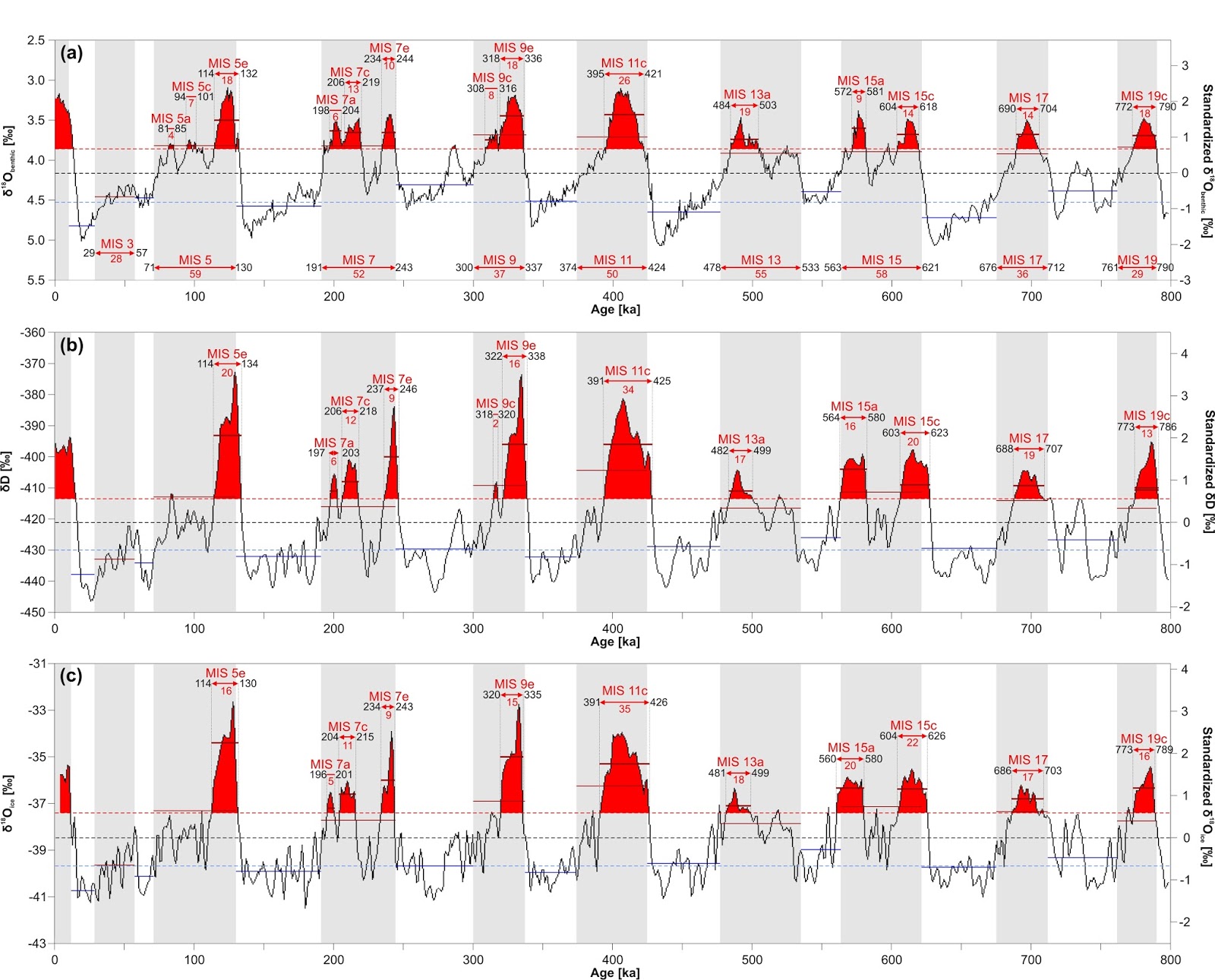
(1) Perhaps you are unaware that the planet has been cooling for the past several million years to the point that now it spends 90% of its time in a default glacial state characterized by extensive continental ice sheets.
http://i.imgur.com/XyysvX6.png
Nobody knows the cause of that multi-million year cooling, but when the conditions that give rise to an interglacial end, the planet slides naturally to a glacial state.
“Deep sea cores have ONE magnetic reversal in the past million plus years, and you consider that enough for chronology?”
Pardon me, but we have Brunhes, Matuyama, Jaramillo, Olduvai, Kaena, Mammoth, Gilbert, Cochitl, Nunivak, Sidufjall, and Thvera in the past 5 million years. That’s enough to know what orbital periodicities we are talking about. For the past 800,000 years we can compare with Antarctic ice cores. The match is quite good as this figure from Varga 2015 shows:
(a) is LR04 benthic record, and (b) is EPICA Dome C in Antarctica. Do you get lost there?
And the dating of ice cores is quite good with a very small error.
(3) It is your ignorance that shows. DO-events do not appear neither in Antarctic records, nor in benthic records. You have a syndrome known as “Greenland climate represents global climate.”
http://i.imgur.com/aatCBMM.png
(4) “D/O events (especially the Younger Dryas) show that global climates can shift from full glacial to full interglacial in a few hundreds years”
DO-events and YD do not represent a shift from full glacial to full interglacial. They affect mainly the northern hemisphere with some teleconnections affecting Antarctica. DO events do not register and YD barely in the global benthic record.
“Then you need to read the literature and educate yourself–you obvious don’t know much about the issues.”
I think I have read the literature in more depth than you and I know more about these issues than you do.
I already published a very in depth article about the glacial cycle with very extensive literature review at Judith Curry’s blog Climate Etc.
https://judithcurry.com/2016/10/24/nature-unbound-i-the-glacial-cycle/
And I am sending a new one about the Dansgaard-Oeschger cycle today, that if approved will appear shortly at the blog.
Read them and learn.
Magnetic reversal and astronomical dating were confirmed by Potassium- and Argon-Argon dating:
http://pangea.stanford.edu/~mac/pdf/Baksi+%201992.pdf
Earth has been cooling since the mid-Miocene, and longer-term since the Eocene maximum (PETM):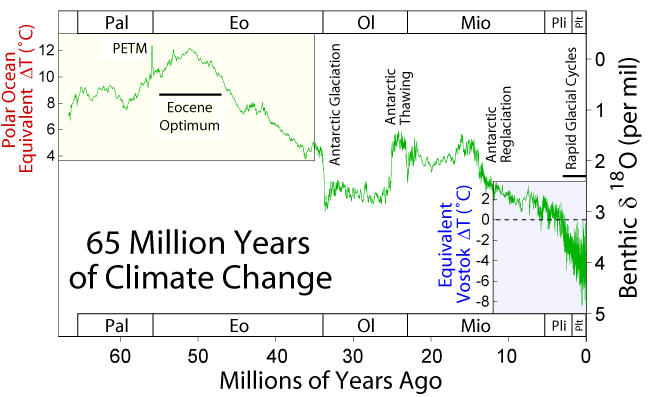
Ralph
That’s a lie. In the methods part of my article it says and shows very clearly that I am using EPICA Dome C chronology.
https://sabercathost.com/4Df5/Nature_unbound_1.pdf
You are the one that subscribes to alternative explanations like forest fires for D-O events, meteorites for the YD, and dust for interglacials.
Your own figure clearly shows that temperatures and interglacials follow the obliquity cycle when the thermal inertia of the planet is taken into consideration.
http://i.imgur.com/pS5a1Wf.png
Thanks for your help in making my point.
Javier,
Your graph also show how variable are the glacials as well as the interglacials, both in duration and temperature.
The last glaciation was a biggie, including two full tilt cycles between the obliquity peaks associated with the Eemian and Holocene. These stillborn interglacials were instead merely major interstadials within the glacial.
Yes, Gloateus,
The planet is so cold that 9 of the last 20 obliquity cycles resulted in aborted interglacials.
Yet here we are, near the end of an interglacial, worried that the planet might warm too much. What a curious species we are.
According to my calculations, the next obliquity cycle will also fail, so we are looking towards at least 70,000 years of glaciation. Large parts of the world will become uninhabitable.
Javier,
Except that in a few thousand years, when high latitude snow no longer melts in summer, we can help it along with soot, if not indeed giant, fusion-powered blow driers or front-end loaders dumping it in trucks to be hauled to warmer climes.
Yes that wall that Trump is building will prove an obstacle when – Day after Tomorrow style – US citizen fleeing glaciation are trying to cross into Mexico.
Warmists do love their theories about how sea ice (or lack of) is a big climate driver. Tail wagging the dog.
>>Tail wagging the dog.
Not necessarily. The feedback effects of ice-albedo are orders of magnitude greater than the feedback effects of CO2.
R
ralfellis,
“The feedback effects of ice-albedo are orders of magnitude greater than the feedback effects of CO2.”
Yes, except it is incorrect to characterize this as ‘feedback’, moreover; we are close to minimum ice now, so the potential cooling effect is far, far larger than the potential warming effect based on the current state of average ice.
Average ice coverage is about 12-13% of the surface. 2/3 of the planet is covered by clouds, thus on average, only 1/3 of the ice, if it all melts, will decrease the net albedo. The difference in reflectivity between average ice (40%) and no ice (7%) averages about 240*(.4-.07) = 80 W/m^2. Calculating the global effect of ice disappearing altogether is 80 * .125 * 1/3 resulting in an average of 3.3 W/m^2 across the globe and this doesn’t include the fact that the portions of the planet covered by ice get less Sun than average. Adding 3.3 W/m^2 to the 3.7 W/m^2 of forcing said to arise from doubling Co2 only adds up to less than half of the power required to sustain a 3C increase (> 16 W/m^2 of incremental surface emissions).
During ice ages, nearly 1/3 of the planet is covered by ice resulting in 80 * 1/3 * 1/3 is an average reduction of nearly 9 W/m^2 whose global temperature influence is about 2-3C (or 7.2C if you believe the absurdly high sensitivity claimed by the IPCC). Of course, they assume a high sensitivity to make a case for CO2, not realizing that the ice albedo effect is similarly increased far beyond reason. I would be remiss to not point out that at lower CO2 concentrations and lower temperature, the incremental effect (cooling or warming) from CO2 is far larger than it is today.
>>Yes, except it is incorrect to characterize this as ‘feedback’,
Classical climatologists tie themselves in knots with this terminology, as Hansen did in one of his papers, because forcing and feedback often overlap.
I term a feedback as anything that is a terrestrial response to a change in forcing. Orbital cycles are obviously a forcing. Since ice-albedo cooling is a response to that initial forcing, I term it as a feedback. Likewise with ice-albedo warming.
R
“Orbital cycles are obviously a forcing”
Technically, only the Sun forces the climate. If the Sun stopped shining, orbital cycles would be irrelevant. Orbital cycles are not so much a specific forcing, but a modulation and redistribution of solar forcing, much like night and day, except to a lesser extent.
When the IPCC says doubling Co2 is 3.7 W/m^2 of forcing, what they really mean is that doubling Co2 is EQUIVALENT to 3.7 W/m^2 more post albedo power from the Sun, keeping the system (Co2 concentrations) constant.
I think we have to be cautious, they are both equal to 3.7J/s/m^2. But they don’t necessarily add together because the e of the material they encounter will matter greatly for the 15u photon, and the broadband solar is well absorbed.
I also think it is possible it only really lights up when a lot of water vapor is condensing, as it has a wide band around 15u and it has to radiate to change to liquid water, and those photons can couple to co2, and vise versa, very laser cavity like. If this is the case I would expect the top of this area would get really bright at 15u.
It’s also possible its transfer the heat to the surrounding, that it would warm that object, which would have a more BB spectrum, where ~40% can radiate out the optical window,
“But they don’t necessarily add together because the e of the material they encounter will matter greatly for the 15u photon, and the broadband solar is well absorbed.”
This is the whole concept of EQUIVALENCE and since 1 joule does 1 joule of work, this is a convenient metric to be equivalent to. The equivalent forcing attributed to doubling Co2 is adjusted until it’s exactly equivalent to 3.7 W/m^2 of post albedo incident forcing. Climate science puts so many layers of obfuscation when considering the sensitivity, its not all that surprising that it has never been corrected, after all, that was the point of all the obfuscation in the first place.
How can they do that? They don’t have any idea what the e is going to be.
My point is they could actually be putting in 4 times that is, they set e as .25
“How can they do that?”
They guess and they have made a significant mistake, since the definition of forcing sets an instantaneous increase in post albedo input power as the same as an instantaneous decrease in surface emissions passing though the transparent region. All of the former affects the surface temperature, while in LTE, some of the later (about half) ends up escaping out to space.
Also, the LWIR emissivity and absorption of the surface is close enough to unity that e=1 is a good approximation. The ‘equivalent’ temperature of the surface is defined as the temperature of the surface of an ideal BB whose LWIR absorption is equal to its LWIR emissions. It just happens that this surface is a good proxy for the surface whose temperature we care about making its temperature a very good proxy for the actual surface temperature.
As far as short term variations go, this is far more complex.
It appears that the claim that loss of sea ice will adversely impact upon albedo thereby leading to more warming may be incorrect. There is a recent article on the NASA website that sheds considerable doubt upon the correctness of that assumptions.
See: http://earthobservatory.nasa.gov/Features/ArcticReflector/
To form ice sheets over a mile thick in northern latitudes, there must be a source of humidity to provide the snow to create the ice sheets. Ergo, the Arctic must be relatively ice free for extended periods.
The moisture comes from the lower latitudes, where there is no ice. There is no need for the Arctic to be ice free.
One reason for the onset of NH Pleistocene glaciations after the closure of the Inter-American Seaway by the Isthmus of Panama was more moisture brought north by the strengthened Gulf Stream.
Also Indonesia. Hot off the press, Jan 2017:
http://www.nature.com/articles/srep39842
Tectonically induced changes in oceanic seaways had profound effects on global and regional climate during the Late Neogene. The constriction of the Central American Seaway reached a critical threshold during the early Pliocene ~4.8–4 million years (Ma) ago. Model simulations indicate the strengthening of the Atlantic Meridional Overturning Circulation (AMOC) with a signature warming response in the Northern Hemisphere and cooling in the Southern Hemisphere. Subsequently, between ~4–3 Ma, the constriction of the Indonesian Seaway impacted regional climate and might have accelerated the Northern Hemisphere Glaciation. We here present Pliocene Atlantic interhemispheric sea surface temperature and salinity gradients (deduced from foraminiferal Mg/Ca and stable oxygen isotopes, δ18O) in combination with a recently published benthic stable carbon isotope (δ13C) record from the southernmost extent of North Atlantic Deep Water to reconstruct gateway-related changes in the AMOC mode. After an early reduction of the AMOC at ~5.3 Ma, we show in agreement with model simulations of the impacts of Central American Seaway closure a strengthened AMOC with a global climate signature. During ~3.8–3 Ma, we suggest a weakening of the AMOC in line with the global cooling trend, with possible contributions from the constriction of the Indonesian Seaway.
And the lower latitudes did not cool much either.
A very large percentage of the Greenland Ice Sheet was formed during the warmth of the Holocene. See: Cross Section of Ice Sheet according to NASA. The green component is that formed during the warmth of the Holocene.
http://svs.gsfc.nasa.gov/vis/a000000/a004200/a004249/GIS_periods.06429_print.jpg
Yes, because Holocene snow deposition is much greater than at the LGM.
But do also remember that the blue Ice Age ice in your diagram is much more compressed than the upper green Holocene ice. Although we have a complete ice record of the ice age, the lower strata have been squeezed to almost nothing, and the bulk of the ice has been forced to the margins, where it can melt.
R
Because the Milankovic cycles describe physical motions of the
Earth it is assumed that they could only be ” Earth’s cycles”. But
this is simply not true. The Milankovic cycles are in fact the sole
property of the Sun. They are members of an exclusive group of
frequencies that are characterized by a 360 degree rotation of the
Sun’s outwardly directed acceleration. They are vector quantities.
The Earth is blessed with a single large moon, so we inherit the
accelerations of the Sun as if these cycles were our own. The Earth
is caught up between the Sun’s accelerations and the pull of its orbiting
moon. This is where we get our 25772 , 41000, 100000 and 113000 etc.
year physical motions.
Milankovic theory as we know it, is completely backwards. It is a solar system
that loses eccentricity that sends us into an ice-age cycle. Take Jupiter
as an example: Jupiter accelerates toward its perihelion and decelerates
toward its aphelion. There is a continual exchange of energy as kinetic is
tranformed into potential and back again. Without eccentricity this exchange
does not take place. In our solar system the lowest level of energy that exists
is when the Sun and the gas giants lose there eccentricity.
Please visit weathercycles.wordpress
“The Sun’s acceleration responsible for ice-age cycles?”
This is all hogwash. Ice ages are a myth. After all, no one was driving SUVs around back then…
Do you have an SUV Kpar?
In my space dynamics course @ur momisugly PSU in late 60’s, I was taught the precession cycle was 26,000 years, not 21,000 as mentioned in the article. That’s a 20% discrepancy and would have a significant variance in the harmonics and the ~100k ice age cycle calculations! Doubt the precession cycle has changed that much over past 50 years!
Hey Bill,
You’re absolutely correct, the Earth’s precession rate is about
25772 years. If the Earth’s elliptical orbit were to also precess at a
rate of ~113,209 years, this would result in a speeding up of the
amount of time it takes for the the Earth’s axis to point in the same
direction.
113209 x 25772 / (113209 + 25772) = ~20993 years
Please visit weathercycles.wordpress
“Earth’s climate linked to . . . “
>>26,000 years
Yes, but you need to take apsidal precession into account, which reduces ‘seasonal’ precession to 21,000 years. This does not change normal precession, which remains at 26,000 years.
Do also remember that the ‘seasonal’ precessional cycle (the one that matters for paleoclimatology) is highly variable, ranging from 15,000 to 25,000 years.
R
Thanks Ralph for the correction on seasonal precession.
I just had surgery last weak and I plead impairment due
to massive amounts of morphine.
…these glacial-interglacial cycles have repeated roughly on a 100,000-year cycle…
What they mean by “roughly”?
And Ice age intensities also “roughly” ?
This is the whole problem – the cycle is not 100 ky at all. It is either 90 ky or 115 ky, and firmly linked to the precessional cycle. But you need to explain the missing cycles. See my comments on dust, above.
R
IMO the glaciations last roughly either two or three tilt cycles, ie 82 or 123 thousand years.
The intervening cycles don’t produce interglacials because the warming effect isn’t strong enough to melt so much ice.
https://wattsupwiththat.com/2016/09/29/earths-obliquity-and-temperature-over-the-last-20000-years/
Obliquity cycles also show up in oscillations of the West Antarctic Ice Sheet from the Pliocene.
http://www.nature.com/nature/journal/v458/n7236/full/nature07867.html
According to the AGW conjecture CO2 controls the primary greenhouse gas, H2O and greenhouse gases are entirely responsible for the atmospher’s insulation effect which keeps the Earth’s surface 33 degrees warmer on average then it would be without the insulaton effect of the atmosphere. CO2, in connection with other phenomena is also responsible for the ice ages and interglacial periods that we have been experiencing. According to the AGW conjecture it has to be CO2 that is responsible because there is no other explanation. It also must be so because of the 98% scientific consensus that both validates and settles the science and that is what they have been requiring our children to learn in our schools. At first all of this seems logical but upon close examination by someone who has at least some understanding of scientific principals, the AGW conjecture falls apart. Clearly this report shows that there are alternate
explanations as to the ice ages and interglacial perieods. CO2 need not be part of the explanation. But let us also discuss some of the other points.
1. According to the AGW conjecture CO2 controls H2O because the additional warming that CO2 produces causes more H2O to enter the atmosphere which causes more warming beccause H2O is also a greenhouse gas with LWIR absorption bands. Actually, molecule per molecule, H2O is a stronger IR absorber than CO2. If the AGW conjecture were true then a random increase in H2O itself would be enough to set off an unstable warming cycle that would end with the oceans boiling over and the Earth’s atmosphere becoming more massive than that of Venus but that does not happen. The reality is that H2O is really a net coolant in the Earth’s atmosphere exemplified by the fact that the wet lapse rate is significantly lower than the dry lapse rate. So this part of the AGW conjecture falls apart. Another fact that the AGW conjecture ignores is that more heat energy is moved from the Earth’s surface, which is mostly some form of H2O, to where clouds form via the heat of vaporization then by both convection and LWIR absorption band radiation combined, according to some popular models. A major problem with the AGW conjecture is that it is based on only a partial understanding of science.
2. As derived from first principals the surface of the Earth is 33 degrees C warmer than it would otherwise be due to the action of the heat capacity of the atmosphere and gravity. In a sense one can consider this to be a convective greenhouse effect. 33 degrees C is what is calculated and what is observed and it has nothing to do with the LWIR absroption properties of so called greenhouse gases. An additional radiant greenhouse effect caused by the LWIR absorption properties of greenhouse gases has not been observed anywhere on Earth or anywhere in the solar system for that matter. The radiant greenhouse must therefore be science fiction as must be the AGW conjecture.
3. Scientists never registered and voted on the the AGW question so the 98% conensus is nothing more than wishful thinking by those that make their living from pushing the AGW conjecture. Such a consensus is meaningless anyway because science is not a democracy. The laws of science are not some form of legislation. Scientific theories are not validated through a voting process. This consensus business in politics and not science. Something must be really wrong if consensus has to be used as an arguement.
4. The AGW conjecture also ignores the fact that good absorbers are also good radiators. Heat energy transfer via convection and conduction dominates over heat transfer by LWIR absorption band radiation in the troposphere. There have been no practical applications where CO2 is used as an insulator. If CO2 really affected climate then the increase in CO2 over the past 30 years should have caused at least a measureable increase in the dry lapse rate in the troposphere but such has not happened. After more than 2 decades of effort the IPCC has been unable to narrow the range of their guesses as to the climate sensivity of CO2 one iota. I am sure that they would not want to even enterain the idea that the climate sensivity of CO2 is really zero or very close to zero as some researchers have found.
This thesis leaves a lot unanswered.
It is well know that it is the combination SUM insolation of 100, 41, & 21 kyr cycles that correlate with hemisphere TOA insolation.
But, the authors suggest that it is during times when the southern hemisphere (SH) is cooler in summer, meaning the SH is tilted away, that SH sea ice grows. These are also the times when the northern hemisphere (NH) receives more insolation.
Proxy data show that major glaciations began when the NH received less summer insolation and the SH glaciation occurred at similar times. This is when the SH received more insolation, just opposite from what the authors suggest.
Then they suggest that the change-over between 41 kyr glaciation cycles to 100 kyr cycles began because of the cooling of the globe, but they do not explain why.
“sea ice in the Southern Hemisphere…. that ice reflects more of the sun’s rays back into space, substantially reducing the amount of solar energy the planet absorbs. As a result, global temperature cools.”
And since the sea ice around Antarctica seems to be growing, we are going to face another ice age any minute.
We’re doomed.
Gimme that old time Milankovich
Gimme that old time Milankovich
Gimme that old time Milankovich
It’s good enough for me
If you go “M’lankovitch”, you get three syllables, as in”religion”.