From the UNIVERSITY OF COLORADO AT BOULDER

A team led by the University of Colorado Boulder has found the mechanism behind the sudden onset of a “natural thermostat” in Earth’s upper atmosphere that dramatically cools the air after it has been heated by violent solar activity.
Scientists have known that solar flares and coronal mass ejections (CMEs) — which release electrically charged plasma from the sun — can damage satellites, cause power outages on Earth and disrupt GPS service. CMEs are powerful enough to send billions of tons of solar particles screaming toward Earth at more than 1 million miles per hour, said CU Boulder Professor Delores Knipp of the Department of Aerospace Engineering Sciences.
Now, Knipp and her team have determined that when such powerful CMEs come off the sun and speed toward Earth, they create shock waves much like supersonic aircraft create sonic booms. While the shock waves from CMEs pour energy into Earth’s upper atmosphere, puffing it up and heating it, they also cause the formation of the trace chemical nitric oxide, which then rapidly cools and shrinks it, she said.
“What’s new is that we have determined the circumstances under which the upper atmosphere goes into this almost overcooling mode following significant heating,” said Knipp, also a member of CU Boulder’s Colorado Center for Astrodynamics Research. “It’s a bit like having a stuck thermostat — it’s really a case of nature reining itself in.”
Knipp gave a presentation at the 2016 fall meeting of the American Geophysical Union being held in San Francisco Dec. 12 through Dec. 16. The presentation was tied to an upcoming paper that is slated to be published in the journal Space Weather.
Solar storms can cause dramatic change in the temperatures of the upper atmosphere, including the ionosphere, which ranges from about 30 miles in altitude to about 600 miles high — the edge of space. While CME material slamming into Earth’s atmosphere can cause temperature spikes of up to 750 degrees Fahrenheit, the nitric oxide created by the energy infusion can subsequently cool it by about 930 F, said Knipp.
The key to solving the mystery came when Knipp was reviewing satellite data from a severe solar storm that pounded Earth in 1967. “I found a graphic buried deep in a long forgotten manuscript,” she said. “It finally suggested to me what was really happening.”
Because the upper atmosphere expands during CMEs, satellites in low-Earth orbit are forced to move through additional gaseous particles, causing them to experience more drag. Satellite drag — a huge concern of government and aerospace companies — causes decays in the orbits of spacecraft, which subsequently burn up in the atmosphere.
As part of the new study, Knipp and her colleagues compared two 15-year-long satellite datasets. One was from the Sounding of the Atmosphere using Broadband Emission Radiometry (SABER) instrument riding on NASA’s TIMED satellite. The other was from data collected by U.S. Department of Defense satellites.
“We found that the fastest material streaming off the sun was triggering these shockwaves, causing the atmosphere to heave up and heat up,” she said. “But it became very clear that these shock waves were at the root of creating the nitric oxide, which caused the atmosphere to shed energy and cool.”
SABER has been collecting data on nitric oxide in the atmosphere since its launch in 2001, following on the heels of another nitric oxide-measuring satellite known as the Student Nitric Oxide Explorer (SNOE). Launched in 1998, SNOE involved more than 100 CU Boulder students, primarily undergraduates, in its design and construction. Once in orbit, SNOE was controlled by students on campus 24 hours a day for nearly six years.
Geomagnetic storms have had severe impacts on Earth. A 1989 storm caused by a CME resulted in the collapse of the Hydro-Quebec’s electricity transmission system, causing six million Canadians to lose power. In 1859 a solar storm called the Carrington Event produced auroras from the North Pole to Central America and disrupted telegraph communications, even sparking fires at telegraph offices that caused several deaths.
###
Yes, I get that we might argue that the lower atmosphere has a greater effect on the upper atmosphere than the upper atmosphere has on the lower atmosphere. That’s how I’m seeing it. So, wouldn’t it be ironic if we discovered that the problem with our human-CO2 belching ways was actually the COOLING of the upper atmosphere, rather than the warming of the lower atmosphere?
And knowing that CO2 acts as a “coolant” in the upper atmosphere, might this change the tone of the whole discussion everywhere in the atmosphere? In other words, stop talking about “heat trapping” and start talking more about heat transfer.
A question that I would have is … How do we know that it is human-caused CO2 migrating in greater quantities to the upper atmosphere? How is this measured? How is human-caused CO2 separated out at that altitude?
Robert says
And knowing that CO2 acts as a “coolant” in the upper atmosphere, might this change the tone of the whole discussion everywhere in the atmosphere? In other words, stop talking about “heat trapping” and start talking more about heat transfer.
A question that I would have is … How do we know that it is human-caused CO2 migrating in greater quantities to the upper atmosphere? How is this measured? How is human-caused CO2 separated out at that altitude
Henry says
there is little doubt that the burning of fossil fuels causes there to be more CO2 in the atmosphere?
Anyway, there are some ways to determine this, e.g. by looking at the isotopes of Carbon. Apparently they can figure out which are which – i.e. which are released by the oceans, naturally, due to warming, – there giga tons of carbonates in the oceans – and which are not. [natural life does not ‘like’ the 1% carbon 14….]
My thoughts of more CO2 in the atmosphere are also that of cooling rather than warming – nobody ever brought us a balance sheet, did they? [on the deflection of sunlight in the 1-2 and 4-5 um range by CO2 versus the entrapment of heat from earth in the 14-15 um range]
never mind all that,
it never even showed up in my results as a factor in my own results
Rsquare equal to 1 means everything is just going down quite naturally…no room for any AGW whatsoever….
Min and Max temp for 76 million station days.
360 samples per year – ~76 million records” width=”600″ />
And then min temp, dew point and rel humidity.
Then the difference between min and max
I have a ton of surface data here http://sourceforge.net/projects/gsod-rpts/
Lost the pictures.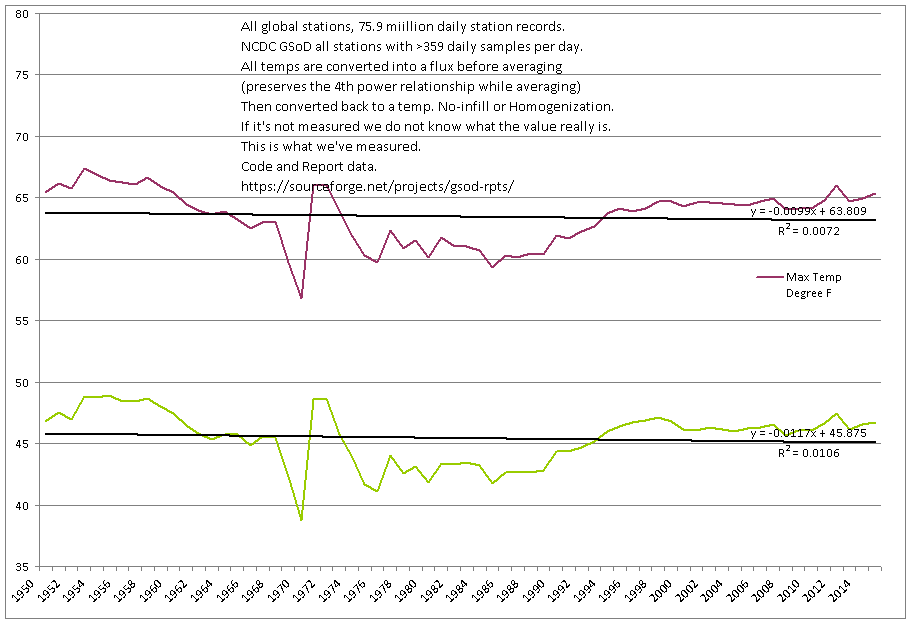


Min Max temp
Min Temp, Dew Point and Rel Humidity
Difference between min and max
I made my own data sets taking into account
1) sh stations = nh stations {each 27 stations}
2) all stations balance to zero latitude
3) looking at the average change in K per annum at each station means you don’t have to worry about longitude
4) I chose the stations 70/30 @sea/inland
5) otherwise the choice of stations is completely random
from
http://www.tutiempo.net
I saw, but it’s such a small subset of the data. I include everything, in this case the only criteria is that they collects at least 360 days of data. But I do a lot of other calculations, enthalpy (wet and dry), estimated solar for that location, derivative of the daily change in temp, and do the averaging as a flux, then convert back to a temp, for true averaging.
Water vapor regulates lower atm to dew points.
@micro6500
I do applaud you on your results which, interalia,
1) shows us the switch in Hale cycle that occurred just before 1972 and 1995 [will happen again just about now, i.e. this year 2017 or next year 2018….]
2) shows that there has been no warming trend, really from 50 or 60years back to now .
However, as I said, like most other data sets based on surface stations it is likely to be biased toward the NH, simply because there are many more measurements performed in the NH.
To show you how this could affect your data sets, consider my result if I were to look only at the area where I live:
iow
there has never been any warming here, whatsoever…
Interesting. With Venus at about .72 AU from the sun, if my math is right, that planet should suffer about twice as many CMEs as Earth. Is the Venusian atmosphere (and temperature) so strikingly different from Earth’s perhaps because of a difference in the availability of nitrogen? That is, without a strong nitric oxide feedback loop, is Venus’ comparatively high temperature the cumulative result of CMEs and not necessarily the result of CO2 trapping?
No, a CME is a large structure with an angular extent of up to 90 degrees so Venus will be hit by as many CMEs as the Earth
We definitely need the opening picture on a t-shirt with the added words “It’s the sun, stupid!”
there is also the elephant in the room to consider
which I only experienced when I went down 1km into a goldmine here
what if that elephant moves around, apparently north, as evident by the movement of the magnetic north pole….
jmorpuss says
Earth is a rotating sphere with a hellish 6000 C core that radiates outwards in all directions to a cold space
henry says
true enough
I only went down 1km here, in one of our goldmines, and suddenly, because of the increase of T, you realize the elephant in the room [from within…]
I am pretty sure that the reason why we see more warming in the Nh and none in the Sh is because of the movement of that core more to the north as evident by the shift in the magnetic north pole.
now, what I want to know, is, how can we predict the movement of earth’s inner core?
Jm says
Earth is a rotating sphere with a hellish 6000 C core that radiates outwards in all directions to a cold space
henry says
true enough
I only went down 1km here, in one of our goldmines, and suddenly, because of the increase of T, you realize the elephant in the room [from within…]
I am pretty sure that the reason why we see more warming in the Nh and none in the Sh is because of the movement of that core more to the north as evident by the shift in the magnetic north pole.
now, what I want to know, is, how can we predict the movement of earth’s inner core?
Henry “now, what I want to know, is, how can we predict the movement of earth’s inner core?”
https://www.youtube.com/watch?v=1MI3YDGgtN4
Henry , I hope these links help. Note how the core rotates faster then the surface. Like a magnetic stirrer https://en.wikipedia.org/wiki/Magnetic_stirrer
I know all about magnetic stirrers
[I was a plant chemist]
makes sense to me to think that if the big stirrer in the deep starts to move, the [coated] stirrer [inside earth] also starts to move.
Either way, it is the sun that causes both local and global cooling/warming on earth…
Henry December 17, 2016 at 7:06 am
Henry December 17, 2016 at 7:08 am
Henry December 17, 2016 at 7:10 am
Henry December 17, 2016 at 7:12 am
Henry December 17, 2016 at 7:15 am
Henry December 17, 2016 at 7:20 am
Henry December 17, 2016 at 7:17 am
Henry December 17, 2016 at 9:23 am
——————————————————–
duplicate posts wow
I dunno the answer to;
“”how can we predict the movement of earth’s inner core?””,
but a clue might be found in the redistribution of mass on the surface providing clues.
The video below is from AGU 2016 and the presentation is about “polar wander.”
FM16 Press Conference: Tracking the reorientation of the terrestrial planets
https://youtu.be/h_dqHY1GV3I
Published on Dec 13, 2016
Major geological processes, like the formation of giant volcanoes or big impact basins, can redistribute large amounts of material on the surface or interior of a planet. This redistribution unbalances the planet and can cause a change in the geographic location of its north and south poles, a phenomenon called True Polar Wander. In this briefing, the researcher will present the first systemic study of True Polar Wander of the terrestrial planets – Mercury, Venus, the moon and Mars – and present a chronology of how each planet reoriented over time. These reorientation chronologies can help scientists better understand the geological history of the planets and have important implications for other planetary processes.
Participant:
James Tuttle Keane, Lunar and Planetary Laboratory, University of Arizona, Tucson, Arizona, U.S.A
I don’t know what happened, with that multiple posting, I was puzzled. I think the name of the previous poster [including p…] triggered a no-go [ to a language check] so it all ended up in the waiting bin.
Anyway, Carla, thanks.
I listened to the presentation and one of the questions that came up at the end was about the recent pole wander. I heard they admit that this is part of us coming out of the ice age – i.e. the melting of ice causing a change of the pole…. Must say, I don’t think the pole wander is due to that. That bit of water cannot possibly change the orientation of earth’s iron inner core.
More likely:
we have come out of the Holocene due to the pole wander, and then it became warmer, as the [north] pole moved further north. The pole wander is still not over an has moved a lot more north during the past 50 years compared to 100 years before that. This would explain my results [i.e. little or no warming in the SH]
I would have appreciated a thought by anyone to ponder on this
but it seems I am left on my own here
my final thought on this is that it must be the sun’s center moving around a bit, pulling the inner iron cores of the planets with it, causing our poles to wander.
The gentleman doing the presentation did not really present any measured data, did he?
Perhaps Leif knows?
so besides irradiation [causing global climate] we also have to consider the gravitational pull of the whole SS, causing local climate
and that would be still be ignoring the forces I don’t know about,
[so I don’t talk about that]
and in my final analysis everything depends on each other –
ie. interdependency of all forces
that ultimately caused life to be on earth.
Hey Mod
Do you think you could post my reply to Henry. It’s been in moderation for 3 days now.
[no such comment exists in our system, sorry -mod]