Over at Weather Underground there has been quite a bit of interest in an Arctic Cyclone that might cause a repeat of record low sea ice extent seen in 2012. They say:
As of Tuesday, the deepest cyclone in the Northern Hemisphere wasn’t anywhere near the tropics–it was spinning in the central Arctic Ocean. A surface low located near 83°N, about 500 miles from the North Pole and about 1000 miles north of Barrow, Alaska, deepened to a central pressure of 968 millibars (mb) at 2 am EDT Tuesday morning, August 16. This is on par with the central pressure you might find in a moderately-sized Category 2 hurricane. Such lows are a common feature of Arctic climate, but they rarely gain such intensity in the middle of summer. The only deeper Arctic cyclone on record in August is the Great Arctic Cyclone (GAC) of 2012. According to a 2012 study by Ian Simmonds and Irina Rudeva (University of Melbourne), this low bottomed out at 966 mb on August 6, yielding the lowest pressure analyzed across more than 1600 August cyclones in the Arctic since 1979. The cyclone’s minimum pressure was even lower–963 mb–in the real-time analyses produced by Environment Canada while the storm was raging.

Here are before and after surface analysis plots:

WU adds:
The GAC of 2012 churned across the Arctic for ten days while its central pressure was below 1000 mb. The cyclone had major effects on the distribution of regional ice and appears to have played at least some role in that summer’s record depletion of Arctic sea ice.
They are calling it the The Great Arctic Cyclone of 2016: After Four Years, a Summer Sequel.
At this time, it appears the center of the storm has moved away from the north pole, and the central pressure shows around 990 to 1000mb:

The Nullschool plot:

A number of people who want to see Arctic sea ice disappear (so they can be right about predictions of doom, aka take that deniers!) are hopped up about this storm. That’s typical, but there is a difference between 2012 and 2016, according to these plots of sea ice thickness, the Arctic is in much better shape now that it was then:


Source: http://ocean.dmi.dk/arctic/icethickness/thk.uk.php
What remains to be seen is what effect this particular Arctic cyclone has had. It may not be as significant as what was seen in 2012, due in part to the increase in observed sea ice thickness. Thicker ice is more resilient to atmospheric effects and wave actions. So far, according to NSIDC there hasn’t been a drop in extent close to 2012 values:

That could change though, as NSIDC runs on a 5 day filter. DMI’s extent product shows a reduction a bit greater than NSIDC:

What is for certain is that Arctic Sea ice won’t disappear in 2016, it may not even set a new low record according to NSIDC. It should be noted that storms like this have always been a part of the Arctic, and the storm in 2012 and this one in 2016, aren’t anything but weather events, though I’m sure there are people out there trying to spin it into a climate event while ignoring the oft cited “weather is not climate” maxim.
In the meantime we’ll watch, and report again.
You do know the DMI thickness chart is modelled, don’t you?
and that this, modelled from same data shows a quite different picture?
The DMI thickness chart shows ice where there isn’t any…
and of course there’s the concentration – ice extent charts show areas with over 15% ice – well there’s a lot of thinly spread out ice out there…
Take a look at these charts:
http://www.iup.uni-bremen.de:8084/amsr2/
and this will update you on how that storm is melting the ice:
http://neven1.typepad.com/blog/2016/08/2016-arctic-cyclone-update-2.html#more
Area second lowest, extent 3rd lowest – and more storms to come.
Really, the evidence shows we are near another record – the ice is clearly NOT ‘recovering’ or in good shape.
Taking one modelled thickness chart – the only chart which shows a good picture of the ice – is misrepresentation…
watch ice road truckers some time, i suggest that because a thickness chart indeed could show large areas of ICE where the “surface” shows none because to top inch or so has melted but at this time is already refreezing…..which also shows that surface area coverage charts do NOT show what is mere inches below that surface……..ice road truckers shows this often inches of water on top of 3 ft thick ice.
I am sure the Masters of disasters will attempt to rewrite history as if we never had any sea ice export from storms before. WU is one of the most oppressive sites there is with respect to censorship of differing opinions. In particular Meff Jasters blog. Try and post anything aside from alarmist borg propaganda there and see for yourself. They know what’s best for you, so you don’t have to think for yourself anymore!
Pfffft !
https://www.wunderground.com/blog/JeffMasters/the-great-arctic-cyclone-of-2016-after-four-years-a-summer-sequel
Follow up on my comment no record low this year. Aug 2012 and the warm arctic summer had something to do with it no matter how we may want to spin the record low. It didnt come out of nowhere as it was way way below all summer. In any case the temps in Aug of 12 http://models.weatherbell.com/climate/cfsr_monthly.php This year http://models.weatherbell.com/climate/ncep_cfsr_t2m_anom.png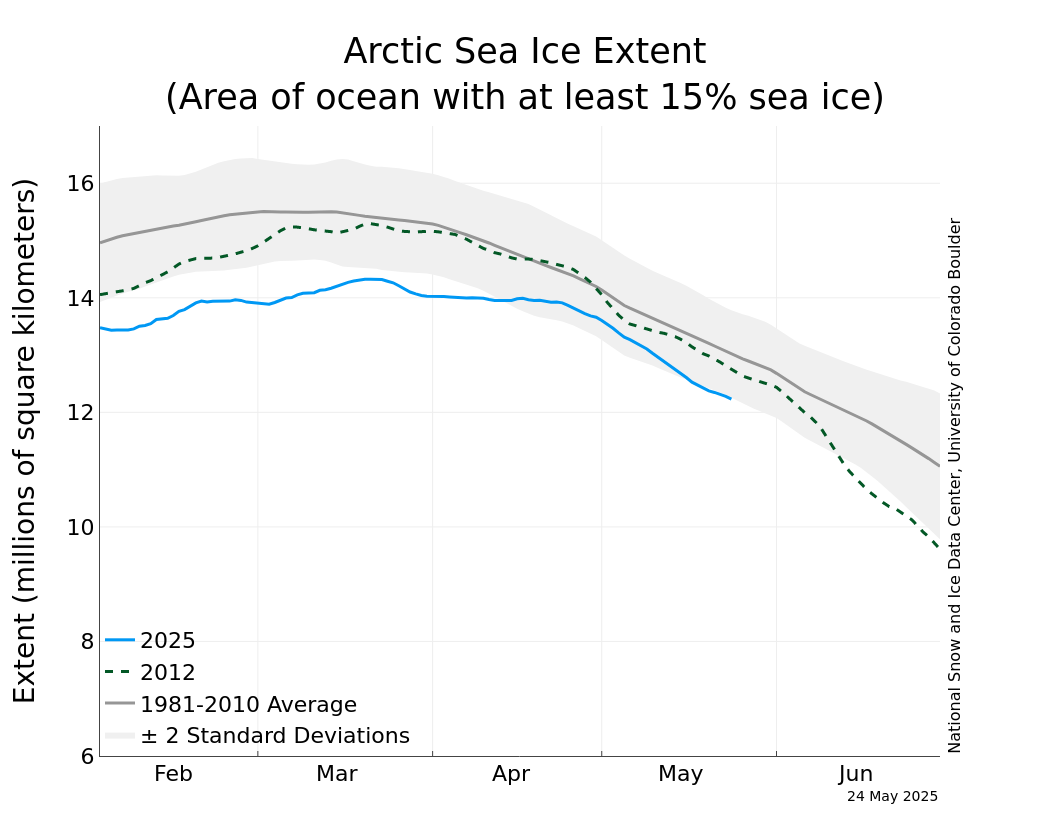
The ice was well under this year and there was no sudden drop because of a storm in 2012
we are safe
Please scroll to August of 2012 on link 1 I am sorry about that, The exact map did not come up
so second lowest is no problem at all?
when for nearly a decade we haven’t got back to pre-2007 levels?
What were the sea ice levels in 1974 and 1904?
Well, since 2006 (now 10 years!) the Arctic sea ice levels have been generally stagnant as they oscillate about a -1.0 Mkm^2 anomaly level…. Not getting lower, not getting higher for ten years now.
Are you seriously prepared to destroy the world’s economies and kill millions of people through disease and malnutrition simply because you “think” that the Arctic sea ice levels need to be artificially maintained at those 1979-1999 levels forever?
Context is always helpful. And note, it’s rolling over and down now.
http://www.climate4you.com/images/AMO%20GlobalAnnualIndexSince1856%20With11yearRunningAverage.gif
Again…WHO T F CARES? What problem?
In 2017 when there is less ice than 2007, the response here will be: Yeah, ok it is warming, but that’s a good thing. Some see the writing on the all and have already progressed there, others still think its something to do with communism.
The storm in 2012 resulted in a loss of 1.5 million sq km in fifteen days
How much of that was excess loss above what would normally melt in 15 days in August? I noticed weeks ago the Barrow point coastline was free of ice. This week there are large ice flows along the shoreline.
The 2012 minimum was an artifact of the measuring system, with vast expanses of 15% slush counted as open sea. A few weeks later, all that slush turned back to ice. Not all was aboveboard either: there was a region of solid ice just north of Wrangel Island, about as large as that island, which mysteriously disappeared off the ice maps in mid-August and re-appeared 6 weeks later. It was an inconvenient truth.
I must have missed something in basic weather class; The reason for the anticlockwise circulation around a low (in the Northern hemisphere and looking down from above) is Coriolis force caused by lighter air rising and air coming in from the sides being unable to keep going in a straight line due to the rotation of the earth. But at the N pole the earth’s rotation is very small or zero thus there can be no Coriolis force. Yet we still have a polar low.
Coriolis force is greatest at the poles! Consider a handful of air 100 miles south of the north pole, it’s about 100 miles from the axis on a circle some 600+ miles in circumference, and hence is moving about 25 mph to go around the pole every day. (Actually it goes about 361 degrees, since the Earth moves 1 degree around the sun every day.)
If that handful of air moves toward the pole or away, it will need a fair amount of acceleration to keep it apparently moving in a straight line. Or, it will curve a lot.
On the equator, a handful of air will be about 4,000 miles from the axis whether it’s moved 100 miles in any direction. While it’s moving at 1,000 mph, the difference with a point 100 miles away is nearly 0. No Coriolis Effect there!