Hypsithermal, Altithermal, Holocene Optimum, Holocene Thermal Maximum, Holocene Megathermal, Anthropogene;
Guest opinion: Dr. Tim Ball
There is frustration and reward when an article appears on the same topic of an article you are completing – in this case the Holocene. Such was the case this week with Andy May’s article “A Review of temperature reconstructions.” Andy points out the basic problems of reconstruction using proxy data for the most recent half of the Holocene – an issue central to historical climate and climate change studies. His paper did not alter my paper except as it reinforces some arguments.
This article examines the entire Holocene and illustrates the history that influenced the studies. There are two distinct parts to the studies, the pre and post Intergovernmental Panel on Climate Change (IPCC). The former is a genuine scientific struggle with issues of terminology and reconstruction, and the latter a scientific struggle to impose a political perspective regardless of the evidence. Because of the damage done to climatology by the proponents of anthropogenic global warming (AGW), both parts require explanation.
The title of this article lists all the names given to a single geologic period. It reflects the problem of inconsistent terminology in the early days of historic climate reconstruction. The names were a result of regional studies reflecting the lack of coordination in a pre-global village world. They were attempts to improve and advance scientific knowledge and understanding, but only created confusion because of failure to agree on the start and end points and duration of the period. The concept of relative homogeneity is critical to determine if a climatic change was regional, hemispheric or global. You cannot achieve accurate analysis if the sequence of events is unknown or incorrect – a point noted in May’s article.
Even a cursory examination of the Holocene shows why the period is problematic for promoters of anthropogenic global warming (AGW). As Steve McIntyre pointed out, the problems began when skeptics noted that the temperature for most of the Holocene contradicted their claim that the latter part of the 20th century was the warmest ever. I know they never used the term ‘ever’, rather, it was left unsaid but implied in the message to the public and not contradicted when used by the media.
McIntyre wrote;
The Team has taken a preditable (sic) position on the Holocene Optimum: that it’s a regional and restricted event.
It was predictable because it was the same argument they used for the Medieval Warm Period (MWP). Prove an event was regional, and you essentially eliminate the Sun as a mechanism of change – an issue central to the AGW CO2 argument. The restriction included the claim that only summer temperatures were warmer. Even if true, it is not possible to say based on proxy records with 40 to 70-year smoothing averages applied. Interestingly, the IPCC clung to this “Team” view as recently as AR4 (2007).
The temperature evolution over the Holocene has been established for many different regions, often with centennial-resolution proxy records more sensitive to specific seasons.
Of course, this was before Climategate and the leaked emails that destroyed the Team’s credibility.
The problem of terminology impacted global reconstruction when attempts were made to synchronize glacial/interglacial events in Europe and North America. European glacial events were labelled in 1909 by Albrecht Penck (1858-1945) and Eduard Bruckner (1862-1927) from the oldest to the most recent, the Gunz, Mindel, Riss, and Wurm. In North America, led by the work of Thomas Chamberlin (1843-1928) and Frank Leverett (1859-1943) the sequence was the Nebraskan, Kansan, Illinoian, and Wisconsin. This helped define what happened within the Pleistocene but didn’t help in defining the end and beginning of the following period or synchronicity.
The term Holocene means most recent and was first suggested by Geologist Charles Lyell whose work influenced Darwin. He anticipated the modern environmental activists because he suggested it marked the human era. The problem is human history covers a few million years, and there is no evidence the Pleistocene is ended. Although Lyell’s claim was unjustified, the idea continues today as some call the Holocene The Age of Man. Regardless, there is no doubt we are in an interglacial but is it just that, and attempts to define shorter periods only part of the political game of blaming humans for all change.
The game continues with the proposal to name the most recent portion of the Holocene the Anthropocene. The definition underscores the politicization of science. However, it requires reassessment because what occurred during the period contradicts the claims for the Anthropocene defined as.
“Relating to or denoting the current geological age, viewed as the period during which human activity has been the dominant influence on climate and the environment.”
This is false if we accept the IPCC conclusion, the human influence on climate is discernible only after 1950.

Correlating Events
Another book I consider significant in the attempts to match the various records was Climate, Man, and History by Robert Claiborne published in 1970. It spoke to the contradictory dates used in different disciplines. He wanted to write a doctoral thesis on the conflicting dates and incompatibility of events used by glaciologists and anthropologists, but the idea was rejected. As a result, he quit university, the supposed bastion of innovative thought, and wrote the book. He referred to the closed mind of academia in the first sentence.
“This book will probably annoy quite a number of scientists.”
Naturally, it was immediately attacked because it questioned the prevailing wisdom and worse, crossed the boundary between science and arts. The following comment illustrates the confused reaction by obliquely acknowledging the problem but then equally obliquely questioning Claiborne.
Claiborne’s caveat in the preface to this thoroughgoing study of climate and culture is that he’s going to venture some opinions of his own, attack others’, and, in general, try to dispel the fog that has enveloped many scientific studies of man in nature. He does this somewhat modestly at the beginning, coping with the complex, often conflicting theories on the causes, conditions, and timing of the last ice ages, and then increasingly with a more idiosyncratic style and sharper tongue.
There are parallels between Claiborne’s experiences and the claims made about the weather, climate, and history today. The official story of weather and climate promulgated by governments through the IPCC and environmentalists’ state that current weather and climate are anomalous and exhibiting more extreme conditions than ever before. The message is amplified and further distorted by a complicit and duplicitous media. Recently, a UK Daily Mail headline read,
“Sizzling UK records hottest day ever.”
The story did not qualify the word “ever” by saying it was the record within the modern span of thermometer measurements. The headline is what stays with the uninformed. Put the claim in the larger perspective of the Holocene and a completely different picture emerges about the official claims. They are creating the Anthropocene to isolate it from the Holocene because it gives the lie to the entire anthropogenic global warming deception. Judith Curry provided an interesting discussion about the lack of evidence for the Anthropocene, especially its mythical threat to humanity.
Weather and climate conditions through the Anthropocene are normal; that is, they are well within the range of all previous weather and climate variations. Despite official and media claims to the contrary, there are no dramatic increases in temperature, precipitation, hurricanes, tornadoes, or any other severe weather. The climate is changing just as it always has and always will, and the rate of change is perfectly normal. Of course, that is not what the government, environmentalists, or the media promote and as a result most of the public believe. The misconception is deliberate and central to the exploitation of global warming and climate change as the vehicle for a political agenda.
What The Public Need To Know
The following is not new to skeptics but identifies issues the public need to know to understand the AGW deception. Figure 1 shows one reconstruction of the temperature of the Northern Hemisphere derived from Greenland ice cores. It provides a brief context to show the wider natural range of temperature over the last 10,000 years. It shows the meaningless identification of the Anthropocene identified by the small red bar.

Figure 1
The accuracy of the climate record is critical for determining underlying mechanisms. It is critical if you want to identify specific periods but is still difficult because of determining points of starting and ending. Figure 1 appears to show a clear start of the Holocene with a dramatic warming around 10,500 years ago, but many place the onset at 11,700 years ago. Figure 2 shows why it is not clear cut. Is the Younger Dryas part of the Holocene? Is the extent of a geologic period determined by the major causative mechanism or some arbitrary temperature threshold? Search for an explanation of the Younger Dryas generated many speculative papers. There is an entire journal The Holocene devoted to the period.

Figure 2
The Younger Dryas is the focus of intense research, but also great speculation about the causative mechanism.
Other important points from Figures 1, 2 and 3 expose the lies and distortions about the last 120 years being anomalous include,
- Current temperatures are proclaimed as the warmest on record. In fact, the world was warmer than today for 97 percent of the last 10,000 years.
- The Medieval Warm Period (MWP) just 1000 years ago was 2°C warmer than today. The public is told that a similar warming will be catastrophic.
- The Minoan warm period approximately 3500 years ago was 4°C warmer than today.
- We are told the amount and rate of temperature increase in the last 100 years is abnormal. Compare the slope with any of the previous increases in Figure 2.

Figure 3.
· Figure 3 shows the CO2 trend over the Holocene. CO2 rose as temperature declined over the last 8000 years.
The Holocene is also problematic for AGW proponents because the major causative mechanism appears to be the changing precession, one of the Milankovitch Effect (ME) trilogy along with orbital eccentricity and axial tilt. A recent article at WUWT cites from Bender’s book Paleoclimate
“The orientation of Earth’s spin axis has changed over the past 10 Kyr so that northern summers now occur when Earth is farthest from the sun, whereas at 10 Ka [10,000 BP] they occurred when Earth was closest to the sun. Northern summertime insolation reached a maximum at about 10 Ka and has declined to the present, when it is near the minimum.”
The IPCC AR4 Physical Science Basis FAQ section provides the only reference to the ME. This includes the remarkable observation that
These examples illustrate that different climate changes in the past had different causes. The fact that natural factors caused climate changes in the past does not mean that the current climate change is natural.
True, but it was the same IPCC report that said natural changes became insignificant after 1950. They ‘proved’ this by eliminating most natural changes from their reports and their computer models. The IPCC is only comfortable discussing ME on time scales greater than the Holocene. AR5 says,
There is high confidence that orbital forcing is the primary external driver of glacial cycles (Kawamura et al,. 2007; Cheng et al., 2009; Lisiecki, 2010; Huybers, 2011).
But they couldn’t leave that comment unqualified, so they added,
However, atmospheric CO2 content plays an important internal feedback role.
There is no reference to the ME in the AR5 FAQ section or the Glossary of AR4 or AR5. This supports the information that it is not included in the IPCC computer models. The justification for exclusion is the time scale, but even in the 120 years of the Anthropocene, the impact is at least marginally significant relative to CO2 changes. The bigger problem is the inability to validate the models by recreating previous conditions without including the ME.
The Holocene is an interesting warm period that many believe marks the end of the last ice advance of the Pleistocene. It fascinated early scientific attempts to understand the events and mechanisms in the early days of climate reconstructions, which were complicated by a lack of standardized terminologies and central collections of data. For example, I recall long discussions about the need for centralized data banks on tree rings. The Holocene became ignored or distorted after the advent of AGW and the IPCC because the evidence of its existence contradicted most of their claims.
The orientation of Earth’s spin axis has changed over the past 10 Kyr so that northern summers now occur when Earth is farthest from the sun
The orientation of the spin axis has nothing to do with the shape of the orbit, so this ‘explanation’ is nonsense.
I think you are misinterpreting the comment. Precession of the equinoxes doesn’t alter the shape of Earth’s orbit. It merely changes the Hemisphere that receives the most Solar insolation in that part of the orbit closest to the sun.
Ditto. Well said @tomwys1.
The 100,000 year glaciation cycle is due the changes of when in the year the earth is closest to the sun, not to the precision of the spin axis which has a 26,000 year period.
lsvalgaard,
The article refers to the past 10K years not the past 100K years so your comment is misplaced.
No, because the temperature follows the 100k year cycle.
Dr Svalgaard: Wouldn’t the northern hemisphere, with a majority of land vs ocean, receiving the most insolation during the summer months cause an effect on weather patterns? Land doesn’t absorb near the amount of energy that the oceans do. Wouldn’t that allow for less energy transport from the tropics to the poles?
While I don’t think it would cause a glaciation by itself, I could see this, over a long period of time, helping to either usher in a glaciation with other factors and/or keeping a glaciation in progress.
The temperature follows the 100,000 year cycle, not the 21,000 year cycle.
The temperature follows the combined effect of multiple cycles which sometimes complement and sometimes offset one another.
For the past several million years the 100,000 year cycle has been dominant.
Not disputed but irrelevant.
On other timescales other cycles dominate for short periods.
No, because these other cycles have not shown up in the current temperature record.
Of course they have, in terms of short term modulations of the 100.000 year cycle.
I’m aware of your life’s project to remove solar effects from the climate record by ironing flat the records of solar variabilityso I don’t expect you to agree.
I do note that however flat you try to make the solar record the basic variations remain even though diminished in scale.
Sure, the Sun has an effect of the order of 0.1C.
I have a little issue with the Sun having only .1C influence on the Earth. Other than heat coming from inside (geothermal), which is minuscule, almost all the heat and radiation coming to Earth is from the Sun.
Changes in the Sun cause direct and indirect changes on Earth. If 7% more direct radiation comes into the North Hemisphere, it melts more ice, heats more water and does a lot of things we may or may not know. That can change ocean currents, jet streams, increase decrease cloudiness and alter long term patterns. It may have a big or small effect, but it will have an effect.
The solar input varies due to the orbit by 50-100 times more than the variation due to solar activity, so you can see that the activity-related variation drowns compared to the annual variation due to the varying distance to the sun.
Northern Hemisphere summer solar insolation does NOT follow the 100,000 year ice age cycle we have experienced in the last 4 ice ages. (Note it really wasn’t 100,000 years before the last 4 ice ages).
If one combined the Milankovitch Cycles with the fact that the ice age glaciers change the Earth’s Albedo by up to 4% and the glaciers are slow to melt as the Milankovitch Cycles change (ie. it takes a sustained period or several periods of high Milankovitch solar insolation to break the back of the glaciers and return the Albedo to normal levels), then it starts to make sense. But the 100,000 year cycle is just a fluke of combining solar insolation and the Albedo changes. Its just a fluke really.
——-
The Sun is only capable of a max 0.1C changes between solar cycles. But if you have 5 cycles in a row of +0.1C changes, the energy will accumulate in the oceans / on land so that after decades, one will have a warmer Earth. Even right now, the 0-2000 metre ocean is warming by 0.2C per century / accumulating 0.6 W/m2/year so that sustained periods of “slightly” higher solar input will result in a warmer Earth.
The issue is that it takes decades, not just one 11 year cycle to provide for the higher temperatures. Energy accumulation at very very small rates, 0.6 W/m2/year even, eventually changes the Earth’s climate.
But if you have 5 cycles in a row of +0.1C changes, the energy will accumulate in the oceans / on land so that after decades, one will have a warmer Earth.
Since cycles vary by about a factor of two, the average solar cycle variation is more like 0.05C and that has accumulated in the oceans for billions of year, so if your argument has value, we would have had run-away warming long ago. I take it that this means that your argument does not hold water.
Solar TSI at 1,362.5 W/m2 in scenario1 versus 1,360.0 W/m2/year in scenario2 .
In scenario 1, the Earth accumulates 0.8 X 10^22 joules per year and warms by 1.0C over 100 years at which point it reaches equilibrium and it stops warming. Versus scenario 2 where the Earth loses 0.8 X 10^22 joules per year and cools off by 1.0C over 100 years before it reaches equilibrium.
Right now, the Sun (after Albedo) is providing 384.2 X 10^22 joules of energy to the Earth each year but the amounting escaping back to space is 383.4 X 10^22 joules / year. Energy accumulating at 0.8 X 10^22 joules per year. This what is happening at 1362.5 W/m2/year average solar TSI.
If Solar TSI falls to scenario2, 1360 W/m2/year, the total energy received falls to 382.7 X 10^22 joules and NOW, the Earth is emitting the same 383.4 X 10^22 joules per year and there is a deficit of 0.7 X 10^22 joules per year. Over 100 years, it cools off by 1.0C before it reaches equilibrium again.
A decline of just 2.5 W/m2/year in Solar TSI is just enough to tip the balance over decades.
First, the imbalance is much smaller than you think, so the warming/cooling is much less than you think. Perhaps 0.5 W/m2 between the Maunder Minimum and now. Second: since there is a 100-year cycle in solar activity, the temperature will warm again in the third 100-year period, then cool again over the fourth 100-year period, then warm, then cool, etc, with no long-term trend due to the sun..
All three cycles have dominated over the last 2.6 my during the Pleistocene. The first 1.7 my of Pleistocene was dominated by 22 and 41 k yr cycles. One only need to become familiar with the 104 marine isotope stage record and notice not only the dominant trend changes between stages, but also all the minor change of trends within cycles. We are currently in warming trend #52 (Holocene) which followed #52 cooling trend (Wisconsinan). Only the last 900 ky has the 100 ky cycle been dominant…..
lsvalgaard
The temperature follows the 100,000 year cycle, not the 21,000 year cycle.
It looks indeed like the 100kyr eccentricity cycle, since the MPR, but it turns out that it may in fact be a complex derivative of the precession 22kyr cycle, according to Maslin and Ridgewell:
http://sp.lyellcollection.org/content/247/1/19.short
Regardless of what causes the 100-kyr cycle, it is there and that is the point. Temperatures the last million years have followed a 100-kyr cycle. There are certainly other cycles, but they are not dominant. In particular, the oft claimed 41-kyr obliquity cycle is not a change of the orientation of the spin axis so has nothing to do with the claim of the article that “The orientation of Earth’s spin axis has changed over the past 10 Kyr so that northern summers now occur when Earth is farthest from the sun” and that that is the controlling factor in glaciations. It is not.
What we are looking at is a weakly forced nonlinear oscillator. Its not monotonic but complex, eccentricity is playing a pacing role but the cycle is not slavishly following eccentricity. (If it was then that would be a strongly forced nonlinear oscillator.) Some interglacials are even two-headed, interestingly at the peaks of eccentricity asymmetry where you would expect forcing to be strongest, not weakest. By contrast interglacials are sharper and better defined at the nodes of subdued eccentricity forcing.
I would image the S Hemi is an infinitely better heat sink than the N Hemi. Is there evidence that the inter-glacial period is due to the earth being closest to the sun when the S Hemisphere is in Summer, and the earth tilted so most sunlight falls on the S Hemi? That would explain the cycle, no need to even consider CO2.
lsvalgaard July 31, 2016 at 1:50 pm
For the past several million years the 100,000 year cycle has been dominant.
That assertion is questionable at best and outright wrong at worst. The 100 K cycle arguably only becomes prominent in the last million years at best. Five million years ago long-term variability seems to have been far lower in amplitude – perhaps no more than , marked by much shorter “cycles,” and the mean temperature significantly warmer than at present. So “several million years” seems quite an exaggeration. For instance, see:
Lisiecki, L. E., and M. E. Raymo (2005), A Pliocene-
Pleistocene stack of 57 globally distributed benthic d18O records,
Paleoceanography,20, PA1003, doi:10.1029/2004PA001071
The reciprocal of the dO18 value is proxy of the movement of temperature.
The later Pleistocene pattern is quite distinct from that of the early Pleistocene and Pliocene. The Pliocene appears to be dominated by a year cycle, possibly as short as 20 ka, while the early Pleistocene is marked by steady, gradual cooling and an amplification of the “cycles” between warm and cool periods – if that is what they really are. The prominence of the 100 ka pattern really doesn’t emerge until a million years ago at most. All that assumes that there really is some sort of genuine cycle or multiple superimposed cycles. I have read arguments to the effect that the “cycle” may have more in common with a Lorenz – type strange attractor, which appears quasi-cyclic and changes states abruptly.
The 100 K cycle arguably only becomes prominent in the last million years at best
I’ll give you that, but it does not change anything, namely that the 100-kyr cycle is dominant NOW and is an observational fact, regardless of how it produced..
While the direction of the earth’s tilt may not affect global temperatures, the tilt does affect the records/proxies. This is because most of the records collected thus far are from the northern hemisphere.
North toward the sun at the earth’s closest approach to the sun –> warmer summers in the NH. (And colder winters.) Where you collect your data affects the results.
felt to react with a series of questions to Isvalgaard:
if only the 100 kyr cycle is relevant what causes the following found cyclic events that were discovered in the ice core records:
– the approximate 1400 – 1500 Oescher dansgaard cycles in the glacial periods?
– The opposite Bond events of the same cycle length in the interglacials?
– The suess Devriess cycles?
– The off synched oceanic oscillations (that sometimes amplifies or cancel out each other)?
– the correlation between solar input and temperature? (ok we know correlation doesn’t mean causation but that could apply to the 100kyr cycle as well see a bit further)
in the article they talk about the last 10,000 years, not 100,000 years so the 100 kyr cycle doesn’t apply but above mentioned ones do. Evading this question is evading the scope of the article.
now the “100 kyr problem”:
when we look at the 100 kyr cycle we see actually also other cycles of the same class:
– the 21 kyr cycle
– the 40 kyr cycle
– the 100 kyr cycle
– the 400 kyr cycle
in that way correlation with only the 100 kyr cycle doesn’t mean causation as otherwise we would see or smaller but similar 21, 40 and 400 kyr signals in the records, but they aren’t there.
imho even that there is a clear 100 kyear signal in the current ice age, i suspect there is more then only the flat 100 kyr cycle that triggers interglacials. otherwise we would have seen it from the beginning, but it didn’t. Till 800 kyear ago there was the more important 41 kyr cycle signal. All you can say is that the glacial cycles’ resonance frequency with the milankovich cycles suddenly changed 800 kyr ago. who says this resonance frequency won’t change again?
and finally: science doesn’t even know how AMO and PDO is impacting our current climate which are on a geological scale such small oscillators, so how could the science then be settled about a 100 kyr cycle resonance change?
in the article they talk about the last 10,000 years, not 100,000 years so the 100 kyr cycle doesn’t apply but above mentioned ones do. Evading this question is evading the scope of the article.
The dominant cycle is the 100-kyr cycle. That is the elephant in the room.
seems to make sense that closer to the sun the hotter it is.
http://spaceweather.com/glossary/perihelion.htm: “Averaged over the globe, sunlight falling on Earth at perihelion is about 7% more intense than it is at aphelion,” says Roy Spencer of NASA’s Global Hydrology and Climate Center (GHCC).
So then, how come it doesn’t get hotter by altitude (I actually had a millenial tell me this as a fact)?
space is cold 😉
@ur momisugly BFL
Duh, it does get hotter by altitude.
Why every start of Spring around here, iffen there is any snow or ice upon the hilltops it will get “hotter” enough up there to melt it all.
Incoming radiation is 7% higher between the Perihelion and aphelion. From that we should be able to calculate out the ΔW/M^2 and the ΔTemp. CO2 only traps around 3W/M^2, so from these numbers we should be able to calculate out if it is even plausible for the minuscule amount of energy CO2 traps to actually change the temperature of the atmosphere.
Note, 7% more high energy incoming radiation only warms the earth 2.3°C. If 7% high intensity visible light can only warm the globe 2.3°C, how could trapping a fraction of the outgoing radiation be expected to increase temperatures by a similar amount? The numbers just don’t add up.
http://science.nasa.gov/science-news/science-at-nasa/2001/ast03jul_1/
Hi Doc
Nice to see there are few more ‘cranks’ prepared to question the absolutistic dictatorship of understanding you are so readily prepared to enforce.
cranks are cranks, no quotes needed. Good to see that you admit being one. Although we all knew that.
we being those who claim to know all based on a few measurements that span an inconsequential amount of time of the period in question.
Dr. Svalgaard: You have an open question on Solarcycle 24. Thank you in advance for your response.
Be a bit more specific.
Correct. The only reason northern summers are farther from the sun is eccentricity.
But it’s not the northern summers that are important, it’s the southern summers. That’s where the oceans pick up all the heat and transfer it north into the Greenland Sea. As we move back into minimum eccentricity, the southern summers are farther from the Sun and less heat is moving into the Artic, hence we always have glaciation at minimum eccentricity.
Either way, the result is the same.
No AndyJ. Precession of the Equinoxes is responsible for the times when summers in either hemisphere are closest or farthest form the Sun. Currently NH summer solstice is at aphelion but about 13,000 years ago NH summer was at perihelion.
To better understand the Anthropocene and what is going on, it should be relabeled Marxpocene?
Marxcene that started with the Frankfurt school Marxists idea about domination of nature. That is Marxism domination of Nature.
http://hyperphysics.phy-astr.gsu.edu/hbase/Solar/earthprecess.html
Currently the polar axis points toward Polaris. In thirteen thousand year the axis will point 47° away from Polaris.
Assume the orbit shape never changed, and 13,000 years ago the north pole summer occurred at perigee, and the southern winter occured at apogee.
Today, 13,000 year later the north pole summer would occur at apogee and the south pole summer would occur at perigee.
The orientation of the spin axis has nothing to do with the shape of the orbit. It has everything to do with the timing of perigee and polar summer.
Just for clarification: perigee and apogee relate to distance from the earth. The corresponding terms for distance from the sun are perihelion and aphelion.
PA, wouldn’t the northern summer and southern winter occur at the same time? Also, I believe the terms would be perihelion and aphelion…
1. Fine, aphelion and perihelion are the correct terms
PA, wouldn’t the northern summer and southern winter occur at the same time?
2. Astute observation. It should have read: “…north pole summer occurred at perihelion, and the southern summer occurred at aphelion.”
The essential point is the precession of the axis controls the relationship of the poles to aphelion or the point of maximum energy.
“The essential point is the precession of the axis controls the relationship of the poles to perihelion or the point of maximum energy.”
Fixed it first.
PA August 1, 2016 at 12:34 am
Assume the orbit shape never changed, and 13,000 years ago the north pole summer occurred at perigee, and the southern winter occured at apogee.
I’ve never studied Astronomy, but it seems obvious to me that “If one thing is moving, everything is moving.” In other words, there is no Fixed Plane of Reference anywhere in the Infinite Universe. In which, for example, there is no Center, but at the same time everything is at the Center because “space” continues on to be infinitely distant from everything, that is, if it’s ok to at least imagine a straight line proceeding directly/radially away from these “centers”; although if you tried to actually do it, you’d almost have to get lost at some point.
So does the Earth “really” change its axis relative to the Sun 47 deg. every 13,000 years? Or is this only what “it looks like” if you use Polaris as “fixed”, but that Einstein’s equations correct well enough for our Frame to explain and get things done? And likewise that, ignoring the unknowns, Milankovitch Cycles and everything else so far known that immediately-enough affects the Earth’s climate, including precession, can be used to bring at least some order out of Chaos?
Also, I’m always thinking that it’s nice to have a Constant around if everything’s moving, but it sounds to me a bit impossible to have one. So maybe this problem and its solution is that we have to measure “everything moving” using Light?
At least this topic is less unsettling than having to face “Politics”, except when we have to deal with CO2-Climate Change Believers:
Thank you again, Dr. Ball!
JDPeden: In the case of orbital motion, the orientation of the angular momentum vector of the Earth’s rotation (i.e., its axis) can be measured relative to the orientation of the angular momentum vector of the Earth’s orbit (or, equivalently, the plane of the ecliptic). Clocking of that angular separation can be measured relative to the “fixed stars” (fixed over most times of interest, at least). And it would be well to study astronomy.
JPeden August 2, 2016 at 9:14 am
I’ve never studied Astronomy,
That’s obvious.
The point was about 4 times during the 100,000 year cycle of orbital eccentricity the worst case alignment of northern summer and aphelion will occur and 1 time will be when aphelion is the maximum or almost maximum distance.
In Norway most glaciers did not exist between 8.000 – 5.300 years ago. They reappeared 5.300 years ago and have since grown cyclical. Last glacier maximum was around 1740-44. We had cold Summer’s no bees and no fruit. I worry more about glaciers than global warming.
Right on, Santa Baby, ….. to wit:
lsvalgaard July 31, 2016 at 12:43 pm
The orientation of the spin axis has nothing to do with the shape of the orbit, so this ‘explanation’ is nonsense.
The 100,000 year glacial cycle is due to the changes of when the Earth is closes to the Sun, not precession which has a 26,000 year cycle.
_____________________________________________
Nonsense Leif.
For a start the precessional cycle is roughly 23 ky, not 26 ky. How could you forget about apsidal precession Leif? Eh? And even 23 ky is an over simplification, because precession varies from 15 ky to 27 ky.
Secondly, the glacial cycle is not 100,000 ky. That is a gross simplifaction. The cycle over the last 400 ky has been more like 85 ky and 105 ky.
Thirdly, on its own the roughly 100,000 ky eccentricity cycle adds no extra insolation forcing to the Earth energy budget, and nor does it redistribute it (without the help of precession).
Your central problem, Leif, is that you cannot explain why a cyclical system should skip several cycles, and only have an effect after four or five cycles. But I have already explained that, in my peer-review paper.
High NH ice albedo can reject any increased insolation from precession or obliquity, and this rejection only stops when the ice sheets get covered in dust. And to generate the dust we need low C02, which kills off plantlife, created C02 deserts, creates dust, and coats the ice sheets with dust. And all of this is confirmed in the ice core records from both Greenland, Antarctica and the dust record of the Loess Plateau.
But you will not entertain nor discuss the possibility.
Ralph
Modulation of ice ages via precession and dust-albedo feedbacks.
http://www.sciencedirect.com/science/article/pii/S1674987116300305
.
>>The cycle over the last 400 ky has been 85 ky and 105 ky.
Sorry, I meant to type 90 ky and 116 ky.
So nothing to do with 100 ky.
Ralph
Hi Ralph
Have downloaded copy of your paper some time ago, impressive research.
ralfellis, I like the way you explain the FACTUAL science, also.
Cheers, Sam C
Try to be a bit more polite please Leif.
Whenever someone states something that doesn’t conform with your pet theory you start shouting, “nonsense!”, like some sort of mad professor stuck in his dusty attic.
Such an attitude won’t endear you to many people, but maybe you don’t care about that.
lsvalgaard
July 31, 2016 at 1:50 pm
Where you say “For the past several million years the 100,000 year cycle has been dominant.” I believe you are incorrect. There is the following.
“The mid-Pleistocene revolution (MPR) is characterized by an increase in mean global ice volume, and a change in the dominant period from 41 to 100 thousand years Milankovitch cycle (Imbrie et al., 1993; Raymo et al., 1997).
Its timing is often considered to be at about 900 thousand years ago. “
also
“Orbital Forcing of Subtropical Climate
The Earth’s axial rotation is perturbed by gravitational interactions with the moon and the more massive planets that together induce periodic changes in the Earth’s orbit, including a 100,000 year cycle in the shape of the orbit (eccentricity), a 41,000 year cycle in the tilt of the Earth’s axis (obliquity) and a 20,000-year cycle in the “wobble” — much like a top wobbles — of the Earth’s axis (precession). All three of orbital cycles — called Milankovitch cycles — impact African climate on long geologic timescales.
The cycle with the most influence on the rains in Africa is the “wobble” cycle, precession. The main climatic effect of precession is to shift the season when the Earth has its closest pass to the Sun. Today, perihelion occurs in northern hemisphere winter but 10,000 years ago (half of a precession cycle) it occurred in northern hemisphere summer, and summer radiation over North Africa was about 7% higher than it is today
This strengthening summer-season solar radiation causes the North African landmass to heat up relative to the Atlantic Ocean because land heats quicker that water. The warmer land mass creates a broad low pressure zone, causing a flow of moist air from the tropical Atlantic onto North African landmass. Leading to stronger summer monsoonal rains.
This strengthening summer-season solar radiation causes the North African landmass to heat up relative to the Atlantic Ocean because land heats quicker that water. The warmer land mass creates a broad low pressure zone, causing a flow of moist air from the tropical Atlantic onto North African landmass. Leading to stronger summer monsoonal rains.
This weaker winter-season solar radiation causes the North African landmass to cool off relative to the Atlantic Ocean because land cools quicker that water. During winter, the land cools relative to the ocean and the winds reverse, returning dry conditions across North Africa. Since precession controls summer insolation, it effectively controls the amount and northward penetration of the monsoonal rains into North Africa. Atmosphere-only climate models shown that a 7% increase in summer radiation, what occurs during the AHP, results in more than a 17% increase in African monsoonal rainfall, and up to 50% if ocean feedbacks are included.”
“results in more than a 17% increase in African monsoonal rainfall,”
And 10K years ago the Sahara was not a desert and it “bloomed” each Springtime and life therein/on was good.
Good thing he never claimed that the spin has anything to do with the shape of the orbit.
Perhaps some “warmists” will claim that the Younger Dryas IS evidence that an extraterrestrial civilization visited Earth, terra-formed it to produce food-stock (us) but became extinct by microbial-borne disease.
Ha ha 😀
Did you mean “Anthropogene” in the title? If so the term is new to me.
http://www.oxfordreference.com/view/10.1093/oi/authority.20110803095416338
I meant Anthropogene.
http://www.oxfordreference.com/view/10.1093/oi/authority.20110803095416338
It is remarkable how many names for the same period. I think it exceeds any other geologic period.
It’s Anthropocene, it is a proposed term for the current period when some say man dominates geology. It is a stupid idea IMHO, since one major glacial period would wipe out most of what man has built. It has not been accepted as a geological period by any geological society that I know of.
Sorry if I inadvertently stole some of your thunder Dr. Ball. I like your post a lot. What is “ME” some abbreviation for variations in the Earth’s orbital cycles?
Isvalgaard: What Dr. Ball wrote is correct. “Precession” has oriented the Northern Hemisphere in such a way that now the perihelion occurs about January 3 in the middle of winter, this lessens the impact of perihelion on Northern Hemisphere winters. This is why it is cooler now in the Northern Hemisphere than 5000 years ago. I discuss this (with references) here: https://andymaypetrophysicist.com/climate-and-human-civilization-over-the-last-18000-years/
Yet, the temperature record does not show any marked 21,000 or 26,000 year variation, so the dominant cause is the variation of the eccentricity.
Dr. S, can you post a link for further study of that? (please)
Not sure what you are asking for, but here is a defense of Milankovitch
http://www.leif.org/EOS/2006GL027817-Milankovitch.pdf
Interglacials have been occurring roughly every 100,000 years for the last million years, but the correspondence to the eccentricity cycle is not very close. Also, there is no compelling or agreed-upon physical mechanism to link the two cycles. Interglacials always begin suddenly, and often end the same way, with the entire thing over and done with inside ~20,000 years.
The so-called 100 kY cycle is the consummate example of “cyclomania”.
Re: Dr.S, Thanks, I’ll digest this as much as I’m able.
After the peak of the Eemian interglacial ~126 kyr ago, insolation at 65N on the summer solstice had dropped by ~90 watts/m^2 some 11 kyr later. That drop was the effect of the ~22 kyr-long precession cycle, not the longer eccentricity cycle. Temperature did not response immediately because some time is required for albedo to significantly change, and because insolation subsequently rose (via precession) into another insolation peak. Temperature changes into the last glaciation clearly show the effect of the various ~22 kyr precession cycles, as the eccentricity cycle proceeds. Glaciation is a CUMULATIVE effect that requires time to proceed, requires a NH cold trigger to initiate significant ice albedo changes, and probably requires factors other than ice albedo (e.g., changes in ocean and air currents, clouds, land and vegetation albedo) to fully develop.
Although Earth is currently near a low in 65N insolation due to orbital cycles, there is no glacial buildup. Reasons include the fact that we are near the minimum o f a ~100 kyr cycle and because no NH cold trigger temperature has occurred.
lsvalgaard
July 31, 2016 at 2:11 pm
Yet, the temperature record does not show any marked 21,000 or 26,000 year variation, so the dominant cause is the variation of the eccentricity.
____________________________________
Nonsense.
Take a look at the image below, which shows a clear correspondence between the precessional Seasonal Great Year cycle (top) and the ice age temperature cycle (bottom). (Note: this is axial precession including apsidal eccentricity precession, and therefore a ~23 ky cycle, not a ~26 ky cycle…..)
And on the way through you will see that these same orange shaded ‘high insolation precession bands’ all line up with the ~100 ky eccentricity cycle. So the ~100 ky eccentricity cycle is not the cause of warming, as such, it is merely the agent of assistance to the precessionary cycle.
So the ghost of eccentricity still shows up in the ice age record, even though eccentricity alone has absolutely no effect whatsoever.
http://s4.postimg.org/gf6jcemnx/temp_and_eccentricity_Page_1.jpg
Image courtesy Mike Palmer.
.
lsvalgaard
July 31, 2016 at 3:38 pm
Not sure what you are asking for, but here is a defense of Milankovitch
http://www.leif.org/EOS/2006GL027817-Milankovitch.pdf
______________________________________
Nonsense. As you know, Leif, that paper is highly disingenuous.
What it says is that a rate of change is the same as change itself.
Or in other words, a weekly rise in temperature from 18 ºc to 20ºc is EXACTLY the same as a weekly rise in temperature from 18ºc to 35ºc, because they went up at the same rate.
Obfuscatory nonsesnse that proves nothing.
Ralph
Andy, ME = Milankovitch Effect(s) This acronym was rightly defined (thank you) the first time Dr. Ball used it.
I agree with Leif Svalgaard that since the MRP glacial/inrterglacials have approximately followed the
100,000 year eccentricity cycle. But it’s not as simple as none cycle or another, several can be involved because its a complex, not simple, nonlinear forcing. Its analogous to tidal forcing in an bay with a narrow outlet to the sea. Lots of frequencies start appearing.
It looks indeed like the 100kyr eccentricity cycle, since the MPR, but it turns out that it may in fact be a complex derivative of the precession 22kyr cycle, according to Maslin and Ridgewell:
http://sp.lyellcollection.org/content/247/1/19.short
What we are looking at is a weakly forced nonlinear oscillator. Its not monotonic but complex, eccentricity is playing a pacing role but the cycle is not slavishly following eccentricity. (If it was then that would be a strongly forced nonlinear oscillator.) Some interglacials are even two-headed, interestingly at the peaks of eccentricity asymmetry where you would expect forcing to be strongest, not weakest. By contrast interglacials are sharper and better defined at the nodes of subdued eccentricity forcing.
If the eccentricity were zero, all the other cycles would have no effect as the distance to the Sun would not vary with time.
lsvalgaard August 1, 2016 at 12:44 pm
If the eccentricity were zero, all the other cycles would have no effect as the distance to the Sun would not vary with time.
________________________________
Oh, Leif, Leif, Leif….
As you know (or should know), the effects of obliquity remain even if there was no orbital eccentricity at all.
Ralph
Not being clear enough. I meant ‘related to precessions’ which were the topic being discussed in the original posting and my first comment.
More evidence that we should pay attention to the Minoans and their SUV’s, as that was such a dreadful period 🙂
Their Minotaur was a ruminent. Flattulant CO2.
Well said, but what of flatus and CH3?
Brain fart, or bad typing, not sure which. I was referring to Methane, CH4.
It is pretty well established what caused the onset of the YD. Meltwater formed Lake Aggaziz behind a ginormous ice dam in what is now the St. Lawrence seaway. When that ice gave way, Aggasiz provided an enormous pulse of meltwater into the north Atlantic that shut down thermohaline circulation. Among the geological evidence is seaway rock scour in upstate New York and the alluvial detritus plain on the seabed. The comet theory has been fairly thoroughly debunked.
What is not well understood is why it ended so rapidly. Leading theory is sudden detachment/ subsequent disintegration of the resulting massive Greenland ice shelf extending toward Iceland.
MWP was global. Evidence was found in ikaite mineralization on the Antarctic peninsula.
The YD impact hypothesis has been thoroughly discredited in every detail.
There is nothing unusual about the YD. It was preceded by similar events during the deglaciation leading to the Holocene, during the glacial phase itself (Heinrich Events) and during prior glacial and interglacial intervals.
ristvan
July 31, 2016 at 1:21 pm
What is not well understood is why it ended so rapidly. (YD)
Leading theory is sudden detachment/ subsequent disintegration of the resulting massive Greenland ice shelf extending toward Iceland.
—————————————–
Maybe there is a simpler explanation for it, maybe, an explanation that needs no theories or hypothesis to explain it.
It simple seems or looks as it ended rapidly because the whole YD event is actually exaggerated and it was not such as “large” as represented and considered.
Is the effect of the “ice core data” interpretation, a kind of interpretation that makes you believe that the ice ages (the long ones not the glacial periods) really do exist, when as far as I can tell there is no any real evidence for such as.
Is the very same effect that makes us consider the end and the start of a glacial period as rapid when considering the length and time duration of a glacial period.
Is the very effect which makes the interglacial periods to be considered in climatic term as very rapid swings and very rapid thermal variations.
cheers
Or a meltwater pulse may have exited via the McKenzie River.
Dr, Ball, Thanks for the great cartoon to add to my wall decoration. I’m concerned that someone might question the CO2 graph though, as it does not appear to reflect the current 400 ppm.
The usual problem : date of year 0 in all those reconstructions?.
Pop Piasa
July 31, 2016 at 1:31 pm
Dr, Ball, Thanks for the great cartoon to add to my wall decoration. I’m concerned that someone might question the CO2 graph though, as it does not appear to reflect the current 400 ppm.
————————–
And you will be the first to have raised the question…:)
If the CO2 graph did represent the current 400ppm and the rapid swing up of it, you would have there a brand new hockey stick……..:)
And that will be contrary to the Dr. Ball claim of it causing trouble for AGW “science”.
It would be much more effective in converting people to AGW and CAGW.
I for once when looking at that graph, even without it reflecting the current 400ppm, am tempted to be converted to the AGW believe, if I have to consider that graph as proper and fairly accurate representation of reality….
cheers
No Whiten, eager as you are to jump on a friendly critique, the graph only represents the Holocene and not the Anthropocene era. Half-educated folks like myself (and you, obviously) sometimes miss these details.
…Which part of “Ice Core” data can you not read ?
My bad…
I assume he’s referring to the 21,000 years cycle caused by the combined effect of axial precession and the precession of the earth’s elliptical orbit.
Sorry, this was meant as a reply to Isvalgaard July 31, 2016 at 12:43 pm .
The temperature and amount of glaciation does not follow the 21,000 year cycle.
The total solar insolation on the earth during the Summer side of its orbit depends not just on the distance from the Sun but also on the time spent during that half year. Further from the Sun means less insolation but also a longer exposure time since the Earth moves more slowly in orbit when it is further away. The effect cancel now. But at the next half cycle of the precession of the equinoxes, the two effects do not cancel for the Northern Hemisphere. If you are still around then, go south young man!
The Holocene is an interesting warm period that many believe marks the end of the last ice advance of the Pleistocene.
This is an opinion devoid of evidence and the opposite of reality. The pleistocene temperature history makes it clear that glaciation is deepening, not lessening – the last Wisconsin glaciation was the deepest of the pleistocene. It is not the last glacial but this interglacial, that may be the last.
BTW
http://sp.lyellcollection.org/content/247/1/19.short
I think he’s referrring to the Alarmists who are convinced the ice will never return.
As long as there is a warm current flowing into the Greenland Sea, the glacial/interglacial cycle will occur with the change in eccentricity. How the continental drift will affect the thermohaline circulation in the next ten million years will determine if the cycle continues.
The “last” ice advance could simply mean “most recent”, without any prejudice as to whether or not there will be another one in the future.
Yes I realise Tim was citing prevailing opinion and not his own – sorry if that was not clear
No, MIS 12 (420 ky) was coldest glacial on record, and the following MIS 11 interglacial was warmer than the Holocene maximum 7 k yrs ago….
great scholarship and another excellent article.
in an age sorely lacking for real heroes, he is a man who never broke down and never gave up.
i still think there should be a gold coin minted with dr ball on it.
then you could get whatever you wanted if you had the balls.
Dr. Ball is Canadian. We have a gold coloured coin we call the Loonie (unofficial nickname). I’m not sure Dr. Ball would want his name tied to that coin. At least until he’s proved right.
Dr. Tim Ball,
We finished the detailed Holocene analysis, explaining each temperature spike upwards and
downwards, in http://www.knowledgeminer.eu/climate/papers.html. Part 1 to 5 cover 8500 BC
to 1 AD, published already. The following parts, Part 6 and 7, covering 1 AD to 2110 AD, will be
out in a few weeks, thus, 10,000 years were/are consistently covered, which AGW is
unable to do so….. Also google: “Climate Pattern Recognition”.
As said before, each and every climate change within the Holocene was/is analyzed, soon
reaching the present CE period ……
Only 0.32°C of warming is still open to reach the maximum temperature plateau of 2050-2110
AD, with its central periodicity peak in 2080 AD. Global warming, therefore, proceeds on its exact
path upward into the Commen Era Warm Period (CEWP), without any nonsensical CO2/AGW
contribution.
JSei..
The constant in climate change is that the remedial solutions that progressives demand all converge on bigger government, less personal liberty and less prosperity. Every action, demand, study and slogan is an excuse to that achieve end goal.
The modern environmental activists have it backwards.
We have had ten thousand years of unusually stable climate over a wide swath of geography. It is unlikely that civilization would have developed if this were not so.
We are what we are because of the Holocene not vice versa.
Tim Ball knows perfectly well that the “Present” he’s marked on the temperature graphs is 1855, not 2016: http://www.skepticalscience.com/10000-years-warmer.htm. He also knows perfectly well that those measurements are from a single spot in Greenland, and therefore not reasonably representative even of the Northern Hemisphere let alone the entire globe: http://www.skepticalscience.com/the-two-epochs-of-marcott.html
Sorry Tom, but Michael Mann clearly shows that the top of that little tick-up is around 1970.
And you wouldn’t want to say he was wrong, would you 😉
Use of the Cuffey-Clow GISP2 series ought to be discouraged. However, SKS’s account is much worse. While the Cuffey-Clow series ends in 1855, GISP2 d18O data comes to 1987 and does not show elevated late 20th century values. Nor does the limited other d18O data available from Greenland – which is execrably archived.
I agree that one cannot rely on Greenland for a Holocene perspective, but there is convincing evidence of early Holocene warmth in the Southern Hemisphere as well – a topic very poorly discussed by IPCC.
The actual situation is not what SKS portrayed. In particular, the hockey stick portion of Marcott is invalid. Marcott’s work should have been retracted and the failure to do so is highly unethical in my opinion,
Steve, the GISP2 ice core data correlate remarkably well with glacial fluctuations globally and there is excellent correlation with the CET record. Comparison of these is about to be published in the new Elsevier volume with relevant data. These data suggest that your criticism of GISP2 is not well founded.
” are from a single spot in Greenland”
Isn’t that a bit like using a single tree in the Yamal Peninsula to get a hockey stick that spans the globe 😉
After some study…I have found that although the net NH summer insolation follows an approximate 20-25k year cycle- it is not an indicator of global temperature. It also needs to be coupled with the positive going rate of eccentricity in order to create the correct glaciation cyclic of ~100K years. This simple algorithm is predictive of the long term interglacial phases as well as the lower level intermediate temperature swings. Work so far suggests that we have begun the long decline into the next big freeze and can expect ~48,000 years before the following interglacial “melt” and the next about 70,000 years after that. This suggests the 100K rhythm is finished.
While I strongly encourage people to look closely at the Holocene, I really urge people to stop using the GISP2 series as a prism – a point that I’ve made over and over. Vinther has convincingly shown that elevation lowering of the Greenland ice cap have distorted the GISP2 d18O record. A better perspective is given by the Renland d18O series (shown below) and it is really one that “skeptics” ought to like better:
The Renland series convincingly shows long-term d18O over the Holocene in accordance with Milankowitch theory and that modern warming has not resulted in proxy values outside the Milankowitch envelope.
Use of the GISP2 series over-focuses on speculations about the Roman Warm Period, Minoan Warm Period and Medieval Warm Period – rather than the very large scale changes over the Holocene.
Over-emphasis on the Greenland data also results in too little attention to Southern Hemisphere and tropical data, both of which have important stories.
“(shown below)” ?????
I fully agree with Steve M. here. Throw out the temperature estimates from GISP2 because the dO18 isotopes have been recalibrated from the correct temperature/dO18 conversion formula to an INCORRECT borehole/assumption model.
Sorry, but this is the fate from ALL Greenland ice core temperature reconstructions because the Greenland ice core scientists (unlike the Antarctic ice core scientists) have “chosen” to use an incorrect borehole temperature model rather than the scientifically measured dO18/temperature model, probably because it makes the temperature changes seem so much more drastic.
The ups and downs need to be dampened down by 50% to be accurate just for the Greenland Ice Sheet and then by 75% if one is trying to approximate the northern hemisphere average temperature.
Ie. the Younger Dryas northern hemisphere temperature change was only about 2.5C versus Richard Alley’s GISP2 10.0C (and then there was an Older and Oldest Dryas a few thousand years earlier that the Greenland ice core scientists like to ascribe to the Younger Dryas because it adds to the “alarm factor”).
Richard Alley can come on here and correct me if he chooses to.
The Cuffy and Clow data has a different basis than the isotope data. What is remarkable is that both show the same temperature changes and both correlate very well with global glacial fluctuations.
Cuffey and Clow 1997 use the borehole temperature to dO18 isotope method and have temperature change from the last glacial maximum to today of -23C on the Greenland ice sheet. The Antarctic ice cores using the correct dO18 isotope to temperature conversion formula is only -10C.
So, polar amplication is supposed to be 2X, yet Cuffey and Clow are at 4.5X. Sorry, but is just a mistake and/or climate science scam. The other Greenland ice core scientists continued on with the incorrect methodology/scam and people do not see what has happened here.
http://onlinelibrary.wiley.com/doi/10.1029/96JC03981/abstract
Don says: “The Cuffy and Clow data has a different basis than the isotope data. What is remarkable is that both show the same temperature changes and both correlate very well with global glacial fluctuations.”
No, this isn’t correct either. The Cuffey-Clow reconstruction uses isotope data, which they combine somehow with borehole data with the borehole data modifying low-frequency properties. The similarity to isotope data is not “remarkable” since it contributes to the reconstruction.
>>Bill Illis
>>So, polar amplication is supposed to be 2X, yet Cuffey and Clow are at 4.5X.
Sorry, Bill, but where do you get 4.5X from. The Cuffey and Clow paper says “20ºC warming from LGM to Holocene”, which is more like 2X.
Ralph
Global temperature change from LGM to Holocene (/today) –> +5.0C
Cuffey and Clow 1997 Greenland ice-sheet temperature change from LGM to Holocene (/today) –> +23.0C
23.0C / 5.0C = 4.6 times
Cuffey and Clow 1997 Greenland Temp reconstruction using borehole calibration..
http://kaltesonne.de/wp-content/uploads/2014/10/don5.gif
Best comment so far. Greenland temperatures are not world temperatures, and GISP2 is unreliable for a climatic history of the Holocene.
Must be a typo, because it is absurd. If not I would like to see a scientific citation supporting it.
Temperatures during the Holocene are following obliquity, as they usually do.
http://www.euanmearns.com/wp-content/uploads/2016/05/Figure-9.png
The wiggles are due to different factors, freshwater outflows, solar variability, oceanic variability, and lately anthropogenic warming.
I disagree with with the anthro warming. The only thing I’m sure of is that temperature controls co2, at least in the last 50 years for sure. What caused the recent warming? Variability of orbit, solar variability ?… Maybe… I think we are missing something. From the record perhaps cosmic rays, or magnetic strengthening or weakening. Its a matter of seeing the pattern in it. The information is there.
* temperature controls co2, but its not the only thing. Solar activity influences cosmic rays and cosmic rays influence co2.
Rishrac:
temperature controls co2, but its not the only thing. Solar activity influences cosmic rays and cosmic rays influence co2.
Wow, didn’t know that. As far as I can see, the temperature of the ocean surface did control CO2 levels for millions of years until some 160 years ago… By Henry’s law for the solubility of CO2 in seawater, that should be currently around 290 ppmv in dynamic equilibrium between ocean surface and atmosphere.
I don’t see with what mechanism solar influences or cosmic rays could add 110 ppmv, while humans added some 200 ppmv extra without any resulting increase?
All what temperature does is mainly causing the variability in uptake, only a fraction of the upgoing trend and all what cosmic rays do is producing some 14C from 14N, but that is many orders of magnitude smaller than the 110 ppmv extra…
sorry, @Javier
my investigations show there is no man made global warming
there is no room for it in my equation…
Steve, I agree we need much more data than Greenland alone to try to decipher the paleo climate. Here is a comparison of two Greenland and two Antarctic ice core proxy estimates of temperature anomalies, referenced to each data set average for 200 to 1,200 years ago as zero (to normalize the different sources). The HadCRUT4 global temperature anomaly estimates referenced to 1961-1990 are plotted in red for perspective.


And here is a closer view of these same estimates for the last 4,000 years.
A very noisy climate signal indeed, much of which may be uncertainty. Just for grins, I averaged all four of the ice core proxies together for the last 2,000 years.
It would be nice to have some tropical and subtropical proxies to add to the mix.
oz4caster, since you’re posting ice core graphs, here’s another time/temperature comparison of the Arctic and the Antarctic: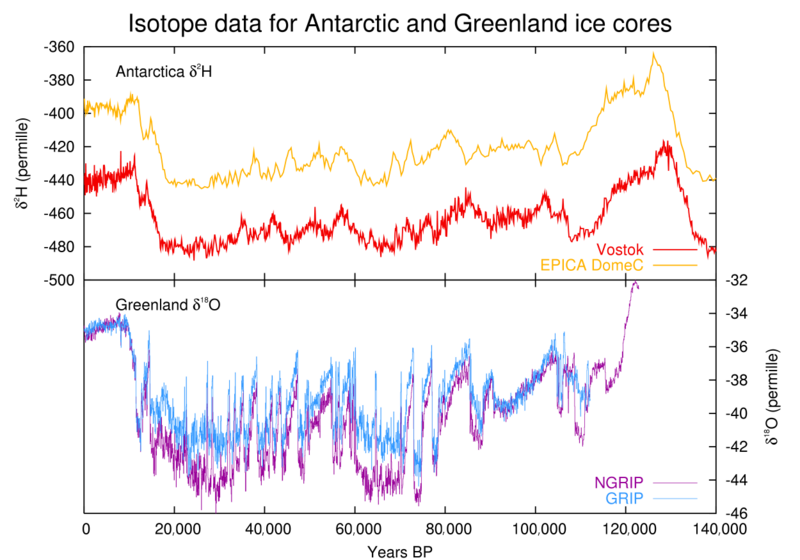
Ice core temperature changes move in the same direction simultaneously in both hemispheres, making the polar temperature record a good proxy for global temperature changes. The ∆temperature becomes more pronounced at higher latitudes, but it’s clear that the synchronicity in both polar temperatures reflects global warming and cooling.
Since polar ice core evidence shows synchronous global warming and cooling, it supports the hypothesis that the MWP and LIA were global events.
Again, I urge interested readers to thoroughly assimilate Vinther’s observations about the effect of elevation changes. Vinther observed that Renland and Agassiz were less impacted by elevation change and in my opinion they are better choices. Vinther estimated GISP2 elevation changes and re-estimated its d18O for consistency with Renland/Agassiz. You’d be better off looking at this data.
In Antarctica, I suggest that you look at James Ross Island, as its elevation has not changed a great deal over the Holocene. You have to examine elevation changes at each site as the Holocene history depends on it – see Masson et al 2000 for interesting comparisons.
Steve, thanks for the info. I was able to find a PDF copy of the Mason paper here, in case anyone else may be interested:
http://climate.colorado.edu/reprints/Masson-DelmotteEtAl_JClimate_2008.pdf
The Vinther paper seems to be pay-walled, if I found the right one.
http://www.sciencedirect.com/science/article/pii/S027737911400434X
Are the reconstruction data from these sources available on the web to be downloaded?
Steve, these issues are a distraction. Stay focused on the big issues, not the minutia. There is absolutely no mechanism defined by anyone I know that explains how CO2 would ever lead temperatures to pull the globe out of an ice age, nor is there a mechanism by which CO2 would ever decrease in advance of temperatures to start an ice age. Facts are CO2 can’t possibly cause a cyclical trend in temperatures. There has to be something other than CO2 driving the temperature on a grand scale. CO2 has a natural “off switch” and absorbs less and less energy on a marginal basis once you get above 50 or so ppm. CO2 has been 7000 ppm and never caused CAGW, why would this time be different. If Warmists can’t explain why CO2 would cause cyclical temperatures, they can’t explain the climate.
In the beginning the MWP and the LIA didn’t happen. They couldn’t happen. CAGW would have to explain their flat graphs of co2. How could temperatures vary if co2 didn’t vary? Now they’ve acknowledged that both happened, but the explanations are vague.
Two years ago I pulled the anomalies of temperature and co2 for the years. While co2 production continued to increase, the ppm of co2 varied with temperature. They’ve slightly adjusted the record increasing many in the last few years and decreasing many in past years. What they’ve done is skew the data by rearranging so that co2 leads temperature rather than lags. No reason as to how co2 ppm vary year to year. In some cases as much co2 as was produced. I wonder why they have to keep adjusting the Data? Did the equipment fail ? Where they wrong then and right now ? Or is it ” it’s worse than we thought” ? If the current year was wrong, why were are the previous years wrong ? How many times are they going to do that ? I sound like a crank if I submit a paper with the wrong data on it. Any organization that I submit the paper to will discard it. ” you’re not really a scientist are you? “… but it’s ok when they use out of date, wrong, or assumptions that later become fact via by magic, information.
The only thing CAGW has is the manipulation of data.
true
I can testify that the data in Gibraltar (UK) has been changed as it did not tie up with three surrounding stations, one in Morocco and two in Spain.
This isn’t science anymore. It’s all make believe. They will have enough useful idiots to support them. There is a way to stop them, but it isn’t going point by point. It’s to degrade the entire field of climate science. I’ve jokingly said I should have went into astrology. My apologies to the astrology field. Climate science is several floors beneath astrology.
As proof that CAGW is not only wrong but using the wrong formulas, there is no way that an organization with so many trained people, access to the most sophisticated equipment, and so well funded… could make so many failed predictions/projections and yet persist in no uncertain terms that they are right. Not only right but have most or all scientific organizations and allegedly scientists too. What’s the use of arguing with Mosher, or any warmist, when it’s fixed to start. In report after report, which will probably disappear now, they used the wrong TSI number. They knew as far back as 2002 that it was wrong. 10 w/m^2 results in a 1/3 of global warming not happening. That is a significant amount from co2 math they use.
I hate graphs with these stupid big scales…pare them down to a scale that people can relate to
..and they are all flat lines
But then where’s the scary part in that?
Latitude, here’s your flat line: http://denialdepot.blogspot.com/2010/11/how-to-cook-graph-skepticalsciencecom.html
Trillions of dollars of wealth redistribution lie in those little wiggles. That’s the man-made part that is mostly a “take-it on faith that things will get worse” dogma.
Now hand over your wallet please, and your credit cards. The Left is also gonna need your IRA and/or 401K eventually, as the they will keep running out of one pot of OPM and always looking for new ones.
Latitude on July 31, 2016 at 3:05 pm
To Tom Dayton’s comment I’ll add: don’t forget to read some of the comments, e.g.
Robert7 November 2010 at 16:21
“Figure 1 shows one reconstruction of the temperature of the Northern Hemisphere derived from Greenland ice cores.”
No it does not, it shows a temperature proxy for Greenland, which is largely in the inverse of the mid latitude temperatures.
“The Medieval Warm Period (MWP) just 1000 years ago was 2°C warmer than today. The public is told that a similar warming will be catastrophic.”
The warmest part of the Medieval Warm Period for Europe, was in the 8th century, where the GISP2 proxy is at its second coldest for the Holocene. And of course Greenland temperature changes are larger than for the mid latitudes.
“The Minoan warm period approximately 3500 years ago was 4°C warmer than today.”
Calling that very warm spike on GISP2 at ~1350-1150 BC the Minoan Warm Period, is one of the greatest errors ever made in climate science. The Minoans, as did many other cultures worldwide, expanded and prospered from around 2700 BC, where GISP2 is at its third coldest in the Holocene, their demise along with several other cultures was around centered around 1200 BC. Because that was a very cold-dry period for the mid latitudes, one of the worst through the Holocene.
And I bet there is evidence for a brief warm period in the mid latitudes at the 8.2Kyr event.
In reply to Leif.
A paradox is an observation that cannot be explained by a theory.
When there are piles and piles of paradoxes a field of science should be in crisis. Climate science is in crisis. There is a massive cyclic forcing function that has not been taken into account which explains why climate science has piles and piles of urban legends
P.S. The mysterious unknown forcing function is the sun. Where or where have large sunspots gone?
Why are there massive coronal holes that stretch across the solar equator? The solar cycle has been interrupted. The sun is entering a different state.
Are at least 12 different observations and analysis results that support the assertion that insolation changes at 65N are physically not capable of causing the temperature changes observed in the paleo record and did not cause what is observed. For example the causality problem or the Younger Dryas problem or the Southern Hemisphere cools at the same time as the Northern hemisphere problem.
The following is a sample of the paradoxes which disproof the theory.
1) 100,000 year problem
2) Southern Hemisphere cools cyclically at the same time as the Northern Hemisphere
http://www.news.wisc.edu/9557
3) Stage 5 problem (Causality Problem)
4) Effect exceeds cause
5) The unsplit peak problem
6) The transition problem
http://en.wikipedia.org/wiki/Milankovitch_cycles#/media/File:Five_Myr_Climate_Change.svg
7) Identifying dominant factor
The solar cycle has been interrupted. The sun is entering a different state
Since you never define was ‘interrupted’ means, your comment is void, but apart from that the, Sun is just behaving normally, been that, done that.
O sole
O sole mio
è che il tuo viso
http://www.vukcevic.talktalk.net/Image7.jpg
As I suggested in a post above, it’s not obscure. The cycles are not a series of additive values but are rate specific.
The mechanism is simple if one looks at the formations of the ice caps as a starting point. Moving continents changing the thermohaline circulation currents and therefore the heat circulation process in the oceans. The Artic glaciated because the Panama Current ended when North and South America connected and the Pacific was not dumping it’s heat directly into the Gulf Stream,
If one looks at the TC currents, all the warm currents from the southern oceans are channeled between Africa and South America and sent north to end in the Greenland Sea. When we are at minimum eccentricity, those currents are weaker and cooler due to increased distance from the Sun in the southern summers. Less heat enters the Greenland Sea, which during glaciation and subsequent sea level drops, is the only entrance to the Artic Ocean.
The previous 41ky cycles were probably due to Greenland being much closer to Scandinavia with much less heat penetrating so deep into the Artic during max eccentricity, therefore obliquity dominated.
That’s my theory. It’s the oceans.
The switch from 41 K to 100 K cycles occurred only about a million years ago. Greenland and Scandinavia were only around 20 km. closer together then, assuming a spreading rate of two cm per year.
Milutin Milankovitch was right. The 41 kyr cycle rules the glacial-interglacial cycle. It just fails to get the world out of a glacial state about half of the times or more because the world has been getting colder as the Ice Age advances.
http://i1039.photobucket.com/albums/a475/Knownuthing/Glacial%20cycles_zpst84kkzo4.png
Since the Pleistocene started 1.8 million years ago some obliquity cycles have failed to reach interglacial temperatures (red line) and can only raise to a declining temperature (blue line). This produces the false impression that other factor is now responsible for interglacials.
1) 100,000 year problem: Solved
2) Hemispheric symmetry of glaciations: Solved
3) Stage 5 problem (Causality Problem): Solved
4) Effect exceeds cause: Feedbacks can explain that.
5) The unsplit peak problem: Solved
6) The transition problem: Solved
7) Identifying dominant factor: Solved
A quibble:
The Pleistocene Epoch now includes the Gelasian Age, 2.58–1.80 Ma, so that all the NH glaciations occur within it. The Gelasian used to be the last age of the Pliocene, but that made little sense.
There is now not much left of the truncated Pliocene Epoch, wedged in between the long Miocene and Holocene, which of course is really just another interglacial in the Quaternary glaciations.
Actually the “problems” began much earlier, when a “global temperature” was presented. There is no such thing, there never will be such a thing. It’s a fantasy masquerading as science on both sides of the debate.
One thing is for certain , the longer we go back the less scary it gets .
Most of our hottest ever ,wettest ever ,most destructive ever only goes back 20 – 30 years but weather and climate have been going on for billions of years and will still be changing for billions more with or without us humans .
Greenland ice proxies are faithful recorder of the Iceland’ volcanic eruptions affecting its weather and not much else.
https://earth.nullschool.net/#current/wind/isobaric/500hPa/orthographic=-13.98,65.70,1137/loc=-21.861,65.347
Dr. S. may advise to be otherwise
None of those assertions are supportable, because there is no global temperature. You can certainly make those assertions about parts of Greenland, but not globally.
This claim that there is no 21,000 year Milankovitch effect on climate is a false one. There is one, it’s well studied and described as one of the orbital/axial forcings, but it’s constantly modulated by the other cyclical forcings, in a manner that commonly hides its effect in the overall temperature record. It’s certainly true that there is no clear 21,000 year cycle in that record, but the 21,000 year forcing does indeed effect shorter term temperature rises and falls. Including especially during our current holocene period. The fading of that forcing is a major factor in the gradual cooling of the holocene. It also contributes to the 100,000 year cycle, even though there is no actual cycle of any single forcing that is 100,000 years in length. It’s a complex multiple of a number of smaller forcings that creates peaks and valleys, some of which are regular, others not.
https://en.wikipedia.org/wiki/Milankovitch_cycles
Figure 2 looked awfully familiar. When I looked closer, I recognized it as a graph I plotted from data in Cuffy and Clow (1997) and Alley (2000) several years ago. Since then it has been bounced around the internet and used by others. I also plotted the oxygen isotope curve from the same core using data from Stuiver and Grootes. Both show essentially the same temperature changes, which are well correlated with global glacier fluctuations, so they relected global temperature changes.
We can learn a lot from these graphs, not only about past temperature changes, but also about possible causes of those changes. Perhaps the most important of aspect of the temperature changes is their abruptness and magnitude, along with the number of sudden climatic changes (see Easterbrook, 2010, 2014 and numerous posts on WUWT). They are important because they place limits on possible causes. For example, take a look at the Younger Dryas on Fig. 2–the climate changed abruptly from nonglacial values
back to full glacial conditions in about a century, stayed there for more than 1000 years, then back to full interglacial in about a century. Obviously, whatever caused the Younger Dryas was capable of causing a full glaciation in a very short period of time. The abuptness of these climatge changes from full nonglacial to glacial and back to interglacial proved that they could not possibly be caused by Milankovitch orbital variations and cast serious doubts on the Milankovitch theory. Another problem with the Milankovitch
theory is that when the N. Hemisphere was in a glacial phase, the S. Hemisphere should have in an interglacial, and we now know from many hundreds of isotope dates that climate changes in both hemisphere are almost exactly synchronous. Anyone who still adheres to the Milankovitch orbital theory as the cause of ice ages must explain how variations that take many thousands of years can cause
climate changes from interglacial to full glacial to interglaciation in about a century. It can’t be done! It doesn’t work even if some short-term climate fluctuation is superimposed on orbital changes (this has been attempted, but doesn’t work).
” Since then it has been bounced around the internet and used by others.”
Yes, misleadingly, as in this post. There is a big arrow saying “Present global warming”. And a green line saying “Present temperature”. But, as Steve McIntyre notes above, and have also many others, the GISP2 data ends in 1855.
As too often, Nick Stokes misrepresents what I said and provides incorrect information. It is not true that GISP2 data ends in 1855 or that I “noted this above”. GISP2 data is available until 1987, as I observed. It is ludicrous that Stokes should claim that GISP2 data ends in 1855.
As I actually observed, it is the Cuffey-Clow temperature reconstruction from GISP2 that ends in 1855. The Cuffey-Clow version has been widely used in “skeptic” articles, but there is really no need to use it since isotope data is available to 1987 and use of the Cuffey-Clow version permits cheap responses such as Stokes.
“It is not true that GISP2 data ends in 1855”
I said “the GISP2 data”. The data used in that plot. Which Prof Easterbrook sourced: ” a graph I plotted from data in Cuffy and Clow (1997) and Alley (2000)”. That data ended in 1855, as you said. So that graph is misleading.
” cheap responses such as Stokes.”
It’s a very central response. A key proclamation in this rant is
But as Phil. points out below, none of those Figs includes any data from the last 120 years. That is a central issue.
No, that’s not true. The GISP2 core data ends in 1987 (see the Stuiver/Grootes data set. You’re confusing the Cuffy and Clow and Alley curve (core temp) with the isotope data.
“You’re confusing the Cuffy and Clow and Alley curve (core temp) with the isotope data.”
I’m not confusing it. I was responding to your statement that:
“Figure 2 looked awfully familiar. When I looked closer, I recognized it as a graph I plotted from data in Cuffy and Clow (1997) and Alley (2000) several years ago. Since then it has been bounced around the internet and used by others.”
Could the Younger Dryas be due to massive initial melting creating vastly increased cloud cover and re-insulating the planet for a brief period?
The Bølling-Allerød interstadial, as well as Dansgaard-Oeschger events, would be the reduction of ice shelves and opening of the Arctic to warm Atlantic ocean transport. The Younger Dryas, and termination of DO events would be the closing off of warm ocean transport to the Arctic ocean, and the polar see-saw effect should cease during a glacial Arctic, and it’s temperature change in unison with the Antarctic.