
Guest essay by Eric Worrall
More evidence that global warming is spreading its icy tentacles across the entire Northern Hemisphere; devex reports that global warming is freezing Mongolian livestock, and preventing the grass from growing in the Summer.
For Mongolians, climate change is as personal as it gets
When the world adopted the newest climate agreement during the United Nations climate change conference — or COP21 — in Paris, France, last December, an urgent warning was sounded: The effects of climate change will only worsen if nothing is done to address the problem.
…
Even in the landlocked nation of Mongolia, the negative effects of climate change have hit home — quite literally. Oyun Sanjaasuren, inaugural president of the United Nations Environment Assembly, said that her country’s vulnerability to climate change could be the highest in the world by the turn of the century, if current rate of temperature increase continues.
“Mongolia’s average warming over the past couple of years is 2.2 degrees Celsius, which is considered the hottest in the country since the 1940s, and the global average is at 0.8 degrees Celsius,” said Sanjaasuren, who has also served as a member of parliament in the East Asian nation since 1998.
The effects of climate change have been severe in Mongolia, bordered by Russia to the north and China to the south. In 2009 and 2010 alone, around 8.5 million livestock died — consisting mostly of goats, sheep, cows and horses — as a result of extreme weather conditions known as a “dzud,” a summer drought followed by a heavy snowfall.
The phenomenon is unique to the East Asian nation, exacerbated by the fact that around one-third of the country’s work force depends on animal husbandry and livestock herding to earn a living. And this year, dzud is once again threatening livelihoods.
Since November 2015, large parts of the country have been experiencing very low temperatures of up to minus 40 degree Celsius, followed by heavy snowfall that has covered around 90 percent of Mongolia’s territory. This has resulted in sharp reductions in plant life used for livestock feed and rendering pastures — and even basic services such as transportation — largely inaccessible.
…
“Herders and livestock were used to warmer winters … so now with colder winters, it makes it hard to cope with the temperature,” Tsedensednom, governor of Ulziit district, located more than 600 kilometers southwest of the capital city of Ulaanbaatar, told Devex.
“I’m not a scientific expert, but in my personal experience, the changes [to the environment] are evident,” he added. “When I was a kid, the grass was so high you couldn’t see calves. Now grass only grows 10 centimeters, or not at all.”
This situation has been exacerbated by overgrazing, an issue in the country for several years. …
Read more: https://www.devex.com/news/for-mongolians-climate-change-is-as-personal-as-it-gets-87832
The harsh conditions are obviously no laughing matter for the Mongolian people, who are obviously suffering severe hardship, but the attempt to frame this as a problem caused by warming is more than a little ridiculous. Still, perhaps Mongolian authorities are taking their lead from US Climate Scientists, who frequently claim brutal cold and heavy snow are our fault.
maybe they can blame warming for the cold but they can’t blame fossil fuel emissions for the warming
http://papers.ssrn.com/sol3/papers.cfm?abstract_id=2725743
Lean Alfred Santos is right: the climate is changing. But like some, he’d be well inspired to understand meteorology before blabbing such ridiculous claim that it is a result of global warming.
The mean annual surface pressure in the Gobi desert has been rising since the 1960s while the temperature has steadily declined. (CDC/NCEP-NCAR data in Leroux 2010 page 382).
That means more powerful anticyclonic conditions are affecting the region, not because air comes down from the sky, but because of colder travelling polar air masses descending southward to the Himalayas, hence the summer drought, the low temperatures in winter and occasionally some heavy precipitation during transitional season. If anything these conditions are compatible with those experienced during cooling periods.
And yes, warming during summer and extreme cold are of course compatible statements since both result of those anticyclonic conditions.
Sounds like these folks need some buffalo (bison) which will grow fat in areas that cattle, sheep, and goats will starve in. Sheep are somewhat of a problem since they graze the grass so short they kill the plants.
Last winter the flow was very meridienal at times, and there were plenty of headlines about the cold getting farther south than usual, if you checked out that “Ice Age Now” site. In January my site, which is suppose to focus on arctic sea-ice, kept getting sidetracked to the weather in places like Thailand and Africa. The cold in Thailand came south by way of Mongolia, of course.
https://sunriseswansong.wordpress.com/2016/01/27/arctic-sea-ice-the-return-of-the-nudger/
Currently the loopy flow may have some warmth surging north in the east of USA (which the mainstream media will report) but at the same time it is snowing way down in the mountains of central Mexico, (which only “Ice Age Now” will report).
Here is one of Dr. Ryan Maue’s excellent maps from the Wearherbell Site, showing the forecast snows in the west over the next week, and how they extend way down into Mexico. Remind yourself this isn’t the dead of winter. This is not January. For it to be that cold in Mexico in March simply must be due to Global Warming . /sarc.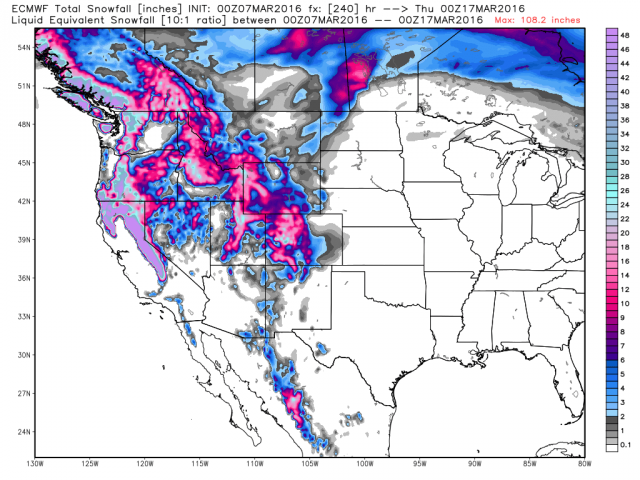
Ah Yes perhaps the reason for the colder weather in Mongolia is due to the same phenomenon that the BBC was reporting as the cause for the current cold snaps – SSW – Sudden Stratospheric Warming. It beggars belief that these people get paid for this nonsense. Find a cold weather pattern and find some adjacent warming and then blame the cooling on the warming – easy case proved. However maybe the SSW is the result of the polar Vortex.
Why not claim that sudden cooling causes stratospheric warming…….perhaps its just plain bad science (sarc)
Nothing says warming like cooling. 🙂
I had some fun during a heat-wave last summer headlining a post about snows in Hawaii and Africa.
https://sunriseswansong.wordpress.com/2015/07/19/july-snow-in-hawaii-and-africa/
If you can’t beat them, join them (and reduce things to absurdity).
The Mongolians have it worked out. No matter what the problem, blame climate change and wait for a share of the $100bn.
I’m glad we’re not experiencing the onset of the next Ice Age, or we’d be having overwhelming heat waves of genocidal proportions.
/sarc
Mongolia needs to move itself west a bit.
http://realclimatescience.com/wp-content/uploads/2016/03/ch_tlt_2016_02_anom_v03_3.png
I notice in the caption to the lead photograph the structure is called a “Mongolian Yurt”. Mongolians would not take kindly to that as a Yurt is Russian, in Mongolia they are known as Ghers.
Was there a few years ago in early May and there was a couple of days where we had that fluffy solid global warming falling from the sky.
Alan, not to quibble but they spell it ‘ger’ and it is pronounced that way because ‘gh’ is a different sound. It may appear as gher in other transliterations. A ger is a highly sophisticated piece of technology that can be set up in 90 minutes and taken down in 45. It can be transported by 5 mature camels, the minimum number needed by a poor family.
And you are right about the fluffy warming stuff. I think there is no day of the year it never snowed.
Up list there is a mention of a 90% coverage in snow. That is amazing because a large portion of Mongolia is desert where is basically never has precipitation.
If global warming causes global cooling, isn’t that evidence of “The Great Global Thermostat”? Seems to me that CO2 atmospheric temperature forcing is a self-eating watermelon (as anyone should have long since concluded from studying the reconstructed history of 500,000 years of global temperature).
Mongolian Throat Singing
The drought and snows have been happening periodically since the time of Genghis Khan.
As with Genghis they have to face the same problem for a nation of herders, grazing.
This is just like the Zimbabwe scam, scandalously bad management blamed on climate. Lets blame global warming for the great swathes of dry Russian steppe that gets bloody hot in summer and bloody cold in winter. I suppose global warming created the Gobi desert too.
Mongolia is not rich, like the Maldives and are only happy to accomodate this kind of nonsense to get stuck into the UN green fund
Overgrazing leaves barren dry land as even grass roots are eaten and done over a large area to that degree leaves more or less barren land with sparse growth. Rise and repeat and you have a grazing problem.
The Mongolian steppe seen decades of drought in the 12th century along with cold winters. It was very arid in that period. The same thing happens with the Russian open steppe. Hot dry summers followed by severe winters, just ask the Germans as they tried to make their way through in the 40s.
One method taken up by the Mongols was heating bricks on fires and putting them under animal skins to sleep on to fight the cold.
Mongolia then got very wet in the following decades with a huge increase in precipitation by 1213
Now according to Tenberth, Mongolia should be seeing less drought in a warmer and wetter world, yet Mongolia has not seen as much rain as in the thirteenth century.
Isn’t Mongolia the final refuge of a species of Camel that is able in winter to derive all it’s water by eating snow and ice? As I understand it that is a pretty specific adaptation to harsh winters and that ordinary ruminates would die of dehydration or frostbite without that adaptation of the digestive system. Makes one think that very cold extends into prehistory in that area of the world.
There was a recent (1990’s) excavation of an Altai burial site in Mongolia. The woman was buried c. 500 BC and was known as the Siberian Ice Maiden. She was completely frozen and contact with air began the process of disintegration. She was buried with her horses and had tattoos. These people have lived this way for thousands of years. They make beautiful curved iron bits and tack for their animals and live in these yurts.
http://horsetalk.co.nz/wp-content/uploads/2012/11/altai-mountains.jpg
What I want to point out is that the documentary on the Altai woman makes shameless claims for the loss of these frozen burial sites because of Global Warming. Of course this casts the academics raiding graves as the heroes preserving the past. The true threat to the destruction of their way of life as keepers of fine domesticated animals is political, because they are free nomads. The weather they have always suffered, but it is help from this generation of know-it-alls in the West that they would not survive. Alas I think I will not either, but it has been a good life thank God.
“The Ice Maiden’s tomb was found on the Ukok Plateau near the border of China, in what is now the Autonomous Republic of Altai. The plateau, part of the Eurasian Steppes, is characterized by a harsh, arid climate. The area is known by the local people as the “second layer of heaven,” one step above ordinary people and events.[2] Present day Altai herdsmen still bring their sheep and horses to the plateau during winter because the fierce wind blows the snow off the grass and provides grazing land for the animals despite the freezing temperatures.”
Correction:
“Of course this casts the academics raiding graves for gold and antiquities as the heroes preserving the past. The true threat to their way of life as keepers of fine domesticated animals is political, because they are free nomads. The weather they have always suffered, but it is help from this generation of know-it-alls in the West that they would not survive.” Thank you.
Forgot how to talk.