A couple of days ago we ran a piece at WUWT: Did We Really Save the Ozone Layer? In light of this press release, the question is worth pondering again.
From the NASA/GODDARD SPACE FLIGHT CENTER
Annual Antarctic ozone hole larger and formed later in 2015

The 2015 Antarctic ozone hole area was larger and formed later than in recent years, said scientists from NASA and the National Oceanic and Atmospheric Administration (NOAA).
On Oct. 2, 2015, the ozone hole expanded to its peak of 28.2 million square kilometers (10.9 million square miles), an area larger than the continent of North America. Throughout October, the hole remained large and set many area daily records. Unusually cold temperature and weak dynamics in the Antarctic stratosphere this year resulted in this larger ozone hole. In comparison, last year the ozone hole peaked at 24.1 million square kilometers (9.3 million square miles) on Sept. 11, 2014. Compared to the 1991-2014 period, the 2015 ozone hole average area was the fourth largest.
“While the current ozone hole is larger than in recent years, the area occupied by this year’s hole is consistent with our understanding of ozone depletion chemistry and consistent with colder than average weather conditions in Earth’s stratosphere, which help drive ozone depletion,” said Paul A. Newman, chief scientist for Earth Sciences at NASA’s Goddard Space Flight Center in Greenbelt, Maryland.
The ozone hole is a severe depletion of the ozone layer above Antarctica that was first detected in the 1980s. The Antarctic ozone hole forms and expands during the Southern Hemisphere spring (August and September) because of the high levels of chemically active forms of chlorine and bromine in the stratosphere. These chlorine- and bromine-containing molecules are largely derived from man-made chemicals that steadily increased in Earth’s atmosphere up through the early 1990s.
“This year, our balloon-borne instruments measured nearly 100 percent ozone depletion in the layer above South Pole Station, Antarctica, that was 14 to 19 kilometers (9 to 12 miles) above Earth’s surface,” said Bryan Johnson, a researcher at NOAA’s Earth System Research Laboratory in Boulder, Colorado. “During September we typically see a rapid ozone decline, ending with about 95 percent depletion in that layer by October 1. This year the depletion held on an extra two weeks resulting in nearly 100 percent depletion by October 15.”
The ozone layer helps shield Earth from potentially harmful ultraviolet radiation that can cause skin cancer, cataracts, and suppress immune systems, as well as damage plants. The large size of this year’s ozone hole will likely result in increases of harmful ultraviolet rays at Earth’s surface, particularly in Antarctica and the Southern Hemisphere in the coming months.
Ozone depletion is primarily caused by man-made compounds that release chlorine and bromine gases in the stratosphere. Beginning in 1987, the internationally agreed-upon Montreal Protocol on Substances that Deplete the Ozone Layer has regulated these ozone-depleting compounds, such as chlorine-containing chlorofluorocarbons used in refrigerants and bromine-containing halon gases used as fire suppressants. Because of the Protocol, atmospheric levels of these ozone depleting compounds are slowly declining. The ozone hole is expected to recover back to 1980 levels in approximately 2070.
This year, scientists recorded the minimum thickness of the ozone layer at 101 Dobson units on October 4, 2015, as compared to 250-350 Dobson units during the 1960s, before the Antarctic ozone hole occurred. Dobson units are a measure of the overhead amount of atmospheric ozone.
The satellite ozone data come from the Dutch-Finnish Ozone Monitoring Instrument on NASA’s Aura satellite, launched in 2004, and the Ozone Monitoring and Profiler Suite instrument on the NASA-NOAA Suomi National Polar-orbiting Partnership satellite, launched in 2011. NOAA scientists at the South Pole station monitor the ozone layer above that location by using a Dobson spectrophotometer and regular ozone-sonde balloon launches that record the thickness of the ozone layer and its vertical distribution. Chlorine amounts are estimated using NOAA and NASA ground measurements and observations from the Microwave Limb Sounder aboard NASA’s Aura satellite. These satellites continue a data record dating back to the early 1970s.
###
Leonard Gianessi
Stopping the Nematode Threat to Potatoes with Fumigation
Posted on December 31, 2013
Roots
PCN Damage (right)
Bugs
PCN cyst hatching
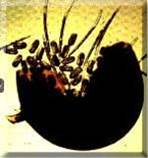
Cyst nematodes are a huge potential threat to potato production in the US. Nematodes are microscopic unsegmented worms. Roots of infected plants contain minute, white bodies of females. When a female dies, its cuticle forms a protective cyst containing 200 to 500 eggs. Cysts containing viable eggs can persist in the soil for up to 20 years. When potatoes are planted, root exudates stimulate juvenile nematodes to emerge from eggs. The juveniles locate and enter potato roots. They cut through cell walls and feed. Infection with nematodes reduces root biomass, which can lead to stunting of plants, yellowing and wilting of foliage and small tubers. Heavy infestations often results in total crop loss. Potato cyst nematodes are widespread in many countries, but only two localized infestations have occurred in the US. The latest infestation, found in Idaho in 2006, has led to a strict treatment program with fumigants.
“Two species of potato cyst nematode are found in the United States: Globodera pallida, the pale cyst nematode (PCN), was first found in Idaho in 2006, whereas the golden nematode, G. rostochiensis (GN), was first found in New York in 1941. Both species are regulated under a Federal Domestic Quarantine Order (USDA-APHIS) and parallel State Rules (Idaho State Dept. of Agriculture, New York State Dept. of Agriculture), and eradication effects are underway.
While some resistance to PCN is present in potato varieties grown in Europe and elsewhere in the U.S., there is no resistance in most of Idaho’s signature russet varieties.
The presence of G. pallida in Idaho has been viewed with alarm by other states and countries that import Idaho potatoes and other farm products. After the initial Idaho PCN detection in 2006, markets for Idaho fresh potato products and nursery stock were lost for Canada, Mexico, and Korea. Japan temporarily closed the market for all U.S. potatoes, and continues to disallow Idaho shipments. Consequently, eradication of PCN is a top priority for the Idaho potato industry, including the Idaho Potato Commission, the Idaho State Department of Agriculture, and USDA-APHIS. Millions of dollars have been spent in Idaho in eradication efforts. A critical component of this work has been treatment of infested fields with the fumigant methyl bromide (MeBr), which has been ongoing since the spring of 2007. Lab tests conducted after each treatment indicate a 95% viability reduction after one year’s fumigation, and over 99% viability reduction after successive treatments.”
Author: Dandurand, L. M.
Affiliation: University of Idaho, Moscow
Title: Novel Eradication Strategies for Pale Cyst Nematode
Source: Potato Progress. September 16, 2013. Volume XIII, Number 10.
Leonard Gianessi
Composition of Seawater at 3.5% salinity
Bromine Br 67.3 ppm
ref:
http://oceanplasma.org/documents/Elemental_Table.jpg
Bromine is #9
Where can I find data on the Antarctic Ozone Hole from say 1700 through 1950? How much larger did it get by 1980? What factors control the size of the hole?
I take no position on Montreal Protocol but if we don’t know how big the hole was in 1800 how can we persuade ourselves we know we made it bigger? I didn’t ask that question in the past but since the Great Hoax is being used to steal my money and the Montreal Protocal allowed “developing” economies to make ClFHC just like the UN wants to do with CO2 I now wonder.
Liars lie. It is what they do. Are the hoaxers the political allies and descendants of the Montrealers?
Wow! Who knew the Earth could get skin cancer and all that other stuff! Maybe you should have said “Earthlings” instead.
Earth’s magnetic field and ozone layer protect against a cancer-causing secondary galactic radiation.
Climate science is becoming a punch line. Remember the old joke?
A guy is walking around town with an elephant gun.
Cop: “Why are you carrying that elephant gun?”
Guy: “To keep the elephants away.”
Cop: “There are no elephants around here.”
Guy: “See? It’s working.”
People who say that the Montreal convention worked as predicted fail to remember the predictions at the time it was agreed to. The alarmists said the hole was growing at an alarming rate. It wasn’t. They said the hole would start shrinking. It hasn’t. Do you remember those predictions? I doubt it. Believers just believe. Those facts have been kicked down the memory hole. I think these believers are worse than religious nuts. I think if they were told tomorrow that human activity was going to cause an ice age, they would immediately believe it and jettison their old “beliefs.” This set of believers believes in only one thing. Free humans are bad. Centralization of all power into the govt, which they think they control, is good. They are no different from the Communist true believers of the 1930’s.
Remember: The human contribution to the influx of CO2 into the atmosphere is 3%. The other 97% is from natural. This according to NOAA and the IPCC.
You have to be completely brainwashed to believe this alarmist nonsense. Nobody understands climate well enough to make accurate quantitative predictions about climate years or decades or centuries into the future. If anybody were that smart, they would be fabulously rich from trading in the commodity futures market.
ARCTIC ozone “hole”
“… the lowest ever recorded ozone concentrations in the Arctic stratosphere during March 2011 and elevated ultraviolet (UV) levels throughout the Arctic and sub-Arctic (Bernhard, et al. 2012a). Manney et al. (2011) described the event as unusual because the Arctic stratosphere is normally too mild for ozone depletion to progress like the Antarctic winter. But in the winter of 2010-2011, extreme cold in the upper atmosphere lasted more than a month longer than any previous Arctic winter, and the temperatures were low enough to generate ozone-depleting forms of chlorine a month longer than normal.”
Wright, Bruce. “Ultraviolet (UV) Radiation in the Arctic and Unusual Mortality Events in Marine Mammals Arctic seals need some sunscreen.”
http://www.environmentalaska.us/ultraviolet-radiation-uv.html
See the presentation at: http://www.youtube.com/watch?v=nuOx17v5ALQ&list=FLST_RpmY_soi7zxWql-VK2g
Is it a coincidence that the ozone hole matches pretty well the sea ice extent?
6 months ago in May, NASA said the ozone hole was solved
8 MAY 2015
NASA SAYS OZONE LAYER HOLE HAS BEEN SOLVED
http://ie.ign.com/articles/2015/05/08/nasa-says-ozone-layer-hole-has-been-solved
16 oz of R-12 for the car, 89 cents at WalMart. Some ba$tard$ responsible for this hoax that’s costing us billions should HANG!…..