Wow! ECMWF Long-Term Weather Model Is Predicting a Super El Niño and I Mean Super
Guest Post by Bob Tisdale
I was notified today of the rather remarkable plume of ENSO forecasts for 2015 from ECMWF (European Centre for Medium-Range Weather Forecasts). See their System 4 ENSO region sea surface temperature anomaly forecast webpage here.
Figure 1 presents the ECWMF plume of sea surface temperature anomaly forecasts for the NINO3 region (5S-5N, 150W-90W), with some of the runs reaching highs in November 2015 in the neighborhood of +4.5 deg C.

Figure 1
For those unfamiliar with them, see the map of NINO regions here.

Figure 2 show the plume for the NINO3.4 region (5S-5N, 170W-120W). Note how a couple of the runs reach beyond the upper +4 deg C extent of the y-axis.
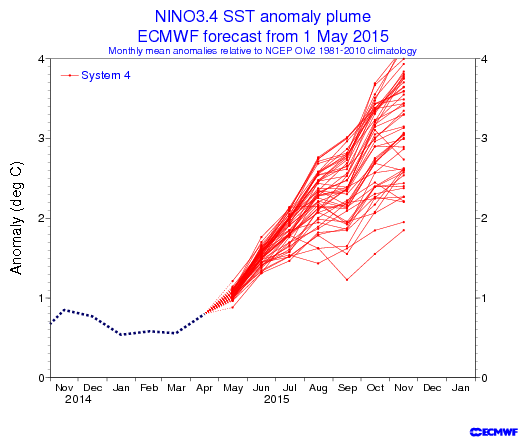
Figure 2
Now consider that NINO3.4 sea surface temperature anomalies peaked at +2.7 deg C in December 1997 in response to the 1997/98 super El Niño, and peaked at +2.8 deg C in January 1983 during the 1982/83 El Niño. See Figure 3, which is from the April 2015 Sea Surface Temperature (SST) Anomaly Update.

Figure 3
ARE NOVEMBER SEA SURFACE TEMPERATURE ANOMALIES OF +4.0 DEG C AND HIGHER IN THE NINO3.4 REGION PHYSICALLY POSSIBLE?
In the post Why Do El Niño and La Niña Events Peak in Boreal Winter?, we illustrated and discussed how and why the sea surface temperatures (absolute) of the NINO3.4 region mimic the seasonal cycle of, and come near to the values of, those in the western equatorial Pacific (5S-5N, 120E-165E) during a strong El Niño, like the one in 1997/98.
Based on the Reynolds OI.v2 data, the average November sea surface temperatures for the NINO3.4 region for the period of 1981-2010 is 26.64 deg C. That value serves as the November reference temperature for NINO3.4 sea surface temperatures anomalies.
Sea surface temperatures in the western equatorial Pacific (5S-5N, 120E-165E) are naturally warmer than those of the NINO3.4 region. The November sea surface temperature for the western equatorial Pacific in 2012 was 29.95 deg C; in 2013 the temperature there was 29.98 deg C; and, for 2014, it was 29.90 deg C. The average November temperature for the western equatorial Pacific for the past 3 years was about 29.94 deg C.
Let’s assume for a moment that the sea surface temperatures in NINO3.4 region did something very unusual in November 2015 and rose to that 2012-2014 average value of the western equatorial Pacific of 29.94 deg C. The November 2015 NINO3.4 sea surface temperature anomaly would be 3.3 deg C. That’s far short of 4 deg C.
Because someone’s bound to ask, in November 1997, the sea surface temperature for the western equatorial Pacific was 29.35 deg C, while the NINO3.4 region was remarkably similar at 29.31 deg C. And for November 1982, the sea surface temperature for the western equatorial Pacific was 29.08 deg C, while the NINO3.4 region was a little less at 28.81 deg C.
[My thanks for the heads-up, anonymous person.]
SOURCE
The Reynolds OI.v2 sea surface temperature data are available from the KNMI Climate Explorer.
Dramatic images emerged from Nicaragua on Monday after visitors to Nicaragua’s Telica volcano found themselves just metres from its massive crater as it spewed dark clouds of ash and gas high into the sky.
Nicaragua’s most-active volcano let out a first, loud explosion on Sunday (May 10) night, according to the Nicaraguan Institute of Territorial Studies, or Ineter, which monitors seismic and volcanic activity.
http://www.stuff.co.nz/world/68521780/nicaraguas-telica-volcano-roars-to-life-spewing-ash-gas
Bring it on. Normal ENSO pattern
is disrupted. In 82/83… The winter
540 thickness was in Canada. No
cold. No freezes for the Southeast
US in 2015/16. But it must be SUPER.
The Fire Volcano in southern Guatemala exploded incandescent rock and ash over surrounding towns Saturday. David de Leon, spokesman for the national disaster. Scores of residents have been.
Scores of residents have been evacuated from their homes in southern Guatemala after the Fuego volcano erupted, the country’s president says. Clouds of black ash belched into the sky, while.
Scores of residents have been evacuated from their homes in southern Guatemala after the Fuego volcano erupted, the country’s president says. Clouds of black ash belched into the sky, while.
https://youtu.be/vVk2aARCXK8
The Fuego volcano has a history of very high sulfur content eruptions. The Fuego eruption in 1974 did not erupt a lot of material but the high sulfur content put it number 6 on its impact on the climate from the volcanoes in the 20th Century.
Many thanks Bob, something to watch through the lazy, hazy, days of summer, if and when they arrive?
I don’t consider a 6-month forecast as a medium-range weather forecast. The ECMWF gained some notability as a result of an impressive 8-day forecast for the yet-to-form Hurricane Sandy. I think medium-range weather forecasting means from 5 days to a few weeks.
26.03.2015
Two of Mexico’s most active volcanoes are putting on a spectacular show. Ash and gas is erupting from the Colima and Popocatepetl volcanoes. More than 60 explosions have been recorded at the Popocatepetl volcano in the last 24 hours. One of the eruptions is reported to have reached more than 1,000 metres into the air.
https://youtu.be/Jq9Pf3ziU1c
Susan Corwin May 16, 2015 at 8:45 am wrote:
“The question we would always ask at Intel for something like this was:
“how much of your salary/retirement would you bet on this being correct?””
Sadly, the more pertinent question here is:
“How much of your salary/retirement was dependent upon your model coming to this particular result?”
Such is the difference between providing goods/services which a private citizen is willing to buy, and obtaining grant money from an activist publicly-funded entity.
SUPER FEAR-MONGERING for the SUPER PARIS POWER GRAB……
Are these people that far gone from reality? Or is this the next ploy to bilk millions from their money and property and submit themselves to the collective as property. The shear amount of unreasonable exaggeration should be a tip off to the models validity.
sheer
Great commentary Joe and Bill…makes sense with what I see also…thanks
Bill Illis that is! and we all know who Joe is!
Q:- For people who seem to think themselves “experts” * they do not seem to cross check their models against reality very well. Considering that the 1998 El Nino only made just under +3˚C anomaly and the average of the subsequent ones is only about +2˚C on what basis do they really “forecast” +4˚C?
* working definition from 1st Year Engineering, ‘x’ in an unknown quantity and a ‘spurt’ is a drip under pressure.
A:- The advent of Paris seems to be putting a lot of pressure on these drips to put on a performance. Perhaps they should apply for ‘arts’ funding.
(Houston, that model over reach problem seems to have cross infected the El Nino codes. Most seem to be going ballistic by the end of the year let alone the end on the century. Switching to manual.)
Answer : The forecast extent of the forecast 2015 El Nino is calculated as the amount needed to prove beyond any doubt that it is all caused by CO2.
Maybe “arts” funding goes to far. But “theology” funding sounds right.
Certainly, as they have done it, not “science” as it is divorced from empirical data.
Good thinking M Steward. You are making a serious point but turning loose the wits. And does WUWT have wits!
Question: If WUWT is twice as witty are the warmists half-witted? Mean, but also serious as they have NO sense of humor.
02 Jul 2013
Scientists unveil new and improved El Niño forecasts
Professor Hans Joachim Schellnhuber, director of the Potsdam Institute for Climate Impact Research and co-author of the study, said:
“Enhancing the preparedness of people in the affected regions by providing more early-warning time is key to avoiding some of the worst effects of El Niño”.
He says the new algorithm the team is using not only extends the period of its forecasts but also enhances their reliability.
Conventional approaches kept on predicting, long into 2012, that there would be a significant El Niño warming in the last year, he said. But the new approach had already correctly predicted as early as 2011 that there would be no such warming.
http://www.carbonbrief.org/blog/2013/07/scientists-unveil-new-and-improved-el-niño-forecasts/
“The variation between El Niño and La Nina is strongly affected by random chance, so, it’s stochastic, it’s unpredictable, and that’s why IPCC doesn’t attempt to predict that.
So you will find a statement in the latest IPCC report which kind of says that this evolution over the last 15 years was not predicted like that by the IPCC …”
Stefan Rahmstorf — The Climate Crisis
Published on Feb 11, 2014, youtube, 9.50 minutes
Of course we only have a handful of previous El Ninos to compare to so any similarities in pre conditions to previous ones could be completely irrelevant. Perhaps temperatures will drop 4C this time instead of rise. So much certainty from such small amounts of data.
If you look at the actual temperature of area 4, you will see most of it is already at 30C with the balance being mostly 29C. http://www.emc.ncep.noaa.gov/research/cmb/sst_analysis/images/tpacv2.png The Ocean limits it’s temperature to less than 31C. Remember Willis’ posts on the Argo float temperatures that show a hard limit at 31C. How will we see the kind of anomalies that are being predicated?
The color coded sea surface temperature map in an earlier comment here shows a spot of ocean east of India as being 32-plus degrees C.
Donald, you have to realize that this is a full world map and is not necessarily accurate in detailed areas.
If you pull the website http://www.oceanweather.com and find the temperature map for that area you will see that the temperature for that area is at 31C. There is also another area between India and the Persian Gulf that has the same temperature and is not shown on the map. But you can’t expect a map like this to be accurate. The website that I referenced serves the shipping industry and their data is collected by automatic on-board weather monitoring equipment. The data includes wave height, wind speed and direction, and temperature. The temperatures given are actual measured temperatures and are direct water temperature measurements.
Region 4 has already lost much of it,s heat load in the last 10 days. Take a look at the difference between 10 days ago and today using a ssta chart.
I have examined many hundreds of thousands/probably millions of entries in ship’s logs and I can confirm that recorded temperatures (and these are drawn at about 7m below surface) are in many areas well above 30degC. The deep ocean (because of currents and ocean overturning, not because of evaporation) tends to restrict temperature to around 30 degC, but shallower oceans, or oceans where currents are less, or slow down and pool can have significantly higher temperatures.
I have seen temperatures as high as 36degC. Temperatures between 32 and 34 are common place in the Gulf of Mexico, Red Sea, South China Seas, Indian Ocean, in and around Indonesia, off the West Coast of Africa (say betwen Gabon and Ghana).
In the Article that you referred to, I posted a comment of the then current temperatures (in about 10 different locations) given by the Port Authorities which were showing that day, or the highest temperature recorded that year temperatures above 32 degC. I provided website links to many of the Port Authority reports confirming the information.
The equitorial/tropical oceans can get very warm but ocean overturning and currents distributes the ‘excess’ heat downwards (heating the ocean to depth) and polewards (heating the higher lattitude areas) as can be seen in the Arcticle a few days ago showing CERES info on energy distribution.
It is an over simplification (and indeed incorrect) to consider that the oceans only reach about 30degC, and that is the maximum temperature that you will see.
Richard, I didn’t notice your post earlier. I would like to see the sources where you have seen temperatures as high as 36C. In Willis’ posts there were temperatures above 31C; however, they were in coastal areas and as near as I can tell they were often near areas where there were mud beaches or muddy rivers emptied into the Ocean. The only places that higher temperatures are found are the Persian Gulf, which is very salty, in the Ocean and in fresh water lakes, a lake in Southern Russia that is very polluted. Most temperature charts for both fresh water and salt water end at 32C. I have looked for higher temperature and have not found them.
“The variation between El Niño and La Nina is strongly affected by random chance, so, it’s stochastic, it’s unpredictable, and that’s why IPCC doesn’t attempt to predict that.”
Is that so?
You might want to look at my public prediction here made in November 2014:
http://astroclimateconnection.blogspot.com.au/2014/11/evidence-that-strong-el-nino-events-are_13.html
If you look at the 31 year Full Moon Epochs for the Perigean spring tides i.e.:
:
Epoch 2 – 15th April 1870 to 18th April 1901
Epoch 4 – 20th April 1932 to 23rd April 1963
Epoch 6 – 25th April 1994 to 27th April 2025
You find that for the historically recognized moderate to strong El Nino’s, 12 that have started at times that are within +/- 45 degrees of the time where the lunar line-of-apse aligns with the Sun at the Equinoxes and ONLY 2 have started at times that are within +/- 45 degrees of the time where the lunar line-of-apse aligns with the Sun at the Solstices.i.e :
+/- 45 deg. Solstices________2 points
+/- 45 deg Equinoxes_______12 points
If you apply a chi squared test to the data, based upon the null hypothesis that there is no difference between number of points within +/- 45 degrees of the time where the lunar line-of-apse aligns with the Sun at the Equinoxes, compared to the number of points within +/- 45 degrees of the time where the lunar line-of-apse aligns with the Sun at the Solstices, then you find that:
expected value = 7.0
total number of points n = 14
degrees of freedom = 1
chi squared = 7.143
and p = 0.008
This tells us that we can reject the null hypothesis.
Hence,we can conclude that there is a significant difference between number of points within +/- 45 degrees of the time where the lunar line-of-apse aligns with the Sun at the Equinoxes, compared to the number of points within +/- 45 degrees of the time where the lunar line-of-apse aligns with the Sun at the Solstices. The difference is such that the El Niño events in the Full Moon epochs preferentially occur near times when the lunar line-of-apse aligns with the Sun at the times of the Equinoxes.
And if you do the same set of calculations for 31 year New Moon Epochs for the Perigean spring tides i.e.:
New Moon Epoch:
Epoch 1 – Prior to 15th April 1870
Epoch 3 – 8th April 1901 to 20th April 1932
Epoch 5 – 23rd April 1963 to 25th April 1994
You find that for the historically recognized moderate to strong El Nino’s,
+/- 45 deg. Solstices________10 points
+/- 45 deg Equinoxes_______3 points
expected value = 6.5
total number of points n = 13
degrees of freedom = 1
chi squared = 3.769
and p = 0.052
Hence,we can conclude that there is a significant difference between number of points within +/- 45 degrees of the time where the lunar line-of-apse aligns with the Sun at the Equinoxes, compared to the number of points within +/- 45 degrees of the time where the lunar line-of-apse aligns with the Sun at the Solstices. The difference is such that the El Niño events in the New Moon epochs preferentially occur near times when the lunar line-of-apse aligns with the Sun at the times of the Solstices.
Relevant to the general El Nino theme is this article contained in the print version of the Sydney Morning Herald (May 16-7 2015) and on line here:
http://www.smh.com.au/environment/climate-change/going-with-the-flow-scientists-probe-changes-in-the-east-australian-current-20150515-gh2fvj.html
Alarmism at Fairfax is indeed alive and well!
“Currently, we have a relatively weak El Niño in progress, but we expect it to become moderate to strong progressing this coming fall and winter,” Noll said.
The weak El Niño has been significant enough to contribute to heavy rainfall in a large part of Texas and the southern Plains and sporadic rainfall in California this spring.
http://www.accuweather.com/en/weather-news/el-nino-texas-california-beneficial-rain-drought/47173554
I do not see how they can claim that the El Nino has caused the rain in Texas, when it can clearly be seen that the stream of wind coming from the east off of the Atlantic and into the Gulf of Mexico, then turns north into Texas. It is that northward wind flow over the extra warm gulf waters that has carried the rain into Texas and into states further north. What does that have to do with El Nino conditions?
“….After the rain, when the sun comes out,
It will be the hottest day ever;
Computer models will confirm that this is the case;
These climate scientists are so very clever.
But what happens, instead, on a day full of clouds,
With neither any sun nor rain?
Then the scientists will know that this is a sign,
That it will never ever snow again!
If it does snow again? Then that’s just further proof,
That the oceans are storing the heat.
This climate science witchcraft is such clever stuff,
Mother Nature could never compete!….”
From “Alice in Wonderland Revisited” More http:///wp.me/p3KQlH-7G
The upwelling off Peru has been only partly interrupted by the Kelvin wave. Upwelling continues, displaced a little south, where continued strength of the anchovy fishery is still ongoing. This neans no el nino yet.
Well I already read an article that 2015 was the warmest year ever recorded..so I’m sold
I might have missed it above, but is anyone aware if there any published papers around with NOAAs model or BOM model showing any skill for predicting an El Nino? For example, last year the BOM stated something like 80+% certainty of an El Nino at this time of year, but it ended up not happening. And that was not the first year that they got it wrong. Any light shed on their skill would be much appreciated.
El Nino, Katrina and other powerful meteo phenomena will always take us by surprise, even if we know when they will happened. I think that man’s activities on the oceans (such as shipping, fishing, off-shore drilling, off-shore wind farms and other ocean uses) had constantly contributed to the global warming since the start of industrialization, more than 150 years ago. A new chapter on the climate change issue could be now opened, giving more attention to oceanic phenomena under the influence of the potential of the “1982 United Nations Convention on the Law of the Sea” . All research would lead to a better understanding and protection of the stability of our short-term weather and long-term global climate.
Robert Marston Fanney, writing as Robert Scribbler, has begun to re-run his alarmist predictions from last year about a “super El Nino” coming. Although with no visible qualifications, and a terrible track record of predictions, he has a big following.
https://robertscribbler.wordpress.com/2015/05/15/summer-el-nino-on-the-way-long-range-models-are-still-freaking-out/
He mentions the “the so-called Super El Nino Threshold of +1.8 C.”. I see no mention on Google of this. NOAA describes a “strong El Niño” as greater than or equal to 1.5°C, but doesn’t mention a higher level. Has anyone seen this, or is he making this up?
Isn’t he a fantasy novelist?
MRW,
Yes. So I find it odd that he has such a large following for his analysis. He takes the raw data and interprets it as if he is an expert. Sometimes he cite’s experts, but the big calls are his.
Last year he ignited the hysteria about the super monster El Nino, which echoed so strongly on alarmists’ websites.
@Editor of the Fabius Maximus website,
I went to his site–the one you linked to–and read the comments. Let’s hope he doesn’t fart, because if he does he’s going to blow some people’s brains out.