Guest essay by David Archibald
President Obama didn’t start the war on coal. That war had its origins back in the 1970s. The nuclear industry joined the fray in 1982 with the establishment of the Carbon Dioxide Information Analysis Center (CDIAC) at Oak Ridge, part of the U.S. Department of Energy. The CDIAC collects data on carbon dioxide concentrations around the planet and conducts experiments with pre-ordained outcomes. By that I mean growing plants in elevated carbon dioxide concentrations to study the effects of that on growth rates but at the same time adding ozone so that the growth would be stunted. Not everything the CDIAC is completely useless though.
The pause in global temperature rise might cause a loss of faith in the global warming faithfully so the priests of the movement are required to provide an explanation. The explanation they have come up with is that the missing heat is hiding in the depth of the Altantic Ocean and will one day leap out at us when we are least expecting it. This is an illustration of the heat gone AWOL:

The illustration shows heat plunging into the depths as far as 1,500 metres. The oceans don’t work like that. Most of the heat energy of sunlight is absorbed in the first few centimetres of the ocean’s surface. Waves mix the water near the surface layer such that the temperature may be relatively uniform in the top 100 metres. Below that there is almost no mixing and no vertical movement of water.
This is where the CDIAC comes in handy. Following is a map of CDIAC voyages in the Atlantic Ocean:

And this is the temperature profile of A16 from almost 60°S to near Iceland, a distance of over 13,000 km.:

It shows how the Antarctic is a giant refrigerator for the planet. The dark blue in the bottom left is cold water below 1°C plunges near Antarctica and ponds in the deep ocean right up to the equator. The CDIAC voyages also record carbon dioxide data of course. This is the carbon dioxide and total alkalinity profile for A20, to the west of the A16 voyage:

Once again, most variation is near surface while the bulk of the ocean is effectively homogenous.
We didn’t need the CDIAC data to debunk claims of missing heat in the ocean depths but it is good to have empirical data. The CDIAC is well past its use-by date though. Apart from the unnecessary cost, it was conceived for a dark purpose under President Carter. The United States will need all the energy it can get soon enough.
David Archibald, a Visiting Fellow at the Institute of World Politics in Washington, D.C., is the author of Twilight of Abundance: Why Life in the 21st Century Will Be Nasty, Brutish, and Short (Regnery, 2014).
Reference:
Is Atlantic holding Earth’s missing heat?
Eli Kintisch
Armchair detectives might call it the case of Earth’s missing heat: Why have average global surface air temperatures remained essentially steady since 2000, even as greenhouse gases have continued to accumulate in the atmosphere? The suspects include changes in atmospheric water vapor, a strong greenhouse gas, or the noxious sunshade of haze emanating from factories. Others believe the culprit is the mighty Pacific Ocean, which has been sending vast slugs of cold bottom water to the surface. But two fresh investigations finger a new suspect: the Atlantic Ocean. One study, in this issue of Science, presents sea temperature data implying that most of the missing heat has been stored deep in the Atlantic. The other, published online in Nature Climate Change, suggests a warming Atlantic is abetting the Pacific by driving wind patterns that help that ocean cool the atmosphere. But some climate specialists remain skeptical. In a third recent paper, also published online in Nature Climate Change, other researchers argue that the Pacific remains the kingpin. One reason some scientists remain convinced the Pacific is behind the hiatus is a measured speedup in trade winds that drive a massive upwelling of cold water in the eastern Pacific. But there, too, the Atlantic may be responsible, modeling experiments suggest. A consensus about what has put global warming on pause may be years away, but one scientist says the recent papers confirm that Earth’s warming has continued during the hiatus, at least in the ocean depths, if not in the air.
I hate to argue with David Archibald (nice story!), but it may have helped if he had quoted from the synopsis of the experiments that he opened his arguments with:
The CDIAC collects data on carbon dioxide concentrations around the planet and conducts experiments with pre-ordained outcomes. By that I mean growing plants in elevated carbon dioxide concentrations to study the effects of that on growth rates but at the same time adding ozone so that the growth would be stunted. Not everything the CDIAC is completely useless though.
The synopsis clearly states:
During one growing period, 5-year-old spruce trees (Picea abies L., Karst.) were exposed in environmental chambers to elevated concentrations of carbon dioxide (750 cm3 m−3) and ozone (008 cm3 m−3) as single variables or in combination. Control concentrations of the gases were 350cm3 m−3CO2 and 0.02 cm3 m −3 ozone.
So, one growing period (a year) – not too useful, but they appear to have tested a number of scenarios where they either raised the CO2 level alone, or the ozone (O2) level alone and compared that with raising both the CO2 and O2 together and the result was:
Elevated concentrations of ozone or CO2 as single variables caused a significant reduction in the activities of superoxide dismutase and catalase in the current year’s needles. Minimum activities of superoxide dismutase and catalase and decreased peroxidase activities were found in both needle age classes from spruce trees grown at enhanced concentrations of both CO2 and ozone. These results suggest a reduced tolerance to oxidative stress in spruce trees under conditions of elevated concentrations of both CO2 and ozone.
They don’t mention any other variables in the synopsis so one can’t tell if the lighting and temperature, etc. were also controlled, nor if there were control 5-year old Spruce trees in similar settings (same type of chamber with normal atmosphere) – so can’t comment on the conclusion that elevated CO2 appears to effect the superoxide dismutase and catalase production.
So the experiment may (or may not) be indicative of a problem for the combination of raised CO2 & O2, but as an opening argument it suffers from just being a poor example as the paper is behind a paywall and it is not possible for the average person to review…
Would it not be better to use non-paywalled examples so that his opening argument that the results were ‘pre-ordained’ can be verified more easily?
John Robertson – no known relation to john robertson
Matt G says:
“Using the only reliable ocean heat data for the Atlantic ocean, there is no supportive evidence for missing heat.”
Your data only goes down to 700 meters. Argo has been measuring down to 2000 meters since 2005, and there have been Pentadal annual data there since 1955. They’re all on this page:
– http://www.nodc.noaa.gov/OC5/3M_HEAT_CONTENT/basin_data.html
The theory of carbon based AGW at least posited a mechanism: IR energy absorbed by CO2 molecules get warm and thereby warm everything else.
What is the mechanism of deep ocean warming? Do they suggest atmospheric CO2 does this? So now these warm atmospheric CO2 molecules somehow warm the deep oceans without a warming of the atmosphere and upper levels of ocean first?
What’s up with that?
The weather forecasters in my Chicago suburbs have been “threatening” a 90F degree day lately.
They have been stymied of late by clouds and thunderstorms.
Their last hope appears to be Monday, before the cold front arrives.
Seeing as the area has received 3-5 (or more) inches of rain recently, I doubt She can heat all that water vapor to 90F.
We’ll see 🙂
The illustration shows heat plunging into the depths as far as 1,500 metres. The oceans don’t work like that. Most of the heat energy of sunlight is absorbed in the first few centimetres of the ocean’s surface. Waves mix the water near the surface layer such that the temperature may be relatively uniform in the top 100 metres. Below that there is almost no mixing and no vertical movement of water.
Are you saying that the thermohaline circulation and the Atlantic Meridional Overturning do not exist?
According to Bob Tisdale, it seems that only the Indian and South Atlantic show signs of warming according to ARGO data. Here is a recent graph of the anomalies for the years 2000 – 2013: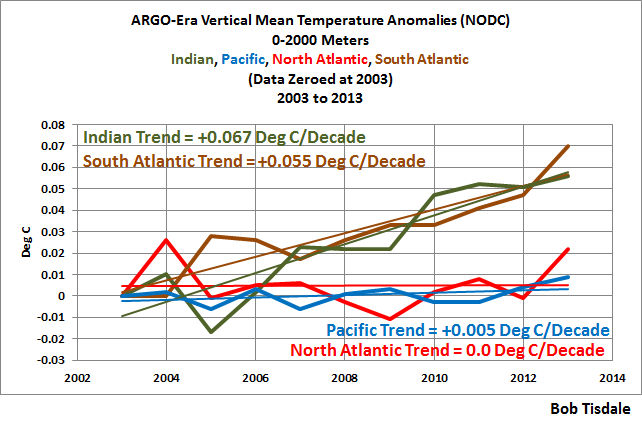
Eric Worrall says:
August 24, 2014 at 12:15 am
“God of the gaps – the global warming scare survives in the gaps in our knowledge.”
So true. I hadn’t thought of it from that perspective.
Dudley Horscroft says:
August 24, 2014 at 3:17 am
“But when there is land in the way, the current can either be diverted laterally or vertically. If vertically, the warm water goes down.”
How far down do you think wind can essentially pump the water downward? I would aver that you would need sustained hurricane force winds to move it even marginally deep.
rogerknights says:
August 24, 2014 at 3:35 am
‘The neutral word is “plateau.”’
There you go – pefect. I will use that term from now forward.
nickreality65 says:
August 24, 2014 at 4:44 am
“…could it be rising from geothermal heat flux through that paper thin ocean floor?”
Something I have wondered… Anyone have any numbers?
Latitude says:
August 24, 2014 at 5:24 am
‘…the oceans wouldn’t all of a sudden decide to hide the heat’
Indeed, the oceans are not a conscious entity, and cannot be arbitrarily fickle. If we presume chaotic behavior, then their behavior could appear spontaneous. However, if it just happened spontaneously, then it could have as easily spontaneously been releasing the heat that was formerly driving surface temperatures higher.
James Strom says:
August 24, 2014 at 6:26 am
“Roy Spencer offers an explanation of how the deep ocean could warm without surface warming…”
A) Why now, and not before? See above responses.
B) The heat still has to transport through the upper layers. Why is this not observed?
Edward Richardson says:
August 24, 2014 at 7:35 am
“Correct, and in the past 17 years the sea level has increased two inches.”
But, there hasn’t been a change in that trend since before the plateau.
wayne says:
August 24, 2014 at 9:09 am
“…is there any possible way for those huge numbers of joules causing the rise, through natural processes of energy transport, to exit upward and warm the atmosphere any more than 0.03°C?”
No.
Steven Hales says:
August 24, 2014 at 9:56 am
“…the change is smaller than the margin of error for the instruments used…”
The computed error bars are huge. And, those error bars are based on a model of random sampling. Are such error bars even in any way reliable, given the non-uniform, time-varying spatial distribution of the samples?
Bart says:
August 24, 2014 at 12:01 pm
.
“But, there hasn’t been a change in that trend since before the plateau.”
…
Correct, the thermal expansion of the ocean continues.
As is now being noted here and in Australia, UK, the so-called warming trend in past decades may actually be artificially manufactured by continual “adjustments” to land and sea temperature records in a co-ordinated fashion between North America/USA/Australia/NZ weather record orgaizations. Since satellite-measured temperature measuring was introduced in the 1980s, adjusting temperatures upwards would have become more difficult and obvious, so coincidentally warming in land/sea temperature records has slowed or stopped for twenty years or more..
Now that it has become impossible to explain the halt in warming from climate models, or increasing C02 theories, or unfathomable deep ocean heat burying theoriesetc, perhaps the most obvious explanation is that the “warming” and “heat” actulaly never existed and was completely manufactured from temperature record manipulation.
Tenuc:
In your post at August 24, 2014 at 9:29 am you ask me
There are three needed answers to that.
Firstly, people keep disputing that global warming has stopped and that needs to be corrected.
Secondly, global warming is an increase to global average surface temperature anomaly (GASTA). Global warming has stopped and global temperature is in a plateau: the ‘missing heat’ and heat going into the oceans are not relevant to that.
Thirdly, my first post in this thread stated the three known possible reasons why the ‘missing heat’ may not exist. That post is at August 24, 2014 at 12:55 am and this link jumps to it. All my subsequent posts have drawn attention to it.
Richard
Thanks for the verification Bart.
Seems this ‘speak’ of ocean heating is but another diversion tactic away from the real culprit, the constant artificial pushing downward adjustments of the old temperature records giving the appearance of some upward trend caused by mankind, though we do know there was some real warming from a recovery from the LIA over a century and the sometimes large real current UHI influence near cities, but it’s not that what is being shown to the public. Lately every article not addressing this real culprit tends to irks me but I have to stop and say so every now and then. Honestly, who really gives a damn about hundredths or thousandths (all in error range) of changes in averaged temperature (which is not a temperature at all, it’s a statistic)?
SonicsGuy says:
August 24, 2014 at 10:23 am
“Argo has been measuring down to 2000 meters since 2005, and there have been Pentadal annual data there since 1955. They’re all on this page:
– http://www.nodc.noaa.gov/OC5/3M_HEAT_CONTENT/basin_data.html”
The data down to 2000 m is not reliable at all before Argos so I don’t trust it. Only the data down to 700 m before Argos, is reliable since 1979 and there has been a much better coverage down to 2000 m since 2003. The North Atlantic doesn’t show warming even with Argos, but the Southern Atlantic does.
http://www.oceanobs09.net/proceedings/pp/2A1-Wijffels-OceanObs09.pp.40.pdf
The ocean below 2000m remains inadequately
monitored [22]. Besides a small number of deep time
series stations (largely restricted to the North Pacific
and Atlantic Oceans), the global repeat hydrographic
program [20] is the only broadscale deep ocean
sampling achieved. While eddy-resolving along the
transects, these sections are sparse in both space (one or
two meridional or zonal transects per basin) and time
(5-10 year repeat spacing).
The global ocean temperature observing system has made impressive progress over the past decade in some areas, such as broadscale observing via Argo and satellite altimetric observations. Monitoring ocean heat advection, the polar, marginal and deep oceans remains inadequate. Some clear next steps emerge from the community deliberations at OceanObs’09, which are outlined above. These can be used as a guide to focus international efforts over the next decade so that future generations have a stronger basis on which to understand, adapt to and predict our climate and environment.
Sorry ignore Argos, automatically was changed from Argo without my notice.
One tell that the ocean-ate-the-climate-crisis is just post hoc excuse making is that it was the cliamte scientists who are not oceanographers who made up this excuse. It is not likethe atmospheric science gang sent out a “help us find a heat” message and then the oceanographers said, “hey, dudes, here it is”. Instead we have a bunch of atmosphere guys scrambling and tossing stuff against the wall and hoping some of it sticks or sounds so plausible that no one really bothers to check.
THE MAJOR GAPS
The present in situ ocean temperature observing system
is largely confined to the ice-free open oceans above
2000m, with the limiting factors being observing system
technologies (cost) and legal constraints. Prior to Argo,
the ice-free polar oceans were poorly sampled and
primarily in summer. The global surface drifter array
remains at suboptimal densities in these regions, and
satellite retrievals are difficult to process due to
insufficient understanding of biases in the cold, high
wind, high wave surface conditions.
Latitude says:
August 24, 2014 at 5:24 am
The oceans don’t work like that…
Exactly….it would be constant…..the oceans wouldn’t all of a sudden decide to hide the heat
There was a forcing.
modeling experiments suggest.
The do?
WTF is a “modeling experiment”?
SonicsGuy says:
August 24, 2014 at 10:23 am
Care to explain the heat transfer/fluid flow mechanism? And explain why the heat transport was not noticed? A paragraph should do. One liners are inadequate.
Unfortunately, someone just read half of my post. You can pause a video and not resume it.
Is it not physically impossible for heat to be “missing”?
Conservation of energy is absolute.
I don’t know, maybe they are onto something. During the LIA for example, the heat could have just been hiding in the deep oceans the whole time. Perhaps there is a fifth, heretofore unknown
mode of heat transfer. This could be groundbreaking science, people. Ice ages themselves could be described as periods where the heat is locked away for millenia.
Karl Braun
“According to Bob Tisdale, it seems that only the Indian and South Atlantic show signs of warming according to ARGO data”
Yup Indian and South Atlantic. That’s where the cold salty water of THC passes transporting heat before it resurfaces in the North Pacific. Note the THC has 1,000-year cycle. The oceans may still hold the heat from MWP.
One thing I always ask alarmists is this – Will hot air stop rising under CAGW? Will the adiabatic lapse rate change under CAGW?
The illustration shows heat plunging into the depths as far as 1,500 metres. The oceans don’t work like that. Most of the heat energy of sunlight is absorbed in the first few centimetres of the ocean’s surface. Waves mix the water near the surface layer such that the temperature may be relatively uniform in the top 100 metres. Below that there is almost no mixing and no vertical movement of water.
Thanks for the article. Actually David – vertical mixing of the oceans does occur and is significant climatically. However this has been known for decades. The Warmunists are being very dishonest and machievellian in wheeling it out now.
Warmist talk of warm water physically descending to the bottom of the ocean is a myth only possible in a mind sterile of even the most basic physics. Warm water can no more descend below colder denser bottom water than it could flow to the dark side of the moon.
However at certain well defined locations that have been known for half a century, deep bottom water is formed from the surface and descends to the ocean floor – these are the Norwegian sea and around Antarctica. Here water becomes near freezing and hypersaline, thus very dense. Only denser water can descend. These sites of cold bottom water formation drive the system of deep currents which is called the ThermoHalineCirculation or THC.
There are two parallel ocean circulation systems, one at the surface and the THC deep down. They act almost independently often flowing in different or opposite directions. However globally they are connected in a winding route rather like the route through an IKEA furniture store and after about 1000 years seawater ends up where it started.
This is no doubt a simplification and looked at at higher magnification one would see a much more complex intermittently turbulent circulation. This complexity is the key. Circulation is subject to chaotic-nonlinear dynamics including intermittent turbulence and this complexity and variability gives ocean circulation the possibility to vary the atmosphere climate by variable delivery of cold water to the surface. It makes much more sense to think of the ocean’s influence on atmosphere climate in terms of variable upwelling of cold to the surface than to parade childish ignorance by talking about heat or warm water hiding in the deep.
Warmunist spin-doctor central have clearly decided to make an about face on ocean circualtion. Up to now any mechanism that could explain “natural” (odd how they hate that word) climate variability was suppressed or discounted since their AGW theory requires climate stasis in the absence of CO2 change. However, interestingly, now they are abandoning that line of defense and moving back to another one. With the pause challenging their credibility they – clearly under some pressure – have decided that they can admit what has been known for decades that ocean circulation causes natural climate variation. Variable delivery of cold water to the surface and alternating stratification and turbulent mixing are instead spun and packaged as “warm water hiding in the deep”. They clearly judge that the media and most of the public are too slow and dimwitted to see the obvious fact that, by this, they are admitting that variation and “climate change” are completely normal and natural. And this makes it less likely (although still possible at least in part) that late 20th century warming was anthropogenic CO2 related.
So overall this tactical retreat by the warmist Berchesgarden shows a little desperation and risk-taking mixed with insulting the public’s intelligence.
Further to the previous comment – if and where there is no vertical mixing in the ocean, the bottom becomes anoxic. This happens in the Black sea and is why it has this name. But in most of the open ocean there is oxygen at depth originating from the surface.