Allan MacRae says: Thanks to Alberta Jacobs
2
1
vote
Article Rating
From Ulric Lyons on August 14, 2014 at 4:49 am:
@kadaka
Area is the same as extent. (…)
Rookie mistake. For as long as you’ve been on this site, you should know better.
http://www.ijis.iarc.uaf.edu/en/home/seaice_extent.htm
Definition of sea-ice cover (extent and area)
The area of sea-ice cover is often defined in two ways, i.e., sea-ice “extent” and sea-ice “area.” These multiple definitions of sea-ice cover may sometimes confuse data users. The former is defined as the areal sum of sea ice covering the ocean (sea ice + open ocean), whereas the latter “area” definition counts only sea ice covering a fraction of the ocean (sea ice only). Thus, the sea-ice extent is always larger than the sea-ice area. Because of the possible errors in SIC mentioned above, satellite-derived sea-ice concentration can be underestimated, particularly in summer. In such a case, the sea-ice area is more susceptible to errors than the sea-ice extent. Thus, we adopt the definition of sea-ice extent to monitor the variation of the Arctic sea ice on this site.
With an extent cutoff of 15%, any square kilometer with 15% or greater sea ice is counted as a square kilometer of extent. For area, a square kilometer of 20% sea ice would count as only 0.2 km^2, while 5% would be 0.05 km^2.
Area is not the same as extent.
@Kadaka Knoebel
If we count back 90 years, as the apparent cycle in this post is alleged to be, we are in 1924.
Those still pointing to melting arctic ice and NH glaciers, as “proof” that it is (still) warming, and not cooling, should remember that there is a lag from energy-in and energy-out.
Now look at some eye witness reports of the ice back then? That was almost 1923:
http://wattsupwiththat.com/2008/03/16/you-ask-i-provide-november-2nd-1922-arctic-ocean-getting-warm-seals-vanish-and-icebergs-melt/
Sounds familiar? Back then,they had seen that the arctic ice melt was due to the warmer Gulf Stream waters. However, by 1950 all that same ‘lost” ice had frozen back. I therefore predict that all lost arctic ice will also come back, from 2020-2035 as also happened from 1935-1950. Antarctic ice is already increasing.
Leif, if you wouldn’t mind, can we please also access your reconstructed monthly SSNs that were used to generate the yearly numbers, and also the daily numbers that were used to generate the monthy numbers? I’d like to compare them to the international numbers (yearly, monthy, daily), and then use them to investigate warm and cold periods wrt solar activity per solar rotation.
Can we deduce with confidence the radio flux, F10.7cm, backwards from 1948 using your SSNs and the known recent relationship between SSN and F10.7? Can we reliably use the recent formula relating them going back to the beginning of your reconstruction, and if not exactly, how accurate would you estimate the relationship to be going back that far using that formula, as a percentage?
Thank you.
Leif Svalgaard says: August 14, 2014 at 6:59 am
vuk says: August 14, 2014 at ? am
Yet another attempt to deflect attention form the core issue. You claimed that the latest research by the Themis team contradicts my earlier findings. I asked you to provide links to their papers showing the contradictions. You keep evading doing so. So again: produce the links.
No Problem
I spend morning writing one. Don’t really care if contradicts your 1977 paper or not.
It is in preprint ‘assessment ‘ stage, and for the next day or two is available at:
http://hal.archives-ouvertes.fr/docs/01/05/59/16/PDF/LODvsSSN.pdf
Its implications can be viewed in the light of the NASA’s Themis satellite discovery, as contained in the key statement:
”For reasons not fully understood, CMEs in even-numbered solar cycles (like 24) tend to hit Earth with a leading edge that is magnetized north. Such a CME should open a breach and load the magnetosphere with plasma just before the storm gets underway..”
http://science.nasa.gov/science-news/science-at-nasa/2008/16dec_giantbreach/
“It has been proposed that Earth’s climate could be affected by changes in cloudiness
caused by variations in the intensity of galactic cosmic rays in the atmosphere. This
proposal stems from an observed correlation between cosmic ray intensity and Earth’s
average cloud cover over the course of one solar cycle. Some scientists question the
reliability of the observations, whereas others, who accept them as reliable, suggest
that the correlation may be caused by other physical phenomena with decadal periods
or by a response to volcanic activity or El Nin˜o. Nevertheless, the observation has
raised the intriguing possibility that a cosmic ray–cloud interaction may help explain
how a relatively small change in solar output can produce much larger changes in
Earth’s climate. Physical mechanisms have been proposed to explain how cosmic rays
could affect clouds, but they need to be investigated further if the observation is to
become more than just another correlation among geophysical variables.”
http://oi58.tinypic.com/30s7yau.jpg
Cosmic Rays, Clouds, and Climate
K. S. Carslaw,1 R. G. Harrison,2 J. Kirkby3
P.S, to my comment above:
It is advisable to read whole article before any questions asked are answered, polite or derogatory comments, of course can be made regardless.
Link: http://hal.archives-ouvertes.fr/docs/01/05/59/16/PDF/LODvsSSN.pdf
” A mechanism linking cosmic rays and clouds could operate directly through the influence of ions on such microphysical processes.”
http://oi60.tinypic.com/fwn1xz.jpg
Leif, I wish I could. One area of knowledge that has been developed over time has to do with temperature and precipitation patterns that are used as analogue years when predicting local and regional weather patterns for the immediate growing season. This has been done meteorologically for several areas around the globe that depend on agriculture as a gross domestic product.
How would this data set improve the BEST set?
1. The reason why this ever expanding data set is important is that it considers geophysical climate boundaries and their related weather patterns (extremes, averages, oscillations, etc) corresponding to oceanic/atmospheric conditions. Researchers usually use 4 to 5 analogue years to predict the next three months of agricultural weather patterns. They smear the temperature and precipitation prediction based on geophysical location, not simply on the fact that there is another station 1000km away they can use to smear the data.
2. It is also the case that this data set includes outliers. Years when the temperature varied considerably outside what it should have been. Some oceanic/atmospheric tied analogue sets have more outliers than other sets, owing to the less consistent weather patterns associated with a particular oceanic-atmospheric condition.
3. Correlating geophysical based analogue years with the BEST temperature data series may allow a more accurate global temperature set that considers geophysical features as well as uncertainties. It is similar to correcting solar observation algorithms with none-SSN solar measures. For example, a correction (or at least error bars) to the data could be obtained by saying that based on the geophysical area’s analogue years, the current temperatures for a particular geophysical area should have been thus and so with a range of thus and so, etc.
These sets are so highly regarded that meteorologists from states that have major agricultural investments nearly always use analogue years to predict what’s coming. Oregon uses analogue years that extend back to nearly the turn of the century.
http://www.google.com/url?sa=t&rct=j&q=&esrc=s&source=web&cd=1&cad=rja&uact=8&ved=0CCQQFjAA&url=http%3A%2F%2Fwww.oregon.gov%2FODA%2Fnrd%2Fdocs%2Fdlongrange.ppt&ei=peHsU7ePDeS8igKv7YBQ&usg=AFQjCNHhHqr-KPBcyM9vlgEC4lkTnBaIIQ&bvm=bv.72938740,d.cGE
Some will say these climate zone issues are overcome by using anomalies instead of absolute data. The problem exists for both anomaly and absolute temperature sets. Different climate zones have different characteristic anomaly patterns. Some respond with faster warming than others, and some will show cooling at various rates under the same oceanic/atmospheric condition, relative to their climate average. And these disparate climate zones could be right next to each other.
The point which is most important now if solar activity went from a very active period to a very inactive period with 2005 being the focal point.
Next is to see the climate response.
If historical data is any indication the temperature response will be for the global temperature trend to trend down just like it has done in the past.
The sun’s magnetic field strength during the recent Grand Maximum of last century was among the strongest in over 8000 years. The temperature trend responded. Going forward due now to very weak solar magnetic conditions the temperature trend will respond once again which will be down.
The graph of temperature data I sent yesterday shows this to be the case.
Bob Weber says:
August 14, 2014 at 8:37 am
Leif, if you wouldn’t mind, can we please also access your reconstructed monthly SSNs that were used to generate the yearly numbers, and also the daily numbers that were used to generate the monthy numbers?
The monthly and daily numbers are still being worked on. Only the yearly numbers are ready for release at this point. So have some patience. How can we have the yearly numbers: http://www.leif.org/research/SSN/Svalgaard11.pdfhttp://www.leif.org/research/SSN/Svalgaard11.pdf
Can we deduce with confidence the radio flux, F10.7cm, backwards from 1948 using your SSNs and the known recent relationship between SSN and F10.7? Can we reliably use the recent formula relating them going back to the beginning of your reconstruction, and if not exactly, how accurate would you estimate the relationship to be going back that far using that formula, as a percentage?
We can do much better than that. T10.7 is a proxy for the Far UV which creates the E-layer of the ionosphere. A dynamo process creates an electric current whose magnetic field we can measure on the ground [the effect was discovered in 1722] and we have reliable data going back to 1781, so we know what FUV was at least back to then, and with some gaps back to 1722. Slides 7-11 of http://www.leif.org/research/SSN/Svalgaard11.pdf describes the process.
vuk says:
August 14, 2014 at 8:42 am
I spend morning writing one. Don’t really care if contradicts your 1977 paper or not.
It is in preprint ‘assessment ‘ stage, and for the next day or two is available at:
I am not interested in what you write.
What I want is the paper where this is published:
“the NASA’s Themis satellite ‘discovery’, as contained in the key statement:
”For reasons not fully understood, CMEs in even-numbered solar cycles (like 24) tend to hit Earth with a leading edge that is magnetized north.”
I think there is no such ‘discovery’. If it were as you quote, geomagnetic activity would be different from what is observed, so the data is in direct contradiction to what is claimed.
http://wattsupwiththat.com/2012/09/13/paper-demonstrates-solar-activity-was-at-a-grand-maxima-in-the-late-20th-century/
Which is what I subscribe to until proven otherwise. I have yet to see any evidence to support a counter argument.
How can we have the yearly numbers: http://www.leif.org/research/SSN/Svalgaard11.pdf
F10.7:
http://www.leif.org/research/What-Geomagnetism-can-Tell-Us-about-the-Solar-Cycle.pdf
Leif Svalgaard says @ur momisugly vukcevic: August 14, 2014 at 9:53 am
1. I am not interested in what you write.
2. What I want is the paper where this is published
3. I think there is no such ‘discovery’
…………….
vukcevic responds to Leif Svalgaard
3. It is none of my business as to ‘what you think’.
2. If you want something or another you have to go and look for it
1. Your interests are least of my concerns, but do I welcome it.
http://www.met.reading.ac.uk/users/users/1513
[Always tell your potential readers what the video or link you are providing will do, and what you want them to learn from it, and why you feel they should invest their time and energy and resources watching it or clicking on the link. .mod]
vuk says:
August 14, 2014 at 10:08 am
2. “What I want is the paper where this is published”
2. If you want something or another you have to go and look for it
There is no such paper[s], but you claim there is, so it is for you to supply the link. If you cannot [will not?] your statements that the ‘discovery’ contradicts my findings and the data are false and shameful.
@ren
you are on the right track there but by now you should be able to distinguish between cause and reaction
Predictably, due to cooling from the top latitudes downwards,
[e.g
it has been cooling significantly in Alaska, at a rate of -0.55K per decade since 1998 (Average of ten weather stations).
http://oi40.tinypic.com/2ql5zq8.jpg
]
there would be a small (?) shift of cloud formation and precipitation, more towards the equator, on average. At the equator insolation is 684 W/m2 whereas on average it is 342 W/m2. So, if there are more clouds in and around the equator, this will amplify the cooling effect due to less direct natural insolation of earth (clouds deflect a lot of radiation). Furthermore, in a cooling world there is more likely less moisture in the air, but even assuming equal amounts of water vapour available in the air, a lesser amount of clouds and precipitation will be available for spreading to higher latitudes. So, a natural consequence of global cooling is that at the higher latitudes it will become cooler and/or drier.
Below is an abstract from the link I sent earlier.
The behavior of the Sun and near-Earth space during grand solar minima is not understood; however, the recent long and low minimum of the decadal-scale solar cycle gives some important clues, with implications for understanding the solar dynamo and predicting space weather conditions. The speed of the near-Earth solar wind and the strength of the interplanetary magnetic field (IMF) embedded within it can be reliably reconstructed for before the advent of spacecraft monitoring using observations of geomagnetic activity that extend back to the mid-19th century. We show that during the solar cycle minima around 1879 and 1901 the average solar wind speed was exceptionally low, implying the Earth remained within the streamer belt of slow solar wind flow for extended periods. This is consistent with a broader streamer belt, which was also a feature of the recent low minimum (2009), and yields a prediction that the low near-Earth IMF during the Maunder minimum (1640-1700), as derived from models and deduced from cosmogenic isotopes, was accompanied by a persistent and relatively constant solar wind of speed roughly half the average for the modern era.
Ulric says: @Greg Goodman
I think that the correlation is better with the NAO than the AO, and really it needs inspection at at least seasonal scales as well to verify the connection, rather than just the trends, e.g., less summer ice extent when the NAO is more negative in those particular months, as in say 2007 and 2012.
===
I find a lot of these “seasonal” metrics rather contrived. I’ve not seen one that I found more informative than a careful analysis of the full year. They are usually desperate attempts to find a correlation where none really exists.
However, if you have some data that shows a better correlation than what I showed with AO, I’d like to see it. I was quite surprised how well AO followed melting season ( or vice versa ).
I think there was some significant geomagnetic activity in 1989 but I never followed it up thoroughly.
ren says:
Greg Goodman
The growth of ice in the Arctic this year will be bigger than we think.
http://arctic.atmos.uiuc.edu/cryosphere/arctic.sea.ice.interactive.html
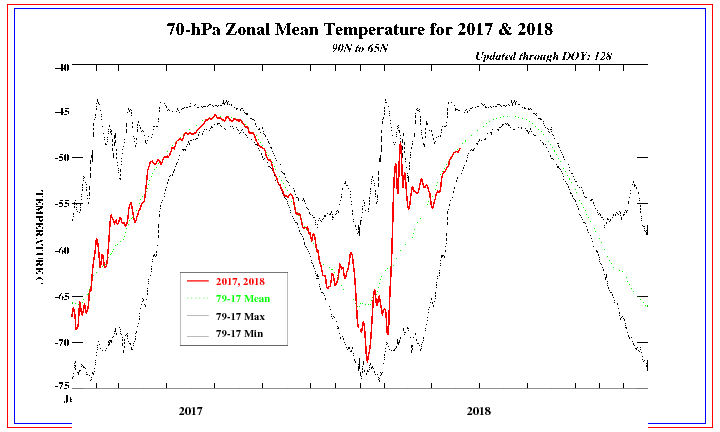
http://www.cpc.ncep.noaa.gov/products/stratosphere/temperature/70mb9065.gif
ren says:
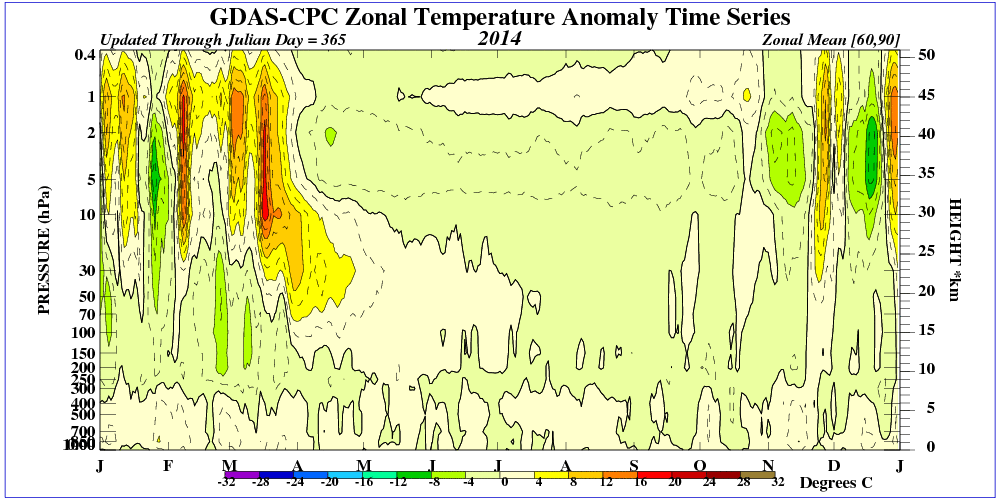
As you can see the temperature in the stratosphere over the northern polar circle below the normal.
http://www.cpc.ncep.noaa.gov/products/stratosphere/strat-trop/gif_files/time_pres_TEMP_ANOM_ALL_NH_2014.gif
====
Firstly, there’s no such thing as “normal” in climate. If you are referring to some average it is best to say so.
Second, Arctic ice coverage tends to alternate ( though not infallibly ) so I’d be a little surprised if there a higher min than last year, even though I think we are now heading towards more ice on a multi-annual basis.
Best to avoid predictions, it’s a bit of coin flip and the one day annual min is pretty worthless as a metric. I used a 20 day low-pass to detect the length of melting seasons.


In a recent paper “The Centennial Gleissberg Cycle and its Association with Extended Minima”, to be soon published in JGR/Space, Feynman and Ruzmaikin discuss how the recent extended minimum of solar and geomagnetic variability (XSM) mirrors the XSMs in the 19th and 20th centuries: 1810–1830 and 1900–1910.
Edited abstract:
Such extended minima also were evident in aurorae reported from 450 AD to 1450 AD. The paper argues that these minima are consistent with minima of the Centennial Gleissberg Cycles (CGC), a 90–100 year variation observed on the Sun, in the solar wind, at the Earth and throughout the Heliosphere. The occurrence of the recent XSM is consistent with the existence of the CGC as a quasi-periodic variation of the solar dynamo. Evidence of CGC’s is provided by the multi-century sunspot record, by the almost 150-year record of indexes of geomagnetic activity (1868-present), by 1,000 years of observations of aurorae (from 450 to 1450 AD) and millennial records of radionuclides in ice cores.
The “aa” index of geomagnetic activity carries information about the two components of the solar magnetic field (toroidal and poloidal), one driven by flares and CMEs (related to the toroidal field), the other driven by co-rotating interaction regions in the solar wind (related to the poloidal field). These two components systematically vary in their intensity and relative phase giving us information about centennial changes of the sources of solar dynamo during the recent CGC over the last century. The dipole and quadrupole modes of the solar magnetic field changed in relative amplitude and phase; the quadrupole mode became more important as the XSM was approached. Some implications for the solar dynamo theory are discussed.
* Says The Hockey Schtick: If it is true that the current lull in solar activity is “consistent with minima of the Centennial Gleissberg Cycles,” and the Gleissberg Cycle is a real solar cycle, the current Gleissberg minimum could last a few decades before solar activity begins to rise again.
* Solar physicist Habibullo Abdussamatov predicts the current lull in solar activity will continue until about the middle of the 21st century and lead to a new Little Ice Age within the next 30 years.