Guest Post by Willis Eschenbach
Recently there have been a number of accusations and bad blood involving myself, David Evans, Joanne Nova, Lord Christopher Monckton, and Leif Svalgaard. Now, I cannot speak for any of them, but on my part, my own blood ended up mightily angrified, and I fear I waxed wroth.
However, I see no point in rehashing the past. What I want to do is to return to the underlying scientific questions. In that spirit, I apologize sincerely and completely for wherever I put in “something extra” in the previous discussion. In Buddhism, there’s a concept called “something extra”, and one is enjoined to avoid putting in “something extra”.
It is explained in the following way:
If I say “I am angry” that is simply a true statement.
But if I say “You made me angry”, that is something extra.
So I ask any and all of you to please accept my sincere apologies for whatever what I said that was something extra, so that we can move past this difficult time and get back to discussing the science. Both sides have legitimate grievances, and I am happy to make the first move to get past all of them by apologizing to all of you for whatever my part was in the bad blood. I hope that the other participants accept my apology in the spirit of reconciliation in which it is offered, and that we can move forwards without rancor or recriminations.
Regarding the science, let me go back to the original question, and see what I can do in the way of making my claims in a more Canadian manner. I’ll start by looking at the recent record of the “TSI”, the total solar irradiance:
 Figure 1. Monthly total solar irradiance as measured by the CERES satellite. Vertical blue line shows mid-2004.
Now, if you don’t like the data from the CERES satellite, here’s the SORCE satellite data:
 Figure 2. Daily total solar irradiance as measured by the SORCE satellite. Vertical red line indicates mid-2004. SOURCE
Note what is happening in both graphs after mid-2004 (vertical lines in both plots). As in every solar cycle, the TSI declines somewhat, and bottoms out. Then, it starts to rise again. And by the end of the datasets, in both cases the TSI is higher that it was in 2004.
So what was the scientific dispute all about, the discussion that underlies all of the bad feelings?
It revolved around the following graph from David Evans, referenced by both Leif Svalgaard and Lord Monckton, showing the basis of his predicted upcoming global cooling :
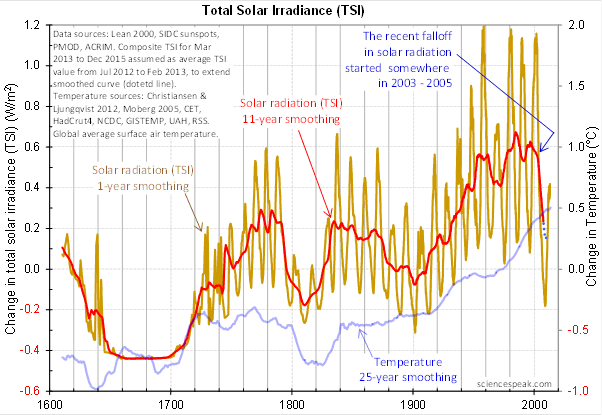
 Figure 3. David Evan’s graph of TSI (gold line), along with a centered 11-year moving average of the TSI data (red, with dotted blue extension), and a 25 year unspecified smooth of temperature, presumably a trailing average (blue line). (Click to enlarge)
Now, as you can see, the bright red line basically falls off the edge of the earth around 2004. The note says “The recent falloff in solar radiation started somewhere in 2003-2005″.
However, a look at both the SORCE and the CERES data shows no such “falloff in solar radiation”, neither precipitous nor otherwise. In fact, both datasets agree that by 2013 the TSI was well above the level in mid-2004.
Since there is no fall in the underlying data of any kind, why does the red 11-year average line show abrupt cooling starting around 2004?
The answer lies in the various problems with the graph.
• The TSI data is a splice of three datasets, with two of them showing the post-2000 period. This is a huge source of potential error in itself. However, it gets worse.
• One of the spliced datasets is the Lean TSI reconstruction, an outdated dataset that the authors of the reconstruction themselves admit is inaccurate.
• Another is the PMOD dataset. It is known to be reading low by 0.2 W/ms at the solar minimum, introducing a spurious apparently strong recent “cooling” where none exists.
• The 11-year centered average is an extremely bad choice for a filter for sunspot/TSI data. Because the solar cycle varies both longer and shorter than 11 years, at times the 11-year average actually reverses the sense of the data, converting peaks into valleys and valleys into peaks. Look at the period from 1760-1800 in Figure 3, for example. What is happening is that the frequency data is getting strongly aliased into the amplitude data. As a result, the average can end up far from the reality, particularly at the ends of the dataset.
For another example, look at the period just after 1740 in Figure 3. The 11-year average takes a huge vertical jump … but meanwhile back in the real word, the TSI itself is not rising at all. It is falling. Clearly, the large vertical jump in the red line is totally spurious.
• The TSI data has had about 900 days of “data” added to it using an arbitrarily chosen value. This is shown by the blue dots which indicate a continuing drop in the temperature.
So regarding the question of why the red line is acting so strangely, the answer is that we have a perfect storm of spliced data, bad data, arbitrary “data” added to the spliced bad data, and an extremely poor filter choice.
And as a result, the red line doesn’t represent reality in any shape or form. There is no precipitous drop in TSI starting around 2004. It doesn’t exist. Sure, the 11-year average says clearly that there is a huge drop starting around that time … but the actual data says something entirely different, as shown in Figures 1 and 2.
Now, in the heat of the moment Leif described the red line as being “almost fraudulent”. I think this was an over-reaction, but perhaps an understandable one. After all, if the red line were flipped over vertically it would make a lovely hockeystick, and if someone claimed warming was coming based on that hockeystick, people would call them alarmists … and calling someone an alarmist is certainly a close relative of calling them “almost fraudulent”.
However, my guideline is, never ascribe to malice what is adequately explained by error and misunderstanding. So I do not call their red line fraudulent, nor did I do so in the original discussion. Instead, I say that it is an error resulting from a misunderstanding. In any case, let me suggest that we leave out all ascription of motive and intent, that goes nowhere, and that we return to the science.
A more scientifically neutral description of the red line is that it is highly inaccurate and potentially misleading, because the apparent drop starting in 2003-2005 is simply an artifact of a combination of bad data and bad filtering.
Finally, to the degree that David Evans’ model predicts future cooling based on the red line, it is already falsified.
That is what I was trying to say, and I believe (subject to correction) that was what Leif was pointing out as well.
In closing, I will endeavor in this thread to keep my comments on as scientific a basis as possible, to avoid any personal references, and to not ascribe motive or intent. I request that everyone do the same. Many toes have already been stepped on in this discussion. Let’s see if we can simply discuss the science.
My best to all,
w.
VERY IMPORTANT: It is important in general, and in this discussion in particular, that you QUOTE THE EXACT WORDS THAT YOU DISAGREE WITH. Note that this doesn’t mean just referencing their entire comment. Quote the exact words of their comment that you think are in error, and tell us why you think those words are wrong. If you do not quote the exact words that you disagree with, none of us will know what you are referring to … and out of such misunderstandings grows animosity and misunderstanding.
Finally, please don’t delve into the rights and wrongs of what has happened in the previous discussions. I am not interested in the slightest in ascribing blame or responsibility. I have accepted my own responsibility for my own actions and apologized for wherever I was over the line. What I or the others did in the past is a blind alley, so please confine your comments to the science, and as the saying goes, “Let the dead past bury its dead”.
lsvalgaard says: July 18, 2014 at 4:04 pm “Perhaps Richard D [or Mr Monckton himself] can educate us on this”
++++++++++++++++++++++++++++++++++++++
Try and stay on topic as you so admonished the op up thread. We were discussing “Mending Fences”, 🙂
You girls are a laugh. Treat Dr. Evans with absolutely horse shit attitude then chastise him for not crawling over to this blog and explain himself. Har har…….
The operative word in the title of this thread is MENDING!
Where the -all is the MENDING WillASS?
Saalllvagaarrd is whinging, the psuede-o-skeptic Mosher is positively giddy at jamming a wedge in anything that splits and weakens true skeptics and you Willis, have explained yourself with alarming clarity, repeatedly (with that fire hose) wondering why you aren’t making friends (something I imagine you’ve had problems with all your life).
Yes I can imagine why Dr Evans wants desperately to help you out.
Keep going girls, it’s Friday night and I can’t enjoy summer because of climate cooling. I need more humor.
Well, OK. Maybe wondering about ‘the monkey’ is off topic.
It seems to me that a couple of Willis’s main points, getting back to the science, are…
…that there are problems with Lean TSI and PMOD.
I read over here http://joannenova.com.au/2014/07/more-strange-adventures-in-tsi-data-the-miracle-of-900-fabricated-fraudulent-days/
and gather that Dr. Evans stands by the choice of these datasets. Unless I’m reading something out of date there.
So this seems to boil down to a question of fact. Are these datasets good? Are there problems with them? Are they useful for this purpose, or do they compromise the results?
I guess it’s time for me to go learn something about them.
Hey, I’m one of the girls too you know. Maybe a ditzy one, but still…
William McClenney says:
July 18, 2014 at 2:36 pm
Good post!
Richard D says:
July 18, 2014 at 4:16 pm
Try and stay on topic as you so admonished the op up thread. We were discussing “Mending Fences”, 🙂
“if someone wants to jump in and explain how fiddling with the parameters until the results match the observations is something more.”
If Evans would do this, that would be a step on the way to mending fences.
Mark Bofill says:
July 18, 2014 at 4:35 pm
So this seems to boil down to a question of fact. Are these datasets good? Are there problems with them? Are they useful for this purpose, or do they compromise the results?
I guess it’s time for me to go learn something about them.
Here is my list of arguments for reconstructing TSI:
Recent advances in reconstructions of solar activity can be described thus [I’ll number them for easy reference. Papers and analyses can be given for each point, but are better presented if and when a point is up for discussion]:
1) Variations of TSI are the result of variations of the Sun’s magnetic field.
2) The sunspot number is a very good measure of solar magnetic fields.
3) Variation of the UV flux is due to variations of the Sun’s magnetic field.
4) The F10.7 microwave flux is a very good proxy for the UV flux and it is at the same level at every solar minimum.
5) The variation of the diurnal variation of the geomagnetic field is caused by the UV and is a very good proxy for said UV since 1781.
6) The solar magnetic field is dragged out into the heliosphere and can be measured directly by spacecraft or almost as accurately by its effect on the Earth’s ring current (Van Allen Belts) whose magnetic effect can be measured on the ground, since 1830s.
7) The magnetic effects caused by the solar wind can also be monitored at auroral latitudes, allowing determination of both the solar wind magnetic field and the solar wind speed. Different research groups agree on these determinations.
8) Cosmic Rays modulation depends [inversely] largely on the heliospheric magnetic field.
9) These various determinations [by several researchers] of the solar magnetic field agree, so we know with good accuracy the solar magnetic field back to at least the 1830s, and hence also TSI.
10) The sunspot number has recently been revised and the result is that solar activity in each of the centuries 18 to 20 is very similar: a minimum about every 100 years near the turn of the centuries and a local maximum in mid-century.
11) There is therefore no Modern Grand Maximum.
12) A result of all of the above is that solar activity reaches almost the same low level at every solar minimum.
13) Early reconstructions of TSI assumed that the solar cycle variation was riding on a varying background level which itself varied as a function of solar activity
14) This background was assumed to be caused by a solar-cycle dependent emergence of small magnetic [so-called] ephemeral regions. Modern measurements show that this assumption is false and that the emergence rate of ephemeral regions is almost constant in time and thus does not vary with solar activity.
15) Thus, reconstructions that show varying background level [e.g. Lean, Krivova, Wang, and others] are not correct, and conclusions based on them are similarly suspect.
16) All our determinations show that solar activity recently is very much the same as a century ago.
17) This means that the decrease of solar activity from the 1870s to the 1910s is very much similar to the decrease from 1980 to now. In particular, TSI now is very likely the same as it was 100 years ago
http://www.leif.org/research/SSN-HMF-TSI-Evans.png
Dr. Evans released his datasets and code here (10 days ago for those with faulty memories).
http://wattsupwiththat.com/2014/07/08/solar-notch-delay-model-released/
Bill Illis says:
July 18, 2014 at 5:53 pm
Dr. Evans released his datasets and code here (10 days ago for those with faulty memories).
No, he didn’t. What is missing is how to construct the ‘parameter set’, which is the MODEL. Without that, the code to just RUN the model is useless.
lsvalgaard says:
July 18, 2014 at 5:59 pm
——————–
I think you are still trying to argue that solar activity/TSI is not down when it clearly is.
There is a possibility your solar model is not accurate you know or is there no chance at all.
Bill Illis says:
July 18, 2014 at 6:11 pm
I think you are still trying to argue that solar activity/TSI is not down when it clearly is.
You are too vague. TSI is generally down the past 40 years, but TSI the past decade is up.
http://www.leif.org/research/SSN-HMF-TSI-Evans.png
There is a possibility your solar model is not accurate you know or is there no chance at all.
There is always that chance, but the date constructed by Evans is definitely wrong. This is not question about chance.
lsvalgaard says:
July 18, 2014 at 6:16 pm
Bill Illis says:
July 18, 2014 at 6:11 pm
I think you are still trying to argue that solar activity/TSI is not down when it clearly is.
You are too vague. TSI is generally down the past 40 years, but TSI the past decade is up.
———————-
TSI in the past decade?
There is a solar cycle you know and TSI is way down from the peak of the last solar cycle. It is down 0.55 W/m2.
When did it start becoming a lower number?
Bill Illis says:
July 18, 2014 at 6:19 pm
There is a solar cycle you know and TSI is way down from the peak of the last solar cycle. It is down 0.55 W/m2.
Central to Evans’ claim of the sharp drop in temperature [0.5C] is his contention that from the 2003-2005 timeframe until today, TSI has decreased substantially. Note his annotation on the bottom panel of http://www.leif.org/research/SSN-HMF-TSI-Evans.png
This is not correct. TSI has increased since then
http://www.leif.org/research/TSI-since-2003.png
which means that neither TSI, nor temperatures are ‘falling off a cliff’
lsvalgaard says:
July 18, 2014 at 6:26 pm
———
You are comparing 2003 which was on the down-side of the last solar cycle with today which is at the peak of the solar cycle.
It is like comparing 3/4 the way through a cycle with a 2/4 way through. It is disingenuous.
Bill Illis says:
July 18, 2014 at 6:31 pm
You are comparing 2003 which was on the down-side of the last solar cycle with today which is at the peak of the solar cycle. It is like comparing 3/4 the way through a cycle with a 2/4 way through. It is disingenuous.
No, I am not. Evans is making that comparison. Tell him It is disingenuous. Do you even look at the links I provide?
lsvalgaard says:
July 18, 2014 at 6:34 pm
Bill Illis says:
July 18, 2014 at 6:31 pm
No, I am not. Evans is making that comparison. Tell him It is disingenuous. Do you even look at the links I provide?
——————
I look at all the links you provide.
You are the one being disingenuous.
lsvalgaard says:
July 18, 2014 at 6:34 pm
———————–
Show us TSI from 2000 to June 2014.
Bill Illis says:
July 18, 2014 at 6:37 pm
You are the one being disingenuous.
Do you get and understand that it is Evans who is making the claim that TSI since 2003-2005 to today has fallen off?
Bill Illis says:
July 18, 2014 at 6:41 pm
Show us TSI from 2000 to June 2014.
Already done: http://www.leif.org/research/SSN-HMF-TSI-Evans.png
Note that Evans has a fall-off of more than 0.7 W/m2. Twice as large as the actual fall-off.
lsvalgaard says:
July 18, 2014 at 6:42 pm
Do you get and understand that it is Evans who is making the claim that TSI since 2003-2005 to today has fallen off?
You evaded to answer the question
lsvalgaard says:
July 18, 2014 at 6:46 pm
Bill Illis says:
July 18, 2014 at 6:41 pm
Show us TSI from 2000 to June 2014.
Already done: http://www.leif.org/research/SSN-HMF-TSI-Evans.png
——————————-
Looks kind of “down” to me. Maybe I’m missing something, but then down is down.
Mosher is sticking a wedge in between skeptics?
1. Willis is a heretic not a skeptic
2. If I were so what. The request is valid
3. I treat everyone the same. Show your work.
Why? Well we know from empirical studies that authors cannot reproduce their own work it a disturbingly high percentage of cases.
Every excuse I hear here for not sharing code I have heard before. From Mann. From Jones. From scaffetta.
Every personal attack I’ve heard before from warmests
Lame excuses pathetic attacks.
Bill Illis says:
July 18, 2014 at 6:54 pm
Looks kind of “down” to me. Maybe I’m missing something, but then down is down.
Fact is that Evans claims a much larger decrease than there really is. Plus that he claims that TSI decreased sharply from 2003-2005 until now, while in reality TSI increased. See the little black arrow in the bottom panel. In reality it is up [see the little black arrow in the middle panel].
lsvalgaard says:
July 18, 2014 at 7:01 pm
Bill Illis says:
July 18, 2014 at 6:54 pm
Looks kind of “down” to me. Maybe I’m missing something, but then down is down.
Fact is that Evans claims a much larger decrease than there really is. Plus that he claims that TSI decreased sharply from 2003-2005 until now, while in reality TSI increased.
——————–
Just to use your method of timeline cherrypicking, how much did TSI decline from 2003-2005 to 2008-2009.
Dr. Svalgaard,
Thank you. I might end up learning a thing or two about Sun if I keep this up despite myself. 🙂