Guest Post by Willis Eschenbach
Recently there have been a number of accusations and bad blood involving myself, David Evans, Joanne Nova, Lord Christopher Monckton, and Leif Svalgaard. Now, I cannot speak for any of them, but on my part, my own blood ended up mightily angrified, and I fear I waxed wroth.
However, I see no point in rehashing the past. What I want to do is to return to the underlying scientific questions. In that spirit, I apologize sincerely and completely for wherever I put in “something extra” in the previous discussion. In Buddhism, there’s a concept called “something extra”, and one is enjoined to avoid putting in “something extra”.
It is explained in the following way:
If I say “I am angry” that is simply a true statement.
But if I say “You made me angry”, that is something extra.
So I ask any and all of you to please accept my sincere apologies for whatever what I said that was something extra, so that we can move past this difficult time and get back to discussing the science. Both sides have legitimate grievances, and I am happy to make the first move to get past all of them by apologizing to all of you for whatever my part was in the bad blood. I hope that the other participants accept my apology in the spirit of reconciliation in which it is offered, and that we can move forwards without rancor or recriminations.
Regarding the science, let me go back to the original question, and see what I can do in the way of making my claims in a more Canadian manner. I’ll start by looking at the recent record of the “TSI”, the total solar irradiance:
 Figure 1. Monthly total solar irradiance as measured by the CERES satellite. Vertical blue line shows mid-2004.
Now, if you don’t like the data from the CERES satellite, here’s the SORCE satellite data:
 Figure 2. Daily total solar irradiance as measured by the SORCE satellite. Vertical red line indicates mid-2004. SOURCE
Note what is happening in both graphs after mid-2004 (vertical lines in both plots). As in every solar cycle, the TSI declines somewhat, and bottoms out. Then, it starts to rise again. And by the end of the datasets, in both cases the TSI is higher that it was in 2004.
So what was the scientific dispute all about, the discussion that underlies all of the bad feelings?
It revolved around the following graph from David Evans, referenced by both Leif Svalgaard and Lord Monckton, showing the basis of his predicted upcoming global cooling :
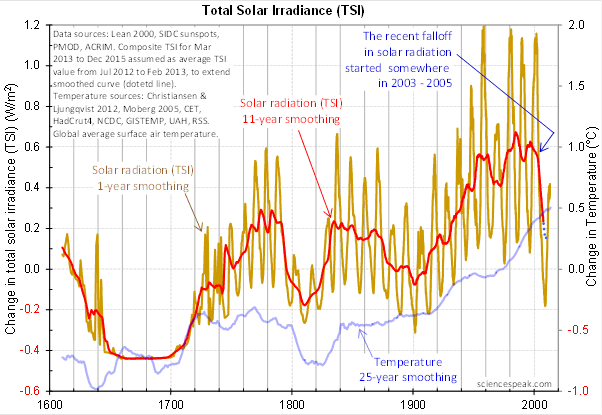
 Figure 3. David Evan’s graph of TSI (gold line), along with a centered 11-year moving average of the TSI data (red, with dotted blue extension), and a 25 year unspecified smooth of temperature, presumably a trailing average (blue line). (Click to enlarge)
Now, as you can see, the bright red line basically falls off the edge of the earth around 2004. The note says “The recent falloff in solar radiation started somewhere in 2003-2005″.
However, a look at both the SORCE and the CERES data shows no such “falloff in solar radiation”, neither precipitous nor otherwise. In fact, both datasets agree that by 2013 the TSI was well above the level in mid-2004.
Since there is no fall in the underlying data of any kind, why does the red 11-year average line show abrupt cooling starting around 2004?
The answer lies in the various problems with the graph.
• The TSI data is a splice of three datasets, with two of them showing the post-2000 period. This is a huge source of potential error in itself. However, it gets worse.
• One of the spliced datasets is the Lean TSI reconstruction, an outdated dataset that the authors of the reconstruction themselves admit is inaccurate.
• Another is the PMOD dataset. It is known to be reading low by 0.2 W/ms at the solar minimum, introducing a spurious apparently strong recent “cooling” where none exists.
• The 11-year centered average is an extremely bad choice for a filter for sunspot/TSI data. Because the solar cycle varies both longer and shorter than 11 years, at times the 11-year average actually reverses the sense of the data, converting peaks into valleys and valleys into peaks. Look at the period from 1760-1800 in Figure 3, for example. What is happening is that the frequency data is getting strongly aliased into the amplitude data. As a result, the average can end up far from the reality, particularly at the ends of the dataset.
For another example, look at the period just after 1740 in Figure 3. The 11-year average takes a huge vertical jump … but meanwhile back in the real word, the TSI itself is not rising at all. It is falling. Clearly, the large vertical jump in the red line is totally spurious.
• The TSI data has had about 900 days of “data” added to it using an arbitrarily chosen value. This is shown by the blue dots which indicate a continuing drop in the temperature.
So regarding the question of why the red line is acting so strangely, the answer is that we have a perfect storm of spliced data, bad data, arbitrary “data” added to the spliced bad data, and an extremely poor filter choice.
And as a result, the red line doesn’t represent reality in any shape or form. There is no precipitous drop in TSI starting around 2004. It doesn’t exist. Sure, the 11-year average says clearly that there is a huge drop starting around that time … but the actual data says something entirely different, as shown in Figures 1 and 2.
Now, in the heat of the moment Leif described the red line as being “almost fraudulent”. I think this was an over-reaction, but perhaps an understandable one. After all, if the red line were flipped over vertically it would make a lovely hockeystick, and if someone claimed warming was coming based on that hockeystick, people would call them alarmists … and calling someone an alarmist is certainly a close relative of calling them “almost fraudulent”.
However, my guideline is, never ascribe to malice what is adequately explained by error and misunderstanding. So I do not call their red line fraudulent, nor did I do so in the original discussion. Instead, I say that it is an error resulting from a misunderstanding. In any case, let me suggest that we leave out all ascription of motive and intent, that goes nowhere, and that we return to the science.
A more scientifically neutral description of the red line is that it is highly inaccurate and potentially misleading, because the apparent drop starting in 2003-2005 is simply an artifact of a combination of bad data and bad filtering.
Finally, to the degree that David Evans’ model predicts future cooling based on the red line, it is already falsified.
That is what I was trying to say, and I believe (subject to correction) that was what Leif was pointing out as well.
In closing, I will endeavor in this thread to keep my comments on as scientific a basis as possible, to avoid any personal references, and to not ascribe motive or intent. I request that everyone do the same. Many toes have already been stepped on in this discussion. Let’s see if we can simply discuss the science.
My best to all,
w.
VERY IMPORTANT: It is important in general, and in this discussion in particular, that you QUOTE THE EXACT WORDS THAT YOU DISAGREE WITH. Note that this doesn’t mean just referencing their entire comment. Quote the exact words of their comment that you think are in error, and tell us why you think those words are wrong. If you do not quote the exact words that you disagree with, none of us will know what you are referring to … and out of such misunderstandings grows animosity and misunderstanding.
Finally, please don’t delve into the rights and wrongs of what has happened in the previous discussions. I am not interested in the slightest in ascribing blame or responsibility. I have accepted my own responsibility for my own actions and apologized for wherever I was over the line. What I or the others did in the past is a blind alley, so please confine your comments to the science, and as the saying goes, “Let the dead past bury its dead”.
Willis: ” Purely from visual observation, however, I’m not impressed. While the major “v” shape occurs in both datasets, there appears to be little correlation between the 11-year cycles and the temperature. Much of the time they move in opposition to each other.”
Which part of this text from my comment were you having trouble following, Willis?
http://climategrog.wordpress.com/?attachment_id=981
You’ve done relaxation models yourself and posted about them, so you don’t need my code, but it’s a good suggestion, so I’ve added a direct link the script from my site that I used.
“Finally, the early part of the HadSST is the output of a climate model”
Really? That’s the first time I’ve heard that. Where did get that idea from?
Fences are never mended when there is a “yeah, but….” that follows. Seems after 275 comments feelings have only hardened and positions only more deeply entrenched. Reminds me of the dust up with Tallbloke. Much lost, nothing gained.
I would have thought the effect of volcanic eruptions on TLS
http://climategrog.wordpress.com/?attachment_id=902
and on the SH SST
http://climategrog.wordpress.com/?attachment_id=988
were more relevant to explaining the false attribution of recent temperature rise to AGW.
Willis: “This seems to me to be a simple boxcar filter, which simply averages fewer and fewer points when it comes to the start or the end of the dataset.”
Oh no ! He’s not running it into the buffers as well, is he? I thought a least he was padding it with the other data. Isn’t that what the dotted line was about?
ABJ
“See Smoothing, SmoothIrregularTS(). Also, Interpolate, InitializeInterpolatorForIrregularTS().”
The last three relate to ‘irregular’ data, which SSN is not. That leaves us with “Smoothing”. Is that anything different to the straight boxcar running average Willis is referring to?
Hi Willis
Firstly Kudos for getting Lord Monkton to refer to you as “Mr” this appears to be a mark of rare distinction…..
Far be it from me to offer advice to one who has, despite my best efforts, led a more windswept and interesting life than I. But I fear that there are those invested in this debate, probably not the principals,who will interpret your invitation to bury the hatchet as an opportunity to plant it in the back of your skull…
Still I’ve been driving all day, and am on the verge of stir crazy, what do I know….
Andy Krause: “Geronimo – “Above all else in life the way you interact with strangers is the most important. ” And then you go ahead with “self-serving”, “very clever” self-convinced” , you could try your own advice sometime.”
I have tried my own advice. I find an apology with a caveat isn’t an apology. I told Willis so, politely, he came back with the “anonymity” card, and an unrepentant, not to say arrogant, refusal to accept he’d done anything wrong. As I said in the first post, I have no dog in the fight, and was only telling Willis how it looked from the outside, to some people. Not you clearly.
When you’re in a hole you should stop digging, there are enough people, who admire Willis, telling him he’s out of order, that his so called “apology” isn’t an apology at all. And yes it is self-serving to apologise and say you don’t know what you’re apologising for,. Read my first post and then Willis’ response.
Look at the responses from David Evans and Joanne Nova and compare them to the rants of your hero. That’s how he should have conducted himself instead of grandstanding for his adoring fans. (Are you an adoring fan?).
“Ouch. I’ve always admired Joanne Nova, but with a single paragraph she destroys her credibility. That doesn’t make Eschenbach right about everything nor does it make Joanne Nova wrong about everything. But you simply can’t do what Joanne Nova just did.”
What did she do Will?
With all due respect to everyone; I dare say that this back-and-forth between many us and Willis has gone beyond the point of benefit and it’s mean . . .back-and-forth in both directions. At the risk of being the old school Marm. . . enough is enough. Yes, Willis is often overbearing and consequently, he’s not my favorite guy; but maybe we should all take a time out. Right now, the progression of this dialog is not good for our WUWT community. . . it not advancing science . . . and is only can creating schisms within a WUWT community of largely like-minded folks interested in truthfully understanding, evaluating, and advancing climate science.
Maybe all wounds heal eventually; but there in no need to prolong the bleeding and continue the build-up of angst within our team. And maybe there’s a lesson here for all of us! Just my thoughts. . . let’s be humble; let’s be respectful and more eager to learn than pull down the other guy or gal!!
Since I’m the School Marm. . . can we stop it!
Best to you all . . . I hope you agree.
Dan Backman . . .
P.S. A school Marm in the US is the teacher that held the ruler tight! And yes, I’m not a Marm. . . the expressions just seemed right! My bad.
Mary Brown: “Skeptics are skeptical and should fight about most everything. If everyone agreed and acted like cheerleaders, then we would start to look just like those…other people.”
Disagreement isn’t the issue for me Mary. Willis has apologised and said he didn’t know what he was apologising for, moreover he remains robustly unrepentant for anything he said, which is fine, but if you’re not sorry don’t say you are but you don’t know what for, that’s all, it’s graceless.
Monckton of Brenchley says:
July 17, 2014 at 2:34 pm
Christopher, thanks for your reply. I will let the first part of your remarks stand without much comment. I disagree with it, but it’s not really my fight. You seem to misunderstand my position, you seem to think that I approve of calling Dr. Evan’s graph “fraudulent”. I absolutely do not approve. I think it is understandable that people might think that, but I’ve made it clear that that is not my opinion, saying:
I hope that clarifies my position.
Moving on, you say …
As I said, Christopher, David clearly said that he added arbitrary data from May 2013 to December 2015, viz:
I fail to see how putting that data at the end of the dataset and using it to extend the 11-year average is not “adding 900 days of ‘data’ to his TSI dataset”. However, it is a minor point, and not the source of the main problems with the graph. If you wish to describe it differently, that’s fine by me.
Mmmm … I don’t see how that logically follows. The 11-year smooth shows a drop in 2003-2005. The actual satellite data, despite going back well before 2003-2005, shows no such drop. Why would I need earlier data to say that?
Nor am I attempting to “malign” Dr. Evans, I’m simply pointing out where I think he made an error. Dang, my friend, when did making a cogent, cited, and clearly argued objection to someones work become “maligning” them?
Christopher, he has NOT published the full model. Why is this so difficult to get across to you? Both Steven Mosher and I have requested the code for how he set the arbitrary values of the parameters. Without that, we cannot test or falsify his claims. He has not revealed the code. So despite your earnest assurances, he has most assuredly not “published his full model”, despite repeated requests to do so.
Nor are there “full explanations of the parametrizations chosen by Dr Evans” anywhere that I know of … and in any case, he needs to release the code, not the explanations. You and I have come up against this difficulty before. You still seem to think that an explanation in plain English can substitute for computer code. If it could, we’d write computer programs in English … which is why we need the CODE, not the fancy words and explanations.
Finally, I asked some weeks ago for the results of the out-of-sample tests that Joanne had said were already done at that time. They still have not been revealed. I asked again in the previous thread for those tests. No reply. I asked in this thread for those test results … nothing.
So I fear that you are not following the story. There is no way for us to do the out-of-sample tests on Dr. Evans model until he releases the model code that sets the parameters. Despite repeated requests, he has not released that code. In addition, they’ve said that they have done the out-of-sample tests, which would be at least a poor second since we are unable to do the out-of-sample tests ourselves without the code. Despite repeated requests, he has not released those out-of-sample results.
So please, cease your futile effort to convince us that all is revealed. It is not. We cannot falsify his work, and as such, it is not science in any form.
Again, Christopher, David specifically asked for people to comment on and criticize his work, while he was secure in the knowledge that he could deflect all inconvenient questions because the work was not published. I fear that your objection, that we acceded to his specific request and commented on and criticized his work before it was published, makes no sense. He asked for comments without publishing his work, and now you want to bust me for commenting? … perhaps that’s OK with you, asking for comments while not revealing your work, but for many of us, it is not OK at all.
And it approaches farce for you to complain that we commented and criticized his work when he requested that we do so.
As to “gathering adherents”, that was the effect of his choice to not reveal the data. If you go to his website and look at the posts from before he revealed the data, a number of people bought into his claims completely without ever seeing the model or the code or the results. If you have another term for a process which gets people on your side before they have all the facts, please scratch out my term and use yours. It was not my intention to be “inflammatory”, so I take the term back and I ask, what term would you use to describe the difficult process of getting people to believe in something without showing them any evidence?
Christopher, that’s exactly what he was from the second post up to the eleventh post. He requested that we comment, but he was indeed “sure in the knowledge that no one will be able to falsify what he refuses to make available”. And he used that to great advantage, because any question he didn’t like, he could and did just say that when it’s all revealed we’d understand it … which may have been true, but certainly it made it impossible to falsify what he refused to reveal. So those words are indeed true, that is exactly what he did. He blew off my objections and a number of others, knowing that we couldn’t show that he was wrong.
I asked at the time of his second post for him to make his data and code available. He flatly refused to do so. I asked them at the time of the second post to reveal the results of the out-of-sample tests. He flatly refused to do so. I don’t understand how you can twist that to say he has never refused to make anything available. He refused flat-out to reveal them.
More than that, he still has not posted the code for the setting of the parameters. This means that we are unable to falsify his work through the usual method, the out-of-sample test. So once again, to this very day he is still “sure in the knowledge that no one will be able to falsify what he refuses to make available”.
See above and below.
I have no “campaign against Dr. Evans”, or against anyone. Instead, I have a campaign for scientific transparency. The direction of the campaign is clear and simple—no code, no data, no science. I do my best to apply those simple scientific rules to skeptics and alarmists alike. You seem to think that the rules don’t apply to folks like Nikola Scafetta and David Evans because they are skeptics, or because they are friends of yours … sorry, but they do, and in spades. The skeptics need to avoid even the appearance of impropriety.
First, Dr. Evans refused to reveal his work for a number of weeks, while at the same time inviting comments on his work. Worse, to date, although he has released some of his work, Dr. Evans work is still unfalsifiable because he has not released all of his code. I’m sorry, but in 2014 that won’t wash.
I have indeed apologized for whatever I said to Dr. Evans that was over the top, for everything that was something extra. And I am sincere in that apology.
However, I will not apologize for saying that he invited comments on his work while “sure in the knowledge that no one will be able to falsify what he refuses to make available”, because that was entirely true. And since his work still cannot be falsified because he hasn’t released the code for the parameters, it is as true now as it was then.
And in the event, it gets worse. What he revealed was obviously NOT the work that he had under wraps in week 2 when I requested code and data. Instead he has released something totally different, with things like including nuclear bomb tests as a factor, and entirely different datasets … so we likely will NEVER see the work that I originally requested. What good are his promises to reveal everything, when he has simply revealed some new, changed incarnation of the work and has not revealed what was originally asked for?
And since we’ll likely never see that work of David’s, the actual data and code that I requested in post 2 when he was telling us all about how good his model was … how is that different from what the alarmists like Mann and Jones have done? Like him, they’ve gone on to something new and improved, in the parlance of the Hockey Team they’ve “moved on” just as David has done, and just left their mistakes hidden.
Science?
Hardly.
Christopher, please, I implore you as a friend, cease with the legal threats. Every time you make such a threat of legal action against some scientist that you disagree with, your credibility sinks another notch.
Yes, you have the means and the position and the title and the power and the friends and the money to cause trouble for people … do you truly not understand that your threats to use your power and money and advantages and hereditary title against some poor skeptical shlub like myself because you don’t like his claims just makes you look like an insecure bully? Is there truly no other way to defend yourself? Dang, dude, you can strip the hide off a buffalo with your unmatchable eloquence, or have half the world laughing at someone’s foolishness with your irascible wit … you don’t need legal means to set things straight, your intellect and your words are more than enough to do that.
In hopes of greater understanding, I remain,
Your friend,
w.
Re: Willis Eschenbach says:
July 17, 2014 at 12:14 pm
Claude Harvey says:
July 17, 2014 at 6:19 am
Willis! Willis! Willis! Can you not see how much “extra” you’ve put into some of your responses?
Claude! Claude! Claude! Can you not see where I said above to QUOTE THE WORDS THAT YOU DISAGREE WITH!
Willis! Willis! Willis! Civil doesn’t seem to work for you. Apparently you can NOT see it without being hammered over the head with what you’ve done. So…the following quotes are a small sampling of the disconnect between your announced goal of being able to “…move forwards without rancor or recriminations” and what you have actually accomplished:
“…I apologize sincerely and completely for wherever I put in ‘something extra’ in the previous discussion.”
” I couldn’t tell you exactly what it was that I said that got folks upset, nor do I care.”
“You don’t like that? So what?”
“Now you’re the anonymous expert on apologies.”
“I love the anonymice who don’t have what it takes to sign their own words.”
“I have absolutely no interest in you, your name, or your opinions.”
“I have no problem with anonymity.”
“So sayeth the anonymous man who can walk away from that very claim if it proves incorrect …”
“Great, it’s another member of the anonymous apology police.”
“Now as I said, I ascribe all of that to ignorance and error.”
“…it is very hard to believe that someone who has spent five years researching the question would not know that the Lean reconstruction is incorrect…”
“But I believe it. I absolutely don’t think that David and Jo’s intent in that regard was bad.”
“Dr. Evans is still channelling Mann and Jones.”
“I have apologized for my part in the bad blood.”
“However, I do not apologize for….”
“Nor do I apologize for….”
“No one else has done so, not Leif, not you, not Jo, not David, and that’s fine by me. I doubt greatly that I’m the only one with something to apologize for, but every man has to live up to his own standards, I don’t make the rules for anyone but myself.”
I’m reminded of an old cowboy who sets out to mend some fences and manages to entomb himself in his own barbed wire. I’ll be very much surprised if any of the participants with whom you set out to mend fences have found your performance in the least comforting. As to the rest of us, anonymous or identified, you’ve made it abundantly clear you don’t give a rat’s fanny WHAT we may think.
“Doing the same thing over and over again while expecting a different result….”
I believe that Willis’ original complaint was about the “press release” approach that Dr Evans has taken with regard to his studies. His contention that dripping bits and pieces of the results of those studies without the formal release of a scientific paper wherein everything is presented in its entirety is not how science should be done. In hindsight, it appears that the current situation about this whole mess that still continues to this minute is the direct result of this unscientific approach to releasing information. All of the name calling, the legal threats, the squabbling, the accusations, the defenses, the taking of sides could have been avoided with the proper, completed presentation of a scientific paper on the subject.
AJB says:
July 17, 2014 at 5:48 pm
Willis Eschenbach says: July 17, 2014 at 5:16 pm
Thanks for the info, AJB. That’s the one I was looking at. I still don’t see anything in there that changes the width of the filter.
That seems to set the time periods for the interpolation of irregular time series. Nothing in there about an adaptive filter.
I looked at the macros called by the buttons. The first one gives me an error message. The third loads the solar peaks from storage. The second appears to calculate new peaks based on “Driving Solar” … what does that mean?
In any case, I still don’t see an adaptive filter of the type you describe.
All the best,
w.
So Willis; by eyeball filter, your fig.1 CERES data seems to have what looks like an annual cyclic periodicity.
Can we deduce from that, that this is in fact raw month by month measurements, so contains no fidgeting for some average annual (orbital) mean value at earth orbit ??
With all due respect to everyone; I dare say that this back-and-forth between many us and Willis has gone beyond the point of benefit and it’s mean . . .back-and-forth in both directions. At the risk of being the old school Master. . . enough is enough. Yes, Willis is often overbearing and consequently, he’s not my favorite guy; but maybe we should all take a time out. Right now, the progression of this dialog is not good for our WUWT community. . . it not advancing science . . . and can only create schisms within a WUWT community of largely like-minded folks interested in truthfully understanding, evaluating, and advancing climate science.
Maybe all wounds heal eventually; but there in no need to prolong the bleeding and continue the build-up of angst and dispute within our team. And maybe there’s a lesson here for all of us! Just my thoughts. . . let’s be humble; let’s be respectful and more eager to learn/teach than pull down the other guy or gal!!
Since I’m the School Master. . . can we stop it!
Best to you all . . . I hope you agree.
Dan Backman . . .
Greg Goodman says:
July 17, 2014 at 6:00 pm
I read your comment, I just wasn’t impressed with the logic. Why should the larger 11-year cycles not have an effect when you claim that the longer secular changes do have such an effect?
Thanks, Greg. I’ll follow up on that. In the meantime, surely you’ve done a cross-correlation analysis and a test of statistical significance, no? What did they reveal?
They provide gridded global “data” for e.g. the year 1870. Do you think that the observations in 1870 have global coverage? And since obviously they don’t, where do you think they got the numbers?
I say from a climate reanalysis model of some kind, although YMMV.
Many thanks for the good stuff, I’ll take a look at it. Might be a bit of time before that, I’m going to town soon to listen to the Baja Boogie band and then I’m back on the road first thing in the morning.
Again, thanks for the code and data … would that all scientific folk were so transparent.
w.
Ooops. . . sorry for the double post!
Dan
Willis says:
“While claims have been made about the Maunder and Dalton minima, the pattern of the cooling does not correspond with what we would expect—in both cases, the warming started well before the sun’s output ramped up. Until someone can answer that question, I hold that the effect is coincidental.”
I am going to work a bit on this, I’m sure there is an answer. It may be a proxy issue, in that solar proxies are not responding as fast as temperatures, or temperature proxies, are. In such a case you get could a warming signal before the solar proxies pick up an increase in TSI.
“Sorry for my lack of clarity. I meant that we have no evidence of an accumulated effect over decades, not over months.”
I think there is evidence, but it isn’t much, since there is a lack of relevant data. I’ll work on this also, for myself if nothing else. One paper by Usoskin indicates a 20 year lag over the last 1000 years to solar changes, although it uses proxies for both TSI and temperature which aren’t very accurate.
I suspect that the evidence is there, its just that the data is poor enough, and also complicated by ocean cycles, to dismiss it.
geronimo says:
July 17, 2014 at 6:39 pm
geronimo, let me try again. I have assuredly said that I did something wrong, otherwise I wouldn’t be apologizing. So your claim that I’ve refused “to accept [I’d] done anything wrong” runs aground on the reef of facts.
And I made no caveats about my apology. I apologized for anything and everything that I’d said that was something extra.
I also was clear what I was not apologizing for. Again, this was not a caveat. It was an attempt to clarify what I was and was not apologizing for.
As to the “anonymity card”, I’m sorry, but I don’t take advice about the proper way to take responsibility for my words from a man who takes no responsibility for his own words. Call me crazy, but that’s how it works in my world.
I’m sorry you don’t like my position, but as I said, it’s of little importance in my world. I have to do the best I can by my own lights, just as you have to do the best you can by yours.
Regards,
w.
Here is my take on the situation:
1. Willis said: “Since there is no fall in the underlying data of any kind, why does the red 11-year average line show abrupt cooling starting around 2004?”, and further on, “Finally, to the degree that David Evans’ model predicts future cooling based on the red line, it is already falsified.”
It doesn’t show cooling, it simply shows a drop in the 11 year average. Any interpretation of that is extra. As far as I can tell, the model does not predict future cooling based on that line at all, and nowhere can I find that he ever said that.
2. The graphs are deceptive. The first two only start at 2003, and their scale is much larger than the third, thus making the changes not look as dramatic. But more importantly, since it is hard to tell exactly where the data lines up with the first two and the third, essentially meaning that the drop cannot be seen in the first two, and therefore they should not be used as a visual indication of anything.
3. What David Evans actually did was to run some scenarios through his model of possible solar output in the next few years to predict what could happen. Although if I understand correctly, the delay means that they are less relevant than what happened eleven years ago. His prediction then is the best estimate that the model gives. His explanation saying that there was a drop in 2003 is simply trying to give an explanation about why his mathematical model gives such a result.
I see no reason why there is such a fuss. To me, the model looks solid, and time will only tell if it is right. The difference here is that no politicians are making policies, nor is anyone being paid ridiculous sums of money to produce these predictions. So why does it even matter, except that the model will be validated in the not so distant future, and if it turns out to be right we have made some progress in scientific knowledge.
Tom in Florida says:
July 17, 2014 at 7:11 pm
Thank you, Tom! I’m glad someone gets it.
w.
Perhaps facing reality as it is, together, will help mend fences all the way around.
From today http://www.spaceweather.com/, “WHERE DID ALL THE SUNSPOTS GO? This week, solar activity has sharply declined. There is only one numbered sunspot on the Earth-facing side of the sun, and it is so small you might have trouble finding it. … Long-time readers absorbing this image might be reminded of 2008-2009, years of spotlessness when the sun plunged into the deepest solar minimum in a century. The resemblance, however, is only superficial. Deep inside the sun, the solar dynamo is still churning out knots of magnetism that should soon bob to the surface to make new sunspots. Solar Max is not finished, it’s just miniature.”
Right now, the SSN is 11, and F10.7 is 92. There is a vast cold front extended all the way to the Gulf states, that dropped temps by 20-25 degrees in some areas, and has persisted for days by shear size and inertia. We also had a similar cool period during the last solar rotation 27 days ago or so when the SSN was 37 and F10.7 reached down to 94. Coastal and inland off the coasts are still now enjoying the heat delivered by the last solar uptick from merely a week to ten days ago, that occured in between these solar lows, when more a more active solar facing SSN went up to 256, and F10.7 up to 201, and the heat index reached into the 80’s and 90’s deep into the US and far north, briefly reaching us here in Michigan, where otherwise summer has been mostly chilly.
TSI over the past few solar rotations here http://lasp.colorado.edu/data/sorce/total_solar_irradiance_plots/images/tim_level3_tsi_24hour_3month_640x480.png
Notice that the recent 3-month TSI, from one solar rotational peak to the next until now, had peak maximums that trended progressively downward, as did the minimum peaks. This indicates solar cycle 24 is slowing down, becoming less energetic. as everyone argues over TSI datasets.
Solar cycle-to-cycle changes are significant, based on F10.7cm flux, in daily solar flux units (sfu) –
SC#: (19, 20, 21, 22, 23, 24)
max: (383, 262, 375, 370, 315, 262)
ave: (139, 113, 135, 123, 122, 100)
min: (63, 66, 66, 66, 65, 65)
The main point here is this solar cycle, at 100 ave sfu/day, is the least energetic cycle in our lives, and at the rate it’s going, that average will be much lower by the solar minimum. Let’s not even get started on SC25. Maybe the upcoming solar slowdown is one reason why Joe is saying http://icecap.us/images/uploads/HLN_Weather_Whys_July11.pdf. “Welcome back to the 1950s and soon the 1960s/70s (and then 1800?)” – by Joseph D’Aleo, CCM in HLN.
****
Leif Svalgaard said some things the other day over at the Solar Notch Delay blog that still have me shaking my head. I discussed solar activity via F10.7 flux, but he kept arguing against the usefulness of the F10.7cm radio flux index as a TSI proxy, and then he argued about the meaning of the electric and magnetic field contributions to the sun’s overall output, radiant and particle, from the protons and electrons – charge-in-motion that comprise the solar plasma + wind, and then he argued about the solar wind’s electric-magnetic effects on the Earth’s magnetosphere.
What I said to Leif came out of my electical engineering undergraduate university education 30 years ago supplemented with recent internet searches, only to be argued with by Leif. Thanks to http://en.wikipedia.org/wiki/Electromagnetic_radiation , in addition to many other sources I found, I sleep well knowing I was right and can prove it, & so can Pamela Gray’s high school students.
To make a long story short, Leif offered this beautiful graph set here http://www.leif.org/research/Solar-Indices-1960-2014.png that apparantly he didn’t realize illustrated one of my points very well. At least now I won’t have to prove F10.7 is a decent TSI proxy.
If only Leif would add the list of graphs I’ve listed here to his solar indices graphic: WSO polar mag field, the IMF magnitude and tilt angle, the solar wind speed/density, solar flare index, cosmic rays, the Earth’s polar cap index, PC, Ap, the geomagnetic index, and maybe IDV/IHV – then we’d have the all-time greatest hits of Leif’s great solar-geomagnetic career in one place! A big poster with all that together would make one helluva teaching aid!
The relevance to this post: TSI varies continually. It is lower today as SSN and F10.7 is low, compared to a week ago, and is much lower than “normal” cycle averages. F10.7cm flux does work as a TSI proxy, and with it’s measurement going back to 1947, could be used to normalize different TSI readings in the satellite era, if it isn’t already. Maybe Leif could crank out a few regression equations to show the usefulness of the four TSI solar indice proxies, including SSN?
Would David Evans have been better off using an F10.7cm flux proxy, or SSN, instead of TSI?
“””””……
HenryP says:
July 17, 2014 at 12:27 pm
as a matter of fact
http://en.wikipedia.org/wiki/File:Solar_Spectrum.png
why [on earth] are we concentrating on knowing TSI (the yellow area)
instead of knowing ESI (the red area)
which is relevant for knowing what heat is actually getting on my head?
Does anyone have an answer to this question?…….”””””””
Well that oughta be self evident.
In order to be able to piece together a picture of what planet earth’s atmosphere etc does, to affect our weather / climate, you need to know what you have to begin with for that system to work with.
And what is getting on your head, is mostly solar radiant energy. It is your head, that is turning it into “heat”, along with its contact with the warm atmosphere.
And I did mean mostly solar RE. You will also get some earth surface originating LWIR radiant energy impinging on your head, but I doubt you can feel that as “heat”.
Try holding a 16 oz or so bottle of water near your head, and see how much “heating” you feel from that. Because that is about what the mean earth surface is sending at you.
I think the Willis doesn’t really like the sun being a major influence on climate, is that 1) the data on TSI and the sun in general isn’t very good, especially going back past the last few decades, meaning its open to being dismissed and 2) it weakens his pet thermostat model a tad.
However both can still be influential, just to a greater or lesser degree.
Bit I think you are wrong in dismissing solar influence during the LIA for example, as the data isn’t accurate enough to make claims like “the warming started well before the sun’s output ramped up”, (e.g. proxy issues etc), and there also may be other short term influences such as changes in ocean cycles, like which occurred ~1977 when the earth started warming again after the PDO went positive-the Great Pacific Climate shift, or whatever it is called. This occurred out of sync with TSI as well, yet there is still broader correlation with increased TSI and late 20th century warming.
Greg Goodman says:July 17, 2014 at 6:20 pm
There are only two Greg :-). Module Smoothing, routine SmoothIrregularTS() and Module Interpolate, routine InitializeInterpolatorForIrregularTS(). While I haven’t found time to single step it in debug mode yet and could be wrong (who knows what is actually being called from where and when in all this!?), it looks pretty obvious to me that the averaging window is being clipped. Why else would you need an additional time() array and completely different logic from SmoothRegularTS() above which *is* a simple box-car? Precisely how that additional array is being prepped, I have yet to establish definitively. That will need a lot more digging and hours spent in debug mode to confirm.