…or Introductions to the Impacts of El Niños on Global Weather Patterns and to the Long-Term Effects of Strong El Niño Events on Global Surface Temperatures
Since the first of the year, there have been hundreds, possibly thousands, of news stories about the growing possibility of a strong El Niño evolving this year. Your local weather forecaster has probably mentioned it a couple of times over the past few months. Joe Bastardi of WeatherBELL Analytics has made regular visits to the cross posts of this series at WattsUpWithThat. Also in that time, the blogosphere has been alight about the possible El Niño…with many of the posts by climate alarmists providing more misinformation than facts. We discussed one of those alarmist posts in The 2014/15 El Niño – Part 2 – The Alarmist Misinformation (BS) Begins.
Because El Niño events are typically tied to the seasonal cycle, this El Niño, if it continues to develop and it likely will, would peak in November 2014 to January 2015. So you may be wondering why there’s all the interest in some slow-developing weather event that may happen to grow throughout the rest of the year.
In short, El Niño events cause massive changes in “normal” weather patterns around the globe and El Niño events can cause long-term changes in global surface temperatures. A more detailed answer…
THERE ARE NO OTHER WEATHER-RELATED EVENTS ON EARTH THAT COMPARE IN MAGNITUDE TO AN EL NIÑO
El Niño events are by far the largest of any weather-related phenomenon taking place on the planet, and they impact weather around the globe. If you think tropical cyclones (hurricanes) are big, sometimes it takes two cyclones straddling the equator in the western Pacific just to kick start the initial processes that might cause an El Niño to form. Only catastrophic explosive volcanic eruptions like El Chichon in 1982 and Mount Pinatubo in 1991 can counteract the global effects of an El Niño.
We’ve all seen animations of hurricanes forming over the eastern tropical North Atlantic, just west of Africa, and we’ve watched the satellite images of those hurricanes spiraling as they march their way westward toward the Americas. (Those of us living along the Atlantic or Gulf coasts watch a little more closely.) As an El Niño develops thousands of miles west in the tropical Pacific, that developing El Niño suppresses the formation of hurricanes by chopping off their tops…through a phenomenon called wind shear. That’s why forecasters reduce the number of possible hurricanes during an El Niño-development year. The impact of El Niños on hurricanes was first reported by longtime hurricane forecaster Dr. William Gray, Professor of Atmospheric Science at Colorado State University. See Gray (1984) Atlantic Seasonal Hurricane Frequency. Part I: El Niño and 30 mb Quasi-Biennial Oscillation Influencesand Atlantic Seasonal Hurricane Frequency. Part II: Forecasting its Variability.
Parts of the U.S., Australia and other regions around the globe have been plagued recently by drought. The persons living through them understand that the lack of precipitation has been influenced, to some extent, by the recent dominance of La Niña events (or the non-Niño 2013/14 season). La Niña events, though the processes behind them are not the opposite of El Niño events, can have effects on regional weather that tend to be the opposite of El Niños—with tend being the operative word in that sentence. So droughts might be lessened in some parts of the globe if an El Niño forms this year.
Correction: I’ve crossed out Australia in the above paragraph. As I was reminded in comments, in Australia, droughts are associated with El Niño. And that agrees with my later description of precipitation migrating eastward during an El Niño, accompanying the warm water. (Thanks, Nick and Angech.)
On the GRID-Arendal webpage Climate impacts of El Niño Phenomenon in Latin America and the Caribbean, they provide a map (Figure 1) which shows the impacts of the 1997/98 El Niño on those regions. Note the graph that presents the impact of that El Niño on the fishing industry. Fisherman there would not be looking forward to a strong El Niño.

Figure 1
The Royal Netherlands Meteorological Institute (KNMI) webpage Effects of El Niño on world weather illustrates the typical impacts of El Niño events on precipitation, temperature and tropical cyclones around the globe, on seasonal (quarterly) bases. Lots of detail.
Because El Niño events can have strong impacts on Australia’s weather, their Bureau of Meteorology (BOM) has numerous El Niño-related webpages, including, for example:
- ENSO Wrap-Up – Current state of the Pacific and Indian Ocean
- Risk Management and El Niño and La Niña
- Australian rainfall patterns during El Niño events
NOAA has a multitude of webpages about the impacts of El Niño events, including:
- El Niño Impacts
- El Niño-Southern Oscillation (ENSO) Diagnostic Discussion, which includes their Weekly ENSO Update (pdf)
- Weather Impacts of ENSO
The UK Met Office (UKMO) has a similar webpage titled ENSO Impacts, where ENSO stands for El Niño-Southern Oscillation. El Niño in that commonly used term represents the ocean component and the Southern Oscillation represents the atmospheric side. Figure 2 shows the maps prepared by the UKMO for El Niños, with precipitation on the left and temperature on the right.

Figure 2 (Click to enlarge.)
The UKMO includes the following note of caution (their boldface):
Each ENSO event is different, and occurs in conjunction with other climatic events. Not all impacts occur in all events, and impacts may not be confined to the regions indicated. Thus these maps should not be regarded as forecasts for a current event, but rather as an indication of areas where impacts are likely, based on historical evidence.
Japan Meteorological Agency (JMA) also has El Niño Monitoring and Outlook discussions.
Researchers at the Japan Agency for Marine-Earth Science and Technology (JAMSTEC) have been studying the differences in the impacts on weather of Central Pacific El Niño events (El Niño Modoki) and East Pacific El Niño events. Yes, El Niños come in different flavors depending on which part of the equatorial Pacific they directly influence. As their names imply, some El Niños are focused more toward the central part of the equatorial Pacific, while others, the stronger ones, also extend into the eastern portion. See Ashok et al. (2007) El Niño Modoki and Its Possible Teleconnection.
Now you may be wondering how a weather-related event in the central and eastern equatorial Pacific causes all of those changes in weather patterns around the globe.
It’s a matter of scale.
WEATHER PATTERNS AROUND THE GLOBE DEPEND ON THE STATE OF THE TROPICAL PACIFIC
I’m going to borrow parts of a couple of illustrations from my book Who Turned on the Heat? for this portion of the discussion. But first, I want to try to impress on you the size of the tropical Pacific.
There are lots of stats about the monstrous scale of the Pacific. The Pacific Ocean covers about 33% of the surface of the globe, more than the continental land masses combined. El Niño events take place along the equator in the Pacific, and the equatorial Pacific stretches almost halfway around the globe as shown in Figure 3.

Figure 3
The 1997/98 El Niño had caused warm water from the western equatorial Pacific to shift eastward about one-quarter of the way around the globe, Figure 4, temporarily raising the sea surface temperatures west of the Galapagos Islands 5 to 6 deg C (9 to 11 deg F). (See the discussion of Animation 1 and Figures 7 through 9 in the post here.)

Figure 4
Figure 5 is a cartoon-like image of the Pacific Ocean during “normal” conditions (aka ENSO-neutral conditions). The trade winds blow across the surface of the tropical Pacific and the sunlight-warmed water accumulates in an area of the western tropical Pacific known as the West Pacific Warm Pool. In effect, it’s “stacking up” against the land masses there. As a result of that trade-wind-blown process, the West Pacific Warm Pool contains some of the warmest ocean water on the planet. With the warm water comes lots of evaporation. As the warm moist air rises, it cools and condenses, forming clouds and eventually falling as rain. Rainfall in that part of the world is also extremely high.

Figure 5
(Note: For a detailed cartoon-based introduction to El Niño and La Niña events see the post here. Where most introductions to ENSO include 3 cartoons—one each for El Niño, ENSO-neutral, and La Niña conditions—that post includes 29 illustrations.)
Back to scale and the enormity of the Pacific: the West Pacific Warm Pool can grow to be the size of Russia or about twice the size of the United States, and that pool of warm water can be 300 meters deep in places.
Because West Pacific Warm Pool is so large, and because the water is naturally so warm, it is one of the primary sources of moisture for the atmosphere globally, and because of its enormity and warmth and because of its impact on atmospheric circulation, the West Pacific Warm Pool helps to direct the locations of the jet streams in both hemispheres. So “normal” weather on the planet is, in effect, partly governed by the location of all of that warm water in the western tropical Pacific.
During an El Niño, that warm water floods eastward. See Figure 6.

Figure 6
The convection, the clouds, and the precipitation accompany the warm water, so they too head to the east during an El Nino. The jet streams in both hemispheres shift as well, impacting regional weather around the globe. (See the brief introductory discussion of the impacts of El Niños on the jet streams at the NOAA webpage here.) Some places are warmer than normal during an El Nino, others are cooler, but because the areas that warm and the amount they warm (as a result of those El Niño-caused changes in atmospheric circulation) are greater than the regions that cool, global surface temperatures around the globe rise in response to the El Nino…and they do it without a direct exchange of heat from the tropical Pacific. (See Trenberth et al (2002) for a detailed scientific discussion of how, where and why portions of the globe warm during an El Niño without a direct exchange of heat with the tropical Pacific.) The shifts in the locations of the jet streams in both hemispheres also alter precipitation patterns globally. In some parts of the globe, precipitation increases, and if it escalates enough, there’s flooding. In other regions, precipitation decreases, and if rainfall and snowfall decline enough, there’s drought. Globally, drought is more likely that flooding during an El Nino, because precipitation on land decreases during an El Niño and increases over the oceans. This can be seen in the comparison graph of global precipitation for land and oceans, Figure 7, which I borrowed from an earlier post here. The large upward spike in ocean-based precipitation in the late 1990s is the response to the 1997/98 El Niño, as is the massive dip and rebound in land-based precipitation. Most of the other spikes in ocean precipitation are also responses to El Niños, as are most of the dips in land precipitation. (The significant dip in land precipitation in the early 1990s appears to be a response to the eruption of Mount Pinatubo.)

Figure 7
Much of the increase in precipitation over the oceans during an El Niño occurs in the tropical Pacific. As the warm water from the West Pacific Warm Pool spreads east across the tropical Pacific during an El Niño (centered along the equator), more of the tropical Pacific is covered by warm water. With the warm water covering a greater surface area of the tropical Pacific, there’s much more evaporation, cloud cover and precipitation there. (Evaporation is the primary way that an El Niño releases heat from the tropical Pacific to the atmosphere.) El Niño events cause global sea levels to rise, because precipitation increases over the oceans and decreases on land. This relationship can be seen if we detrend global satellite-based sea level data and compare it to a commonly used index for the strength, frequency and duration of El Niño and La Niña events (the Multivariate ENSO Index). See Figure 8. (See the post here for a further discussion.)

Figure 8
Back in the late 1990s, in response to the very strong 1997/98 El Niño, almost every weather event on the planet was blamed on El Niño. Cartoons about El Niño effects became commonplace. There used to be a collection of them at the Florida State University (FSU) Center for Ocean-Atmospheric Prediction Studies (COAPS) website. Sadly, it appears FSU has removed them. Some were quite funny. Of course, there’s still a portion of the Saturday Night Live El Niño skit with Chris Farley on YouTube.
To sum up this section, El Niño events can cause drastic changes in “normal” weather patterns. Some of the changes may be good for some parts of the globe, and in others, the changes caused by a strong El Niño may be catastrophic. One thing for sure: there will be people blaming any weather catastrophe on hypothetical human-induced global warming.
WHY PROPONENTS OF HUMAN-INDUCED GLOBAL WARMING ARE HOPING FOR A STRONG EL NIÑO
It has been well known for decades that global surface temperatures warm in response to El Niño events and cool in response to La Niñas. (But they don’t cool proportionally during La Niñas, and we’ll expand on this later in this section.) Figure 9 presents the global surface temperature anomalies based on the average of the three suppliers: GISS, NCDC and UKMO. Also shown are the average of the global lower troposphere temperature anomalies based on the RSS and UAH datasets. Both averages have been smoothed with 12-month filters to reduce the seasonal components and weather noise. I’ve highlighted the spikey responses of global surface temperatures to the stronger El Niño events. La Niña events are responsible for most of the dips. The exception to that is the large dip caused by the eruption of Mount Pinatubo in 1991.

Figure 9
It should be obvious from Figure 9 why global warming alarmists are looking forward to a strong El Niño for the 2014/15 ENSO season. It’s possible 2014 would be the warmest on record. But because the global effects of an El Niño peak a few months after the event tops out in the tropical Pacific around December, it’s likely that 2015 would be the warmest on record if there was a strong El Niño in 2014/15, bringing a quick end to the hiatus in global warming. Well, that’s what they’re hoping for.
As I noted on Figure 10, proponents of human-induced global warming believe, and would like you to believe, that the manmade greenhouse gases are responsible for the warming over that time period, while El Niño and La Niña events only create noise in the temperature record. Their hypothesis of human-induced global warming depends on that relationship.

Figure 10
We can see evidence of this in the way that alarmists portray the instrument temperature record. Refer to the SkepticalScience animation on their recent ENSO Temperature Trends webpage. There they write in explanation of the first frame of their animation:
First Frame: The Cowtan & Way (2013) global surface temperature data show a clear increasing trend, but it is “noisy” because multiple influences are present in the data (AGW, ENSO, volcanoes, solar cycle).
Of course, any portrayal of El Niño and La Niña events as noise is intended to mislead or misdirect. It’s nothing more than nonsense based on their misunderstandings or misrepresentations of El Niño and La Niña processes. There are a number of other examples being used by the global warming enthusiasts.
But last year one of the former lead authors of two IPCC assessment reports and a well-known expert on El Niño presented a different view of how global warming occurred: in steps, in “big jumps”, not continuously. Apparently proponents of manmade global warming failed to understand the significance of that simple presentation. The graph is presented as Figure 11. It is the only illustration in the Royal Meteorological Society article “Has Global Warming Stalled”, written by NCAR’s Kevin Trenberth. (Note: The dashed horizontal blue lines are not explained in the article. They are period-average temperatures, not trends.)

Figure 11
Dr. Trenberth failed to discuss the causes of the “big jumps” in his RMS article. In the blog post Open Letter to the Royal Meteorological Society Regarding Dr. Trenberth’s Article “Has Global Warming Stalled?” (WattsUpWithThat cross post is here.), however, I illustrated and discussed the reasons for them. They were the Pacific Climate Shift of 1976, the 1986/87/88 El Niño and the 1997/98 El Niño. See Figure 12. In that blog post, I provided a short introduction to the processes through which those two strong El Niño events caused upward shifts in the sea surface temperatures of the global oceans. I also provided a link to my well-illustrated essay “The Manmade Global Warming Challenge” (42MB), which is a more detailed introductory discussion of the processes through which strong El Niño events cause the upward shifts in sea surface temperatures, and in turn global surface temperatures.

Figure 12
We have been illustrating and discussing the long-term effects of El Niño and La Niña events for more than 5-years. My first presentations of those effects were in the two-part January 2009 blog series “Can El Niño Events Explain All of the Global Warming since 1976?” Part 1 is here and Part 2 is here, with the cross posts at WattsUpWithThat hereand here. Since that time, we have confirmed in numerous blog posts and in numerous ways that an El Niño is the discharge phase of a recharge-discharge-redistribute process that is chaotic, naturally occurring and sunlight fueled. (Thanks to all of you, here at ClimateObservations and at WattsUpWithThat, who contributed to our understanding of ENSO.) The instrument temperature records (NODC ocean heat content data and Reynolds OI.v2 satellite-enhanced sea surface temperature data) indicate the oceans warmed as a result of naturally occurring processes, not in response to manmade greenhouse gases. Again, if this topic is new to you, please refer to the essay “The Manmade Global Warming Challenge” (42MB).
In later interviews and articles, Dr. Trenberth has confirmed that El Niño events do cause the upward steps in global surface temperatures. See Trenberth’sAugust 2013 interview on NPR . His mention of 1998 is, of course, a reference to the response of global surface temperatures to the 1997/98 El Nino. Trenberth stated (my boldface):
The oceans can at times soak up a lot of heat. Some goes into the deep oceans where it can stay for centuries. But heat absorbed closer to the surface can easily flow back into the air. That happened in 1998, which made it one of the hottest years on record.
Trenberth says since then, the ocean has mostly been back in one of its soaking-up modes.
“They probably can’t go on much for much longer than maybe 20 years, and what happens at the end of these hiatus periods, is suddenly there’s a big jump [in temperature] up to a whole new level and you never go back to that previous level again,” he says.
You can think of it like a staircase. Temperature is flat when a natural cool spell cancels out the gradual temperature increase caused by human activity. But when there’s a natural warm spell on top of the long-term warming trend, the story is dramatically different.
In summary of this section: At the beginning of it, I noted it has been well known for decades that global surface temperatures warm in response to El Niño events and cool in response to La Niñas. But only a few portions of the surface of the global oceans respond, warming and cooling, proportionally to El Niño and La Niña events. And that’s important. The eastern Pacific Ocean from pole to pole and from the dateline to Panama is one of them. The East Pacific (90S-90N, 180-80W) covers about 33% of the surface of the global oceans (about 24% of the surface of the globe), so it’s not a small area. While it responds proportionally to El Niño and La Niña events, the surface of the East Pacific shows little to no warming over the past 32+ years, which is the satellite era of sea surface temperature data. Refer to the graph here from the March 2014 Sea Surface Temperature (SST) Update. And the sea surface temperature anomalies of the East Pacific serve as a reasonable indicator of the timing, magnitude and duration of El Niño and La Niña events. So I’ve compared the sea surface temperature anomalies of the East Pacific to those of the rest of the world (Atlantic-Indian-West Pacific, also from pole to pole) in Figure 13. Note the step-like response of the sea surface temperatures of the Atlantic, Indian and West Pacific Oceans in response to the 1986/87/88 and 1997/98 El Niño events. Those are what cause Trenberth’s “big jumps” in global surface temperatures. It’s blatantly obvious that the sea surface temperatures of the Atlantic, Indian and West Pacific Oceans are not cooling proportionally to the La Niña events that follow the 1986/87/88 and 1997/98 El Niños. Refer also to the color-coded graph of the sea surface temperature anomalies of the Atlantic, Indian and West Pacific Oceans here from the March 2014 Sea Surface Temperature (SST) Update.

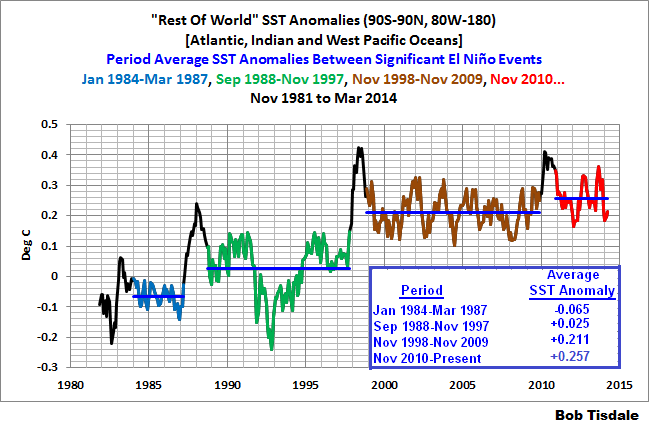

Figure 13
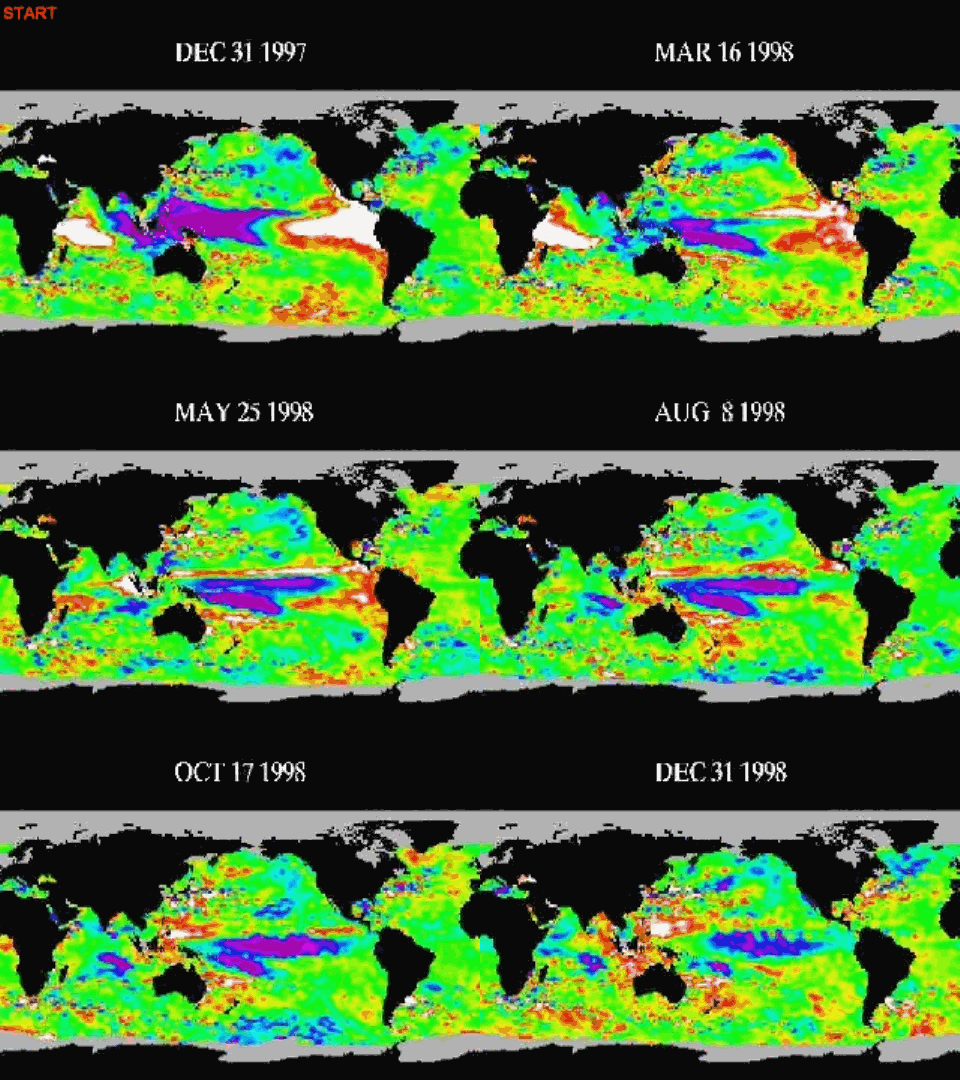
And if you haven’t yet read the post and essay linked earlier in this section, here’s a relatively brief explanation of what causes those step-like shifts in the sea surface temperatures of the Atlantic, Indian and West Pacific Oceans. An El Niño releases a vast amount of warm water from below the surface of the West Pacific Warm Pool. (Important thing to consider: When the warm water was below the surface of the west Pacific Warm Pool it was not included in the surface temperature record. During and after the El Niño, the warm water is included. The result: A quick, naturally caused rise in global surface temperatures.) That warm water floods into the East Pacific, where it temporarily raises the sea surface temperatures. See the spike in 1997/98 in Figure 13 in response to the 1997/98 El Nino. After the El Niño, the trade winds push all of the left over warm surface water back to the western tropical Pacific, where it is distributed poleward and into the eastern Indian Ocean. There is also a phenomenon called a slow-moving Rossby wave that returns warm subsurface water (left over from the El Niño) back to the western extratropical Pacific. (The slow-moving Rossby wave is visible in the animation here, at about 10N in the tropical Pacific, after the 1997/98 El Niño.) That subsurface warm water left over from the El Niño is redistributed around the globe, where it eventually rises to the surface, and it is also fed back to the equatorial Pacific to serve as fuel for secondary weaker central Pacific El Niños, like those that occurred in 2002/03, 2004/05, and possibly 2006/07. The leftover warm water accumulates in regions of the western extratropical Pacific, areas known as the Kuroshio-Oyashio Extension (KOE) and the South Pacific Convergence Zone (SPCZ), where sea surface temperatures rise drastically during the La Niñas that trail the strong El Niños. Those leftover warm waters counteract the La Niña taking place in the tropical Pacific and prevent surface temperatures around the globe from responding fully to the La Niña.
CLOSING
There is much more to El Niño event than a simple warming of the eastern tropical Pacific. They have strong impacts on weather around the globe. A strong El Niño event can also cause an upward shift in the temperatures of two-thirds of the surface of the global oceans, while having no apparent long-term effect on the other one-third. Those upward shifts in surface temperatures give the appearance of a relatively steady rise in global surface temperatures when the data are looked at globally. As a result, the rise in global surface temperatures have been incorrectly attributed to human-induced global warming. That means the climate science community is no closer to finding evidence of the human fingerprint in global warming than they were in the early 1990s, the early years of the IPCC. The IPCC has no one to blame for that than themselves, with their focus on carbon dioxide.
EARLIER POSTS IN THIS SERIES
- The 2014/15 El Niño – Part 1 – The Initial Processes of the El Niño.
- The 2014/15 El Niño – Part 2 – The Alarmist Misinformation (BS) Begins
- The 2014/15 El Niño – Part 3 – Early Evolution – Comparison with 1982/83 & 1997/98 El Niño Events
- The 2014/15 El Niño – Part 4 – Early Evolution – Comparison with Other Satellite-Era El Niños
- The 2014/15 El Niño – Part 5 – The Relationship Between the PDO and ENSO
FURTHER READING
My ebook Who Turned on the Heat?goes into a tremendous amount of detail to explain El Niño and La Niña processes and the long-term aftereffects of strong El Niño events. Who Turned on the Heat? weighs in at a whopping 550+ pages, about 110,000+ words. It contains somewhere in the neighborhood of 380 color illustrations. In pdf form, it’s about 23MB. It includes links to more than a dozen animations, which allow the reader to view ENSO processes and the interactions between variables.
I’ve lowered the price of Who Turned on the Heat? from U.S.$8.00 to U.S.$5.00. A free preview in pdf format is here. The preview includes the Table of Contents, the Introduction, the first half of section 1 (which was provided complete in the post here), a discussion of the cover, and the Closing. Take a run through the Table of Contents. It is a very-detailed and well-illustrated book—using data from the real world, not models of a virtual world. Who Turned on the Heat? is only available in pdf format…and will only be available in that format. Click here to purchase a copy. Thanks.
I don’t get it.
Nobody has ever shown any skill at forecasting ENSO 6 months out.
FergalR, there’s a chunk (<—technical term) of warmer-than-normal water below the surface of the eastern equatorial Pacific. The sea surface temperature anomalies for most of the tropical Pacific are at or near the +0.5 deg C threshold of an El Nino. The only holdout had been the far eastern equatorial Pacific, but it's anomalies are now positive.
http://bobtisdale.wordpress.com/2014/04/28/preliminary-april-2014-sea-surface-temperature-sst-update/
It is possible, but unlikely, that an El Nino may fail to develop.
I appreciate the series that Bob has worked so hard on. And yes, everyone and their uncle has been talking about this El Nino. Which gives me pause. Karma is a b witch. And the Karma says this one will be a fizzle. Yes it will be an El Nino. But it is not going to be what they want it to be,
“Parts of the U.S., Australia and other regions around the globe have been plagued recently by drought. The persons living through them understand that the lack of precipitation has been influenced, to some extent, by the recent dominance of La Niña events”
Bob, I believe that’s true for parts of US. But here in Australia, La Nina means rain, El Nino drought (and heat). You can see this in your third BoM cite. Fig 1 shows the winter/spring El Nino pattern – dry. And in most of the S and SW, that’s important rain time.
It’s true the current drought is worst in Qld, which has more summer/autumn rain. But Fig 2 shows the pattern there, and while the El Nino difference is less, it’s still on the dry side.
Bob, a casual review of the “steps” leaves an impression as expressed by Trenberth that the climate shifts up with an El Nino but it doesn’t shift back down. Looking at your fig. 15, one could imagine the steps going up forever. Isn’t there more to say about this process?
I’m confused about the PDO… Long term forecasters like Joe D’Aleo are saying the PDO is in cold phase/ Given that, he’s confident this will not be a strong el nino. Judith Curry is also calling this a cold PDO. She too is skeptical this el nino will come to much.
Bob, I believe you’re telling us the PDO is actually positive. Yet I get the sense you don’t think this El Nino’s going go be a pause buster either.
“El Niño events cause massive changes in “normal” weather patterns…” Strong statements like this bother me. I would be much more comfortable with “correlates.”
Looks like Kelvin Wave is surfacing…
Harvard says its the sun wot done it.
https://archive.org/stream/cyclesdroughtan00hutcgoog#page/n10/mode/2up
Want to know how I know this el nino will be weak? The SOI number (best el nino indicator) had a positive (+) 6.4 reading for month of April. That doesn’t happen with the strong ones. It doesn’t just peak and collapse. I think there is enough heat in the ocean to cause an el nino, but it’s not looking strong at all so far.
It looks like April will miss official el nino status and May will barely squeek by (maybe). This looks like a June-July-August el nino which are usually fairly moderate. I also predict it won’t last anywhere near as long as the 1997-98 el nino. This one will be a complete spent force by next March.
And for Nick there is this remarkable connection between Australia and South African weather:
https://archive.org/stream/cyclesdroughtan00hutcgoog#page/n128/mode/2up
Bob, the step-increases in temperatures shown in your diagrams and charts make sense. Although I know you are not in the prediction business, I am curious whether you think a period of step-decreases can occur and if so, what the mechanism would be. Thanks.
Bob. I have the same question as Gary Pearse who asks:
“A casual review of the “steps” leaves an impression as expressed by Trenberth that the climate shifts up with an El Nino but it doesn’t shift back down. Looking at your fig. 15, one could imagine the steps going up forever. Isn’t there more to say about this process?”
What were the results of El-Nino’s prior to 1950? (Ref. your “Figure 12”). Do El-Nino’s disappear when temperatures are dropping?
Nick Stokes spot on re Australia. La Niña goes with rain.
Bob I know it is difficult to avoid saying El Niño causes this,that and the other but in reality it is just a description of a developing pattern. The pattern does not cause anything, it is just associated with events.
The cause is the heat from the sun, the tides, currents and Coriolis forces and the interaction of the sea with the land masses.
Yes the SST may go up but not because of El Niño, it is El Niño because the SST goes up with the sea temps.
An ElNino event is vaguely more likely than La Niña as we take a random walk and currently it is on the positive side so closer to an El Niño.
Does anyone remember the last El Niño prediction? It was only 9 months ago, strongly pushed and went away unfulfilled.
No matter one will come eventually and forecasters will always try to claim it forgetting their last 20 failed predictions
Jeff says: April 30, 2014 at 7:07 pm
Agreed. Troup’s SOI as of yesterday …
http://s17.postimg.org/qai44259p/Troup_SOI.png
[Note: “pyromancer76” is “beckleybud” and “H Grouse”. He is the same sockpuppet. Banned multiple times. ~mod.]
“THERE ARE NO OTHER WEATHER-RELATED EVENTS ON EARTH THAT COMPARE IN MAGNITUDE TO AN EL NIÑO
El Niño events are by far the largest of any weather-related phenomenon taking place on the planet, and they impact weather around the globe.”
Except for the Seasons. Summer>Winter, etc, are much larger than El Nino
In figure 1. it looks like I live in a severe drought area (at the tip of the Baja) if an El Niño takes place this year. One hurricane can cancel that out in the southern Baja. I’ll be keeping track of that – the rainy season is Aug & Sept, I’ll be keeping track of that no matter what happens…We haven’t had rain for about 5 months here – I wonder where they get the water to pump into our homes – there are no reservoirs here in the southern Baja like in CA, US…And they keep building new condos, etc. like mad here…
I’m doubtful that this El Nino will have much of an effect in North America other than a minor redistribution of seasonal snowfall, rainfall and temperature patterns, given all of the other factors at work. Perhaps the desert southwest will get a little more rain and snow, and the great lakes region will get a little less. Perhaps Manitoba and Winnipeg won’t be quite so cold, and the cold won’t hang on so long. Those would be good things. I imagine there will be little for the alarmists to crow about. Cold and snow records next winter will continue to be established, just in different places.
I was busy in the bamboo grove during spring, El Nino 2009. The most notable thing was the continued prevalence of oceanic winds during the “event”, in spite of the much publicised Big Dust. (The outback silt sometimes takes wing on the westerlies and heads to the ocean, where it dumps far more iron than any fleet of ships could do). This was very different to the El Ninos of the 1990s, giving us more a European than an East Australian spring – a season in which you expect inland winds to dominate till October, at least, even without El Nino.
2009 was an El Nino, with fewer storms into the new year, though it was not the parching, windy affair it was supposed to be. This is because ENSO is not a mechanism, just a rough observations set. As Nick and angech point out, El Nino is supposed to spell heat and drought for Eastern Oz, La Nina is supposed to give us a good drenching. Yet one of our worst years for heat and fire was the 1938-9 La Nina, and the 1997-8 Super El Nino was relatively benign compared to the “weak” events of 2002-3 and 1902-3. The BoM presently does not even define any year between 1926 and 1940 as El Nino, but the 1930s were Australia’s driest-known decade.
Drought in Oz never reads the ENSO instruction book. We were a drier continent for a half century before the big wets of the 1950s and I often wonder how the alarmists who won’t even recognise such a significant fact can be so well informed about decades of weather which haven’t even happened yet.
Do plankton (etc) act like clouds in the ocean, keeping the sun’s energy near the surface where it is easily re-radiated to space ?
During PDO cold or Nina phase only 25% of years are ENSO Nino positive. During these years ocean temperature, evaporation, and rainfall shift from the subtropical Americas to subtropical Australia and China. The salient question is why the eastern Pacific American phase seems to have so much more power regarding atmospheric temperature.
Some horse riders will always get on or off on the left side of a horse, and tell you that’s the way it should always be. That’s not wise advice.
Several posters here and some not here always refer to the PDO as cold or warm. And that is not wise. It perpetuates the notion that the index is a reference to temperature. All should use the terms “negative” and “positive” with an understanding of the mathematical derivation and meaning of the index.
Whatever they say will happen likely won’t. Don’t think anybody predicted the pause. Either way, hoping for rain for California.
I may have missed this, and apologise if I have, but what causes the warm water to flow east? Is it simply a “toppling effect” where the trade winds can no longer support the build up, or do the trade winds reduce ?