The Elusive ~ 60-year Sea Level Cycle

Guest Post by Willis Eschenbach

I was referred to a paywalled paper called “Is there a 60-year oscillation in global mean sea level?”  The authors’ answer to the eponymous question is “yes”, in fact, their answer boils down to “dangbetcha fer sure yes there is a 60-year oscillation”, viz:

We examine long tide gauge records in every ocean basin to examine whether a quasi 60-year oscillation observed in global mean sea level (GMSL) reconstructions reflects a true global oscillation, or an artifact associated with a small number of gauges. We find that there is a significant oscillation with a period around 60-years in the majority of the tide gauges examined during the 20th Century, and that it appears in every ocean basin.

So, as is my wont, to investigate this claim I got data. I went to the PSMSL, the Permanent Service for the Mean Sea Level, and downloaded all their monthly tidal records, a total of 1413 individual records. Now, the authors of the 60-year oscillation paper said they looked at the “long-term tide records”. If we’re looking for a 60-year signal, my rule of thumb says that you need three times that, 180 years of data, to place any confidence in the results. Bad news … it turns out only two of the 1,413 tidal gauge records, Brest and Swinoujscie, have 180 years of data. So, we’ll need to look at shorter records, maybe a minimum of two times the 60-year cycle we’re looking for. It’s sketchy to use that short of a record, but “needs must when the devil drives”, as the saying goes. There are twenty-two tidal datasets with 120 years or more of data. Figure 1a shows the first eight of them:

all tide records over 120 years 1-8Figure 1a. Tide gauge records with 1440 months (120 years) or more of records. These are all relative sea levels, meaning they are each set to an arbitrary baseline. Units are millimetres. Note that the scales are different, so the trends are not as uniform as they appear.

Now, there’s certainly no obvious 60-year cycles in those tidal records. But perhaps the subtleties are not visible at this scale. So the following figure shows the Gaussian averages of the same 8 tidal datasets. In order to reveal the underlying small changes in the average values, I have first detrended each of the datasets by removing any linear trend. So Figure 1b emphasizes any cycles regardless of size, and as a result you need to note the very different scales between the two figures 1a and 1b.

gauss all tide records over 120 years 1-8Figure 1b. Gaussian averages (14-year full-width half-maximum) of the linearly detrended eight tide gauge datasets shown in Figure 1a. Note the individual scales are different from Figure 1a.

Huh. Well, once the data is linearly detrended, we end up with all kinds of swings. The decadal swings are mostly on the order of 20-30 mm (one inch) peak to peak, although some are up to about twice that. The big problem is that the decadal swings don’t line up, they aren’t regular, and they don’t have any common shape. More to the current point, there certainly is no obvious 60-year cycle in any of those datasets.

Now, we can take a closer look at what underlying cycles are in each of those datasets by doing a periodicity analysis. (See the notes at the end for an explanation of periodicity analysis). It shows how much power there is in the various cycle lengths, in this case from two months to seventy years Figure 1c shows the periodicity analysis of the same eight long datasets. In each case, I’ve removed the seasonal (annual) variations in sea level before the periodicity analysis.

periodicity all tide records over 120 years 1-8Figure 1c. Periodicity analysis, first eight long-term tidal datasets.

Boooring … not much of anything anywhere. Top left one, Brest, has hints of about a 38-year cycle. New York shows a slight peak at about 48 years. Other than that there is no energy in the longer-term cycles, from say 30 to 70 years.

So let’s look at the rest of the 22 datasets. Here are the next eight tide gauge records, in the same order—first the raw record, then the Gaussian average, and finally the periodicity analysis.

all tide records over 120 years 9-16 gauss all tide records over 120 years 9-16 periodicity all tide records over 120 years 9-16Figures 2a, 2b, and 2c. Raw data, Gaussian averages, and periodicity analysis, next 8 stations longer than 120 years.

No joy. Same problem. All kinds of cycles, but none are regular. The largest problem is the same as in the first eight datasets—the cycles are irregular, and in addition they don’t line up with each other. Other than a small peak in Vlissingen at about 45 years, there is very little power in any of the longer cycles. Onwards. Here are the last six of the twenty-two 120-year or longer datasets:

all tide records over 120 years 17-22 gauss all tide records over 120 years 17-22 periodicity all tide records over 120 years 17-22

Figures 3a, 3b, and 3c. Data, Gaussian averages, and periodicity analysis as above, for the final six 120-year + tide gauge datasets. 

Dang, falling relative sea levels in Figure 3a. Obviously, we’re looking at some tidal records from areas with “post-glacial rebound” (PGR), meaning the land is still uplifting after the removal of trillions of tons of ice at the end of the last ice age. As a result, the land is rising faster than the ocean …

How bizarre. I just realized that people worry about sea-level rise as a result of global warming, and here, we have land-level rise as a result of global warming  … but I digress. The net result of the PGR in certain areas are the falling relative sea levels in four of the six datasets.

Like the other datasets, there are plenty of cycles of various kinds in these last six datasets in Figure 3, but as before, they don’t line up and they’re not regular. Only two of them have something in the way of power in the longer cycles. Marseille has a bit of power in the 40-year area. And dang, look at that … Poti, the top left dataset, actually has hints of a 60-year cycle … not much, but of the twenty-two datasets, that’s the only one with even a hint of power in the sixty-year range.

And that’s it. That’s all the datasets we have that are at least twice as long as the 60-year cycle we’re looking for. And we’ve seen basically no sign of any significant 60-year cycle.

Now, I suppose I could keep digging. However, all that are left are shorter datasets … and I’m sorry, but looking for a sixty-year cycle in a 90-year dataset just isn’t science on my planet. You can’t claim a cycle exists from only enough data to show one and a half swings of the cycle. That’s just wishful thinking. I don’t even like using just two cycles of data, I prefer three cycles, but two cycles is the best we’ve got.

Finally, you might ask, is it possible that if we average all of these 22 datasets together we might uncover the mystery 66-year cycle? Oh, man, I suppose so, I’d hoped you wouldn’t ask that. But looking at the mish-mash of those records shown above, would you believe it even if I found such a cycle? I don’t even like to think of it.

Ah, well, for my sins I’m a scientist, I am tormented by unanswered questions. I’d hoped to avoid it, so I’ve ignored it up until now, but hang on, let me do it. I plan to take the twenty-two long-term records, linearly detrend them, average them, and show the three graphs (raw data, Gaussian average, and periodicity analysis) as before. It’ll be a moment.

OK. Here we go. First the average of all of the detrended records, with the Gaussian average overlaid.

mean detrended 22 tide recordsFigure 4a. Mean of the detrended long-term tidal records. Red line shows a 14-year full-width half-maximum (FWHM) Gaussian average of the data, as was used in the earlier Figures 1b, 2b, 3b.

Well, I’m not seeing anything in the way of a 60-year cycle in there. Here’s the periodicity analysis of the same 22-station mean data:

periodicity mean detrended 22 tide recordsFigure 4b. Periodicity analysis of the data shown in Figure 4a immediately above.

Not much there at all. A very weak peak at about forty-five years that we saw in some of the individual records is the only long-term cycle I see in there at all.

Conclusions? Well, I don’t find the sixty-year cycle that they talk about, either in the individual or the mean data. In fact, I find very little in the way of any longer-term cycles at all in the tidal data. (Nor do I find cycles at around eleven years in step with the sunspots as some folks claim, although that’s a different question.) Remember that the authors said:

We find that there is a significant oscillation with a period around 60-years in the majority of the tide gauges examined during the 20th Century …

Not able to locate it, sorry. There are decadal swings of about 25 – 50 mm (an inch or two) in the individual tide gauge datasets.  I suppose you could call that “significant oscillations in the majority of the tide gauges”, although it’s a bit of a stretch.

But the “significant oscillations” aren’t regular. Look at the Gaussian averages in the first three sets of figures. The “significant oscillations” are all over the map. To start with, even within each individual record the swings vary greatly in amplitude and cycle length. So the cycles in each individual record don’t even agree with themselves.

Nor do they agree with each other. The swings in the various tidal records don’t line up in time, nor do they agree in amplitude.

And more to the point, none of them contain any strong approximately sixty-year signal. Only one of the twenty-two (Poti, top left in Figure 3a,b,c) shows any power at all in the ~ 60 year region in the periodicity analysis.

So I’m saying I can’t find any sign in those twenty-two long tidal datasets of any such sixty-year cycle. Note that this is different from saying that no such cycle exists in the datasets. I’m saying that I’ve pulled each one of them apart and examined them individually as best I know how, and I’m unable to find the claimed “significant oscillation with a period around 60-years” in any of them.

So I’m tossing the question over to you. For your ease in analyzing the data, which I obtained from the PSMSL as 1413 individual text files, I’ve collated the 1413 record tide station data into a 13 Mb Excel worksheet, and the 22 long-term tidal records into a much smaller CSV file. I link to those files below, and I invite you to try your hand at demonstrating the existence of the putative 60-year cycle in the 22-station long-term tidal data.

Some folks don’t seem to like my use of periodicity analysis, so please, use Fourier analysis, wavelet analysis, spectrum analysis, or whatever type of analysis you prefer to see if you can establish the existence of the putative “significant” 60-year cycles in any of those long-term tidal datasets.

Regards to all, and best of luck with the search,

w.

The Standard Request: If you disagree with something someone says, please have the courtesy to quote the exact words you disagree with. It avoids all kinds of trouble when everyone is clear what you are objecting to.

Periodicity Analysis: See the post “Solar Periodicity” and the included citations at the end of that post for a discussion of periodicity analysis, including an IEEE Transactions paper containing a full mathematical derivation of the process.

Data: I’ve taken all of the PSMSL data from the 1413 tidal stations and collated it into a single 13.3 Mb Excel worksheet here. However, for those who would like a more manageable spreadsheet, the 22 long-term datasets are here as a 325 kb comma-separated value (CSV) file.

[UPDATE] An alert commenter spots the following:

Jan Kjetil Andersen says:

April 26, 2014 at 2:38 pm

By Googling the title I found the article free on the internet here:

http://www.nc-20.com/pdf/2012GL052885.pdf

I don’t find it any convincing at all. They use the shorter series in the PSMSL sets, and claim to see 64 years oscillations even though the series are only 110 years long.

The article has no Fourier or periodicity analysis of the series.

/Jan

Thanks much for that, Jan. I just took a look at the paper. They are using annually averaged data … a very curious choice. Why would you use annual data when the underlying PSMSL dataset is monthly?

In any case, the problem with their analysis is that you can fit a sinusoidal curve to any period length in the tidal dataset and get a non-zero answer. As a result, their method (fit a 55 year sine wave to the data) is meaninglesswithout something with which to compare the results.

A bit of investigation, for example, gives the following result. I’ve used their method, of fitting a sinusoidal cycle to the data. Here are the results for Cascais, record #43. In their paper they give the amplitude (peak to peak as it turns out) of the fitted sine curve as being 22.3. I get an answer close to this, which likely comes from a slight difference in the optimization program.

First, let me show you the data they are using:

If anyone thinks they can extract an “~ 60 year” cycle from that, I fear for their sanity …

Not only that, but after all of their waffling on about an “approximately sixty year cycle”, they actually analyze for a 55-year cycle. Isn’t that false advertising?

Next, here are the results from their sine wave type of analysis analysis for the periods from 20 to 80 years. The following graph shows the P-P amplitude of the fitted sine wave at each period.

So yes, there is indeed a sinusoidal cycle of about the size they refer to at 55 years … but it is no different from the periods on either side of it. As such, it is meaningless.

The real problem is that when the cycle length gets that long compared to the data, the answers get very, very vague … they have less than a hundred years of data and they are looking for a 55-year cycle. Pitiful, in my opinion, not to mention impossible.

In any case, this analysis shows that their method (fit a 55-year sine wave to the data and report the amplitude) is absolutely useless because it doesn’t tell us anything about the relative strength of the cycles.

Which, of course, explains why they think they’ve found such a cycle … their method is nonsense.

Eternal thanks to Jan for finding the original document, turns out it is worse than I thought.

w.


0 0 votes
Article Rating

Discover more from Watts Up With That?

Subscribe to get the latest posts sent to your email.

224 Comments
Inline Feedbacks
View all comments
Björn
April 26, 2014 9:36 am

Willis, there is a superfluous space character clinging to the right end of the url in the link you put up to the large .xlsx sheet with the 1412 stations data. It clobbers the intended purpose and you only get small (700 bytes of html text ) error notice from dropbox if you try to download directly from it.
[Didn’t see it. What paragraph? Mod]
[Fixed, thanks, Mod and Bjorn. -w.]

April 26, 2014 10:22 am

Don Easterbrook/ Bill Illis/Willis
I think the point is that warmer water expands and therefore takes up more volume.
On the other side, more rain will also cause increase in sea level.
As we consider this plot
http://www.woodfortrees.org/plot/hadcrut4gl/mean:60/plot/hadcrut3vgl/mean:60/plot/hadcrut4gl/trend/plot/hadcrut3vgl/trend/plot/hadcrut4gl/last:360/trend/plot/hadcrut3vgl/last:360/trend
and provided it is true,
it seems that the whole of earth warmed up a bit, since 1850
it follows that as the water was heated more, over the years, by the sun,
the subsequent increased evaporation provided that extra heat that gave us more warmth.
The warmth is good for the greening of earth. The subsequent greening (also of the oceans), also with the help of mankind, traps more heat. The biosphere is booming. Hence the explanation of increasing water levels.
I hope this explains it, Don?
Willis found the 44 or 45 year cycle in the record, also in Vlissingen and if you take the two Amsterdam cycles it also gives an average of 45.
Strangely enough, these results do make sense to me.
My own results on maximum temperatures led me to this plot:
http://blogs.24.com/henryp/2012/10/02/best-sine-wave-fit-for-the-drop-in-global-maximum-temperatures/
This shows that events related to whatever drives the weather (i.e I mean rain mostly) is on some 87 or 88 year cycle, but after every half cycle of 44 years you are back to zero.
Various investigations which I can quote show that the Gleissberg and DeVries/Suess cycles are real and happening. In both cycles we are now coming to the cooling side of the wave.
Notwithstanding the “current” records
http://www.woodfortrees.org/plot/hadcrut4gl/from:1987/to:2015/plot/hadcrut4gl/from:2002/to:2015/trend/plot/hadcrut3gl/from:1987/to:2015/plot/hadcrut3gl/from:2002/to:2015/trend/plot/rss/from:1987/to:2015/plot/rss/from:2002/to:2015/trend/plot/hadsst2gl/from:1987/to:2015/plot/hadsst2gl/from:2002/to:2015/trend/plot/hadcrut4gl/from:1987/to:2002/trend/plot/hadcrut3gl/from:1987/to:2002/trend/plot/hadsst2gl/from:1987/to:2002/trend/plot/rss/from:1987/to:2002/trend
my results seem to point to a greater rate of global cooling,
happening now.

Matthew R Marler
April 26, 2014 10:25 am

Because the 60 year period was hypothesized based on considerations external to this data set, and prior to analysis of this data set, you can simply test (using a model that is a straight line plus a cosine curve with amplitude and phase estimated) whether there is a significant 60-year period in each series. Then count how many of the corresponding F-tests of the cosine curve, out of ca 1400, are statistically significant, or do the histogram/pdf estimate of the p-values. You don’t have too many parameters for each series: mean, slope, amplitude of cosine, phase of cosine, residual error variance, autocorrelation coefficient (most likely, first-order autoregressive noise is adequate for each series, something that you can test.)
Your rule of requiring a series at least 3 times as long as the longest period is a great rule for when exploring whether there is any periodicity in the data; but when the period is hypothesized a priori, it is not necessary. Also look at the histogram/pdf estimate of the phases to see whether the diverse series are all in phase. Given the dynamics and known lags (as in your “ENSO pump” graphical analysis), there is no necessity that the series all be in phase.
If you don’t want to, I may do this. I have done it lots of times with circadian rhythm modeling where the rhythm, if present, is known to have a period of 24 hours. (I said “if present”; it came as a surprise that there is a circadian rhythm in blood concentrations of prolactin in healthy men; no one to my knowledge has tested whether there is a circadian rhythm in blood testosterone in healthy women, but if there is one it has a period of 24 hours.) You only need data over one full period to estimate and test the rhythm. If you suspect some other periodicity, then you need at least 3 days data for exploratory analyses.

Matthew R Marler
April 26, 2014 10:34 am

some references, or blatant self-promotion:
9. M.R. Marler, R. Jacob, J.P. Lehoczky, and A. Shapiro. Statistical analysis of treatment and activity effects in 24hour ambulatory blood pressure monitoring. Statistics in Medicine 7:697716, 1988.
21. M.L. Rao, G. Gross, A. Halaris, G. Huber, M.R. Marler, B. Strebel, and P. Braunig. Hyperdopaminergia in Schizophreniform Psychosis: A Chronobiological Study. Psychiatry Research, 47: 187203, 1993.

April 26, 2014 10:50 am

The question was asked – why do we expect to see a 60 year cycle? For me, that brought up the question, what would I expect to see in the data given what I know and believe? Thinking about it, my answer was that I think that there has not been a great deal of change in the rate of melting of glaciers in the last 150 years – nothing out of the ordinary in the context of the Holocene. The same is true for the ice caps. Therefore, I think the main reason for sea level changes above and beyond that caused by sinking or rising land masses is changes in heat content of the ocean. The heat content of the ocean given it’s size and depth are long term slow changes. And given how the ocean sloshes around, I would expect the data to be somewhat noisy. Looking at Willis’s data, it seems consistent with this view. But what about oscillations in part of the ocean? On that point, there are “oscillations” that are well known such as the PDO or AMO among others. I would expect that those could have a regional impact on sea level gauges. I’m not sure about the degree of impact or the exact period of any oscillation but given the PDO and AMO are real and do have an impact on the ocean and planet, they should have some impact on sea level. Therefore, I would not be surprised if Daveburton is correct about regional oscillations.

Greg
April 26, 2014 10:57 am

[Didn’t see it. What paragraph? Mod]
You won’t “see” it , its come non displaying character. (maybe non-braking_space char)
Same problem with the CSV file. The .csv extension has an invisible cruft-char too.

Greg
April 26, 2014 11:03 am

Oh no, its a common space char #32 aka “%20” . Means if you do Save_as you get an error page in HTML and no data, that is mysteriously unavailable usless you quote the filename and add the invisible space after .csv
I suspect the others are the same.

Neil Jordan
April 26, 2014 11:22 am

Two general comments. First, The 18.6-year Metonic Cycle for tides is recognized as being large enough to affect surveyed coastal boundaries. I made a comment about that in “Sea level rate of rise shown to be partially a product of adjustments” Posted on January 24, 2013:
http://wattsupwiththat.com/2013/01/24/sea-level-rate-of-rise-shown-to-be-partially-a-product-of-adjustments/
In part, I quoted the American Council of Surveying and Mapping reference to an approximate 18.6-year cycle known for some time as the Metonic Cycle. The cycle is the basis for
the 19-year tidal epoch used to define the sea level datum. See ACSM Bulletin at the
NOAA website:
http://tidesandcurrents.noaa.gov/publications/Understanding_Sea_Level_Change.pdf
My full comment is at
http://wattsupwiththat.com/2013/01/24/sea-level-rate-of-rise-shown-to-be-partially-a-product-of-adjustments/#comment-1208839
Second, NOAA published a technical report on vertical land motion relative to sea level
http://tidesandcurrents.noaa.gov/publications/Technical_Report_NOS_CO-OPS_065.pdf
available at FEMA’s coastal website here
http://www.fema.gov/coastal-flood-risk-resources#Guidance
Technical Report NOS CO-OPS 065 “Estimating Vertical Land Motion from Long-Term Tide Gauge Records” is written for coastal engineering and design community, rather than the climate science community. Long term sea level rise is taken as 1.7 mm/year from IPCC 2007, not the often-quoted 3 plus values. Of particular note is this paragraph in the introduction:
[begin quote]
The purpose of the methodology is to provide a more accurate estimation of local VLM at tide stations with 30-60 years of data rather than just simply subtracting the estimated global sea level trend of 1.7mm/yr from the observed relative mean sea level trend. Relative sea level trends calculated from shorter data periods are more likely to be affected by anomalously high or low oceanographic levels at the beginning or end of their series. By removing the regional oceanographic variability as calculated based on longer-period stations, both more accurate and more precise estimates of land motion are possible at shorter-period stations.
[end quote]
Note “. . .anomalously high or low oceanographic levels at the beginning or end of their series.” These anomalies might be another consequence of what you described in your earlier post:
http://wattsupwiththat.com/2014/04/24/extreme-times/

NikFromNYC
April 26, 2014 11:32 am

Ah, well, something I hadn’t noticed before, the PSMSL archive happens to attach ID numbers by station age, so even though there’s no column for that, the ID column itself acts lets you list the stations by age, more or less.
http://www.psmsl.org/data/obtaining/
Some of the oldest *do* show some acceleration, mostly but not all via a pivot point in the 1920s between linear trends. But thankfully for skeptics at least, the official Church & White 2011 update finally included a simple average of tide gauges that I extracted and added a poor man’s trend line to, and it shows utterly no acceleration, one of the most devastating plots for climate alarmists since they are now claiming the impossible that the deep oceans are heating up but not then also expanding more than usual:
http://oi51.tinypic.com/28tkoix.jpg

RACookPE1978
Editor
April 26, 2014 11:38 am

Matthew R Marler says:
April 26, 2014 at 10:25 am
… you can simply test (using a model that is a straight line plus a cosine curve with amplitude and phase estimated) whether there is a significant 60-year period in each series. … If you don’t want to, I may do this. I have done it lots of times with circadian rhythm modeling where the rhythm, if present, is known to have a period of 24 hours.

Let me take you up on this then please.
The DMI has provided me with a text file from 2007 – 2013 for each hour’s dry bulb temperature, pressure,wet bulb temperature, wind speed and wind direction for an Arctic site at 80 north latitude.
My assumptions:
Each data field will vary over a 24 hour period.
However, each daily value – for example, Taverage (for the day), Tmaximum – Tminimum (for the day), relative humidity each hour, pressure, etc – will also vary periodicaly over the length of an entire year.
Given 7 years of data, I would expect to be able to generate a function adequately calculating each parameter as a function of hour-of-day and day-of-year, right?

Greg
April 26, 2014 11:40 am

Also seems what ever Willis is using stores csv files in old mac format with no linefeed chars.
dos2unix -c mac “Willis Files.cvs”

lgl
April 26, 2014 11:45 am

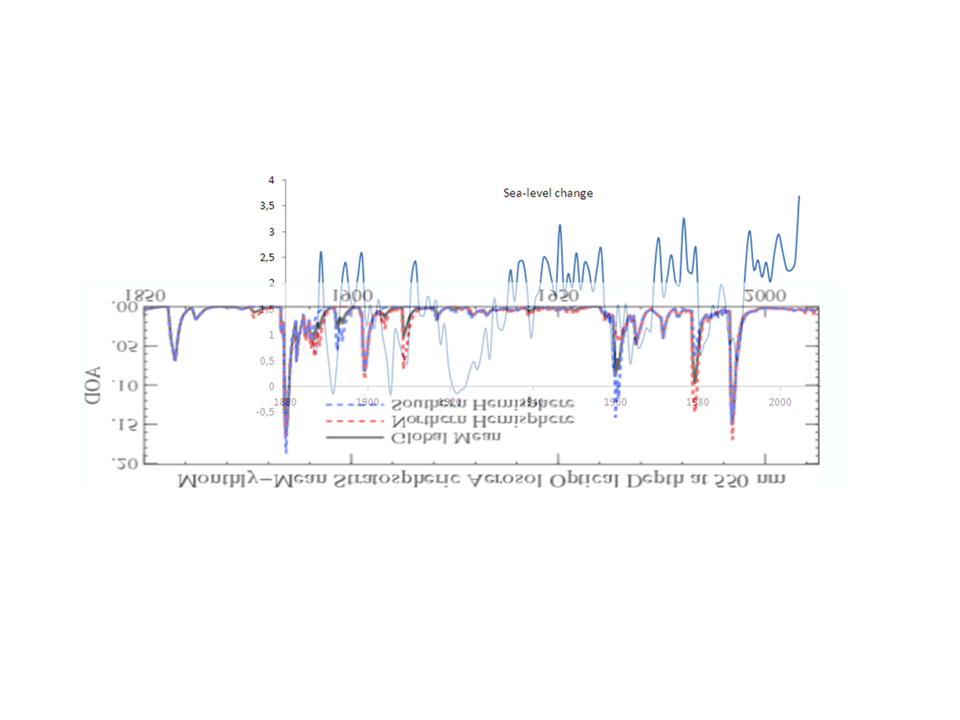
Sea level changed ~2 mm/yr first half of 20th and ~2,5 mm/yr last half of 20th but dropped to 0-0.5 mm/yr after high volcanic activity, so there should be a ~9 and a ~80 yr cycle.
http://virakkraft.com/Sea-level-change-volcanoes.png

April 26, 2014 11:49 am

lgl says
http://virakkraft.com/Sea-level-change-volcanoes.png
henry says
You want me to find a mirror?

Greg
April 26, 2014 11:59 am

“I would expect to be able to generate a function adequately calculating each parameter as a function of hour-of-day and day-of-year, right?”
A sort of 365.25×24 element climatology you mean?
Check out Wilis’ links to the PA software and use 365.25×24 as the window repetition.
“each daily value ….will also vary periodicaly over the length of an entire year.”
otherwise I have a simple awk script that can do this for an arbitrary window length. I can post that up if you’re interested.

Greg
April 26, 2014 12:05 pm

lgl says:
Sea level changed ~2 mm/yr first half of 20th and ~2,5 mm/yr last half of 20th but dropped to 0-0.5 mm/yr after high volcanic activity, so there should be a ~9 and a ~80 yr cycle.
http://virakkraft.com/Sea-level-change-volcanoes.png
===
Any correlation you are seeing there is in your own head.

RACookPE1978
Editor
April 26, 2014 1:01 pm

Greg says:
April 26, 2014 at 11:59 am

(replying to RACookPE)
“I would expect to be able to generate a function adequately calculating each parameter as a function of hour-of-day and day-of-year, right?”

A sort of 365.25×24 element climatology you mean?
Check out Wilis’ links to the PA software and use 365.25×24 as the window repetition.

“each daily value …. will also vary periodically over the length of an entire year.”

otherwise I have a simple awk script that can do this for an arbitrary window length. I can post that up if you’re interested.

If I understand you correctly, yes – sort of.
But if we were to create a look-up table with a simple average of each hour’s data, then the “weather” variations over every day would need further smoothing and manipulation, right? Since I’m trying to approximate the as-found average “weather” on an hour-by-hour basis up north to get hourly heat transfer approximations, I’d prefer to “smooth” the data over the entire year with a single function. However, since no part of any weather pattern is a simple sinusoid at any time interval, you can’t really reduce things to nice simple sine or cosine curves. (Which could be a part of the problem of trying to find “perfect” periodicities in past yearly data…)
For example, I can develop an equation adequately reproducing the DMI average temperature plot for 80 north latitude (from the WUWT Sea Ice page) over a 365 day year.
So, Tave(day-of-year) = A + B*(DOY) + C*(DOY)^2 + D*(DOY)^3 + E*(DOY)^4 + F*(DOY)^5 + … which works as long as DOY never gets below 0 nor higher than 366. Not elegant, but adequate.
Then, if Tmax-Tmin varies over the year over the 7 years of data, that too, can be calcualted on a day-of-year basis.
And, if T(hour) varies consistently and predictably over the year between Tmax (about 14:00 hours) and Tmin(05:00 hours), then getting T(hour-of-year) for every day of the year is straightforward.
From T(hour-of-year), P(hour-of-year), wind speed (hour-of-year), and relative humidity(hour-of-year), you can get Heat lost by evaporation(hour-of-year), heat lost by convection(hour-of-year), and heat lost by long-wave radiation (hour-of-year).

Greg
April 26, 2014 1:08 pm

Ah ha! As my spectral analysis of the Church & White reconstruction showed the 7.5 and 10.2 I found would produce a 57y modulation
I just dug NY Battery out of W’s csv file took the first diff and applied a 2y filter to make it more legible:
http://climategrog.wordpress.com/?attachment_id=936
The circa 60y modulation is clearly visible.
I also found a sub-annual periodicity had a 58 y modulation too.

Greg
April 26, 2014 1:25 pm

“Tave(day-of-year) = A + B*(DOY) + C*(DOY)^2 + D*(DOY)^3 + E*(DOY)^4 + F*(DOY)^5 + … which works as long as DOY never gets below 0 nor higher than 366. Not elegant, but adequate.”
How many poly terms will you need to represent 365 days worth of fluctuations?! I would have thought an FFT approach would have been more suitable. Or perhaps more flexible the PA breakdown that Willis used.
FFT is limiting because of the way the frequency intervals work. That’s why I use chirp-z. which frees it up. You can then pick off the precise frequencies of the main peaks and build a truncated harmonic reconstruction.
While I think of it, if you are working with wind speed consider whether v^2 is what you need to use. Most things like sea evaporation and energy depend upon the square.

lgl
April 26, 2014 1:27 pm

Greg
Who said correlation?
I said sea level change drops after high volcanic activity. Show me one large eruption without a sea level change drop a few years after.

Greg
April 26, 2014 1:28 pm

“And, if T(hour) varies consistently and predictably over the year between Tmax (about 14:00 hours) and Tmin(05:00 hours), then getting T(hour-of-year) for every day of the year is straightforward. ”
I very much doubt that you will find a constant-ish daily cycle that holds through the Arctic winter and the daylight periods.

Greg
April 26, 2014 1:41 pm

“Show me one large eruption without a sea level change drop a few years after.”
Well it’s hard to see on that messy upside down pastiche you presented but it looks like Santa Maria misses and for Mt Pinatubo the drops starts before the eruption so suggesting causation gets a bit tricky unless you close both eyes and peep through your lashes.
El Chichon happens once the AOD has nearly returned to normal , then you have massive heg swings that have nothing to do with any volcanic events. That again makes attributing coincident events rather speculative if they are not different from the variability in the rest of the data when there are no volcanoes.
That is why I mentioned correlation. If there’s a connection , as it appears you are trying to suggest, there must be a correlation. Otherwise the effect is a just like seeing a face in the clouds.

Kasuha
April 26, 2014 2:01 pm

Thank you for interesting and as far as I see correct analysis of data and final conclusion. I really wonder what method could have the paper authors used.
I tried to download your data files to take a look at it myself but I got an “Error (400)” for both links.

Greg
April 26, 2014 2:26 pm

See notes above for the link. There’s an extra spaced got added to the end like “.cvs ” and “.xlsx ”
Copy the link and paste in a new window, then edit off the space 😉

Greg
April 26, 2014 2:35 pm

Just had a look at Honolulu. 7.5 and 10.2 still notable peaks but very strong 9.08 and 21.4 y too.
This is the ubiquitous 9.1 +/-0.1 that can be found just about everywhere in SST it seems and Scafetta claims in aurora data. This is lunar. The 21.4 looks solidly Hale cycle . Surprised to see that come out so clearly.
It seems that, like SST, this needs to be analysed regionally otherwise a lot of valuable information gets muddied out.
Chambers et al got that much right and looked at the details of phase too. Its a shame that they did not do a more general frequency analysis.

Greg
April 26, 2014 2:37 pm

could a climate denier please fix the links to Willis’ files 😉
[Fixed. -w.]