A new paper in Nature from the Department of Oceanography, School of Ocean and Earth Science and Technology, University of Hawaii, makes a somewhat surprising claim about predicting ENSO events. This is probably one of the shortest abstracts ever, but then, there’s not much to be said beyond this simple statement.
Climate science: A high bar for decadal forecasts of El Niño
- Nature 507,437–439 (27 March 2014) doi:10.1038/507437a
- Published online
- 26 March 2014
Climate simulations suggest that multi-decadal periods of high and low variability in the phenomenon known as the El Niño-Southern Oscillation in the tropical Pacific Ocean may be entirely unpredictable.
I suppose this explains why this model has been doing so poorly for the last year in predicting a new El Niño, it has been showing an El Niño just months away for almost a year.
NINO 3.4 SST Anomalies Forecast
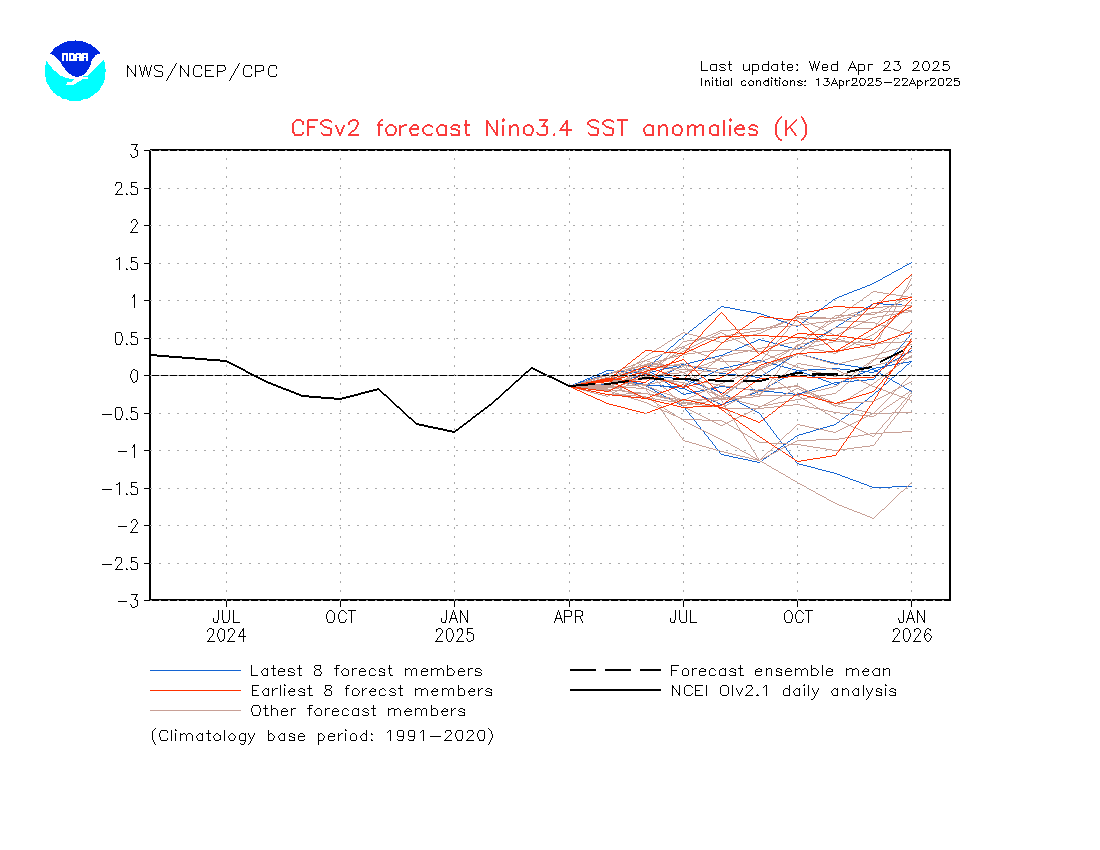
Will we see an El Niño this year? Only chaos knows for sure.
More at the WUWT ENSO page
Climate science: A high bar for decadal forecasts of El Niño
– Pedro DiNezio1
One more data point demonstrating that Climate Science has all the predictive powers of Botnay.
Geoff Withnell says: March 27, 2014 at 7:21 am
rgbatduke says: March 27, 2014 at 7:32 am
phlogiston says:March 27, 2014 at 8:13 am
When I read you comments, I realized that there were two areas of difference.
1. I did not reference Chaos theory; although, it could be appropriate to this discussion. Chaos theory should produce boundaries to where the pencil falls, even if does not tell you which direction. These predictions are short term enough that significant error should not accumulate as to make the predications false almost from the start.
2. My engineering background rejects random events that do not have causes. Generally random events are not random, they are simply events where the reasons are not known. There are many things that are not known about the Ocean and the processes that occur deep in the Ocean. Here is an example: http://gyre.umeoce.maine.edu/physicalocean/Tomczak/regoc/pdffiles/colour/double/08P-Pacific-right.pdf
Currents below 2000 meters, page 119
“At the same latitudes, the cores of the South Subsurface Countercurrent and the North Subsurface Countercurrent are usually located near 600 meters. An explanation for the existence of these currents is still lacking. Recent observations indicate that the banded structure of currents at the equator continues to great depth (Figure 8.15). …(the figure shows currents at depths greater than 2,000 meters.)… the dynamics of the equatorial region cannot be explained by our 1 1/2 layer model. The EIC, NSCC, and SSCC are integral part of a dynamic system that reaches much deeper than the thermocline.”
When you find that there are unknowns about the Ocean currents that would directly impact movement of heat, etc. in the area most sensitive to the ENSO, you cannot expect that predictions will be reliable.
Thanks- Joel O’Bryan says:
March 26, 2014 at 10:22 pm
for the bit more detail. The paper is only looking at one models ability to predict increasing or decreasing strength ENSO events. The model obviously obviously can’t predict in its own simulated results, let alone reality. At least they were honest in saying that.
rgbatduke says:
March 27, 2014 at 7:32 am
“Well, no, often it means that the process involves solution to stiff systems of differential equations or chaotic dynamical systems, either one of which are highly sensitive to small tweaks of their initial conditions”
I can’t help but think that you and Retired Engineer John are talking about the same thing.
In the real world I see the Kelud eruption (Feb 2014 VEI5?) as likely more than just a small tweak of “initial conditions”. The satellite temperature data (and the long/shortwave data) for the next couple of years will be interesting.
Retired Engineer John says:
March 27, 2014 at 5:14 pm
Geoff Withnell says: March 27, 2014 at 7:21 am
rgbatduke says: March 27, 2014 at 7:32 am
phlogiston says:March 27, 2014 at 8:13 am
When I read you comments, I realized that there were two areas of difference.
1. I did not reference Chaos theory; although, it could be appropriate to this discussion. Chaos theory should produce boundaries to where the pencil falls, even if does not tell you which direction. These predictions are short term enough that significant error should not accumulate as to make the predications false almost from the start.
2. My engineering background rejects random events that do not have causes. Generally random events are not random, they are simply events where the reasons are not known. There are many things that are not known about the Ocean and the processes that occur deep in the Ocean. Here is an example: …
The position you outline is known as determinism. If we know everything we can predict everything. It was well articulated by Simon Laplace in 1814:
We may regard the present state of the universe as the effect of its past and the cause of its future. An intellect which at a certain moment would know all forces that set nature in motion, and all positions of all items of which nature is composed, if this intellect were also vast enough to submit these data to analysis, it would embrace in a single formula the movements of the greatest bodies of the universe and those of the tiniest atom; for such an intellect nothing would be uncertain and the future just like the past would be present before its eyes.
—Pierre Simon Laplace, A Philosophical Essay on Probabilities
However this statement of determinism is false, and has been entirely falsified by two principal scientific discoveries of the 20th century. One of these is quantum physics – for example at the quantum scale, particles continually appear out of nothing then disappear – giving rise to radiation at the event horizons of black holes for instance when one of a pair of such spontaneous particles is sucked into the black hole and the other not.
The other equally fundamental and important discovery is chaos and nonlinearity. The Russians discovered this first with the likes of Kolmogorov in the early-mid 20th century, in the west Lorenz first articulated the unpredictability of a chaotic system in DNP62, the period doubling phenomenon underlying it was illucidated by Feigenbaum. (In the west Lorenz was largely ignored for several decades and even now many still labour in futile analysis of complex systems unaware of his work – such as all climate modellers.)
In summary – determinism is false. It doesn’t matter how much you know, quantum physics together with chaos together absolutely prevent any chance of determinism in a complex system. For certain systems, no amount of knowledge will allow you to predict them.
phlogiston says: March 28, 2014 at 9:16 am
“The position you outline is known as determinism. If we know everything we can predict everything. It was well articulated by Simon Laplace in 1814:
We may regard the present state of the universe as the effect of its past and the cause of its future. An intellect which at a certain moment would know all forces that set nature in motion, and all positions of all items of which nature is composed, if this intellect were also vast enough to submit these data to analysis, it would embrace in a single formula the movements of the greatest bodies of the universe and those of the tiniest atom; for such an intellect nothing would be uncertain and the future just like the past would be present before its eyes.
—Pierre Simon Laplace, A Philosophical Essay on Probabilities
In summary – determinism is false. It doesn’t matter how much you know, quantum physics together with chaos together absolutely prevent any chance of determinism in a complex system. For certain systems, no amount of knowledge will allow you to predict them.”
I agree determinism is false. I feel sure if Simon Laplace were alive today, he would also say it was false. My position is not determinism. We cannot determine when a radioactive atom will breakdown and emit some form of radiation or when certain things in quantum physics will occur. We can make estimates based on bulk properties and measured performance. The problem with designating ENSO as a chaotic system without thoroughly exhausting the search for causes means we can be overlooking processes that can be used to predict at least short time behavior.
Random events do not necessarily fall in the category of chaos. A random event is not necessarily based on a series of events that multiply into a random event. The event can be caused by a stress that exceeded the design limits of the device. The event is considered random when the stress cannot be identified.
I am interested in quantum mechanics and I would be interested in a paper or book that gives the details of your statement: ” One of these is quantum physics – for example at the quantum scale, particles continually appear out of nothing then disappear”. I have seen where Hawkings is working with these particles; however, there are no technical details.
If Joe is right, not all El Ninos are equal.
http://www.weatherbell.com/saturday-summary-march-15-2014
“mwhite says: March 29, 2014 at 5:08 am If Joe is right, not all El Ninos are equal.”
I don’t get an article on El Ninos, I get a temperature map. Please check your URL.
During the balmy Pliocene, before closure of the Isthmus of Panama, the tropical East Pacific was more or less in permanent El Niño mode.
During the Holocene Interglacial, the millennial, centennial & decadal scale warm & cold fluctuations (I’ll call the longer term variations Bond Cycles & the shorter PDO/AMO phases, while praying for deliverance from the fury of the Northman Leif) appear to me associated with relative frequencies of El Niño & La Niña events. There seems to be more energy in Earth’s climate system during the warm phases. It would be surprising if solar cycles were not largely responsible for these observations.
The same has probably held for prior interglacials & maybe even more so during the longer glacial intervals of the Pleistocene.
Retired Engineer John says:
March 28, 2014 at 5:36 pm
phlogiston says: March 28, 2014 at 9:16 am
“The position you outline is known as determinism. If we know everything we can predict everything. It was well articulated by Simon Laplace in 1814: …
I agree determinism is false. I feel sure if Simon Laplace were alive today, he would also say it was false. My position is not determinism. We cannot determine when a radioactive atom will breakdown and emit some form of radiation or when certain things in quantum physics will occur. We can make estimates based on bulk properties and measured performance. The problem with designating ENSO as a chaotic system without thoroughly exhausting the search for causes means we can be overlooking processes that can be used to predict at least short time behavior.
Random events do not necessarily fall in the category of chaos. A random event is not necessarily based on a series of events that multiply into a random event. The event can be caused by a stress that exceeded the design limits of the device. The event is considered random when the stress cannot be identified.
I am interested in quantum mechanics and I would be interested in a paper or book that gives the details of your statement: ” One of these is quantum physics – for example at the quantum scale, particles continually appear out of nothing then disappear”. I have seen where Hawkings is working with these particles; however, there are no technical details.
The wiki article on Hawking radiation cites as the original reference just a “conversation” with Charlie Rose. However there are other technical citations addressing particle-antiparticle spontaneous appearance and then one of the pair zipping into the black hole before it has the chance to disappear, the basis of Hawking black hole radiation, with the connected problem of trans-Plankian wavelength:
http://en.wikipedia.org/wiki/Hawking_radiation
Chaos by itself is not strictly speaking (philosophically) an argument against determinism, but, together with quantum mechanics, it becomes one. Quantum mechanics forbids the degree of precision of knowledge that would be needed to predict a chaotic system.