Apparently, all that work in selective crop breeding won’t overcome ‘climate change’
This is the headline and story summary from Eurekalert:
Crop species may be more vulnerable to climate change than we thought
A new study by a Wits University scientist has overturned a long-standing hypothesis about plant speciation (the formation of new and distinct species in the course of evolution), suggesting that agricultural crops could be more vulnerable to climate change than was previously thought.
I’m thinking they’d test this on actual crops, like corn, wheat, soybeans, or the like, crops we consume and that are important to economies. That would make sense, right? But then, I remembered that this is about ‘climate change’, where nothing makes much sense anymore.
From the University of the Witwatersrand:
New study on plant speciation
A new study by a Wits University scientist has overturned a long-standing hypothesis about plant speciation (the formation of new and distinct species in the course of evolution), suggesting that agricultural crops could be more vulnerable to climate change than was previously thought.
Unlike humans and most other animals, plants can tolerate multiple copies of their genes – in fact some plants, called polyploids, can have more than 50 duplicates of their genomes in every cell. Scientists used to think that these extra genomes helped polyploids survive in new and extreme environments, like the tropics or the Arctic, promoting the establishment of new species.
However, when Dr Kelsey Glennon of the Wits School of Animal, Plant and Environmental Sciences and a team of international collaborators tested this long-standing hypothesis, they found that, more often than not, polyploids shared the same habitats as their close relatives with normal genome sizes.
“This means that environmental factors do not play a large role in the establishment of new plant species and that maybe other factors, like the ability to spread your seeds to new locations with similar habitats, are more important,” said Glennon.
“This study has implications for agriculture and climate change because all of our important crops are polyploids and they might not be much better at adapting to changing climate than their wild relatives if they live in similar climates.”
Glennon’s study also provides an alternative explanation for why plants are so diverse in places like the Cape where the climate has been stable for hundreds of thousands of years. Although her study examined plant species from North America and Europe only, she is looking forward to testing her hypotheses using South African plants.
Glennon’s paper has been published in Ecology Letters, a flagship journal for broad-scale ecology research.

Image: Output for Larrea tridentata (creosote bush) diploid and polyploid populations that shows that both ploidies share similar climate habitats, but differ in how they share that climate.
About Dr Kelsey Glennon
Dr Kelsey Glennon is a Carnegie Postdoctoral Fellow in Climate Change Research in the School of Animal, Plant and Environmental Sciences and the Global Change and Sustainability Research Institute at the University of the Witwatersrand, Johannesburg. She became interested in plant genetics while volunteering in the Hunter Lab at Salisbury University in her second year of college. She pursued a PhD at George Washington University in Washington, DC, studying plant hybridisation, its effects on species boundaries, and resulting conservation issues. Dr Glennon came to Wits University from a prestigious NSF Bioinformatics Fellowship at Syracuse University in New York. She is currently doing active field research on baobab trees in Limpopo Province and the medicinally important plant imphepho (Helichrysum odoratissimum).
===========================================================
Mmmmm, creosote.
Never mind the fact that we don’t eat it nor is it considered a “crop”, it seems quite a leap of logic to me to think that the creosote bush, something that has hardly any cross-breeding, selective enhancement, or other improvements to its genetic makeup to enhance yields and make it more palatable for human consumption would serve as a credible model for the highly modified and coddled crops in use today.
Unless of course, our new climate overlords expect us to be eating creosote in the future. I can’t wait for those protests over “GMO creosote”.
I wonder if the author of this study realized how many periods of climate change the King Clone creosote bush has gone through, in the Mojave desert, no less?
King Clone is thought to be the oldest Creosote bush ring in the Mojave Desert. The ring is estimated to be 11,700 years old. It is considered one of the oldest living organisms on Earth. This single clonal colony plant of Larrea tridentata reaches up to 67 feet (20 m) in diameter, with an average diameter of 45 feet (14 m).
I wonder how it survived the Roman Period “megadrought” found in the USA southwest?
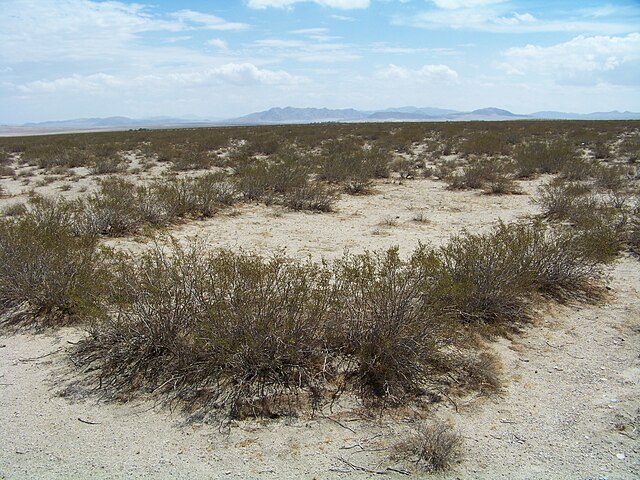
Looks tasty, doesn’t it? Somewhere, Norman Borlaug is ROTFL.
Gee, I wonder how wheat crops will fare when the climate ‘changes’? Oh, wait… different varieties have already been bred to grow in a wide range of climatic conditions.
I guess we’re too stupid to be able to continue using rational solutions. Actually, given the recent focus and conclusions of so many scientIFic studies, perhaps, worryingly, we are becoming that stupid. Aaargh!
This is some hard charging science.
“….could be more vulnerable.”
It’s worse than we thought.
Add the University of the Witwatersrand to the list of universities that publish annoying press releases. I went to their site to figure out what units belong on the X-Y graphics above, but all the information in the press release is here.
I’ll assume the X and Y are in meters, and then the shading is the strength of the creosote scent measured by the scientist’s pet dog.
I’ll pretend the dashed line and solid line don’t exist.
“A new study by a Wits University scientist”
Was the T deliberately left off the name of the university?
The claim that the climate of the Western Cape has been stable for hundreds of thousands of years is absurd. The tiny, but phenomenally rich, floral kingdom found there, is presently the recipient of winter rainfall brought by the westerly wind belt shifting north and kept dry by prevailing southeasterly trade winds in summer. At the end of the last Ice Age it received exclusively summer rainfall with a period in between when it received both, all within thirteen thousand years.
Let’s say I am biologist. I need money for my research. Assume I am not quite a scientist, more a scientist-in-training or a scientist-wanna-be. Let us also say that there are gobs of money lying around for anything that can be associated with global warming. OK heck… why not? I might just come up with a study, about something, like my favorite bush, so I can have a travel budget and get some graduate students to carry my stuff and I get to do talks! Like David Suzuki! Yeah, that’s the ticket!
Yeah, Bushes they are threatened… that’s the word, yeah threatened, by ah… climate change. Yeah….Oh mann, I can see the academic prizes being hung around my neck by my admirers.
Sweet!
It lacks the essential emotive angle,
I have tried to marshal support for the creosote plant BUT – its just not in the penguin or polar bear class at all.
And i suspect that if it lasted this long, it could also survive any outlandish hypothesis, even AGW.
I have zero expertise in climate science, but nearly 60 years experience in gardening, most of that in the Mojave desert. Creosote is a very interesting plant, but has nothing to do with food. It grows so slowly, that it isn’t of any use for anything – animals don’t even eat it. It is highly flamable, and easily damaged by fire and motorized vehicles, but it survives remarkably anyway.
As for food crops, all that is really necessary is abundant and low cost energy to deal with almost any climate change imaginable. Green houses and subterranean farms would be effective almost everywhere. The climate hysterics insist on attempting to pour two quarts of liquid into a one quart container – and call it “science.”
Further proof that climate ‘science’ and reality cannot co-exist.
Let’s not be quite so sarcastic. According to Wikipedia:
‘In 2005, Health Canada issued a warning to consumers to avoid using the leaves of Larrea species because of the risk of damage to the liver and kidneys.’
Ok, see, there’s lots of people in this world who could safely consume this plant because we know there’s lots of people in this world who don’t have livers and kidneys. Would anybody here wish to take away a tasty, juicy, delectable food source that people without livers and kidneys could potentially enjoy? See, it is a valuable food crop after all – if you don’t have a liver or a kidney.
Or a brain.
Some scientists are having difficulty ‘separating the wheat from the creosote’.
Creosote bush? I used to live in the High Desert area of Southern California where the creosote bush thrives in summer daytime temperatures exceeding 115F while dropping to about 70F at night. Now, that’s climate change!
vigilantfish says:
February 21, 2014 at 6:12 am
Gee, I wonder how wheat crops will fare when the climate ‘changes’? Oh, wait… different varieties have already been bred to grow in a wide range of climatic conditions.
________________________
My favorite lefty told me the other day that modern wheat varieties, which grows shorter and produce greater yields, have been assigned the name “frankenwheat” among the trendy health- conscious greenies because it makes you fat. Since she weighs twice as much as me, I didn’t pop off and say “any port in a storm”.
pimf- “grow shorter”
Wits School of Animal, Plant and Environmental Sciences
You sure this isn’t the famous wits-end university of high quality idiots. It’s great to see how they added the word environment to the list just to ensure plenty of AGW grant money.
Half-Wits!
Creosote leaves used to be sold in health food stores (and might still be- don’t know.)
The word was that the leaves, while toxic in inappropriate amounts, de- toxed or otherwise masked the traces of THC in the human body. Scuttlebutt had it that the feds banned its use for that reason.
I don’t understand how the conclusion of the study was reached. If the polyploid and diploid variants of a given genome were living in the same environment, wouldn’t you expect them to resemble one another? What would be the driver for one plant to morph into something else? Wouldn’t it be a better experiment to look for species in neighboring, yet contrasting environments (Mountain tops vs. low valley at the base, for example) to see if there are polyploids that have similar genomes, yet have quite different adaptations?
This cannot be a “proper” scientific study. She nowhere mentions what the climate models predict (ooops, sorry! project) will happen to yields. Can’t do a scientific study with computer models!
sarc off/
Maybe all those polyploids will kick-in when the climate starts changing? Perhaps we need to fund more studies on this?
Oh wait…Mission accomplished!!
May I proclaim the discovery of the new sub-species, Homo Fatuus?
Alan Robertson
February 21, 2014 at 6:59 am
says:
‘The word was that the leaves, while toxic in inappropriate amounts, de- toxed or otherwise masked the traces of THC in the human body.’
Well, Colorado and Washington State just eliminated any imaginable commercial use for this plant.
No link to the paper, but I’m guessing that a fairly straightforward study of the population dynamics of polyploids morphed via press release into a study that “has overturned a long-standing hypothesis about plant speciation” and “means that environmental factors do not play a large role in the establishment of new plant species.” The latter is a ridiculously long reach given all the recent work elucidating how edaphic specialization can drive speciation.
What happens when plant/crop-ignorant climate change artists start speculating.
Anyone with half a brain nows that global warming would help, not hurt, plant life, especially with an abundant supply of CO2. Ane WE control where those plants seeds go, not Nature, and if we need to move some species to a higher latitude, big deal.
I was certain the creaosote link would take me to Monty Python’s Mr Creosote.