Date: Friday January 17, 2014
Subject: “The Global Warming Hoax” and “War on Carbon” Clips
From: Bob Tisdale
To: Jon Stewart
Dear Jon:
I am an independent climate researcher and regular contributor at the award-winning science blog WattsUpWithThat. I am also the author of three ebooks on global warming, climate change and the poor performance of climate models. I am writing to you about your January 6, 2014 episode (full episode here) of The Daily Show. It began with “The Global Warming Hoax” and “War on Carbon” clips, which ran consecutively when aired.
First, let me say that I applaud you and your staff for making The Daily Show a massively entertaining political satire. I enjoy the show thoroughly.
During your January 6th episode, however, you expressed beliefs in climate models and in the climate science community…the human-induced global warming wing thereof. Unfortunately, the climate models used to hindcast past climate and to project future climate are so flawed that they are not fit for their intended purposes. And the climate science community under the direction of the IPCC (Intergovernmental Panel on Climate Change) has specialized in only one aspect of global warming, which is why the models perform so poorly. I’ll provide evidence for those statements in the following, including data and peer-reviewed scientific studies.
MUCH HAS CHANGED IN 7 YEARS
For most people, their understanding of climate science comes from the time around 2006-2007 when there was a lot of interest in global warming and climate change. Al Gore’s An Inconvenient Truth was getting press and the IPCC and Al Gore were awarded the Nobel Peace Prize. Things have changed drastically since then. Specialists in many fields of climate science are now writing papers about model failings, and they’re not small problems. They’re fatal flaws. Skeptics have become much better at presenting and illustrating those model failures, too, and describing why they’re important. And there has been a flood of peer-reviewed papers over the past two years, in which climate scientists are trying to explain the hiatus in global warming—with limited success and limited agreement; that is, there’s no consensus on the cause of the pause. Examples are discussed in the very recent Nature article Climate Change: The Case of the Missing Heat by Jeff Tollefson. Those scientists wouldn’t be writing those papers if the climate models had anticipated the current cessation of global surface temperature warming. Unfortunately, with the IPCC’s focus on manmade greenhouse gases, climate scientists still do not know how to model nature’s handiwork. More on this later.
THE DOCTORS ARGUMENT AGAIN
You presented a clip of Dan Weiss of the Center for American Progress who said:
If 97 doctors told you that that lump on your lung was something to worry about, and 3 scientists — er, doctors — told you not to worry about it, are you going to listen to the 97, or the 3? Sounds like you might listen to the 3, which would be sad.
(Quotes from the DailyKos transcript here.)
That argument has been used a lot recently.
You were right to point out the error in the logic of the response to it, which was to the effect of climate scientists are paid to… But the reality of the situation is something altogether different.
The climate science community has specialized in only one aspect of global warming and climate change, and as a result, they have overlooked other major contributors.
I’ve addressed this problem previously in two open letters—one to George Clooney and your associate Lewis Black here, and one to the Executive Producers of the upcoming ShowTime series Years of Living Dangerously here. As I wrote to Black and Clooney:
The climate science community, under the direction of the IPCC (Intergovernmental Panel on Climate Change), has only been tasked with determining whether manmade factors, primarily carbon dioxide, could be responsible for the recent bout of global warming, and what the future might bring if the real world responds to projected increases in manmade greenhouse gases in ways that are similar to climate models. They were not asked to determine if naturally caused, sunlight-fueled processes could have caused the global warming over the past 30 years, or to determine the contribution of those natural factors in the future—thus all of the scrambling by climate scientists who are now trying to explain the hiatus in global warming. Refer to the IPCC’s History webpage (my boldface):
Today the IPCC’s role is as defined in Principles Governing IPCC Work, “…to assess on a comprehensive, objective, open and transparent basis the scientific, technical and socio-economic information relevant to understanding the scientific basis of risk of human-induced climate change, its potential impacts and options for adaptation and mitigation…”
It is not the IPCC’s role to understand the scientific basis for naturally caused climate change, which the Earth has experienced all along. As a result, even after decades of modeling efforts, climate models still cannot simulate naturally occurring ocean-atmosphere processes that contribute to global warming or stop it. So a “doctors” example falls flat because it relies on experts whose understandings of climate are extremely limited in scope.
The response to “97 doctors” argument should have been: “Would you see a podiatrist or proctologist for that lump on your lung?”
CLIMATE SCIENTISTS ABOUT THE IPCC’s FOCUS ON MANMADE GREENHOUSE GASES
The climate science community now understands the problems caused by limiting their research to the increased emissions of manmade greenhouse gases, primarily carbon dioxide.
The Royal Netherlands Meteorological Institute (KNMI) is concerned about the IPCC’s focus. See their document titled Submission by The Netherlands on the future of the IPCC. Under the heading of “The IPCC needs to adjust its principles”, KNMI begins:
We believe that limiting the scope of the IPCC to human-induced climate change is undesirable, especially because natural climate change is a crucial part of the total understanding of the climate system, including human-induced climate change.
This failure to properly account for natural factors also led a former lead author of IPCC reports (Kevin Trenberth of NCAR) to remark in David Appell’s 2013 article “W(h)ither global warming? Has global warming slowed down?”
“One of the things emerging from several lines is that the IPCC has not paid enough attention to natural variability, on several time scales,” he [Dr. Trenberth] says, especially El Niños and La Niñas, the Pacific Ocean phenomena that are not yet captured by climate models, and the longer term Pacific Decadal Oscillation (PDO) and Atlantic Multidecadal Oscillation (AMO) which have cycle lengths of about 60 years.
To put that into more basic terms: There are naturally occurring multidecadal variations in surface temperatures of the Northern Hemisphere oceans (see the post here), and they were major contributors to the warming experienced since the mid-1970s. Climate models do not simulate those modes of natural variability. To compound the problems, the modelers had tuned their models during the naturally occurring upswings, failing to account for the peaking and downswings in cycles that would eventually occur (and are now occurring). I provided an overview of the potential impact of this in the post Will their Failure to Properly Simulate Multidecadal Variations In Surface Temperatures Be the Downfall of the IPCC?
That article by David Appell is also noteworthy, because it provides another example of the lack of consensus on the cause of the cessation of global surface warming. If climate scientists can’t agree on an explanation for why Earth’s surface stopped warming, it casts a lot of doubt on their consensus on the cause of the warming we had experienced from the mid-1970s to about 2000.
CLIMATE SCIENTISTS DISCUSS THE FLAWS IN CLIMATE MODELS
You mentioned climate models and peer-reviewed science in your clip, Jon. It appears you may not beaware of this, but there are a number of peer-reviewed papers that are very critical of climate model performance. I presented some of them recently in the post Questions Policymakers Should Be Asking Climate Scientists Who Receive Government Funding. Those papers served as references for the following questions, which all began with a common phrase:
After decades of climate modeling efforts…
- …why does the current generation of climate models simulate global surface temperatures more poorly than the prior generation?
- …why can’t climate models properly simulate sea ice losses in the Arctic Ocean or sea ice gains in the Southern Ocean surrounding Antarctica?
- …why can’t climate models properly simulate atmospheric responses to explosive volcanic eruptions?
- …why do climate models continue to poorly simulate precipitation and drought?
- …why can’t climate models simulate multidecadal variations in sea surface temperatures?
- …why can’t climate models simulate the basic processes that drive El Niño and La Niña events?
In that post (linked again here), I quoted portions of the peer-reviewed papers that supported those questions and I translated the science-speak into language that is more readily understood by readers who aren’t intimate with climate science.
BLOG POSTS THAT ILLUSTRATE THE PROBLEMS WITH THE MODELS
If you’re a visual person, Jon, over the past year I’ve presented a series of blog posts that illustrated and discussed many climate model failings, and for those posts, I’ve presented the average of all of the outputs of the current generation of climate models stored in an archive used by the IPCC for their 5th Assessment Report. Climate-related data and climate model outputs are available online to the public, in easy-to-use formats, through the web tool called Climate Explorer from KNMI (Royal Netherlands Meteorological Institute). I have also published posts that provide Step-By-Step Instructions for Creating a Climate-Related Model-Data Comparison Graph and a Very Basic Introduction To The KNMI Climate Explorer. It’s a relatively easy process. In fact, many middle school students could replicate my graphs. Some of the posts that illustrate the many flaws in climate models are linked below by subject. Basically, climate models do not properly simulate:
- Global Surface Temperatures (Land+Ocean) Since 1880
- Global Sea Surface Temperatures Since 1880
- Satellite-Era Sea Surface Temperatures
- Daily Maximum and Minimum Temperatures and the Diurnal Temperature Range
- Hemispheric Sea Ice Area
- Global Precipitation
Those posts and other examples are collected in my ebook Climate Models Fail, which is available in pdf and Amazon Kindle editions. Refer to the introduction here.
THE SHIP OF FOOLS
Back to your January 6th episode. You played a clip of Fox News’s Eric Bolling stating:
I gotta tell you, I think these scientists are laughing from their lavish laboratories, and their vacations up at the Arctic, in their nice boats that are well-equipped.
While first showing a image of an ice field and then showing a photo of the Akademic Shokalskiy caught in sea ice (screen cap below), you replied:
This Arctic? This lavish boat?
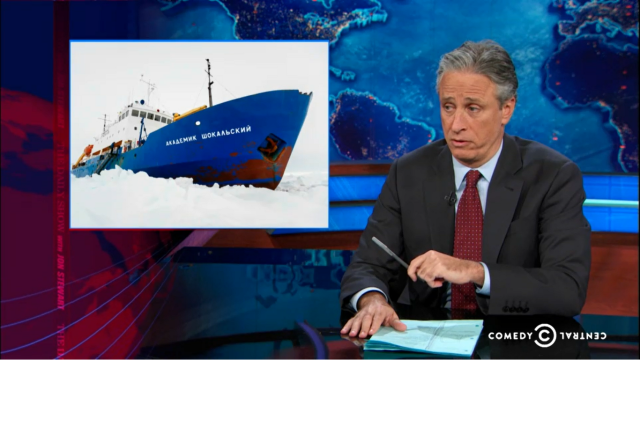 A minor problem: That “lavish boat” was not in the Arctic. The AkademicShokalskiy, one of the “Adventure Class” tour boats from Southern Explorations, was caught in the sea ice of the Southern Ocean surrounding Antarctica. And it was just after the start of the Southern Hemisphere summer a few weeks ago. Tours on that ship are not inexpensive. Rates range from “$5,720 to $21,590 per person”. The Mark Steyn: Global warming’s glorious ship of fools article at TheSpectator is a very humorous overview of the fiasco involving the Spirit of Mawson researchers, their families, tourists and reporters getting stuck in the sea ice…and the international rescue efforts. On the more technical side, Steve McIntyre of ClimateAudit has documented the sea ice conditions leading to the debacle, including where the data contradicts the claims made by the lead researcher. See Steve’s post Ship of Fools. Recall also that climate models simulate that sea ice should be decreasing in the Southern Ocean, but it has increased in area since 1979.

DATA SHOWS NO CHANGES IN EXTREME WEATHER OR RELATED INSURANCE LOSSES
Early in the show, Jon, you mentioned weather extremes (my boldface):
There you have it. War on Christmas is over, the War on Carbon begins. Global warming, just one more liberal conspiracy. Because even though there is a great deal of scientific data establishing climate trends, even though many of the models of global warming predict more extremes of weather — not just warming — apparently decades of peer-reviewed scientific study can be, like a ficus plant, destroyed in one cold weekend.
As presented earlier, climate models are flawed, likely to the point that they are not fit for purpose.
Data from the real world present an entirely different picture of extreme weather events. In my Open Letter to the Executive Producers of the Years of Living Dangerously, (also linked earlier) I included graphs of data from the testimony of Roger Pielke, Jr. at the U.S. House Subcommittee on Environment held on December 11, 2013: A Factual Look at the Relationship Between Climate and Weather. So please click on the link above to Dr. Pielke Jr’s testimony for graphs of the data. The following are the take-home points from his testimony, points that are supported by data (my boldface):
- Globally, weather-related losses have not increased since 1990 as a proportion of GDP (they have actually decreased by about 25%).
- Insured catastrophe losses have not increased as a proportion of GDP since 1960.
- Hurricanes have not increased in the US in frequency, intensity or normalized damage since at least 1900.
- There are no significant trends (up or down) in global tropical cyclone landfalls since 1970 (when data allows for a comprehensive perspective), or in the overall number of tropical cyclones.
- Floods have not increased in the US in frequency or intensity since at least 1950.
- Flood losses as a percentage of US GDP have dropped by about 75% since 1940.
- Tornadoes have not increased in frequency, intensity or normalized damage since 1950, and there is some evidence to suggest that they have actually declined.
- Drought has “for the most part, become shorter, less frequent, and cover a smaller portion of the U. S. over the last century.”
I also addressed sea levels and Hurricane Sandy in that Years of Living Dangerously article.
A COUPLE OF QUICK MODEL-DATA COMPARISONS
Let’s return to climate models: how poorly they simulate global surface temperatures. The following graphs are very easy to understand. They are model-data comparisons of global surface temperatures for the past 3+ decades. The start time is dictated by the use of satellite-enhanced sea surface temperature data. The graph on the right compares global land air surface temperature data with climate model simulations of it. The models performed reasonably well on a global basis when simulating land surface air temperatures. Before we move to the graph on the left, you have to understand that the vast majority of the rise of land surface air temperatures in the real world is in response to the warming of the surfaces of the oceans. Land surface air temperatures mimic and exaggerate the variations in the surface temperatures of the oceans. Now, the graph on the left compares global sea surface temperature data with climate model simulations. The models doubled the rate of warming of the surface temperatures of the global oceans for the past 3+ decades. Doubled. That, in and of itself, is horrendous. Now consider that the modelers had to double the rate of warming of the surfaces of the oceans in order to get the land surface air temperatures near to where they needed to be.
(Click to enlarge.)

A BIG FLAW IN THE MODELS
I’m sure you’ve heard of the global warming hiatus, the pause, etc. I presented the following in a post that I linked earlier, but it should be repeated. Recently, there have been two very enlightening peer-reviewed studies on the topic of the recent cessation of the warming of global surface temperatures. The first is Von Storch, et al. (2013) “Can Climate Models Explain the Recent Stagnation in Global Warming?” They stated:
However, for the 15-year trend interval corresponding to the latest observation period 1998-2012, only 2% of the 62 CMIP5 and less than 1% of the 189 CMIP3 trend computations are as low as or lower than the observed trend. Applying the standard 5% statistical critical value, we conclude that the model projections are inconsistent with the recent observed global warming over the period 1998- 2012.
According to Von Storch, et al. (2013), both recent generations of climate models (CMIP3 used by the IPCC for their 2007 4th Assessment Report, and CMIP5 used by the IPCC for their recent 5th Assessment Report) cannot explain the recent slowdown in global surface warming. The models show continued global surface warming, while observations do not.
The second paper is Fyfe et al. (2013) “Overestimated global warming over the past 20 years.” Fyfe et al. (2013) write, requiring no translation from science-speak:
The evidence, therefore, indicates that the current generation of climate models (when run as a group, with the CMIP5 prescribed forcings) do not reproduce the observed global warming over the past 20 years, or the slowdown in global warming over the past fifteen years.
Looking at this realistically, if the climate models cannot explain the current slowdown or halt in global surface warming, then they cannot be used to explain the warming that had occurred from the mid-1970s to the late-1990s. In turn, they have little value as tools for making predictions of future climate. It’s unfortunate, but that’s the sad reality of the state of climate science today.
CLOSING
In closing, Jon, when people imagine climate models, maybe it’s best to think of early generations of CGI (computer generated imagery). A decade or two ago, we’d go to the movies and be amazed at the images on the big screen. And we probably thought some of the video games at that time were also impressive. Looking back at them now, they look hokey.
Climate models used by the IPCC for hindcasting and projections of future climate are at the hokey-looking phase of development. And the more you investigate them, the hokier they look.
Jon, if you have any questions, please feel free to leave a comment on any thread at my blog Climate Observations.
Sincerely,
Bob Tisdale
PS: If you should know of a comedian who’s tired of the tripe we’ve been seeing from the catastrophic manmade global warming wing of the climate science community, please let them know I’m looking for a co-author for my next book. Working title: The Oceans Ate My Global Warming. I’m looking for someone to help make it fun to read.
Thanks.
Discover more from Watts Up With That?
Subscribe to get the latest posts sent to your email.
If you should know of a comedian who’s tired of the tripe we’ve been seeing from the catastrophic manmade global warming wing of the climate science community,
The American comedian Evan Sayet would seem to fit the bill — he recently published a book called The Kindergarden of Eden, which takes issue with the overall “progressive” mindset of which the global warming scare is a subset.
Brilliant Bob – thank you
I wish these people would actually sit down and read what you wrote. Unfortunately they fall into two categories.
1. They know CAGW is a hoax and have a monetary interest in making sure the Hoax is not uncovered. Would you trust “Bernie” Madoff for financial advice?
2. They are fanatics whose minds are set in concrete. They do not care whether CAGW is true because they see it as a way to further ‘The Cause’
“We redistribute de facto the world’s wealth by climate policy…Basically it’s a big mistake to discuss climate policy separately from the major themes of globalization…One has to free oneself from the illusion that international climate policy is environmental policy. This has almost nothing to do with environmental policy anymore.” ~ Ottmar Edenhoffer, high level UN-IPCC official
Another great article, Bob. Some people just won’t get it until you hammer it in.
The question is, does Jon Stewart have sufficient character to reject the invalid data sets on which he based his programme of 6th January, or is he just a deluded comedy actor?
While I realise that on open letter isn’t just for the benefit of the addressee, I’d suggest that if you actually want him to read it then perhaps it should be a lot shorter. All good stuff though in any case.
I suspect your open letter is over the head of Mr. Stewart and I would be surprised if he or any of his staff had the attention span to make it all the way through. In entertainment terms he is akin the the Star Trek character ‘Q’; a smart guy with an entourage of cheering or sneering sycophants waiting to be told which reaction to display. He’s going for laughs, not facts.
Rick Bradford, thanks for the tip.
@Blair – the letter is indeed over the head of Jon Stewart. But it is a good reference work when debating the type 2 people that Gail Combs talks about. While it will not change their minds (as she says, they are fanatics), it will show the casual observer the emptiness of their fanaticism.
Jon Stewart Leibowitz does simple Brechtian Agitation & Propaganda. He’s not about facts or truth but about earning big bucks for ramming through his political agenda. We have BTW an imitation of him in German state TV and it’s just as repulsive.
Up to your usual high standard Bob, thanks,
PS, I thought you were reducing output, obviously not. Keep it up.
This is probably over the head of comedians but not because they choose to ignore it. rather becasue it outside of their field of expertidse.
This requires analysis of measurements. “Journalists” analyse sources. This technical report fails against the authority of the UN IPCC.
However, satirists are the one group of journalists who may look critically at authority. So it is worth a punt.
Bob,
Your open letters are pearls before swine.
More to the point, “Would you see those 97% if their misdiagnosis rate were 95%? The actual global temperature is going to fall below their 95%-confidence range this year.
It’s too much to expect anyone with a regular show on TV to take a contrarian position, because they’d lose so much of their audience and draw so much vitriol. They most we can expect from non-heroic humanity in their positions at this point is silence or waffling.
Incidentally, has Jay Leno made any cheap jibes at contrarians? (I know Letterman has.)
Everyone has biases, both personal and professional. Most people come to think of their collective biases as “mature judgement”.
“Fish gotta swam; birds gotta fly …”
Surgeons have a bias towards surgery; bureaucrats have a bias towards regulation.
Comedians have a bias toward what’s funny. TV show personalities have a bias towards what fits the average viewer’s attention span.
The problems with your open letter with respect to Jon Stewart are it isn’t funny and it isn’t brief.
I loved it, but I don’t do a weekly commentary/comedy TV show for a living.
Educational read as always. Sadly another I fear will fall on deaf eyes, so to speak. I doubt very much that Jon Stewart would welcome the education. There is no material in the truth.
hunter says:
January 17, 2014 at 4:32 am
Bob,
Your open letters are pearls before swine.
________________________________________________________________
That was the phrase that came to mind. Does Stewart have the the intellectual depth or interest for this letter to make any impression? One of our problems is an amazing percentage of people get their news from Jon Stewart. I know some very bright college professor types who get most of their national news from Stewart.
Still, it was an excellent letter one that should be written. Good job, Bob
Actually if I were writing to Jon about his coverage of climate change, I’d ask him to consider whether he wasn’t perhaps guilty of viewing the issue through exactly the same polarized left vs right political lenses that he accuses news organisations of using. Fundamentally this issue isn’t political Jon. Or it shouldn’t bel. The twits from Fox news keep trying to make it political. I wish they’d go away because they just stir the pot without adding anything of value to the discussion. The serious skeptics are skeptical for reasons havingf to do with the fundamental weakness of the scientific case, and they come from across the political spectrum.
And please also consider directing some of your razor wit the other way. There are some really pompous balloons in Big Green who deserve to be pricked. For example you were quite right to ridicule those who tried to link the cold snap to global warming. How about also ridiculing those who try to turn every storm, tornado, forest fire and flood into a hollywood global warming disaster movie.
Alan Watt, exactly. Arguing difficult facts with people only looking for the funny angle in anything is futile. If anyone in Stewart outfit reads it all, it will be with an eye to finding a quote that can be taken out of context and twisted so as to “expose” the insanity of the “denialists.”
Gail Combs says:
January 17, 2014 at 4:00 am
I wish these people would actually sit down and read what you wrote. Unfortunately they fall into two categories.
1. They know CAGW is a hoax and have a monetary interest in making sure the Hoax is not uncovered. Would you trust “Bernie” Madoff for financial advice?
2. They are fanatics whose minds are set in concrete. They do not care whether CAGW is true because they see it as a way to further ‘The Cause’
————————————————————————-
If you mean by “these people” people who believe, or claim to believe, in CAGW then you have missed out some massive categories.
I am sure other people can add others but here are two:
One group are those people who have not studied the issue at all, never read a sceptic blog and have pretty much ONLY heard the warmist view through the media. They may never have heard a sceptical argument actually put forward by a sceptic. Not surprisingly, if asked, they would agree with the warmist view but otherwise don’t think about it much.
Another massive group are more fervent believers. They may or may not have purposefully sought out information about CAGW but believe mainly because it fits their world view and is the default position of their group (e.g. the liberal left) and the media they consume and trust and to question CAGW it would require an heroic effort of rethinking on their part. Most importantly the arguments against CAGW are mostly put forward by people with whom they, by default, disagree Add their trusted media’s evil caricature of anyone who questions CAGW and there is almost zero chance they will question their received beliefs while they remain the group orthodoxy.
This second group includes, i suspect, almost all non-scientists you ever hear in the media being vehement about global warming and condemning sceptics. Virtually all comedians, writers, filmmakers, commentators etc you have heard on the subject fall into this group including, I believe, Jon Stewart. They are particularly influential because they are often popular, articulate, evidently bright and capable of putting an argument across in a convincing manner no matter how factually wrong it is..
I suspect there are comedians etc who privately question CAGW and avoid speaking directly about it in public because they realize that at the moment it would be career and personal relationship damaging to “come out”.
I’ve said before that we will know that the CAGW scare is really dead on its feet when “credible” comedians routinely make jokes about it on mainstream television. Even though things can change quickly, that’s still a way off.
Bob Greene says:
January 17, 2014 at 4:44 am
“I know some very bright college professor types who get most of their national news from Stewart.”
He plays them like a fiddle and you call them bright?
DirkH says:
January 17, 2014 at 4:25 am
Any particular reason for not just using Stewart’s professional name which everyone knows him by?
I, for one, don’t want to have anything to do with anyone using someone’s mere accident-of-birth ethnicity against them. I hope you don’t either.
Nice letter but I can assure you of one thing: That idiot is unable to read a letter as long as this. His type lives in soundbites. He does not have the attention span to read so many words in one sitting.
I watched the program that day, and considered writing a letter to Jon Stewart as well. Of interest, at least in my TV market; one of the ads that played right after the “Global Warming Hoax” segment was “Save the polar bears.”
Stewart will never own up to his mistakes, especially when it comes to the cause du jour.
I mean, seriously: do these liberal media personalities become famous by being measured and thoughtful, or by being relentless and uncompromising?
I, too, have friends who get their news from Jon Stewart, and their moral guidance from South Park. And people wonder why we’re nearly bankrupt?
Anyway, thank you for taking the time to construct this very well crafted, factually driven view of global warming/climate change.