Seas have been rising and falling for thousands of years – without help from the EPA or IPCC
Guest essay by Robert W. Endlich
Sea levels are rising rapidly! Coastal communities are becoming more vulnerable to storms and storm surges! Small island nations are going to disappear beneath the waves!
Climate alarmists have been making these claims for years, trying to tie them to events like “Superstorm” Sandy, which was below Category 1 hurricane strength when it struck New York City in October 2012, and Typhoon Haiyan, which plowed into the low-lying central Philippines in November 2013.
For alarmists, it does not seem to matter that the strength and frequency of tropical storms have been decreasing in recent years, while the rate of sea level rise has fallen to about seven inches per century. Nor does it seem to matter that the lost lives and property have little to do with the storms’ sheer power. Their destructive impact was caused by their hitting heavily populated areas, where governments had not adequately informed citizens of the size and ferocity of imminent storm surges, too few people had evacuated – and people, buildings and emergency equipment were insufficiently prepared to withstand the furious storm onslaughts.

The alarmist cries are not meant to be honest or factual. They are intended to generate hysterical headlines, public anxiety about climate change, and demands for changes in energy policies and use.
China is rapidly becoming one of the richest nations on Earth. It is by far the largest single emitter of carbon dioxide, which alarmists claim is causing “unprecedented” storms and sea level rise. And yet at the recent UN-sponsored climate talks in Warsaw, China led a walkout of 132 Third World countries that claim First World nations owe them hundreds of billions of dollars in “reparations” for “losses and damages” allegedly resulting from CO2 emissions.
The Obama Administration brought (perhaps “bought” is more apt) them back to the negotiating table, by promising as-yet-unspecified US taxpayer money for those supposed losses. Details for this unprecedented giveaway will be hammered out at the 2015 UN-sponsored climate confab in Paris, safely after the 2014 US mid-term elections. Meanwhile, a little history will be instructive.
In 2008, presidential candidate Barack Obama proclaimed, “This was the moment when the rise of the oceans began to slow.” He was actually right. Sea level rise has slowed, but not because of CO2 emissions, which are still increasing. Mother Nature cannot be bought.
Sea level changes over relatively recent geologic and human history demonstrate that alarmist claims do not withstand scrutiny. Sea levels rose significantly after the last ice age, fell during the Little Ice Age, and have been rising again since the LIA ended around 1850. In fact, Roman Empire and Medieval port cities are now miles from the Mediterranean, because sea levels actually fell during the Little Ice Age.
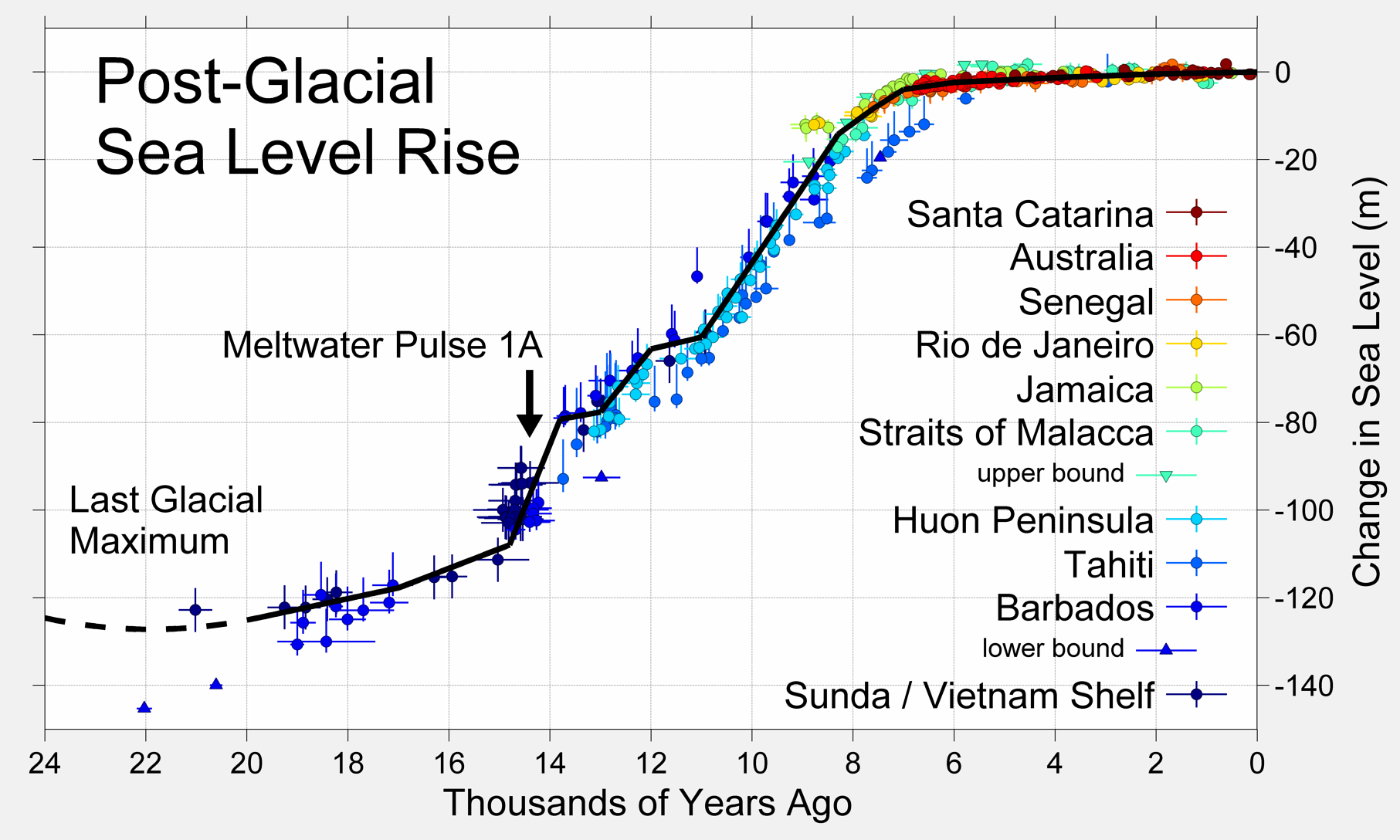
During the deepest part of the last ice age, known as the Wisconsin, sea levels were about 400 feet lower than at present. As Earth emerged from the Wisconsin some 18,000 years ago and the massive ice sheets started to melt, sea levels began rising. Rapid sea level rise during the “meltwater pulse phase,” about 15,000 years ago, was roughly five meters (16 feet) per century – but then slowed significantly since the Holocene Climate Optimum, about 8,000 years ago.

Those rising oceans created new ports for Greek and Roman naval and trade vessels. But today many of those structures and ruins are inland, out in the open, making them popular tourist destinations. How did that happen? The Little Ice Age once again turned substantial ocean water into ice, lowering sea levels, and leaving former ports stranded. Not enough ice has melted since 1850 to make them harbors again.
The ancient city of Ephesus was an important port city and commercial hub from the Bronze Age to the Minoan Warm period, and continuing through the Roman Empire. An historic map shows its location right on the sea. But today, in modern-day Turkey, Ephesus is 5 km from the Mediterranean. Some historians erroneously claim “river silting” caused the change, but the real “culprit” was sea level change.

Ruins of the old Roman port Ostia Antica, are extremely well preserved – with intact frescoes, maps and plans. Maps from the time show the port located at the mouth of the Tiber River, where it emptied into the Tyrrhenian Sea. The Battle of Ostia in 849, depicted in a painting attributed to Raphael, shows sea level high enough for warships to assemble at the mouth of the Tiber. However, today this modern-day tourist destination is two miles up-river from the mouth of the Tiber. Sea level was significantly higher in the Roman Warm Period than today.


An important turning point in British history occurred in 1066, when William the Conqueror defeated King Harold II at the Battle of Hastings. Less well-known is that, when William landed, he occupied an old Roman fort now known as Pevensey Castle, which at the time was located on a small island in a harbor on England’s south coast. A draw bridge connected it to the mainland. Pevensey is infamous because unfortunate prisoners were thrown into this “Sea Gate,” so that their bodies would be washed away by the tide. Pevensey Castle is now a mile from the coast – further proof of a much higher sea level fewer than 1000 years ago.
Before modern Italy, the region was dominated by the famous City States of the Mediterranean, among which is Pisa, with its picturesque Cathedral Square and famous Leaning Tower. Located near the mouth of the Arno River, Pisa was a powerful city, because maritime trade brought goods from sailing ships right into the port. Its reign ended after 1300 AD, the onset of the Little Ice Age, when sea levels fell and ships could no longer sail to her port. Once again, some say “river silting” was the cause.

However, Pisa is now seven miles from the Tyrrhenian Sea, with large meanders upstream from Pisa and little meandering downstream. When a river is “at grade,” the downstream gradient is as low as possible, as with the meandering Mississippi River and delta in Louisiana. Rivers with a strong downstream gradient flow to the sea in a direct route, with few meanders, as with the Rio Grande in New Mexico.
The facts of history are clear. Sea level was 400 feet lower at the end of the Wisconsin Ice Age, 18,000 years ago. Sea levels rose rapidly until 8,000 years ago. As recently as 1066, when the Normans conquered England, sea levels were quite a bit higher than today.
During the Little Ice Age, 1300 to 1850 – when temperatures were the coldest during any time in the past 10,000 years – snow and ice accumulated in Greenland, Antarctica, Europe and glaciers worldwide. As a consequence, sea levels fell so much that important Roman Era and Medieval port cities (like Ephesus, Ostia Antica and Pisa) were left miles from the Mediterranean.
Since the Little Ice Age ended about 160 years ago, tide gages show that sea level has risen at a steady rate – with no correlation to the rise in atmospheric carbon dioxide levels.
Sea level is a dynamic property in our planet’s climate cycles, which are closely linked to changes in solar energy output and other natural factors. It is unlikely to change in response to tax policies that make energy more expensive and economies less robust – no matter what politicians in Washington, Brussels or the United Nations might say.
Much to their chagrin, Mother Nature doesn’t listen to them. She has a mind of her own.
____________
Robert W. Endlich served as a weather officer in the US Air Force for 21 years and a US Army meteorologist for 17 years. He was elected to Chi Epsilon Pi, the national Meteorology Honor Society, while a basic meteorology student at Texas A&M University. He has degrees in geology and meteorology from Rutgers University and the Pennsylvania State University, respectively, and has studied and visited the ancient sites of Rome, Ostia Antica and Pisa.
Discover more from Watts Up With That?
Subscribe to get the latest posts sent to your email.
Chip Javert says:
December 2, 2013 at 9:43 am
“Water being incompressible (essentially true) does not necessarily mean a given mass of water has constant volume. Water above about 4 degrees will expand when heated. Your home’s water heater has been engineered to safely accommodate this physical property.”
———–
All bodies of water on the surface of the earth, …. including all the oceans, the seas, the lakes, the rivers, the swamps and the ponds ……. have all been gradually “warming up” ever since the end of the Little Ice Age.
Thus, the total volume of all said water has expanded in direct proportion to the amount of said “warming up” ….. therefore causing a greater outflow of water into the oceans …. from all the aforesaid containment entities ….. which is cumulative with the expansion of the ocean waters themselves …… therefore directly causing an increase in sea levels.
How much of an increase in sea levels? I wouldn’t know.
(avg 150 year temp increase) (orig vol of H2O) (expn coefficient of H2O) = current vol of H2O
***
rgbatduke says:
December 2, 2013 at 1:54 pm
Water is also “odd” in that it achieves its highest density at around 4C (281K), not at its freezing point. Ice actually floats and is LESS dense than water by around 10%. That is, water expands by 20-30 times as much cooling from 4C to freezing than it does expanding from 4C to 100C. So BOTH ice and the coldest seawater and all the warmer water float on top of 4K seawater.
***
Never before spotted a boo-boo in your replies, but seawater is most dense at zero C. You described pure water.
***
Werner Brozek says:
December 2, 2013 at 4:30 pm
As for the highest density at 4 C, that only applies to fresh water. Ocean water with all of its salt is densest at its freezing mark of -1.94 C.
***
Sorry — didn’t see your reply at first. You’re right, of course.
“Sea levels are rising rapidly! Coastal communities are becoming more vulnerable to storms and storm surges! Small island nations are going to disappear beneath the waves! Climate alarmists have been making these claims for years…”
Not to mention the fact that in many countries the majority of the population live near the coast, so these claims of rising seas by so-called “scientists” are being used to increase regulations and insurance rates on people’s land.
We often see the claim that river deposited sediment should raise sea level, but over the long haul, as continents turn inside out, they rise as they lose mass due to erosion. That’s how the Colorado River stayed more or less at the same elevation as the Grand Canyon rose above it. Continental lift compensates for erosion/sedimentation. The rest of the planet–mainly ocean basins–must then drop to compensate for the continental lift. –AGF
Very interesting. Another example of potential sea level decline: The coast at Thermopylae, where the 300 Spartans of antiquity famously held off a huge Persian army in a narrow pass between the mountains and the sea, would now be impossible to defend: The shoreline is now several kilometers away, with the difference ascribed to “sedimentary deposition” from river silt and travertine deposits of the hot springs from which the “Hot Gates” took their name.
http://en.wikipedia.org/wiki/Thermopylae
The usual crap. Global warming deniers grabbing every new shaky argument they can after the old ones all fall, one after the other, through the seriousness of continuous scientific investigation. Not even wasting my time to contrast this article. What I see instead is the damage these people do for continuously delaying urgent action. But, hey, irresponsible people like to put obstacles everywhere before doing something and taking responsibility for the incompleteness of the reasoning in what they say. For that the onus is always on the others.
[Make up your mind which email address and what logon name you are going to use.
Do not use false email addresses, do not use two different ID’s. Mod]
Can you name even one “shaky” idea that has fallen? No? I didnt think so.
The truth is that what small relationship to temperature additional CO2 has is a reaction to rising temperature. This is apparent in all, even the alarmist doctered, data. The reason CO2 rises is most likely (97%) in response to the natural function of cooling the troposhere through its radiation of heat away from the earth. Basic radiative science….
Of course science has nothing to do with the beliefs of activist, like you appear to be.
OK. You – the hysteria and propaganda you are promoting about 1/5 of 1 degree increase in temperature since 1970, 3/4 of 1 degree since 1850, killed 26,000 real people last winter in the UK alone.
You, your propaganda and hatred, are directly responsible for the deaths of millions and the future harm to billions by denying them cheap energy, clean water, good food and better transportation and clean air and warm houses and sewage treatment.
Against this real world harm and real deaths, you offer nothing but a “possibility” of averting “some” of a “potential” increase in global temperature that – in reality – has NO harm at all but with an increase in CO2 that promotes plant growth and more food, fuel, fodder, and green growth for all on earth. Worse, even that “potential” aversion of potential far-distance-future-temperature increase is falsified by the facts that CO2 levels and global temperatures levels have had no relationships at any time: while CO2 was constant, global temperatures increased, decreased, and remained steady. While CO2 has increased, global temperatures have increased, decreased, and remained steady.