Guest essay by Jim Steele, Director emeritus Sierra Nevada Field Campus, San Francisco State University.
On July 29, 2013 the BBC’s Hardtalk journalist Stephen Sackur wrote “The Alaskan village set to disappear under water in a decade.” He opened the story with “within a decade Kivalina is likely to be under water. Gone, forever. Remembered – if at all – as the birthplace of America’s first climate change refugees.” He then quotes a local who laments, “The US government imposed this Western lifestyle on us, gave us their burdens and now they expect us to pick everything up and move it ourselves. What kind of government does that?”

Given the context, such a statement sounds like the locals were feeling abandoned by global warming. But the tone also reminded me of the complaints by many native Arctic people who were relocated by the US, Canadian and Russian governments in a 20th century battle to secure claims to Arctic territory. Such a vulnerable location seemed odd for a permanent settlement.. Sure enough Wikipedia supported my suspicions Kitvalina. The original village was located at the north end of the Kivalina Lagoon but was relocated to its present location in about 1900. Reindeer were brought to the area and some people were trained as reindeer herders, suggesting there as a government attempt to force a permanent settlement. From the history I can glean on the internet “the people of Kivalina, like the Ipiutak before them, utilized the barrier reef only as seasonal hunting grounds, making camp there in warm-weather months.” Their recent plans to relocate due to erosion and an expanding population are opportunistically blamed on global warming.
The Arctic people have long been victimized by “southern people’s” politics. Relocation of indigenous families became a tactic employed by all the “polar bear countries” in an international chess match to stake claims on Arctic resources. In 1925, Denmark relocated families in Greenland to counter any Norwegian claims to the island. The following year the Soviet government moved a small Eskimo community to Wrangel Island in order to replace an occupation of Alaskan Eskimos that had been established there by American interests. The relocation of families was also a crucial cold-war tactic by Canada to insure their claims on the Arctic, but not just against any Russian threats, but more so from perceived encroachments by the United States.631
In 1944, Henry Larsen, a staff sergeant in the Royal Canadian Mounted Police, became the first to navigate the Northwest Passage from the west to east and back again. This celebrated feat greatly strengthened Canada’s claims to Arctic lands, and offset any potential Scandinavian claims based on Norway’s Roald Amundsen’s successful crossing of Canada’s Northwest Passage in 1903-06. However the US military bases built during World War II were now perceived as a threatening foothold. So in the 1950s Larsen was put in charge of relocating several Inuit families to Grise Fiord and Resolute Bay in the far northern reaches of the Canadian Arctic. Grise Fiord is known by its Inuit name that means “the place that never thaws.” Although these were strategic places in ongoing international maneuverings, it was a region long abandoned by the Inuit’s ancestors. Government stories of an unspoiled land where hunting was more bountiful enticed Inuit families to leave the milder climates of their villages along the central Hudson Bay. Government officials sealed the deal by suggesting there was absolutely no risk and promised a swift return passage if the families found their new settlement unsatisfactory.
But it was a promise that Canadian officials never intended to keep. Ironically, the woman who played Nanook’s wife in the popular 1930s documentary “Nanook of the North” and her son (who was fathered by the documentary’s producer) were among the families relocated to Grise Ford. Although “Nanook of the North” had enthralled Americans and Europeans with a glamorized depiction of Inuit resilience and adaptability, their new settlements doled out such incredible hardships their resilience was severely tested. The struggles of those families have now been well documented in the book, The Long Exile: A Tale of Inuit Betrayal and Survival. It was the film producer’s granddaughter, daughter of his half-Inuit, half-Caucasian son, who finally forced the Canadian government to own up to their betrayal. The Canadian government finally made a public apology in 2008 and paid reparations to the offended families.
Sackur’s article continues the long tradition of half-truths. To indict climate change he wrote:
- “Kivalina’s story is not unique. Temperature records show the Arctic region of Alaska is warming twice as fast as the rest of the United States.”
- “Retreating ice, slowly rising sea levels and increased coastal erosion have left three Inuit settlements facing imminent destruction, and at least eight more at serious risk.”
- “No longer does thick ice protect their shoreline from the destructive power of autumn and winter storms.”
However his story relies on zombie data. It was indeed true that Alaska had been warming twice as fast as elsewhere. In a 2012 paper climate scientists from Alaska Climate Research Center, University of Alaska reported, “a sudden temperature increase in Alaska was recorded starting in 1977, seemingly driven by the change in polarity of the Pacific Decadal Oscillation (PDO) Index, which went from dominantly negative before 1977 to dominantly positive values after that year” However unlike Sackur they also reported for the 21st century ” The mean cooling of the average of all stations was 1.3°C for the decade”1 Alaska is now one the most rapidly cooling areas on earth.
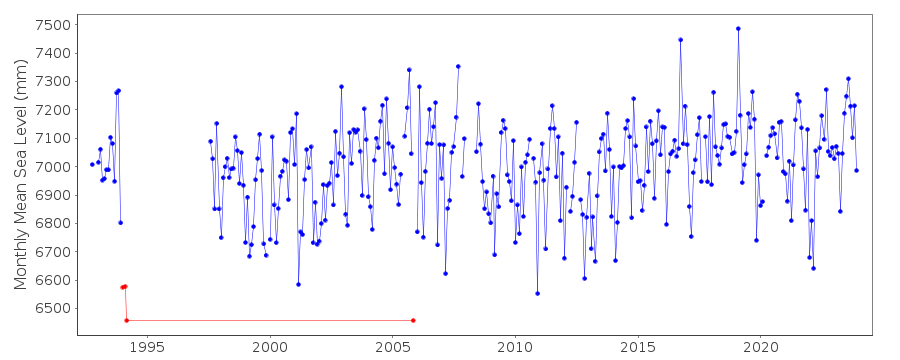
Sackur’s reference to “slowly rising sea levels” are also questionable. Go to the Permanent Service for Mean Sea Level website and view the 2 stations nearest to Kitvalina. At Nome Alaska the sea level is rising so slow it appears to be dropping over the last decade.
http://www.psmsl.org/data/obtaining/rlr.monthly.plots/1800_high.png

Or look at Prudhoe Bay .

http://www.psmsl.org/data/obtaining/rlr.monthly.plots/1857_high.png
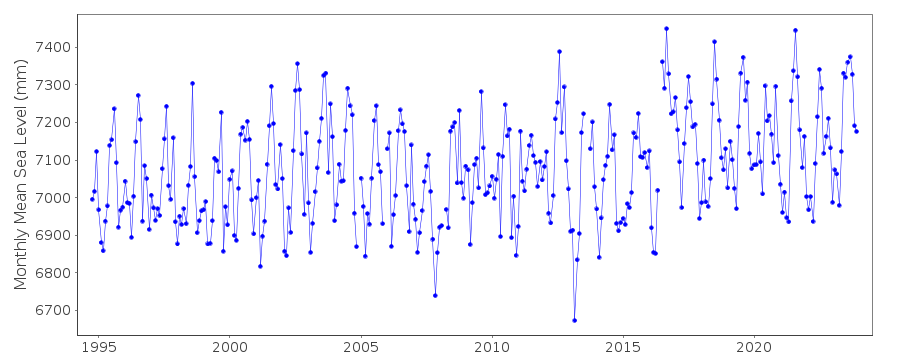
Except for a brief surge for a few months in late 2013, Prudhoe Bay sea level has been dropping there as well. The shifting PDO is also known to change sea level across the Pacific Ocean.
Finally it is hard to understand Sackur’s claim, “No longer does thick ice protect their shoreline.” In 2012 the National Snow and Ice Data Center reported “ice extent in the Bering Sea was much greater than average, reaching the second-highest levels for January in the satellite record.” NASA’s Earth Observatory wrote, “For most of the winter of 2011–2012, the Bering Sea has been choking with sea ice… NSIDC data indicate that ice extent in the Bering Sea for most of this winter has been between 20 to 30 percent above the 1979 to 2000 average. February 2012 had the highest ice extent for the area since satellite records started.” And in 2013 Bering Sea ice was again above normal as seen in National Snow and Ice Data Center picture.

So why has the BBC published this story filled with references to zombie data and half-truths? The region’s temperatures are cooling, sea level is dropping and sea ice is above average. The story about Kivalina has been published many times before and residents sued Exxon six years ago. Are they trying to rekindle global fear in a time of paused global warming? Are they now tools of the IPCC? Climategate emails revealed Michael Mann’s distress at a BBC’s story that the PDO could delay global warming, and he told his fellow advocates he would have a talk with their “science” writers. Did Michael Mann and the fellow IPCC warming advocates successfully pressure the BBC to present such a biased and unsupported story that does not educate the public about the complexities of climate change but instead attempts to instill gloom and climate fear? I once saw the BBC as a trusted source, but count me as a climate war casualty. I will never again trust another BBC climate article.
1. Wendler,G., et al. (2012) The First Decade of the New Century: A Cooling Trend for Most of Alaska. The Open Atmospheric Science Journal, 2012, 6, 111-116
Mr. Steele is author of Landscapes & Cycles: An Environmentalist’s Journey to Climate Skepticism
The BBC is obsessed about global warming and includes mention of it in almost every programme genre, including TV for children.
They imply in their nature programmes that global warming is the likely cause of all manner of problems even when they must be aware that the evidence points at other causes.
Complaints to the BBC on specific points receive non-specific replies that waffle about how they strive for balanced reporting whilst reflecting the strong consensus of scientific opinion that global warming is an established fact, etc.
The BBC Trust is not fit for purpose and commissioned the well documented report into their impartiality in reporting science. The report concluded that the BBC gave too much coverage to climate change deniers.
The BBC, is funded by a compulsory licence fee and dominates news output to about 80% in the UK. It is largely staffed by left wing liberals. These people are normally Guardian readers and are usually recruited through that media. They really do not seem to have any awareness of their bias since it is so universal and engrained within the culture of the organisation. They exhibit similar left wing bias in politics. For example, they are obsessed about welfare cuts, they are strongly Europhile and they dislike the monarchy.
They must have a huge influence on public opinion by frequently pouring out material in support of their agendas. However, an even greater but more subtle influence is their complete silence on matters which they would prefer to conceal from the public. Thus, they give massive coverage to alarmist headlines but never report subsequent retractions. They avoid informing the public that the EU is the originator of most of the unpopular legislation applied in the UK.
The BBC trust should be disbanded. The Corporation should be broken up and privatised. However, it remains effectively unaccountable to anyone. The Government does not wish to be seen to be interfering with BBC’s independence and no political party wants to upset a body with such attitude shaping influence.
It has campaigned for free love and drugs ” homosexuality, lesbian, minority groups, handicaped you name it ” all its life.
It’s integrity is still in place among the uneducated brits who make up 97% of the population.
I just wish the BBC would tell who the next Doctor Who will be.
btw, what else do they produce ???
I hope Dellers is all over this..!
It’s been decades since the BBC had any integrity.
I’m afraid it is the BBC’s coverage of Climate that made me question everything that they had told me was ‘true’. The ‘Murray Gell-mann’ effect then comes into play and you realise, “If they don’t know what they’re talking about on this subject…?
BBC workers read, by a vast majority, the Guardian (a left of centre non-tabloid newspaper); so much so that the two are almost interchangeable.
Here is a typical Guardian piece on deniers, with WUWT featuring.
http://www.theguardian.com/science/political-science/2013/jul/30/climate-sceptics-scientific-method#start-of-comments
Is it any wonder that the BBC is not completely impartial?
There are no trained scientists on the BBC reporting staff – not one, so such BBC drivel is quite normal. Half truths are simply what the BBC believes is ‘balanced’ reporting!
perhaps some of you twitter literate folk could remonstrate with him on twitter!
https://twitter.com/stephensackurCachedThe latest from stephen sackur (@ur momisuglystephensackur). My day job on @ur momisugly BBCHARDtalk is focused on in-depth, interviews with public figures. Here’s where I get to …
Some years ago Jeremy Paxman, one of the BBC’s most feared (by politicians) and respected journalists/presenters, said on the matter of the BBC’s attitude to global-warming:
I think the t.v. science and history programme ‘attractive presenter’ problem stemmed from Michael Woods’ jean clad arse. He was and is a fine presenter and had not a bad arse. But those bits of boys who came after take centre stage, elbowing the subject into the wings, and go on a personal journey of discovery. Sad to say, they come back.
Kivalina is built on a sand spit. A naturally and continuously changing geomorphic feature. The America’s ‘first’ climate refugees, huh? What about all those Canuckleheads living in Florida?
Bloody Hell, what tripe.
‘Will the cost of the climate wars be the BBC’s integrity?’
I just love that question: it suggests (laughingly, I presume) that the BBC has some!
The Beeb has integrity to lose?
Look on the bright side:
You can’t lose what you haven’t got.
Looks to me that they are not going anywhere anytime soon. It appears they are in the process of building a seawall to protect their village from high tide storm surges.
“The US Army Corps of Engineers built a defensive wall along the beach in 2008, but it was never more than a stop-gap measure.”
(from the BBC)
Over a quarter century, the BBC’s ultra-partisan/political prevarications, uniformly in lockstep ideological mode, have sunk to prima facie Goebel-esque pronunciamentos. Anyone respecting this Ministry of Truth as a news-gathering organization will get the hey-rube coverage his little heart desires.
Stephen Richards says:
July 31, 2013 at 5:56 am
“It has campaigned for free love and drugs ” homosexuality, lesbian, minority groups, handicaped you name it ” all its life. It’s integrity is still in place among the uneducated brits who make up 97% of the population.”
And what’s it’s policy on peadophilia, ageism, sexism, value for money, accountability, hypocrisy, obscenity, bullying, regional snobbery? The BBC picks and choses where it takes a moral stand and then pretends it’s balanced.
I rather pity revolving Lord Reith! We need someone of his integrity to work the BBC over.
Mike Bromley the Canucklehead says:
July 31, 2013 at 6:44 am
America’s ‘first’ climate refugees, huh? What about all those Canuckleheads living in Florida?
======
perfect.
If global warming is bad, why is the US population in general moving southward rather than northward? A big city in Alaska would hardly make it as a small town in the South. Towns in Alaska are offering rewards for doctors to come and live there.
Why do most Canadians live within 100 miles of Canada’s southern border? With all this global warming you would think they would be flocking northward to escape the heat. Instead, given the chance they are flocking to the USA’s southern border, with large populations of retired Canadians moving even further south to Mexico and Central America.
In contrast, we find almost no Canadians moving north to retire. Tuktoyaktuk is not the retirement capital of Canada.
Willis already did an article which the BBC could have used and been more accurate, only it was about a nearby village Shishmaref also on a western AK barrier island:
http://wattsupwiththat.com/2013/07/02/the-sixth-first-climate-refugees/
When will the BBC or the NY Times do an actual investigative report on the “global warming scam”? Where are the true journalists in the MSM? The Guardian wrote an article claiming that Anthony Watts wasn’t such a bad guy…big deal. Where’s their article about the CAGW scam ? You don’t see that one.
The drowning of Kivalina appears also being pushed by Huffington Post, International Business Times, Mail Online. The advocates must be in dire need of an alarming story.
Jim Steele
Recommend that you submit a formal “Complaint” to the Chairman of BBC, BBC’s Board of Governors, the BBC Trust, and to the former chairman Lord Grade.
“complaints about bias, inaccuracy and some commercial issues . . .are the BBC Trust’s responsibility”
BBC Complaints
PO Box 1922
Darlington DL3 0UR UK
or OnLine
See: BBC ‘needs complaints ombudsman’
“The BBC needs an independent ombudsman to deal with complaints against it, the corporation’s former chairman Lord Grade said today.”
A great article. You have just done the job that the ‘journalist’ Stephen Sackur should have done. As soon as I started reading this post I thought that they are to be America’s ‘firstsecond’ climate refugees. Susan Goldenberg has beaten him to it. 🙂
Secondly, you do have to wonder how much the BBC really cares about
global warmingclimate change. Why can’t the chaps at the top of the BBC put pressure on their pension trustees to do something to tackle climate change? LOL.BBC Pension – Top equity Investments at 31 March 2012
British American Tobacco
BG Group [Oil & natural gas]
BP [Oil & natural gas]
Royal Dutch Shell [Oil & natural gas]
Imperial Tobacco
Centrica [Natural gas & electricity]
Reynolds American [Tobacco]
Petrofac [Oilfield services]
Oao Gazprom [Natural gas]
International Power [Electricity generaton]
Apache
Total SA [Oil & natural gas]
Occidental Petroleum [Oil & natural gas]
Altria Group [Tobacco]
Drax Group [Electricity generation]
Philip Morris International [Tobacco]
The above list “Does not include any assets held in pooled funds.”