Climate Dialogue about the (missing) hot spot
by Marcel Crok
Over at the Climate Dialogue website we start with what could become a very interesting discussion about the so-called tropical hot spot. Climate models show amplified warming high in the tropical troposphere due to greenhouse forcing. However data from satellites and weather balloons don’t show much amplification. What to make of this? Have the models been ‘falsified’ as critics say or are the errors in the data so large that we cannot conclude much at all? And does it matter if there is no hot spot?
The (missing) tropical hot spot is one of the long-standing controversies in climate science. In 2008 two papers were published, one by a few scientists critical of the IPCC view (Douglass, Christy, Pearson and Singer) and one by Ben Santer and sixteen other scientists. We have participants from both papers. John Christy is the ‘representative’ from the first paper and Steven Sherwood and Carl Mears are ‘representatives’ of the second paper.
Below I repost the introduction that we – the editors of Climate Dialogue – prepared as the basis for the discussion.
The (missing) hot spot in the tropics
Based on theoretical considerations and simulations with General Circulation Models (GCMs), it is expected that any warming at the surface will be amplified in the upper troposphere. The reason for this is quite simple.
More warming at the surface means more evaporation and more convection. Higher in the troposphere the (extra) water vapour condenses and heat is released. Calculations with GCMs show that the lower troposphere warms about 1.2 times faster than the surface. For the tropics, where most of the moist is, the amplification is larger, about 1.4.
This change in thermal structure of the troposphere is known as the lapse rate feedback. It is a negative feedback, i.e. attenuating the surface temperature response due to whatever cause, since the additional condensation heat in the upper air results in more radiative heat loss.
IPCC published the following figure in its latest report (AR4) in 2007:

Source: http://www.ipcc.ch/publications_and_data/ar4/wg1/en/figure-9-1.html (based on Santer 2003)
The figure shows the response of the atmosphere to different forcings in a GCM. As one can see, over the past century, the greenhouse forcing was expected to dominate all other forcings. The expected warming is highest in the tropical troposphere, dubbed the tropical hot spot.
The discrepancy between the strength of the hot spot in the models and the observations has been a controversial topic in climate science for almost 25 years. The controversy [i] goes all the way back to the first paper of Roy Spencer and John Christy [ii] about their UAH tropospheric temperature dataset in the early nineties. At the time their data didn’t show warming of the troposphere. Later a second group (Carl Mears and Frank Wentz of RSS) joined in, using the same satellite data to convert them into a time series of the tropospheric temperature. Several corrections, e.g. for the orbital changes of the satellite, were made in the course of years with a warming trend as a result. However the controversy remains because the tropical troposphere is still showing a smaller amplification of the surface warming which is contrary to expectations.
Positions
Some researchers claim that observations don’t show the tropical hot spot and that the differences between models and observations are statistically significant [iii]. On top of that they note that the warming trend itself is much larger in the models than in the observations (see figure 2 below and also ref. [iv]). Other researchers conclude that the differences between the trends of tropical tropospheric temperatures in observations and models are statistically not inconsistent with each other [v]. They note that some radiosonde and satellite datasets (RSS) do show warming trends comparable with the models (see figure 3 below).
The debate is complex because there are several observational datasets, based on satellite (UAH and RSS) but also on radiosonde measurements (weather balloons). Which of the dataset is “best” and how does one determine the uncertainty in both datasets and model simulations?
The controversy flared up in 2007/2008 with the publications of two papers [vi][vii] of the opposing groups. Key graphs in both papers are the best way to give an impression of the debate. First Douglass et al. came up with the following graph showing the disagreement between models and observations:

Figure 2. Temperature trends for the satellite era. Plot of temperature trend (°C/decade) against pressure (altitude). The HadCRUT2v surface trend value is a large blue circle. The GHCN and the GISS surface values are the open rectangle and diamond. The four radiosonde results (IGRA, RATPAC, HadAT2, and RAOBCORE) are shown in blue, light blue, green, and purple respectively. The two UAH MSU data points are shown as gold-filled diamonds and the RSS MSU data points as gold-filled squares. The 22-model ensemble average is a solid red line. The 22-model average ±2σSE are shown as lighter red lines. MSU values of T2LT and T2 are shown in the panel to the right. UAH values are yellow-filled diamonds, RSS are yellow-filled squares, and UMD is a yellow-filled circle. Synthetic model values are shown as white-filled circles, with 2σSE uncertainty limits as error bars. Source: Douglass et al. 2008
Santer et al. criticized Douglass et al. for underestimating the uncertainties in both model output and observations and also for not showing all radiosonde datasets. They came up with the following graph:

Figure 3. Vertical profiles of trends in atmospheric temperature (panel A) and in actual and synthetic MSU temperatures (panel B). All trends were calculated using monthly-mean anomaly data, spatially averaged over 20 °N–20 °S. Results in panel A are from seven radiosonde datasets (RATPAC-A, RICH, HadAT2, IUK, and three versions of RAOBCORE; see Section 2.1.2) and 19 different climate models. The grey-shaded envelope is the 2σ standard deviation of the ensemble-mean trends at discrete pressure levels. The yellow envelope represents 2σSE, DCPS07’s estimate of uncertainty in the mean trend. The analysis period is January 1979 through December 1999, the period of maximum overlap between the observations and most of the model 20CEN simulations. Note that DCPS07 used the same analysis period for model data, but calculated all observed trends over 1979–2004. Source: Santer (2008)
The grey-shaded envelope is the 2σ standard deviation of the ensemble-mean trends of Santer et al. while the yellow band is the estimated uncertainty of Douglass et al. Some radiosonde series in the Santer graph (like the Raobcore 1.4 dataset) show even more warming higher up in the troposphere than the model mean.
Updates
Not surprisingly the debate didn’t end there. In 2010 McKitrick et al. [viii] updated the results of Santer (2008), who limited the comparison between models and observations to the period 1979-1999, to 2009. They concluded that over the interval 1979–2009, model projected temperature trends are two to four times larger than observed trends in both the lower troposphere and the mid troposphere and the differences are statistically significant at the 99% level.
Christy (2010)[ix] analysed the different datasets used and concluded that some should be discarded in the tropics:

Figure 4. Temperature trends in the lower tropical troposphere for different datasets and for slightly differing periods (79-05 = 1979-2005). UAH and RSS are the estimates based on satellite measurements. HadAt, Ratpac, RC1.4 and Rich are based on radiosonde measurements. C10 and AS08 [x] are based on thermal wind data. The other three datasets give trends at the surface (ERSST being for the oceans only while the other two combine land and ocean data). Source: Christy (2010)
Christy (2010) concluded that part of the tropical warming in the RSS series is spurious. They also discarded the indirect estimates that are based on thermal wind. Not surprisingly Mears (2012) disagreed with Christy’s conclusion about the RSS trend being spurious writing that “trying to determine which MSU [satellite] data set is “better” based on short-time period comparisons with radiosonde data sets alone cannot lead to robust conclusions”.[xi]
Scaling ratio
Christy (2010) also introduced what they called the “scaling ratio”, the ratio of tropospheric to surface trends and concluded that these scaling ratios clearly differ between models and observations. Models show a ratio of 1.4 in the tropics (meaning troposphere warming 1.4 times faster than the surface), while the observations have a ratio of 0.8 (meaning surface warming faster than the troposphere). Christy speculated that an alternate reason for the discrepancy could be that the reported trends in temperatures at the surface are spatially inaccurate and are actually less positive. A similar hypothesis was tested by Klotzbach (2009).[xii]
In an extensive review article about the controversy published in early 2011 Thorne et al. ended with the conclusion that “there is no reasonable evidence of a fundamental disagreement between tropospheric temperature trends from models and observations when uncertainties in both are treated comprehensively”. However in the same year Fu et al.[xiii] concluded that while “satellite MSU/AMSU observations generally support GCM results with tropical deep‐layer tropospheric warming faster than surface, it is evident that the AR4 GCMs exaggerate the increase in static stability between tropical middle and upper troposphere during the last three decades”. More papers then started to acknowledge that the consistency of tropical tropospheric temperature trends with climate model expectations remains contentious.[xiv][xv][xvi][xvii]
Climate Dialogue
We will focus the discussion on the tropics as the hot spot is most pronounced there in the models. Core questions are of course whether we can detect/have detected a hot spot in the observations and if not what are the implications for the reliability of GCMs and our understanding of the climate?
Specific questions
1) Do the discussants agree that amplified warming in the tropical troposphere is expected?
2) Can the hot spot in the tropics be regarded as a fingerprint of greenhouse warming?
3) Is there a significant difference between modelled and observed amplification of surface trends in the tropical troposphere (as diagnosed by e.g. the scaling ratio)?
4) What could explain the relatively large difference in tropical trends between the UAH and the RSS dataset?
5) What explanation(s) do you favour regarding the apparent discrepancy surrounding the tropical hot spot? A few options come to mind: a) satellite data show too little warming b) surface data show too much warming c) within the uncertainties of both there is no significant discrepancy d) the theory (of moist convection leading to more tropospheric than surface warming) overestimates the magnitude of the hotspot
6) What consequences, if any, would your explanation have for our estimate of the lapse rate feedback, water vapour feedback and climate sensitivity?
[i] Thorne, P. W. et al., 2011, Tropospheric temperature trends: History ofan ongoing controversy. WIRES: Climate Change, 2: 66-88
[ii]Spencer RW, Christy JR. Precise monitoring of global temperature trends from satellites. Science 1990, 247:1558–1562.
[iii] Christy, J. R., B. M. Herman, R. Pielke Sr., P. Klotzbach, R. T. McNider, J. J. Hnilo, R. W. Spencer, T. Chase, and D. H. Douglass (2010), What do observational datasets say about modeled tropospheric temperature trends since 1979?, Remote Sens., 2, 2148–2169, doi:10.3390/rs2092148.
[iv]http://www.drroyspencer.com/wp-content/uploads/CMIP5-73-models-vs-obs-20N-20S-MT-5-yr-means1.png
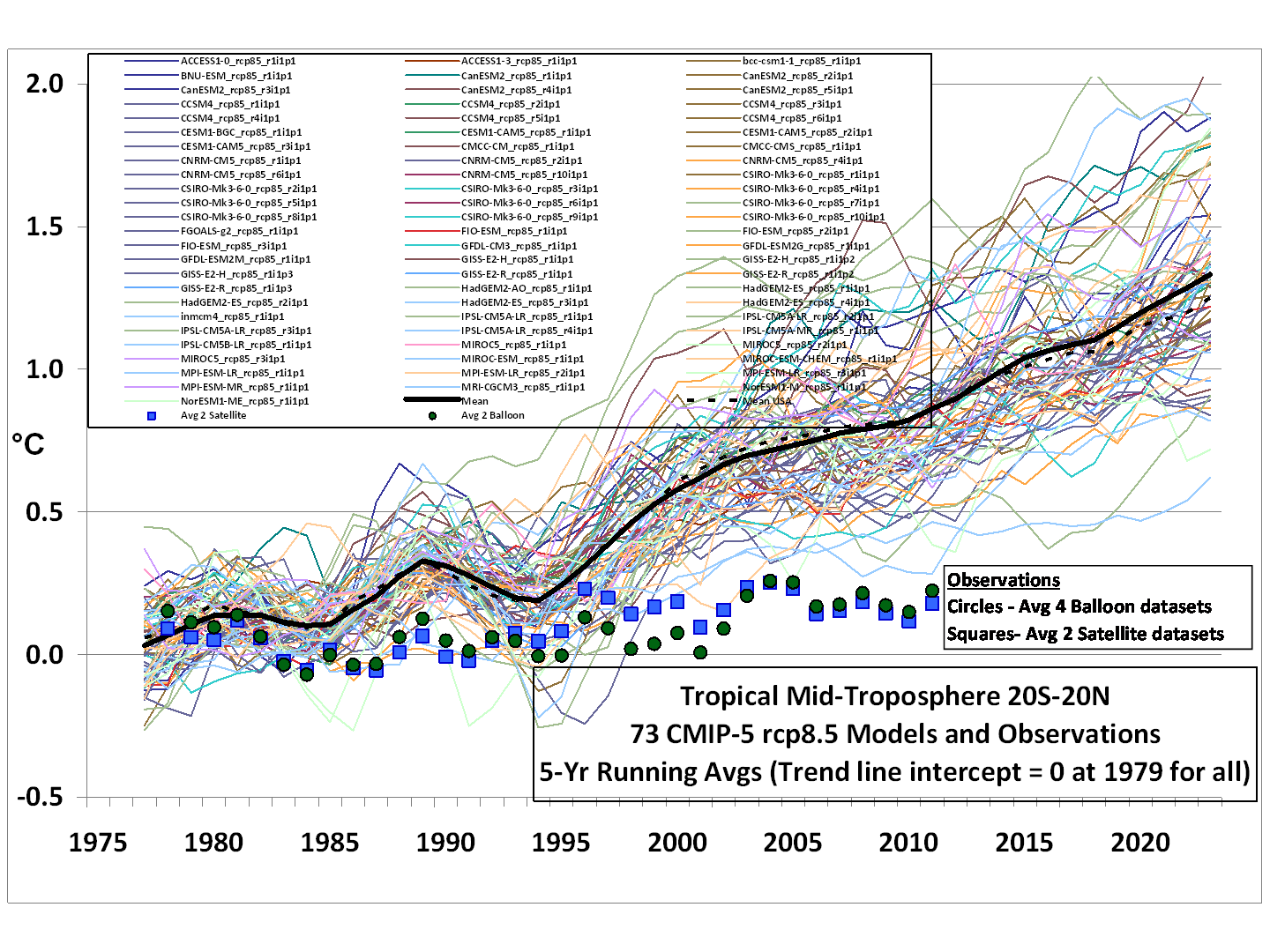
[v]Thorne, P.W. Atmospheric science: The answer is blowing in the wind. Nature Geosci. 2008, doi:10.1038/ngeo209
[vi] Douglass DH, Christy JR, Pearson BD, Singer SF. A comparison of tropical temperature trends with model predictions. Int J Climatol 2008, 27:1693–1701
[vii] Santer, B.D.; Thorne, P.W.; Haimberger, L.; Taylor, K.E.; Wigley, T.M.L.; Lanzante, J.R.; Solomon, S.; Free, M.; Gleckler, P.J.; Jones, P.D.; Karl, T.R.; Klein, S.A.; Mears, C.; Nychka, D.; Schmidt, G.A.; Sherwood, S.C.; Wentz, F.J. Consistency of modelled and observed temperature trends in the tropical troposphere. Int. J. Climatol. 2008, doi:1002/joc.1756
[viii] McKitrick, R. R., S. McIntyre and C. Herman (2010) “Panel and Multivariate Methods for Tests of Trend Equivalence in Climate Data Sets.” Atmospheric Science Letters, 11(4) pp. 270-277, October/December 2010 DOI: 10.1002/asl.290
[ix] Christy, J. R., B. M. Herman, R. Pielke Sr., P. Klotzbach, R. T. McNider, J. J. Hnilo, R. W. Spencer, T. Chase, and D. H. Douglass (2010), What do observational datasets say about modeled tropospheric temperature trends since 1979?, Remote Sens., 2, 2148–2169, doi:10.3390/rs2092148
[x] Allen RJ, Sherwood SC. Warming maximum in the tropical upper troposphere deduced from thermal winds. Nat Geosci 008, 1:399–403
[xi] Mears, C. A., F. J. Wentz, and P. W. Thorne (2012), Assessing the value of Microwave Sounding Unit–radiosonde comparisons in ascertaining errors in climate data records of tropospheric temperatures, J. Geophys. Res., 117, D19103, doi:10.1029/2012JD017710
[xii] Klotzbach PJ, Pielke RA Sr., Pielke RA Jr., Christy JR, McNider RT. An alternative explanation for differential temperature trends at the surface and in the lower troposphere. J Geophys Res 2009, 114:D21102. DOI:10.1029/2009JD011841
[xiii] Fu, Q., S. Manabe, and C. M. Johanson (2011), On the warming in the tropical upper troposphere: Models versus observations, Geophys. Res. Lett., 38, L15704, doi:10.1029/2011GL048101
[xiv] Seidel, D. J., M. Free, and J. S. Wang (2012), Reexamining the warming in the tropical upper troposphere: Models versus radiosonde observations, Geophys. Res. Lett., 39, L22701, doi:10.1029/2012GL053850
[xv] Po-Chedley, S., and Q. Fu (2012), Discrepancies in tropical upper tropospheric warming between atmospheric circulation models and satellites, Environ. Res. Lett
[xvi] Benjamin D. Santer, Jeffrey F. Painter, Carl A. Mears, Charles Doutriaux, Peter Caldwell, Julie M. Arblaster, Philip J. Cameron-Smith, Nathan P. Gillett, Peter J. Gleckler, John Lanzante, Judith Perlwitz, Susan Solomon, Peter A. Stott, Karl E. Taylor, Laurent Terray, Peter W. Thorne, Michael F. Wehner, Frank J. Wentz, Tom M. L. Wigley, Laura J. Wilcox, and Cheng-Zhi Zou, Identifying human influences on atmospheric temperature, PNAS 2013 110 (1) 26-33; published ahead of print November 29, 2012, doi:10.1073/pnas.1210514109
[xvii] Thorne, P. W., et al. (2011), A quantification of uncertainties in historical tropical tropospheric temperature trends from radiosondes, J. Geophys. Res., 116, D12116, doi:10.1029/2010JD015487
“But that doesn’t change the properties of CO2 measured in isolation in the lab. The message to the climate modelers ought to be that there are other factors unaccounted for that affect the final result. They should be sitting down and trying to understand what those might be and how to measure them instead of stubbornly insisting that the models are correct within some statistical bound that must be blurred to accommodate the fact that the theory and data don’t match.”
There are several papers now showing a strong negative feedback in the atmosphere on warming along equator. The problem is that these findings are not UNFCCC conform?
Here are some interesting articles from JoNova covering AR5’s (draft) visual trickery with the still missing hotspot and John Cook’s religious devotion to the missing hotspot.
http://joannenova.com.au/2013/04/ipcc-plays-hot-spot-hidey-games-in-ar5-denies-28-million-weather-balloons-work-properly/
http://joannenova.com.au/2010/06/how-john-cook-unskeptically-believes-in-a-hotspot-that-thermometers-cant-find/
http://joannenova.com.au/tag/missing-hot-spot/
“Where do these people come by their training in simple thermal physics ??”
The political established UNFCCC falsifies the observations of the real world?
” d) the theory (of moist convection leading to more tropospheric than surface warming) overestimates the magnitude of the hotspot”
Clearly that is the correct answer. The observational evidence shows us that the negative system response of more evaporation and convection removes most if not all of the expected thermal forcing all the way from surface to tropopause. A change in the height of the tropopause above regions of enhanced convection would do the trick as per the Ideal Gas Laws.
Instead of the higher tropopause being at a colder height and radiating less to space (as proposed by AGW theory) the entire body of the troposphere expands and lets energy pass to space faster due to the reduction in average density. That faster transmission of energy to space completely negates the expected warming. GHGs might slow the transmission of energy down in a laboratory but in the open air the consequent changes in evaporation, convection and global air circulation speed it up again by an equal and opposite measure to retain total system energy content as determined by mass, gravity and ToA insolation alone. That is why the composition of atmospheres matters little to system energy content. Composition changes result in circulation changes and not changes in total system energy content. Some areas may be warmer as a result of the circulation change but others will be cooler.
“6) What consequences, if any, would your explanation have for our estimate of the lapse rate feedback, water vapour feedback and climate sensitivity?”
Increased evaporation and convection must have some effect on the global air circulation. That is the ‘price’ of the negative system response. However one must then assess any such change as compared to natural variations.
History appears to show that from MWP to LIA to date the global air circulation above some regions shifted latitudinally some 1000 miles on average. That shows us the normal natural scale of negative system response to normal natural (solar and oceanic) forcing elements.
I would guess that the change from our activities would be less than a mile.
That is implicit in my New Climate Model.
Still missing hotspot,
flat temps for 16+ years,
expanding Antarctica,
freezing NH winters & big time snowfalls,
are not entirely inconsistent with the ‘theory’ of hot climate catastrophe caused by co2.
I am surprised that there are arguments about radiosondes vs satellites when there is another source that could be used for validation. Almost all modern aircraft continually report the weather that they are experiencing in particular the wind and ‘outside air temperature’ and this information is available in real time to the WMO. Aircraft particularly transoceanic aircraft fly at the levels that the hotspot would be expected. Their reports could easily be used as another validation of satellite or radiosonde data. Note that the aircraft data is extremely accurate as it must be for flight safety and efficiency.
See http://www.youtube.com/watch?v=99nmJ3mqXXg
.
bushbunny says:
July 16, 2013 at 6:08 pm
Some Australian scientist states that only 41 per cent of people questioned knew how long it takes the Earth to travel around the sun. Reckons it is because people watch too many Jurassic Park films, etc., and believe Sarah Palin’s creationist explanation that humans walked with dinosaurs. So this report would not be understood by the majority. God help us.
That’s because those people are too busy working for their living and enjoying themselves afterwards to worry about how long the Earth takes to orbit the Sun.
“b) surface data show too much warming”
Perhaps “adjustments” made to the surface temps to show how catastrophic the warming has been have inadvertantly dimished the value of the hot spot?
steveta_uk says:
July 17, 2013 at 1:32 am
““b) surface data show too much warming”
Perhaps “adjustments” made to the surface temps to show how catastrophic the warming has been have inadvertantly dimished the value of the hot spot?”
Doesn’t matter. Any rational observer by now knows that warmunism is statist propaganda from start to finish. The unconscious sheep on the other hand will believe anything their dummy box tells them, and the warmunist pseudoscientists know it, so why bother, just keep on lying.
bushbunny says:
July 16, 2013 at 6:08 pm
“Some Australian scientist states that only 41 per cent of people questioned knew how long it takes the Earth to travel around the sun. Reckons it is because people watch too many Jurassic Park films, etc., and believe Sarah Palin’s creationist explanation that humans walked with dinosaurs. So this report would not be understood by the majority. God help us.”
Funny that the progressivist slanderer doesn’t provide a link for his tall tale about Palin; is that your scientific rigor at work, troll?
The biggest problem with the GHE theory, apart from thermodynamic law violations, is that it is not founded in reality but a product of a flat earth with no night/day cycles and a cold sun. I live on a rotating spherical planet with a strong sun during daytime and zero sun at night that supplies enough heat during the day to lift the surface temperature to 88C in the zenith position. Why would I need a GHE in this reality?
According to the GHE the radiated energy from TOA would fall because of the ”trapped” heat. This has also been found to be false.
Global temperature flat for 15 years. 1.4×0=0 so one wouldn’t expect to detect a warm spot. If the models were correct they would have predicted that. But the models are wrong so why are we bothering with the models.
At least Palin had the good sense not to vote for Al Gore.
Can Bushbunny say the same?
Stephen Wilde:
This is what I’ve been trying to explain as well, thanks for stating it more clearly than I have. The AGW theorists have cause and effect backwards, as well as a few other things.
For example, CO2 sinks are not static, or calculable. There is an effectively infinite ability for the biosphere to absorb CO2, if required (at least, relative to the levels the planet and humanity can possibly put into the atmosphere). This is due to the presence of life, particularly plant life, which will automatically multiply in micro and macro forms in an orgy of feeding and reproducing, until the level of CO2 no longer supports this activity, at which point they stabilize, then die off. Likewise the overall ratio of N2 and O2, which are controlled by life.
Atmospheric composition does not alter the temperature balance, and can’t. Our average temperature is more a function of our distance from the sun and overall mass of atmosphere than the composition of the atmosphere.
Sadly, the entire AGW camp simply cannot grasp the fact that energy input will always equal energy output on a planet. Always. Even Venus with it’s “runaway greenhouse” is stable.
“Sadly, the entire AGW camp simply cannot grasp the fact that energy input will always equal energy output on a planet. Always. Even Venus with it’s “runaway greenhouse” is stable.”
A lot of sceptics have problems with that too.
Philip Bradley says:
July 16, 2013 at 6:37 pm
“The simplest and probably correct explanation of no troposphere hotspot is, there is no water vapour feedback.”
Or, a positive feedback is assumed whereas the actual feedback from moist convection is negative, and negative feedback acts to stabilize the lapse rate.
Basic theory suggests the hot spot should occur whenever there is global warming, whatever its cause. The mistake made by Santer (2003), copied by the IPCC, was to assume that the hot spot is an artefact only of greenhouse-gas-driven warming.
The hot spot should have been evident between 1976 and 2001, when there was enough global warming to allow it to be detected.. However, it was not evident. The conclusion is that, since there was warming, and since theory dictates that the hot spot should have been present, either the basic theory is wrong (unlikely) or (more likely) that either the surface temperatures or the mid-troposphere temperatures are being incorrectly measured.
Since the mid-troposphere temperatures change little from place to place in the tropics, only a few sampling points are needed to establish a reliable measurement. Not so on the surface, where the tropics undergo considerable temperature changes from place to place and the sampling points are few and badly managed. A not unlikely conclusion, therefore, is that it is the measurement of tropical surface temperatures that is problematic. Warming that is not occurring is being incorrectly detected, masking much of the differential between tropical surface and mid-troposphere temperatures that indicates the hot spot.
If this explanation is correct, then the presence or absence of the hot spot tells us little or nothing about the cause of global warming.
“Thorne et al. ended with the conclusion that “there is no reasonable evidence of a fundamental disagreement”
=============
Any time you see a double negative in English you cannot trust your understanding matches the meaning.
Why did the author not state the conclusion in standard English? The use of a double negative is almost never recommended, because its meaning can be confusing.
I used the missing “tropic hot spot” in a talk I gave some 4 years ago.
My audience was mixed but mostly non-technical or scientific.
My basic thesis was that the climate models were wrong, overestimating
the sensitivity to CO2. I believe that the missing “tropic hot spot”
was strike 2 for the models. I showed 5 strikes for the models,
then turned to my audience and said: “In baseball, you get three strikes.
Science, done correctly, doesn’t need more. We have here 5 STRIKES
on the climate models, which are the source of most of the alarmist
statements we hear about climate change. Just how many more
strikes do the climate modelers get?”
Same temperature, less RH% = heat loss
If you look at Bob Tisdale’s post of July 16, 2013 and check the variance between modeled and actual temperature, http://bobtisdale.files.wordpress.com/2013/02/02-zonal-pacific.png, you will see that the great variance is in the tropics where the Argo float data shows the surface temperature is being limited to 31C. The modeling of the mechanism that limits the temperature to 31C is inadequate.
Bob Tisdale has it down. Touchdown.
The take-away in the discussion (for me) is Christy’s “… the use of climate models in policy decisions is, in my view, not to be recommended at this time.”
Stephen Wilde says:
July 16, 2013 at 10:59 pm
That faster transmission of energy to space completely negates the expected warming. GHGs might slow the transmission of energy down in a laboratory but in the open air the consequent changes in evaporation, convection and global air circulation speed it up again by an equal and opposite measure to retain total system energy content as determined by mass, gravity and ToA insolation alone.
==============
agreed. the lapse rate is a product of GHG COOLING the atmosphere. otherwise the atmosphere would be isothermal. as GHG cools the atmosphere, it radiates some of this energy to the surface and some to space. mass and gravity determine the limits, beyond which the lapse rate cannot increase.
Adding more GHG cannot warm the atmosphere while it is cooling it. You cannot make the troposphere warmer by removing energy from the troposphere and back radiating some of it to the surface and some of it to space.
All that can happen is that the vertical circulation increases to try and limit the amount of atmospheric cooling and surface warming, removing the excess energy reaching the surface from back radiation. Opposite to real greenhouses, which limit circulation to warm the surface.
The tropical hotspot is a signature of model prediction. the lack of a hotspot demonstrates that they are not correctly capturing the physics of the earth’s climate and cannot be relied upon for accurate predictions of future climate.
“KevinK says:
July 16, 2013 at 9:38 pm
Well, it is also possible that the “GHE” hypothesis has a flaw; the allegedly “trapped” energy is simply delayed as it flows through the system (i.e. the Sun, Atmosphere, Surface, Atmosphere, Surface (again for a few quick trips) and finally onward to the “cold” expanse of space.””
BINGO! I’ve been in some debates of late, and have focused in on the IR radiation to space. There is a certainty that is always omitted, … there has been no decrease in IR out to space. The temp will only go up and down based on an unbalanced equilibrium. LInzen demonstrated this in one of his papers, that OLR is associated with SST [rings the phone of Bob T.]. The goofballs over at Skepticalscience show a graph from NASA that claims “all the decreased OLR is in the range of GHGs .. Like CO2. LOL .. then you look at the graph at the bands of CO2 are flat out on ZERO. Three other papers show no decrease in OLR ranging from 1970 to 2006. Roy Spencer has also weighed in on the issue.
Simply put, you are not going to get any real change in earth’s temperature unless there is an imbalance in equilibrium. The ups and downs of the system seem to me to be the product of heat distribution …. in and out of the ocean, and fluctuations is SW coming in from space due to changes in clouds and slight decreases in TSI with coupled mechanisms to the ocean. Throw on top of that, that the earths system is a convective system, with gases going from a place of higher pressure to lower pressure and increased volume, … I don’t see where there’d be any hotspot … the system is always circulating so there can’t be a static “spot”. AND .. lastly, a point that I made in arguments is that 70% of the IR radiated by CO2 hits the ocean and is used up in latent heat transfer associated with evaporation. That heat bypasses the near surface zone and is released at the top of the atmosphere, where it radiates out to space. I still have some questions:
1) Can the IR radiated by CO2 to the surface of the ocean that is captured as latent heat and transferred to the TOA via evaporation, be released at different wavelengths?? [it would seem to me that if IR can heat water, the heat from that water is going to be reradiated out at WL more indicative of water vapor].
Can CO2 absorb IR at the TOA, then circulate back down to radiate that heat back to the surface? … or do the differences in pressure and temperature affect CO2 ability to absorb and radiate??
I need all ya’lls higher levels of knowledge on these subjects to nail the coffin in my debate.
Thanks