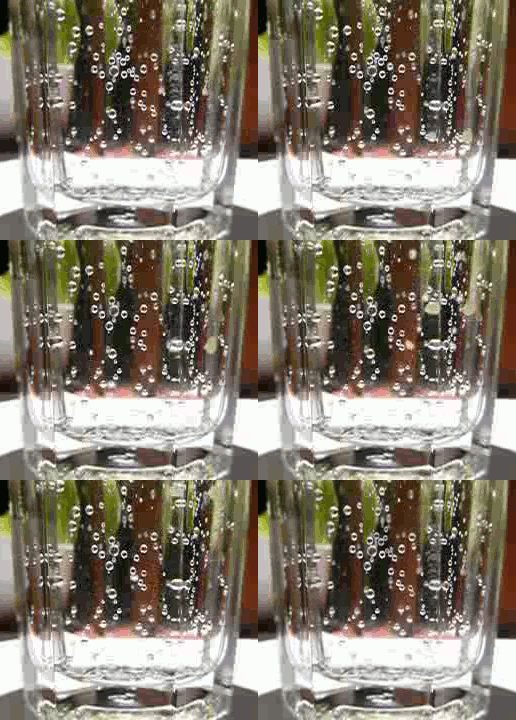
 From the Carnegie Institution , where soda pop science is like a carbonic acid trip, they say (thanks to modeling) we have to make big changes: “To save coral reefs, we need to transform our energy system…” while equating natural dissolution of CO2 into seawater with carbonation of soda pop, done under pressure and reduced temperature, making it supersaturated. The process is described as:
The amount of a gas like carbon dioxide that can be dissolved in water is described by Henry’s Law. Water is chilled, optimally to just above freezing, in order to permit the maximum amount of carbon dioxide to dissolve in it. Higher gas pressure and lower temperature cause more gas to dissolve in the liquid. When the temperature is raised or the pressure is reduced (as happens when a container of carbonated water is opened), carbon dioxide comes out of solution, in the form of bubbles.
While weak carbonic acid does get formed with CO2 dissolution in water [CO2 + H2O  H2CO3 ] the majority of the carbon dioxide is not converted into carbonic acid, remaining as CO2 molecules, which is why it outgasses so easily when a non-chemical catalyst is applied, like vibration. Carbonic acid does not make the soda pop “fizzy”; it is the fact that it is supersaturated, and stored in a way to seal pressure preventing gas escape and maintaining the supersaturation. It is pressure and temperature that drive the main outgassing process, as anyone who as left an open can of soda pop in their car during a hot summer can attest.
Major changes needed for coral reef survival
Washington, D.C.—To prevent coral reefs around the world from dying off, deep cuts in carbon dioxide emissions are required, says a new study from Carnegie’s Katharine Ricke and Ken Caldeira. They find that all existing coral reefs will be engulfed in inhospitable ocean chemistry conditions by the end of the century if civilization continues along its current emissions trajectory. Their work will be published July 3 by Environmental Research Letters.
Coral reefs are havens for marine biodiversity and underpin the economies of many coastal communities. But they are very sensitive to changes in ocean chemistry resulting from greenhouse gas emissions, as well as to coastal pollution, warming waters, overdevelopment, and overfishing.
Ricke and Caldeira, along with colleagues from Institut Pierre Simon Laplace and Stanford University, focused on the acidification of open ocean water surrounding coral reefs and how it affects a reef’s ability to survive.
Coral reefs use a mineral called aragonite to make their skeletons. It is a naturally occurring form of calcium carbonate, CaCO3. When carbon dioxide, CO2, from the atmosphere is absorbed by the ocean, it forms carbonic acid (the same thing that makes soda fizz), making the ocean more acidic and decreasing the ocean’s pH. This increase in acidity makes it more difficult for many marine organisms to grow their shells and skeletons, and threatens coral reefs the world over.
Using results from simulations conducted using an ensemble of sophisticated models, Ricke, Caldeira, and their co-authors calculated ocean chemical conditions that would occur under different future scenarios and determined whether these chemical conditions could sustain coral reef growth.
Ricke said: “Our results show that if we continue on our current emissions path, by the end of the century there will be no water left in the ocean with the chemical properties that have supported coral reef growth in the past. We can’t say with 100% certainty that all shallow-water coral reefs will die, but it is a pretty good bet.”
Deep cuts in emissions are necessary in order to save even a fraction of existing reefs, according to the team’s results. Chemical conditions that can support coral reef growth can be sustained only with very aggressive cuts in carbon dioxide emissions.
“To save coral reefs, we need to transform our energy system into one that does not use the atmosphere and oceans as waste dumps for carbon dioxide pollution. The decisions we make in the next years and decades are likely to determine whether or not coral reefs survive the rest of this century,” Caldeira said.
The World Climate Research Programme’s Coupled Model Intercomparison Project is provided support from the U.S. Department of Energy, which developed a software infrastructure in partnership with the Global Organization for Earth System Science Portals.
Since their models are “sophisticated” you know they must be valid.
DR-I have located documents that make it clear that UNESCO is pushing all aspects of the media to coordinate with the UN system on the “messages” being pushed.
If it’s not a conspiracy since it is in the open, it is indisputably a matter of active, deliberate coordination. The UN name for it is media education and part of its goal is to squelch climate skepticism.
Whether they realize it or not, the just made the case for a lot of the increase in CO2 over the past century not being anthropogenic.
fhhaynie says: June 28, 2013 at 11:50 am
“In the equatorial south pacific. the surface water is already saturated with CO2, no amount that is added to the atmosphere is going into this area of the ocean. It is nearly always coming out of the ocean surface as the sea water is warmed as it goes from East to West. This area of the ocean is adding CO2 to the atmosphere at a rate that is an order of magnitude greater than all the global anthropogenic emissions. The cold polar waters are sucking it up at a slightly less rate resulting in a slow global accumulation. These rates are always changing, some on an annual time scale, others, in decades, or centurys. The rate of temperature change is the controlling factor at a specific area, not just equilibrium at some “global temperature””
I am very much interested in your comment. I have read where the tropical ocean bubbles at night; but I cannot find the article again. This is related to the non-biological production of calcium carbonate in the ocean. If you can provide me references to your statement “It is nearly always coming out of the ocean surface as the sea water is warmed as it goes from East to West”, I would certainly appreciate it.
John,
Use the difference in solubility of CO2 in sea water at say 20 C and 26 C ( 90W and 135W at 10S). That difference has to go somewhere and it is most likely to go into the atmosphere. Some will precipitate as CaCO3 and fall below the thermocline. Just take the amount in a cubic meter on the surface and divide by one month and you can get an estimate of the rate that is being emitted into the atmosphere from that area. These temperatures are always changing in different time scale cycles. I suggest you use the units of kg/m^2/year and compare those values to anthropogenic emission rates in the same units (assumes emissions are uniformly distributed over the surface of the earth).
Ferdinand Engelbeen says: June 29, 2013 at 4:24 am
“The dissolution of carbonate rocks is a much slower sink for CO2. Even with a doubled concentration in the atmosphere and thus a doubled dissolution of carbonate rock, the decay rates are in the thousands of years. Other rock types dissolve much slower…”
I am trying to understand about those thousands of years. When rain water dissolves carbon dioxide and forms a weak carbonic acid and enters the ground, it dissolves limestone and other forms of calcium carbonate (an exothermic reaction) and after a series of reactions enters the ocean as calcium hydroxide. I don’t believe that you are saying that this process takes a thousand years; so how do we get the thousands of years. If there were not some balancing in the system, we would already have seen a large shift in Ph.
http://www.princeton.edu/~achaney/tmve/wiki100k/docs/Carbonic_acid.html
Retired Engineer John says:
June 29, 2013 at 7:26 am
From fhhainie:
This area of the ocean is adding CO2 to the atmosphere at a rate that is an order of magnitude greater than all the global anthropogenic emissions.
That is right, as the equilibrium pressure of CO2 in the tropics may be as high as 750 microatm, that is 350 microatm higher than the partial pressure in the atmosphere of ~400 ppmv CO2 (the difference between partial pressure and ppmv is the % water vapour at sealevel).
Thus the increase in the atmosphere need to go as high as 750 ppmv before some net amount of CO2 will enter the ocean surface in these area’s.
See further Feely e.a. at:
http://www.pmel.noaa.gov/pubs/outstand/feel2331/exchange.shtml
and following pages, including maps for summer/winter and net exchanges between oceans and atmosphere.
Retired Engineer John says:
June 29, 2013 at 10:19 am
I don’t believe that you are saying that this process takes a thousand years
The reaction of CO2 with carbonate rocks is that it forms bicarbonates which are soluble in water. The reaction is quite fast, that is not the limiting factor. The limiting factor is the small amounts of CO2 in rainwater: as calculated before, some 0.000132% at near freezing point.
Thus despite the large amounts of rain, the dissolution of carbonate rock is a quite slow process, so that even a doubling of the speed doesn’t remove large quantities of CO2 out of the atmosphere over short periods of time.
Think of the amount of time needed to dissolve the caves we see in carbonate rock formations, that is hundredthousands to millions of years.
The opposite also needs time: the buildup of the carbonate rock layers was mostly done in the Cretaceous by coccolithophores:
http://www.noc.soton.ac.uk/soes/staff/tt/eh/
But that also needed some 60 million years…
=================================================================
Don’t you mean calcium bicarbonate?
I believe lab and field chemistry results show that heightened carbonic acid makes it easier for living organisms to form shells, but more swiftly dissolves their shells after death (returning the CaCO3 to the accessible mix), and slowing the build-up of limestone beds on the seafloor.
fhhaynie says:
June 29, 2013 at 11:38 am
Just take the amount in a cubic meter on the surface and divide by one month and you can get an estimate of the rate that is being emitted into the atmosphere from that area.
That gives an idea about the probable amounts that can be emitted, not the rate of emissions. The rate is influenced by two main points: the difference in pCO2 between ocean surface (directly influenced by temperature) and the pCO2 (~ppmv) of the atmosphere at one side and the gas transfer velocity, mainly a matter of wind speed.
Diffusion speed of CO2 through water is very slow, so one need a large surface and thourough mixing of waters and between water and air to have a substantial exchange of CO2. See:
http://www.pmel.noaa.gov/pubs/outstand/feel2331/maps.shtml
Ferdinand,
I’m well aware of the mechanisms of mass transfer in boundary layers. Only at low wind velocities should we expect those are significant controllers of rates. In any case, Measuring the loss of CO2 from a cubic meter of surface sea water as it takes a one month journey from 90W to 135W is a rate when divided by one month. The solubility relationship is taken as a function of atmospheric partial pressure and SST. This assumes little difference in partial pressure across the boundary layer. If the partial pressure differences across the boundary layer are greater (low windspeeds), the calculated rates would be lower. On the other hand, if the CO2 comes from deeper than one meter, the rates would be higher. Thanks, for the URL. They know they have a difficult time getting a good estimate of rates as a function of time and latitude.
What does Eli Rabbet mean when he says “Mostly the lithosphere is too far away for the corals.”? The lithosphere includes the crust and to my knowledge coral forms on the crust, albeit in shallower ocean waters.. Besides, the comment appears to bear no relationship to the remainder of the comment.
“Coral reefs use a mineral called aragonite to make their skeletons. It is a naturally occurring form of calcium carbonate, CaCO3. When carbon dioxide, CO2, from the atmosphere is absorbed by the ocean, it forms carbonic acid (the same thing that makes soda fizz), making the ocean more acidic and decreasing the ocean’s pH. This increase in acidity makes it more difficult for many marine organisms to grow their shells and skeletons, and threatens coral reefs the world over.”
Okay I get where the lime (CaO) comes from to make the skeletons of the coral reef and the shells for pelecypods, etc (chemical erosion on land and transportation by rivers to the sea plus some dissolution of existing calcium carbonate in the sea), but how can the creatures make it into aragonite? Oh, I see, they combine the lime with CO2 in the ocean water!!
CaO + CO2 => CaCO3 ta dahhhhh!!
So you need CO2 in the sea (which makes up 44% of the shells). Oh and the pH of the sea is highly buffered which means budging the pH away from its ~8 isn’t accomplished easily.
“A Brief Summary of Carbonate Buffer System Chemistry
Atmospheric CO2 dissolves in seawater and is hydrated to form carbonic acid, H2CO3. Carbonic acid is divalent; that is, it can undergo two de-protonation reactions to form bicarbonate (HCO3-), and carbonate (CO32-). The co-existence of these species in seawater creates a chemical buffer system, regulating the pH and the pCO2 of the oceans. Most of the inorganic carbon in the ocean exists as bicarbonate (~88%)”
http://oceancolor.gsfc.nasa.gov/SeaWiFS/TEACHERS/CHEMISTRY/
And what is bicarbonate good for? Acid indigestion!! Another couple of asterisked PhD’s for retraining in the post-alarm period.
fhhaynie says:
June 29, 2013 at 1:38 pm
Measuring the loss of CO2 from a cubic meter of surface sea water as it takes a one month journey from 90W to 135W is a rate when divided by one month.
pCO2 difference with the atmosphere taken below the surface (mostly from the cooling inlet of seaships) is the deciding factor, besides wind speed. The CO2/bi/carbonate loss while the surface layer floates around the equator is influenced by biomass production which is especially high at the upwelling places, thus not a unique loss to the atmosphere.
Ferdnand.
I did a comparison of the four values at 10S in NOAA’s report Fig.5 with the monthly values (from 1981 to 2012) that I calculated for 10S from 90W to 135W with these results. Expressed as kg/m^2/year, NOAA average 0.0407 with standard deviation of 0.0157, my analysis 0.020 average with a standard deviation of 0.0083. If I had assumed two meters rather than one, the values would be very nearly the same. In the future I will use two meters and calculate the higher values at different locations. Variations in windspeed will average out in monthly measurements.
Typo. Ferdinand for Ferdnand. Sorry about that.
Fred
Gunga Din says: June 29, 2013 at 10:57 am
“Don’t you mean calcium bicarbonate?”
I am considering your question. In fresh water the Co2 is dissolved and becomes a bicarbonate due to the low Ph of rain water. This reacts with the calcium hydroxide to form calcium bicarbonate. When the calcium bicarbonate reaches the ocean, does the high Ph cause it to disassociate into ions and reform as calcium hydroxide and two carbonates? Something happens that forms calcium hydroxide. I will go back and see if I can find this in my chemistry books.
fhhaynie says June 29, 2013 at 11:38 am
Thanks for responding to my question. What I am trying to establish is whether or not there is a non-biological production of calcium carbonate. When I read the literature I find that there are differences of opinion on whether it exists. It is particular interesting to read accounts of calcium carbonate whitings in the Persian Gulf and the Bahamas. Also magnesium appears to inhibit the reaction. One primitive laboratory test for carbon dioxide is to bubble the gas through a solution of calcium hydroxide and watch the solution turn milky as calcium carbonate is formed. The ocean is saturated with calcium hydroxide and I am interested in what happens when the ocean heats and carbon dioxide comes out of solution. If there are unique things that inhibit the reaction, I would like to know what they are.
John,
Most of the carbon in the oceans is inorganic and there is a lot more of it than organic. DICs (dissolved inorganic carbons) will precipitate along with organics when they reach saturation on warming. The ratio of C13 to C12 is a measure of what comes from organics.
Ferdinand Engelbeen says June 29, 2013 at 10:55 am
I realize that the dissolving of major amounts of limestone requires a very long time, perhaps even thousands of years. However, the bottom of the shallow oceans are covered with so much calcium carbonate that it looks like snow. Hydrated (dissolved) calcium carbonate is also found on the ocean floor and shorelines in the form of mineral rocks as well as in solution. This has been going on for a long time, we should have run out calcium if we didn’t have a robust supply coming into the ocean.
Retired Engineer John says:
June 29, 2013 at 6:33 pm
I am considering your question. In fresh water the Co2 is dissolved and becomes a bicarbonate due to the low Ph of rain water. This reacts with the calcium hydroxide to form calcium bicarbonate. When the calcium bicarbonate reaches the ocean, does the high Ph cause it to disassociate into ions and reform as calcium hydroxide and two carbonates?
It is the other way out: CO2 + water in rainwater reacts as carbonic acid (H2CO3), with CaCO3 and MgCO3 (carbonates) to form bicarbonates as Ca(HCO3)2 and Mg(HCO3)2. These are soluble in fresh water and in the oceans in the form of Ca++ and Mg++ ions at one side and HCO3- ions at the other side. The solubility is in a wide range of pH: from acid to at least pH 8.5. Above that carbonate ions are increasing leading to the precipitation of again CaCO3 and/or MgCO3. To form hydroxides of Ca and Mg, you are in a higher pH range, anyway leading to precipitation of the Ca en Mg carbonates. Of course, there are always hydroxyl ions present, but they play no role in the above reactions.
The solubility of carbonate rock is the result of the low pH of CO2 containing rain (slightly acidic). The (deep) oceans are slightly basic, thus not so readily dissolving carbonates, but under pressure, some of the chalk deposits still may dissolve. On the other side, the biological pump (coccoliths) drops some of these cabonates back down to the ocean floor. That is more or less in equilibrium, where slightly more is deposited than dissolved, especially in more shallow seas. In ancient times, that were e.g. the deposits of Southern England (and French Calais and Normandy), still visible as the white cliffs of Dover and beyond.
Ferdinand Engelbeen says: June 30, 2013 at 3:49 am
fhhaynie says: June 30, 2013 at 6:17 am
Thank you both for your answers. I am pleased to find some experts in this field. If you will bear with me I would like to ask some questions and show you why I am interested in this particular chemistry.
There is an energy exchange when CaCO3 is formed. When Ca(HCO3)2 reacts, it is exothermic with CO2 being released. When CaCO3 is formed from Ca ions and Co2 it is endothermic. The endothermic reaction that I reference removes about 1400 Kjoules per mole of CaCo3. This energy is removed from the ocean and stored as chemical energy. I have read a considerable number of papers on the ocean and while I see a lot of chemical reactions, I never see the number of joules of energy that accompany the reaction. Is there a reason for this. I see the ocean as a big chemical factory with a lot of reaction that store energy and remove it from the environment. In addition to the reaction that I mentioned, there are the hydration reactions.
Retired Engineer John says:
June 30, 2013 at 7:38 am
Have a look at the carbon cycle:
http://earthobservatory.nasa.gov/Features/CarbonCycle/
Although only roughly known, the net deposit of carbonates on the seafloor is about 2 GtC or about 17 Gt CaCO3. That is peanuts compared to the total mass of the ocean surface, where most of the thermal and chemical reactions take place, including photosynthesis, which absorbs parts of the solar spectrum. Only a small part of that energy is used by algue to build their shells of which a small part falls out of the surface layer of the oceans to the bottom.
Thus in my opinion, the energy transfer of this reaction is not even measurable in the large energy transfers from the sun to the oceans in general and specific into algue energy buildup.
John,
I think the biggest mistake that climate modelers make is to assume that the earth is naturally in some kind of “dynamic equilibrium” with respect to energy, being upset by the anthropogenic contribution of CO2 to the atmosphere. The fact that the earth rotates and tilts with respect to the sun prevents it from ever being in equilibrium or even in a steady state. It is always changing chasing a moving target like thermodynamic equilibrium. The best we can do is to observe those changes and try to figure out what to expect in the future. Personally, I think that the processes of evaporation/condensation and freezing/thawing are the thermostats that make the earth favorable for life.
Ferdinand Engelbeen says: June 30, 2013 at 9:27 am
“Although only roughly known, the net deposit of carbonates on the seafloor is about 2 GtC”
Thus in my opinion, the energy transfer of this reaction is not even measurable in the large energy transfers from the sun to the oceans in general and specific into algue energy buildup.
I assume that your answer as to why the energy from chemical reactions in the ocean are not listed is that it is not significant. I believe that the 2 GtC number that you quote is from nets that sample shells etc. as they descind into the ocean. It is not clear to me that nets would properly sample non-biological CaCO3 precipitate. I will convert the 17Gt CaCO3 to joules and see if there is enough energy to be significant.
When I look at the graphs of the temperatures of the Argo floats, the ascending and descending temperatures, the repeatability of the temperatures from year to year are to precise to be caused by winds or clouds. The ocean’s maximum temperature of 30.5C to 31C is also the maximum of inland lakes both large and small. I believe that such precision can only be caused by a chemical reaction and my best candidate is the calcium carbonate reaction.
fhhaynie says: June 30, 2013 at 6:17 am John,
“Most of the carbon in the oceans is inorganic and there is a lot more of it than organic. DICs (dissolved inorganic carbons) will precipitate along with organics when they reach saturation on warming. The ratio of C13 to C12 is a measure of what comes from organics.”
Do you have the ratio of C13 to C12? I can get an understanding of the amount of inorganic carbon by comparing it to number on the Oregon State website.