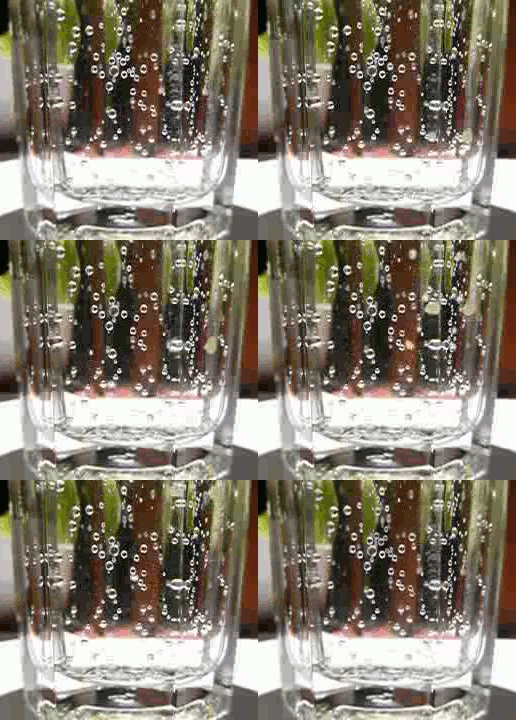
 From the Carnegie Institution , where soda pop science is like a carbonic acid trip, they say (thanks to modeling) we have to make big changes: “To save coral reefs, we need to transform our energy system…” while equating natural dissolution of CO2 into seawater with carbonation of soda pop, done under pressure and reduced temperature, making it supersaturated. The process is described as:
The amount of a gas like carbon dioxide that can be dissolved in water is described by Henry’s Law. Water is chilled, optimally to just above freezing, in order to permit the maximum amount of carbon dioxide to dissolve in it. Higher gas pressure and lower temperature cause more gas to dissolve in the liquid. When the temperature is raised or the pressure is reduced (as happens when a container of carbonated water is opened), carbon dioxide comes out of solution, in the form of bubbles.
While weak carbonic acid does get formed with CO2 dissolution in water [CO2 + H2O  H2CO3 ] the majority of the carbon dioxide is not converted into carbonic acid, remaining as CO2 molecules, which is why it outgasses so easily when a non-chemical catalyst is applied, like vibration. Carbonic acid does not make the soda pop “fizzy”; it is the fact that it is supersaturated, and stored in a way to seal pressure preventing gas escape and maintaining the supersaturation. It is pressure and temperature that drive the main outgassing process, as anyone who as left an open can of soda pop in their car during a hot summer can attest.
Major changes needed for coral reef survival
Washington, D.C.—To prevent coral reefs around the world from dying off, deep cuts in carbon dioxide emissions are required, says a new study from Carnegie’s Katharine Ricke and Ken Caldeira. They find that all existing coral reefs will be engulfed in inhospitable ocean chemistry conditions by the end of the century if civilization continues along its current emissions trajectory. Their work will be published July 3 by Environmental Research Letters.
Coral reefs are havens for marine biodiversity and underpin the economies of many coastal communities. But they are very sensitive to changes in ocean chemistry resulting from greenhouse gas emissions, as well as to coastal pollution, warming waters, overdevelopment, and overfishing.
Ricke and Caldeira, along with colleagues from Institut Pierre Simon Laplace and Stanford University, focused on the acidification of open ocean water surrounding coral reefs and how it affects a reef’s ability to survive.
Coral reefs use a mineral called aragonite to make their skeletons. It is a naturally occurring form of calcium carbonate, CaCO3. When carbon dioxide, CO2, from the atmosphere is absorbed by the ocean, it forms carbonic acid (the same thing that makes soda fizz), making the ocean more acidic and decreasing the ocean’s pH. This increase in acidity makes it more difficult for many marine organisms to grow their shells and skeletons, and threatens coral reefs the world over.
Using results from simulations conducted using an ensemble of sophisticated models, Ricke, Caldeira, and their co-authors calculated ocean chemical conditions that would occur under different future scenarios and determined whether these chemical conditions could sustain coral reef growth.
Ricke said: “Our results show that if we continue on our current emissions path, by the end of the century there will be no water left in the ocean with the chemical properties that have supported coral reef growth in the past. We can’t say with 100% certainty that all shallow-water coral reefs will die, but it is a pretty good bet.”
Deep cuts in emissions are necessary in order to save even a fraction of existing reefs, according to the team’s results. Chemical conditions that can support coral reef growth can be sustained only with very aggressive cuts in carbon dioxide emissions.
“To save coral reefs, we need to transform our energy system into one that does not use the atmosphere and oceans as waste dumps for carbon dioxide pollution. The decisions we make in the next years and decades are likely to determine whether or not coral reefs survive the rest of this century,” Caldeira said.
The World Climate Research Programme’s Coupled Model Intercomparison Project is provided support from the U.S. Department of Energy, which developed a software infrastructure in partnership with the Global Organization for Earth System Science Portals.
Link on the relationship between CO2, carbonic acid, and bicarbonate, and carbonate.
The composition depends on the pH.
pH of 12 it is all in the Carbonate
pH of 8 it is all in the Bicarbonate
pH less than 4, it is all in the CO2.
To deionize water, we acidify the water by removing the Cations.
The CO2/Bicarb/Carbonate is now mostly in the CO2 form.
We can then strip the CO2 out with air.
The remaining anions are then removed with an anion bed.
http://ion.chem.usu.edu/~sbialkow/Classes/3650/Carbonate/Carbonic%20Acid.html
But I thought the earliest corals evolved during far higher levels of co2 than today. Oh well. Now here is a fishy story.
“The fishes and the coral live happily in the CO2 bubble plume”
What!!? But you just wait until the end of this century, the corals will be corroded to skelator.
“Scripps blockbuster: Ocean acidification happens all the time — naturally”
What!!? help me Willis Eschenbach.
Jokes and ridicule aside it’s clear that ocean ph varies wildly in different parts of the ocean on a daily basis. The natural swings are greater than that expected by 2100. Alarm over. Move along now folks, nothing to see here.
Here are some studies published this year on ocean acidification or should that be less alkalineification. 🙂
Do these guys have phDs? Revoke them, now!
Sea water is a complex buffer and carbonic acid is a weak acid. There has been no detectable change in ocean pH as a result of rising CO2. They also ignore the fact that all of this sea life evolved under MUCH HIGHER CO2 than there is now. I bet they would love it.
Photosynthesis is in fact an alkalizing process that raises the pH. In a bay or estuary, the pH on a sunny day can go to 10–11 from the normal pH of 8. Sea life is much more resilient, particularly in the presence of more FOOD (CO2). CO2 is plant food and gives the other organisms more to eat!
They also ignore the fact that these ocean populations also adapt quite rapidly to changing conditions as they have such short generation times.
Gunga Din says:
June 28, 2013 at 4:07 pm
Of course pH doesn’t drive the processes. My point was based on the recollection (30+ years) that dissolution of carbonate requires pretty Low (as in acidic) pH values. In the back of my mind,I have some flag showing about magnesium carbonates too – though I have no idea why!!
Seriously,the whole oceanic acidification thing really bugs me, because AFAICR there has not been any geological evidence of an acidic ocean – and, as a geologist, rocks are everything in terms of past climate indication!
[sigh].. Back to grade school – the lot of ’em.
Bet they’ve never tried to dissolve an eggshell (calcium carbonate) in soda water. It won’t happen as the pH of 4 is too weak and the oceans will NEVER absorb that much CO2.
Ocean pH ranges between 7.9 and 8.3, depending on where you measure it. As mentioned here many times, warm water outgasses CO2 and cannot become acidic if Gorebull Warbling occurs.
Their “study” is another blatant falsehood and should be shot down in the courts.
To Kev-in-UK:
“… there has not been any geological evidence of an acidic ocean – and, as a geologist, rocks are everything in terms of past climate indication!”
I am sorry, but this comment displays and perpetuates flat-out ignorance. In a few posts above, I provided a very clear geological example – the PETM – where the evidence for ocean acidification related to massive and rapid carbon input is overwhelming. If you choose to read the geological record incorrectly or close your eyes to the obvious, I cannot help you, but please then do not suggest that the rocks suggest otherwise: the rock record absolutely supports the concept of ocean acidification during massive and rapid input of carbon to the atmosphere and ocean.
To Higley7:
First sentence: yes, probably
Second sentence: why? Are you honestly going to state that you understand carbonate chemistry better than a Research Professor at Stanford University (where I think Caldeira is located).
Third sentence: Absolutely correct.
Fourth sentence: Demonstrably wrong. (Please recall that pH is a log scale).
Fifth sentence: Correct.
Sixth sentence: A huge and likely erroneous jump in logic. This is because the statement conflates multiple concepts. One is assuming that rates of change in chemistry were similar in the past, which is almost assuredly wrong. Another is assuming that past cation concentrations are invariant over time. By such logic, if one pumps CO2 into a closed aquarium (a query from earlier post), corals would be perfectly happy. This is clearly not the case, and I welcome you to buy an aquarium, then put 100 quid on some coral or other carbonate secreting organisms, pump CO2 into the tank, and test for yourself. I think many scientists would be more than happy to reimburse your 100 quid should you be able to demonstrate that the pH stays the same and carbonate secreting organisms like this, because this would conflict with a massive amount of research on the topic.
Second paragraph just off tangent so no point in commenting.
To Olaf:
Indeed, actually try your suggested experiment. Now what you will have to recognize is that, in a closed system, such dissolution will only go so far. Nonetheless, if you weigh the mass before, put into soda water, dry and reweigh, you will realize that dissolution has occurred. Now bring this new found knowledge to an open system.
To all: My basic point is not that I advocate an opinion on what to do about ocean acidification (or to pull a silly notion from some posts “less basification”), but that the process absolutely is happening now and has occurred in the past. Basically, I just ask people to be educated, and then discuss concepts and ideas.
Roy says:
June 28, 2013 at 5:29 pm
Apart from anything else you are deluded to believe that simple ocean acidification was the cause of the PETM -(chicken and egg and all that!) but also, it is considered that methane played a significant part in that episode.
as for the rest of your reply – I just did a quick search and found this (which confirms my recollection!)
http://arstechnica.com/science/2012/03/ocean-acidification-could-become-worst-in-at-least-300-million-years/
from which I quote
”We don’t have good records of pH over this period, so it’s difficult to tell how much of the extinctions were caused by ocean acidification as opposed to the temperature change or decrease in dissolved oxygen that results from warming ocean water.”
I’m not going to argue – as I’m way out of time with modern geological research – but unless you post links to research confirming PETM was acidification based – I’ll rely on my memory!
Ferdinand Engelbeen says: @ur momisugly June 28, 2013 at 3:50 pm
…..From Segalstad:
“This postulate fails for a number of reasons. An increase in atmospheric CO2 will namely increase the buffer capacity of ocean water, and thereby strengthen the ocean’s capacity to moderate an increase of atmospheric CO2”
I have never heard that a buffer capacity is increased by using its capacity…
That te buffer capacity of the oceans (surface) is “only” absorbing 10% of the change in the atmosphere is a matter of chemical equilibria, which makes that the alkalinity of the oceans can absorb ten times more CO2 for the same increase in the atmosphere than fresh water would do….
>>>>>>>>>>>>>>>>>>>>>>>
Segalstad is a geologist so you have to read what he said with that in mind.
Anorthite is a white to greyish-white or reddish-white mineral of the feldspar group and plagioclase series, found chiefly in igneous rocks and more rarely in metamorphic rocks.
Kaolinite is a white or grey clay mineral consisting of hydrated aluminium silicate in triclinic crystalline form, the main constituent of kaolin. Formula: Al 2 Si 2 O 5 (OH)
I certainly hope you know what the word clay means but just in case you do not, Clay is a natural earthy material that is plastic when wet, consisting essentially of hydrated silicates of aluminum
In other words Segalstad is talking about the LITHOSPHERE: the rigid outer layer of the earth, having an average thickness of about 75 km and comprising the earth’s crust and the solid part of the mantle above the asthenosphere
I realize that mentioning the name of Segalstad is like waving a red flag but in this case he is correct. The ocean is full of particles of minerals washed into the sea by rivers eroding their way through the dirt and rock. When he says “An increase in atmospheric CO2 will namely increase the buffer capacity of ocean water, and thereby strengthen the ocean’s capacity” he is talking of CO2 helping to dissolve these particles and put them into solution as a buffer.
(The missing page is much better at explaining this.)
“making the ocean more acidic and decreasing the ocean’s pH”
Gosh, you mean its doing both! Its worse than we thought!
===========================================================
Sorry. Didn’t mean to “aim” at you. Just trying to add a bit of info that might apply or help. For years I was under the mistaken impression that pH drove the reactions.
===============================================================
Off the top of my head, the “red flag” may have to do with dolomite limestone which are calcium and magnesium carbonates rather than just calcium carbonate?
Roy says: @ur momisugly June 28, 2013 at 5:29 pm
…..Basically, I just ask people to be educated, and then discuss concepts and ideas.
>>>>>>>>>>>>>>>>>>>>>
Back at you. The oceans are not sitting isolated in analytical grade glassware. They are part of a complex that includes not only the atmosphere but also ROCKS, Rocks that can and do erode and dissolve to form buffers.
As usual this is a lie by omitting part of the explanation. The interaction of the lithosphere with the atmosphere and oceans.
Don’t try this at home.
http://www.forbes.com/sites/alexknapp/2012/07/10/the-basic-science-of-climate-change-is-undeniable/
Mostly the lithosphere is too far away for the corals. Mixing between the deep ocean and the upper ocean is very slow so it take hundreds if not thousands of years for an equilibrium disturbed at the surface (increased CO2) to return to equilibrium.
Roy, I tried my eggshell in soda water experiment long ago. In 6 months nothing happened, even with daily manipulation to provide stirring. Eggshell remained intact and appeared no different on both sides. I don’t have a scale that can measure micrograms where a difference MIGHT be found, but any might be due to natural entropy, where regrowth of a living organism would overwhelm that.
In any case, water can only continue to be carbonated while above freezing, so pH levels can only drop to about 4, same as soda water unless volcanic activity has something to do with it, but that brings many other elements into the picture completely unrelated to atmospheric CO2 -> ocean.
Kev-in-Uk: No one said the PETM was caused by ocean acidification. Rather, the ocean acidification was caused by a rapid and massive input of carbon. This is well documented and discussed in abundant literature.
Gail: good grief, of course the lithosphere needs to be accounted for. Nobody has suggested otherwise. Indeed, that’s precisely why the carbonate records respond the way they do across the PETM. However, the interaction with the lithosphere is slow….
If the oceans are becoming like soda pop image the fun we can have in the ocean with Mentos! http://m.youtube.com/watch?v=b6u9WJ01Oxs&feature=related
[Snip. Russell Seitz is <persona non grata here. — mod.]
RE: Mike McMillan says:
June 28, 2013 at 1:27 pm
Glad to see you mentioned the places where there is actually CO2 bubbling up through the corals, with no apparent harm to the reef.
If such places exist, why fund a model? Why not visit reality, and observe what actually happens?
Gail Combs says:
June 28, 2013 at 5:43 pm
he is talking of CO2 helping to dissolve these particles and put them into solution as a buffer.
Yes, but one need to take into account the time frames involved: the ocean surface layer is in equilibrium with the atmosphere within 1-3 years, where the CO2 in solution only increases 10% for a CO2 doubling and decreases pH with only a few tenths of a pH unit. Not really helping much with the dissolution of clay particles etc.
The deep oceans (and vegetation) have much slower exchange rates and take excess CO2 away from the atmosphere with a decay rate of ~40 years half life time. The change in pH for the deep oceans is not even measurable for a CO2 doubling over decades.
The dissolution of carbonate rocks is a much slower sink for CO2. Even with a doubled concentration in the atmosphere and thus a doubled dissolution of carbonate rock, the decay rates are in the thousands of years. Other rock types dissolve much slower…
I thought this rubbish science had died with the Dodo. Ocean water chemistry is not this simple, these idiots have missed the most important part of the reaction, the bicarbonate formation, which increases pH to the normal band of 7.6-8.4, and is the building block used by corals to grow. It is at times of high atmospheric CO2 content that corals have thrived and formed the largest limestone formations.
As a matter of physics temperature is far more important to gas solubility than partial pressure. CO2 is but one gas available to dissolve with O2 and N2 far larger constituents and far more readily dissolve. All outgas if temperature rises.
johnmarshall says:
June 29, 2013 at 2:59 am
As a matter of physics temperature is far more important to gas solubility than partial pressure.
A little careful here: it is temperature which influences the equilibrium pressure of CO2 in the oceans, but that is not more than 16 microatm/°C. Thus any increase of 1°C will lead to 16 ppmv increase in the atmosphere, which will restore the previous fluxes in and out of the oceans.
If the increase in the atmosphere – for whatever reason – increases with more than 16 ppmv while the increase in temperature is 1°C, then the releases of CO2 from the oceans (near the equator) will be reduced and the uptake (near the poles) will increase. Currently we are 100 ppmv above the temperature dictated equilibrium…
i learned in the 7th grade that a substance wasn’t acidic until its pH was under 7. and that the proper terminology for a base changing its pH was to say it was “less alkaline” or “more alkaline.” the only way the word “acidification” should come into play is if we’re talking about something with a pH under 7 (which the oceans arent), but of course it sounds really scary so thats why its used…