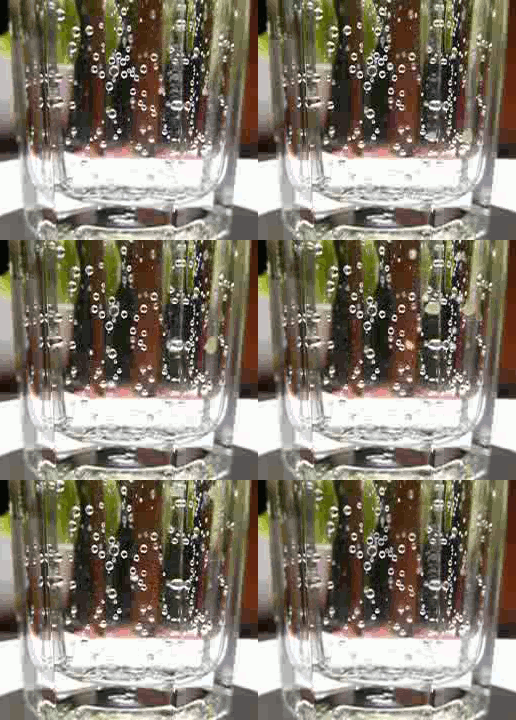
 From the Carnegie Institution , where soda pop science is like a carbonic acid trip, they say (thanks to modeling) we have to make big changes: “To save coral reefs, we need to transform our energy system…” while equating natural dissolution of CO2 into seawater with carbonation of soda pop, done under pressure and reduced temperature, making it supersaturated. The process is described as:
The amount of a gas like carbon dioxide that can be dissolved in water is described by Henry’s Law. Water is chilled, optimally to just above freezing, in order to permit the maximum amount of carbon dioxide to dissolve in it. Higher gas pressure and lower temperature cause more gas to dissolve in the liquid. When the temperature is raised or the pressure is reduced (as happens when a container of carbonated water is opened), carbon dioxide comes out of solution, in the form of bubbles.
While weak carbonic acid does get formed with CO2 dissolution in water [CO2 + H2O  H2CO3 ] the majority of the carbon dioxide is not converted into carbonic acid, remaining as CO2 molecules, which is why it outgasses so easily when a non-chemical catalyst is applied, like vibration. Carbonic acid does not make the soda pop “fizzy”; it is the fact that it is supersaturated, and stored in a way to seal pressure preventing gas escape and maintaining the supersaturation. It is pressure and temperature that drive the main outgassing process, as anyone who as left an open can of soda pop in their car during a hot summer can attest.
Major changes needed for coral reef survival
Washington, D.C.—To prevent coral reefs around the world from dying off, deep cuts in carbon dioxide emissions are required, says a new study from Carnegie’s Katharine Ricke and Ken Caldeira. They find that all existing coral reefs will be engulfed in inhospitable ocean chemistry conditions by the end of the century if civilization continues along its current emissions trajectory. Their work will be published July 3 by Environmental Research Letters.
Coral reefs are havens for marine biodiversity and underpin the economies of many coastal communities. But they are very sensitive to changes in ocean chemistry resulting from greenhouse gas emissions, as well as to coastal pollution, warming waters, overdevelopment, and overfishing.
Ricke and Caldeira, along with colleagues from Institut Pierre Simon Laplace and Stanford University, focused on the acidification of open ocean water surrounding coral reefs and how it affects a reef’s ability to survive.
Coral reefs use a mineral called aragonite to make their skeletons. It is a naturally occurring form of calcium carbonate, CaCO3. When carbon dioxide, CO2, from the atmosphere is absorbed by the ocean, it forms carbonic acid (the same thing that makes soda fizz), making the ocean more acidic and decreasing the ocean’s pH. This increase in acidity makes it more difficult for many marine organisms to grow their shells and skeletons, and threatens coral reefs the world over.
Using results from simulations conducted using an ensemble of sophisticated models, Ricke, Caldeira, and their co-authors calculated ocean chemical conditions that would occur under different future scenarios and determined whether these chemical conditions could sustain coral reef growth.
Ricke said: “Our results show that if we continue on our current emissions path, by the end of the century there will be no water left in the ocean with the chemical properties that have supported coral reef growth in the past. We can’t say with 100% certainty that all shallow-water coral reefs will die, but it is a pretty good bet.”
Deep cuts in emissions are necessary in order to save even a fraction of existing reefs, according to the team’s results. Chemical conditions that can support coral reef growth can be sustained only with very aggressive cuts in carbon dioxide emissions.
“To save coral reefs, we need to transform our energy system into one that does not use the atmosphere and oceans as waste dumps for carbon dioxide pollution. The decisions we make in the next years and decades are likely to determine whether or not coral reefs survive the rest of this century,” Caldeira said.
The World Climate Research Programme’s Coupled Model Intercomparison Project is provided support from the U.S. Department of Energy, which developed a software infrastructure in partnership with the Global Organization for Earth System Science Portals.
Rain is always acid. It is formed by absorption of CO2 in the atmosphere and is approximately a 10 percent carbonic acid solution. I don’t know of any calculations on how much CO2 is removed from the atmosphere by changes in the amount of water in the atmosphere or precipitation. How does variation in precipitation acidity affect the alkalinity of at least the surface layer of the ocean?
RT says:
June 28, 2013 at 2:11 pm
Roy, here are some grade school facts for you. The Earth was MUCH warmer during the PETM.
——————————-
yeah, RT and 90% of all sea life DIED
https://sites.google.com/site/thepaleoceneeocenethermalmaxim/home/carbon-isotopic-excursion
Although insoluble in ordinary water the calcium carbonate mineral – CaCO3 – dissolves in acidic carbonic solutions. Increasing the acidity of the oceans leads to fewer carbonate ions. By reducing the quantity of these raw materials, it slows the speed at which these creatures produce their calcite shells, making them less healthy, prone to dissolution and predators.
When these organisms die their calcareous shells fall to the bottom of the ocean, there they mix with silts to form sediments. Increased acidity dissolves their shells, the greater the acidity the less calcite reaches the sediment. The point at which the dissolution rate exceeds the supply rate of calcite produces the calcite-free red clays that clearly mark the PTEM, found by geologists across the world and recovered from dozens of deep sea drilling cores.
Examination of the remains of these shells (and those from other creatures) from the sediment layers below, in and above the acidic layer of 55 mya shows that the acidic layer marked a period of mass extinction for (or lack of recovery by) Phytoplankton, with dire consequences throughout the food chain.
Lol! Warmists just love to make fantasy connections between the PETM and today.
Link to some more bubble pictures …
http://jennifermarohasy.com/2008/07/ocean-acidification-photographs-from-bob-halstead-and-a-note-from-floor-anthoni/
Also, if I recall correctly, I am pretty sure that pH has to drop to at least 6 or below for CaCO3 solubility to occur significantly – and I am pretty sure it would take a lot to get ocean pH down to that level from current values of 8.2/8.3 !
Miniature reef aquariums have been kept in homes by hobbyists for a couple decades now. The original stumbling blocks were the lack of an efficient aerobic biological filtration system to convert toxic ammonia from animal wastes into still toxic nitrites, and then into less toxic nitrates; along with the unavailability of the powerful lighting systems necessary for the symbiotic algae within the coral polyps. There were some other details too: The corals were far more sensitive to nitrates then other marine animals so provisions were developed for that (constant water changes and/or nitrate consuming anaerobic filters), and reverse flow protein skimmers became common.
In a home the CO2 levels in the air are surprisingly higher than outside; I believe on the order of 25-50%. We could inform Obama that that comes from respiration. Anyway, since a marine aquarium must have a massive surface area differential in relationship to its volume compared to that of the ocean I would think that those home minireef aquariums would reflect this indoor CO2 concentration. Interestingly, the literature on these aquariums never bothers to bring this up as a problem. Could that perhaps be because it isn’t?
Roy says:
June 28, 2013 at 1:37 pm
===
Roy, you have your calcium precipitation and buffers mixed up…..
found this:
http://www.pwtag.org/researchdocs/Used%20Ref%20docs/52%20Carbondioxide%20in%20water%20equilibrium.pdf
(dunno if the link will work- am trying new browser here!)
I’ll have to read it through, but there is an interesting graph (Figure 2) – which shows the Co2/pH relationship in water – strange that the ‘equilibrium point’ seems to be around pH 8.3 ??
Roy says:
June 28, 2013 at 1:37 pm
“not sure if anyone at this post truly cares…”
I took your advice and binged the petm and found:
http://www.wunderground.com/climate/PETM.asp
Wherein it was claimed that humans are putting fossil fuel CO2 into the atmosphere at a rate massively greater than that which occurred in the petm, when allegedly all of the “carbon” stores in the Earth were injected into the atmosphere and oceans, resulting in temperature and ocean pH doom and gloom everywhere – although, fortunately, some adaptation allowed life to continue.
But if so, then where is the evidence that current CO2 additions and concentrations, even in toto, have had any effect on GMT or on the pH of oceans? And where is the evidence that carbon [C’s through and through or even CH3CH2CH2…CH3] is really CO2?
Bob Rogers says:
June 28, 2013 at 12:17 pm
My radical leftist facebook friend has been on about ocean acidification for more than a year now. Setting aside the silly comment in the article, is there any hard science on acidification, one way or another?
>>>>>>>>>>>>>>>>>>>>>>>
Yes Dr. Segalstad has a pdf at http://www.co2web.info/
The distribution of CO2 between atmosphere, hydrosphere, and lithosphere; minimal influence from anthropogenic CO2 on the global “Greenhouse Effect”. Published 1996 In Emsley, J. (Ed.): The Global Warming Debate. The Report of the European Science and Environment Forum. Bourne Press Ltd., Bournemouth, Dorset, U.K. (ISBN 0952773406), pp. 41-50.
part 4. Chemical Laws for Distribution of CO2 in Nature
is the part you want to clik on. (Lots of good stuff on that site and it is not hard to read)
RT: I really do not understand your points. Yes, of course the PETM was MUCH warmer than today. But that’s precisely half the reason why it’s so interesting — it corresponds to a remarkable rapid warming, about 6 deg C above “background conditions” accordingly to multiple independent proxies. The other half of the interest is that it precisely corresponds to a massive input of carbon, with among multiple reasons being that one can see the impact of ocean acidification through carbonate dissolution.
Of course, such commentary should lead one to thinking why the background conditions were also much warmer than today …
And what does commentary on glacial-interglacial cycles d18O have to do with this? Well pretty much nothing — at the beginner level — but kudos for bantering around concepts that seem relevant. Obviously, there are changes in carbon cycling during and corresponding to glacial-interglacial cycles in d18O, as one can easily see in thousands of deep sea cores, but these changes, while really intriguing, do not represent external carbon inputs and outputs to the ocean and atmosphere.
Kev-in-UK: I really don’t understand your comment either. Where do you think significant carbonate accumulates other than through biological components? So, yes, the suggested grade school experiment is not a truly good analog, because it would not have biological precipitation of carbonate. But his completely misses the point.
DGP: Agree and good to know someone likes to actually experiment and think independently. After a grade school student came in curious about ocean acidification, I suggested to him to try it. He thought totally cool and interesting … and well … I guess you can read all the reasons above why it won’t work, except basic chemistry does not lie.
DGP says:
June 28, 2013 at 2:24 pm
Roy,
I did that experiment with Coca-Cola and a baby tooth I had lost recently when I was a kid. I think it was to make me stop drinking soda.
I did that experiment with Coca-Cola and a baby tooth I had lost recently when I was a kid. I think it was to make me stop drinking soda.
That was the phosphoric acid used in coke, not the CO2. That is a stronger acid which dissolves the calciumphosphate Ca3(PO4)2 of the tooth into monophosphate which is soluble in water.
Bob says: @ur momisugly June 28, 2013 at 12:32 pm
……So, adding CO2 to sea water will decrease the pH……
>>>>>>>>>>>>>>>>>>>>
You are leaving out one important fact. The oceans are not pure distilled H2O (Which upon sitting around exposed to the atmosphere has a pH that can go down as low as 5.0.)
The oceans are at a pH of 8.2 to 8.3 because they are BUFFERED!
Again see Dr Segalstad’s information at http://www.co2web.info/
specifically link (glad I check, it is now gives an error message DARN!)
Luckily this shorter version is still on the net.
That is why the Ocean Acidification scare is a crock. Unfortunately most lay people do not understand buffers.
Let’s see. The US Federal Government (Dept. of Energy) pays these “scientists” to produce a paper, the press release of which occurs the same week as the Head of the US Federal Government makes a speech, whose premise is supported by said paper.
Anyone wonder why I put “scientist” in parenthesis?
Mark Bofill was quick to observe:
there will be no water left in the ocean with the chemical properties that
Actually, forever, the water in the oceans will always have the same properties, the molecule won’t change. If their thinking is as sloppy as their language …
JPeden says:
June 28, 2013 at 2:49 pm
Roy says:
June 28, 2013 at 1:37 pm
“not sure if anyone at this post truly cares…”
I took your advice and binged the petm and found:
http://www.wunderground.com/climate/PETM.asp….
>>>>>>>>>>>>>>>
Wundergound is run by Jeff Masters who is a card caring CAGW activist. (I have read his blog on occasion)
Tim Ball says:
June 28, 2013 at 2:30 pm
Rain is always acid. It is formed by absorption of CO2 in the atmosphere and is approximately a 10 percent carbonic acid solution.
The solubility of CO2 in fresh water at near freezing is 0.33%, that includes free CO2, H2CO3, bicarbonate and carbonate ions.
See: http://www.engineeringtoolbox.com/gases-solubility-water-d_1148.html
Plays hardly a role in scavenging the atmosphere.
JPeden:
Here’s a cool photo from National Geographic showing how carbonate chemistry works across the PETM:
http://eps.ucsc.edu/news-events/news-by-year/02-replica-sediment-core-6701.jpg
What you will hopefully see is light (carbonate) going very abruptly to dark (clay from dissolution of carbonate) to slowly getting lighter as the weathering feedback and calcium inputs kick in.
(Some will note from the photo that it is a “replica” core, and some will probably even further jump to the notion that this must therefore be some sort of conspiracy. You can, however, find photos of the actual core — and many others — that span the PETM in the public domain, or visit a core laboratory, or even go collect one).
Bruce: I actually somewhat agree with your comment, because the PETM seems to me an imperfect analog for what is happening today. My point was not to suggest the PETM as our future if several 1000’s of petagrams of carbon are added to the ocean and atmosphere, as will almost assuredly happen at current pace. Rather, my point was to note that there is a clear geological analog in which to test some basic theories, such as that purported by the article that initiated the thread. I strongly suspect that professor Caldeira knows basic carbonate chemistry, and much about the PETM, and for people to make non-sensical comments is not very illuminating.
Give the guy a break. He had to dumb it down for his target audience and political base.
At least he didn’t end up looking as inane as this poor soul.
Carnegie funded the Next Generation Science Standards for the US Common Core K-12 implementation. There was a story today on how it is designed to create experiences that will be accessible to traditionally disadvantaged students. http://www.edweek.org/ew/articles/2013/06/28/36science_ep.h32.html?tkn=RZOFZbsg57N%2FEEIDlr8Vj4SOCd8lGa3bdj0k&cmp=ENL-EU-NEWS1
Secondly, modelling is the term developed around 2005 to replace constructivism. It is less a matter of modelling as designed to accurately reflect reality than modelling designed to influence student’s perceptions of reality. In ways that will provoke them to take action to solve real world problems.
I have written about the NSF funded Understandings of Consequence. They are frequently not true but they are designed to meaningfully influence likely future behavior. Think of it as scince experiments to create beliefs and new values about how society can be restructured in the future. And why it should be.
And if that seems absurdly manipulative, it is. But it is still the intentions if you read beyond the Executive Summary in so much of what the NSF or Carnegie or Gates or Ford are funding in education.
Gail Combs says:
June 28, 2013 at 3:17 pm
From Segalstad:
This postulate fails for a number of reasons. An increase in atmospheric CO2 will namely increase the buffer capacity of ocean water, and thereby strengthen the ocean’s capacity to moderate an increase of atmospheric CO2
I have never heard that a buffer capacity is increased by using its capacity…
That te buffer capacity of the oceans (surface) is “only” absorbing 10% of the change in the atmosphere is a matter of chemical equilibria, which makes that the alkalinity of the oceans can absorb ten times more CO2 for the same increase in the atmosphere than fresh water would do. That is the Revelle factor:
http://www.eng.warwick.ac.uk/staff/gpk/Teaching-undergrad/es427/Exam%200405%20Revision/Ocean-chemistry.pdf
The Carnegie Institution is dangerously close to placing the horse back before the cart.
They have just described in a nutshell: rising temperature preceding CO2 increase.
Next thing you know, we’re gonna hear about a lag or something. Perhaps 800 years or some such. 😉
This paper is further evidence that CO2/AGW obsessives suffer from reduced congintive abilities, especially in the areas of critical thinking and fact checking.
Ferdinand Engelbeen says:
June 28, 2013 at 3:40 pm
Made an error, the solubility of CO2 in fresh water is 0.33% at 1 atm CO2, but CO2 in the atmosphere is only 400 microatm. Thus the real solubility in rainwater is only 0.000132%. Even less if stronger acids from sulphur and nitrogen are present…
==========================================================
Below a pH of 8.3 carbonates can be a mix of calcium bicarbonate and calcium carbonate. Above 8.3 the carbonates will be calcium carbonate and calcium hydroxide.
(Keep in mind that the pH does not drive the chemical reaction but is an indication of the reaction that has occurred. Again, I’m not sure how this applies to the post.)