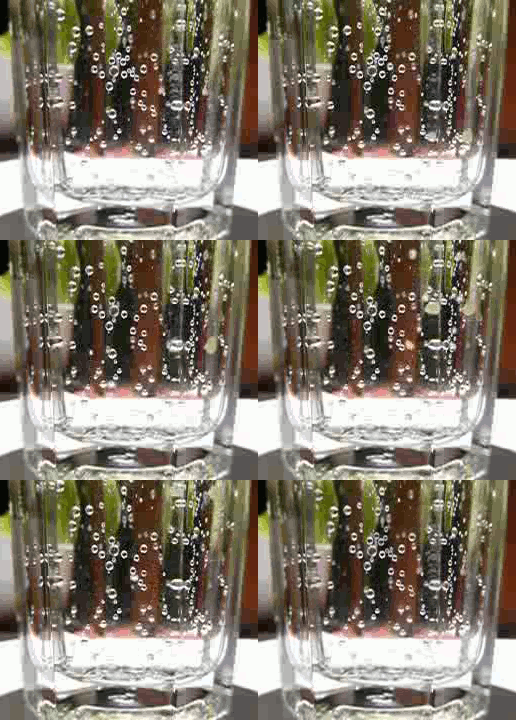
 From the Carnegie Institution , where soda pop science is like a carbonic acid trip, they say (thanks to modeling) we have to make big changes: “To save coral reefs, we need to transform our energy system…” while equating natural dissolution of CO2 into seawater with carbonation of soda pop, done under pressure and reduced temperature, making it supersaturated. The process is described as:
The amount of a gas like carbon dioxide that can be dissolved in water is described by Henry’s Law. Water is chilled, optimally to just above freezing, in order to permit the maximum amount of carbon dioxide to dissolve in it. Higher gas pressure and lower temperature cause more gas to dissolve in the liquid. When the temperature is raised or the pressure is reduced (as happens when a container of carbonated water is opened), carbon dioxide comes out of solution, in the form of bubbles.
While weak carbonic acid does get formed with CO2 dissolution in water [CO2 + H2O  H2CO3 ] the majority of the carbon dioxide is not converted into carbonic acid, remaining as CO2 molecules, which is why it outgasses so easily when a non-chemical catalyst is applied, like vibration. Carbonic acid does not make the soda pop “fizzy”; it is the fact that it is supersaturated, and stored in a way to seal pressure preventing gas escape and maintaining the supersaturation. It is pressure and temperature that drive the main outgassing process, as anyone who as left an open can of soda pop in their car during a hot summer can attest.
Major changes needed for coral reef survival
Washington, D.C.—To prevent coral reefs around the world from dying off, deep cuts in carbon dioxide emissions are required, says a new study from Carnegie’s Katharine Ricke and Ken Caldeira. They find that all existing coral reefs will be engulfed in inhospitable ocean chemistry conditions by the end of the century if civilization continues along its current emissions trajectory. Their work will be published July 3 by Environmental Research Letters.
Coral reefs are havens for marine biodiversity and underpin the economies of many coastal communities. But they are very sensitive to changes in ocean chemistry resulting from greenhouse gas emissions, as well as to coastal pollution, warming waters, overdevelopment, and overfishing.
Ricke and Caldeira, along with colleagues from Institut Pierre Simon Laplace and Stanford University, focused on the acidification of open ocean water surrounding coral reefs and how it affects a reef’s ability to survive.
Coral reefs use a mineral called aragonite to make their skeletons. It is a naturally occurring form of calcium carbonate, CaCO3. When carbon dioxide, CO2, from the atmosphere is absorbed by the ocean, it forms carbonic acid (the same thing that makes soda fizz), making the ocean more acidic and decreasing the ocean’s pH. This increase in acidity makes it more difficult for many marine organisms to grow their shells and skeletons, and threatens coral reefs the world over.
Using results from simulations conducted using an ensemble of sophisticated models, Ricke, Caldeira, and their co-authors calculated ocean chemical conditions that would occur under different future scenarios and determined whether these chemical conditions could sustain coral reef growth.
Ricke said: “Our results show that if we continue on our current emissions path, by the end of the century there will be no water left in the ocean with the chemical properties that have supported coral reef growth in the past. We can’t say with 100% certainty that all shallow-water coral reefs will die, but it is a pretty good bet.”
Deep cuts in emissions are necessary in order to save even a fraction of existing reefs, according to the team’s results. Chemical conditions that can support coral reef growth can be sustained only with very aggressive cuts in carbon dioxide emissions.
“To save coral reefs, we need to transform our energy system into one that does not use the atmosphere and oceans as waste dumps for carbon dioxide pollution. The decisions we make in the next years and decades are likely to determine whether or not coral reefs survive the rest of this century,” Caldeira said.
The World Climate Research Programme’s Coupled Model Intercomparison Project is provided support from the U.S. Department of Energy, which developed a software infrastructure in partnership with the Global Organization for Earth System Science Portals.
Maybe he should shake a warm can of Coke and peer in the opening while opening it up for a first hand experience of acidification. Of the eyeball.
But, when the oceans boil, the coral will be gone anyway.
(For the urbanites, this is sarcastic.)
Less than 20,000 years ago global sea levels were more than 100 metres LOWER than today. Corals seem to be surviving quite nicely thank you. Corals are tough.
The “science” is apallingly bad, and their “conclusion” was a forgone one. Pretty much the standard for all Climatism in other words. Whatever keeps the dough rolling in.
oh ok, so algae only needs CO2 when someone can claim it’s to sequester CO2….
Tell me again……how do photosynthetic corals build skeletons
I read the entire article waiting for the punchline, but there wasn’t any.
I don’t know what the alkalinity of seawater is but before it’s pH would actually decrease it would need to be overcome.
PS “Alkalinity” here describes the ability of seawater to resist a change in pH. Carbonic acid could react with a variety of chemicals in the ocean that would “use it up” before additional carbonic acid would make hydrogen ions available to actually lower pH. (I’m someone here could explain better.)
I’ve interacted with Ken in the past. He believes that all the gigantic Earthly sources and sinks are 1:1 identically and optimally matched such that anthropogenic CO2 is partially choked down by the oceans (acidifying the poor oceans) while the remainder accumulates in the atmosphere.
His is a simple 1-dimentional world.
Ahhh! Typo!!
“(I’m someone here could explain better.)”
Should be
“(I’m sure someone here could explain better.)”
Big Government funded a study calling for more Big Government. What a surprise!
Increased CO2 helps algae Emiliania huxleyi form plates of calcium carbonate called coccoliths.
http://www.rockyhigh66.org/stuff/acid4.png
Natural CO2 bubbling through the water doesn’t seem to bother these coral –
http://www.rockyhigh66.org/stuff/acid1.jpg
Ditto dbstealey on the .gif bubbles. I think I need to visit the fridge.
About 1% of CO2 entering the water becomes carbonic acid, at least temporarily. If the CO2 rises 100 ppm in the next 100 years, that means 1 part per million in the seawater (the surface water, at least) will be extra carbonic acid. In order to change the water at depth this will have to continue for about 800 years. I don’t think this warrants as much attention as is claimed.
not sure if anyone at this post truly cares, but some of the comments above belie some serious misunderstandings about carbonate chemistry, how the world works, and basic geological observations. Over short time intervals, a sudden increase in CO2 to the atmosphere (or for that matter to the ocean) will definitely increase the total carbon content of the atmosphere and ocean, and decrease ocean pH. In fact, this can be observed in records taken over the last 50 years, or a “sody pop” (which typically has a pH of <4). On longer time-scales, however, one has to consider the cations (notably Ca2+), which are supplied from rivers. So what happens when you have a world where carbon inputs increase slowly is indeed greater carbonate precipitation (and the chalks and limestones of the UK) because the greater inputs of carbon and calcium have to be balanced. But just do a google search on the Paleocene-Eocene thermal maximum (PETM) ca. 55 million years ago and you can see what happens when carbon is rapidly added to the atmosphere and ocean — there is indeed widespread carbonate dissolution because of a drop in pH, followed by excess carbonate precipitation, as the cation effect kicks in. In other words, you have a basic theory for how things work and you have examples in the geological record that are entirely consistent with such theory. Please don't obfuscate things. If you really are perplexed by the concept of ocean acidification and carbonate dissolution and precipitation — here's a 6th grade science experiment. Go to the beach and get a shell. Put it in a bottle of sparkling water. Watch it slowly dissolve. Add some Ca2+ and watch white particles precipitate.
We all know there were no coral reefs during the Holocene Climatic Optimum, and all other previous interglacial periods… /sarc
As for the IPSL sophisticated models…
>>>fhhaynie says:
>>>June 28, 2013 at 11:50 am
>>>In the equatorial south pacific. the surface water is already saturated with CO2, no amount that is added to the atmosphere is going into this area of the ocean. <<<
–And the coral reefs are all dead in this area, I presume.
I was in the Caribbean last year and guess what I saw from the airplane window, whitings! A natural phenomenon where CaCO3 precipitates directly out of the sea water and can only occur when the water is supersaturated with CaCO3. I would love to ask the authors when they expect the ocean to no longer be supersaturated with CaCO3, I’m sure the answer would be a blank stare. Are these the same authors that claimed that 75% (can’t remember the exact number) of the krill and plankton around Antarctica has disappeared since the 70s?
Jim Strom.
As I recall, most of the coral reefs are in the warmer waters where they get more sun.
Roy says:
June 28, 2013 at 1:37 pm
Roy, you really need to get out of your apartment more….
Roy, here are some grade school facts for you. The Earth was MUCH warmer during the PETM. The Earth was in a hot-house state where not even Antarctica was glaciated and the oceans still favored the precipitation of low-mag calcite, not aragonite. The Earth was warmer during the peaks of the previous interglacial period, evidenced by O18 isotopes, sea levels, and multiple lines of evidence showing that the Arctic was seasonally free of sea ice. The pH of the ocean has dropped 0.1 units since the beginning of the industrial revolution, which is actually not statistically significant. The diurnal variation of pH in the ocean is much greater and the seasonal variation is as well. So, please do yourself a favor and do not hold your breathe until the Earth returns to a hot-house/low mag calcite state.
Yup, it’s models all the way down.
================================================================
I’m not sure how this fits into the context of this post but calcium carbonate has a much lower solubility than calcium bicarbonate. In lime-soda water softening calcium oxide is added to the water to change calcium bicarbonate to calcium carbonate which then will precipitate. The process raises the pH. CO2 is then added to convert calcium carbonate back into calcium bicarbonate so that it doesn’t settle out in the distribution system.
Again, I’m not sure how this applies to the oceans but the process has been used for 100 years to treat drinking water.
See GLY 216- Paleontology & Stratigraphy – Field Trip – Devonian Stratigraphy and Fossil Assemblages of WNY
There are well preserved Middle Devonian coral reefs there, when atmospheric CO₂ content was 2200 ppmv (8 times preindustrial level). That much about ocean acidification and its dire effect on reefs. Should we introduce tera rubbish as the new unit of nonsense?
I think Roy needs to understand some basic geological facts too. For a start the limestone deposits in the UK (e.g. Chalk and Carb.Limestone) are actually dead carbonate skeletal matter – NOT depositional carbonates (i.e. not from dissolution).
Roy,
I did that experiment with Coca-Cola and a baby tooth I had lost recently when I was a kid. I think it was to make me stop drinking soda.
Did I miss it, or in the Carnegie Institute’s announcement that no pH values, nor their shift, were specified for the ocean? Typical – deal in generalities which scare people, but don’t provide substantive information on which they can make a judgment!