UPDATE: I’ve added graphs of the difference between the observations and the models at the end of the post, under the heading of DIFFERENCE.
####
We’ve shown in numerous posts how poorly climate models simulate observed changes in temperature and precipitation. The models prepared for the upcoming Intergovernmental Panel on Climate Change (IPCC) 5th Assessment Report (AR5) can’t simulate observed trends in:
1. satellite-era sea surface temperatures globally or on ocean-basin bases,
2. global satellite-era precipitation,
3. global, hemispheric and regional land surface air temperatures, and
In this post, we’ll compare the multi-model ensemble mean of the CMIP5-archived models, which were prepared for the IPCC’s upcoming AR5, and the new GISS Land-Ocean Temperature Index (LOTI) data. As you’ll recall, GISS recently switched sea surface temperature datasets for their LOTI product.
We have not presented trend maps in earlier comparisons of observed and modeled global land plus sea surface temperature anomalies, so, for the sake of discussion, we’ll provide them with this post. A comparison is shown in Figure 1 for the period of 1880 to 2012. 
Figure 1
The maps in Figure 1 show the modeled and observed linear trends for the full term of the GISS data, from 1880 to 2012. The CMIP5-archived simulations indicate stronger-than-observed polar-amplified warming at high latitudes in the Northern Hemisphere. The models also show a more uniform warming of the tropical Pacific, while the observations show little warming. There are a number of other regional modeling problems.
Presenting the trends over the full term of the GISS data actually tends to make the models look as though they perform reasonably well. But when we break the observations and model outputs into the 4 periods shown in Figure 2, the models do not fare as well. In fact, the trend maps will help to show how poorly the models simulate observed temperature trends during the early cooling period (1880 to 1917), the early warming period (1917 to 1944), the mid-20th century flat temperature period (1944 to 1976) and the late warming period (1976 to 2012).

Figure 2
To head off complaints by global warming enthusiasts, the IPCC acknowledges those warming and cooling (flat temperature) periods in their 4th Assessment Report. As a reference, see Chapter 3 Observations: Surface and Atmospheric Climate Change of the IPCC’s AR4. Under the heading of “3.2.2.5 Consistency between Land and Ocean Surface Temperature Changes”, the IPCC states with respect to the surface temperature variations over the period of 1901 to 2005 (page 235):
Clearly, the changes are not linear and can also be characterized as level prior to about 1915, a warming to about 1945, leveling out or even a slight decrease until the 1970s, and a fairly linear upward trend since then (Figure 3.6 and FAQ 3.1).
You’ll notice by extending the data back to 1880, the data shows a cooling trend before 1917.
A NOTE ABOUT THE USE OF THE MODEL MEAN
The following discussion is a reprint from the post Blog Memo to John Hockenberry Regarding PBS Report “Climate of Doubt”.
The model mean provides the best representation of the manmade greenhouse gas-driven scenario—not the individual model runs, which contain noise created by the models. For this, I’ll provide two references:
The first is a comment made by Gavin Schmidt (climatologist and climate modeler at the NASA Goddard Institute for Space Studies—GISS). He is one of the contributors to the website RealClimate. The following quotes are from the thread of the RealClimate post Decadal predictions. At comment 49, dated 30 Sep 2009 at 6:18 AM, a blogger posed this question:
If a single simulation is not a good predictor of reality how can the average of many simulations, each of which is a poor predictor of reality, be a better predictor, or indeed claim to have any residual of reality?
Gavin Schmidt replied with a general discussion of models:
Any single realisation can be thought of as being made up of two components – a forced signal and a random realisation of the internal variability (‘noise’). By definition the random component will uncorrelated across different realisations and when you average together many examples you get the forced component (i.e. the ensemble mean).
To paraphrase Gavin Schmidt, we’re not interested in the random component (noise) inherent in the individual simulations; we’re interested in the forced component, which represents the modeler’s best guess of the effects of manmade greenhouse gases on the variable being simulated.
The quote by Gavin Schmidt is supported by a similar statement from the National Center for Atmospheric Research (NCAR). I’ve quoted the following in numerous blog posts and in my recently published ebook. Sometime over the past few months, NCAR elected to remove that educational webpage from its website. Luckily the Wayback Machine has a copy. NCAR wrote on that FAQ webpage that had been part of an introductory discussion about climate models (my boldface):
Averaging over a multi-member ensemble of model climate runs gives a measure of the average model response to the forcings imposed on the model. Unless you are interested in a particular ensemble member where the initial conditions make a difference in your work, averaging of several ensemble members will give you best representation of a scenario.
In summary, we are definitely not interested in the models’ internally created noise, and we are not interested in the results of individual responses of ensemble members to initial conditions. So, in the graphs, we exclude the visual noise of the individual ensemble members and present only the model mean, because the model mean is the best representation of how the models are programmed and tuned to respond to manmade greenhouse gases.
In other words, IF (big if) global surface temperatures were warmed by manmade greenhouse gases, the model mean presents how those surface temperatures would have warmed.
Let’s start with the time period when the models perform best, the recent warming period. And we’ll work our way back in time.
NOTES: For the trend maps in Figures 4, 6, 8 and 10, I’ve used a different range for the contour levels than those used in Figure 1. The contour range is now -0.05 to +0.05 deg C/year to accommodate the higher short-term trends. And for the temperature anomaly comparisons, I used the base period of 1961-1990 for anomalies. Those are the base years used by the IPCC in their model-data comparisons in Figure 10.1 from the Second Order Draft of AR5.
RECENT WARMING PERIOD – 1976 TO 2012
Figure 3 compares the observed and modeled linear trends in global land plus sea surface temperature anomalies for the period of 1976 to 2012. The models have overestimated the warming by about 28%. The divergence between the models and the data in recent years is evident. It’s no wonder James Hansen, now retired from GISS, used to hope for another super El Niño.

Figure 3
Figure 4 compares the modeled and observed surface temperature trend maps for 1976 to 2012. The models show warming for all of the East Pacific, while the data indicates little warming to cooling there. For the western and central longitudes of the Pacific, the models fail to show the ENSO-related warming of the Kuroshio-Oyashio Extension (KOE) east of Japan and the warming in the South Pacific Convergence Zone (SPCZ) east of Australia. The models also underestimate the warming in the mid-to-high latitudes of the North Atlantic. Modeled land surface temperature anomaly trends also show very limited abilities on regional bases, but that’s not surprising since the models simulate the sea surface temperature trends so poorly.

Figure 4
MID-20th CENTURY FLAT TEMPERATURE PERIOD
If we were to look only at the linear trends in the time-series graph, Figure 5, the modeled trend is not too far from the observed trend, only 0.026 deg C/decade.

Figure 5
However, as discussed in the post Polar Amplification: Observations versus IPCC Climate Models, the climate models fail to present the polar amplified cooling that existed during this period. See Figure 6. (Yes, polar-amplified cooling exists in the Arctic during cooling periods, too.) The climate models failed to simulate the cooling at high latitudes of the North Pacific and in the mid-to-high latitudes of the North Atlantic. The climate models also failed to simulate the warming of sea surface temperatures in the Southern Hemisphere, and they missed the warming of Antarctica.

Figure 6
EARLY WARMING PERIOD – 1917 TO 1944
Atrocious, horrible and horrendous are words that could be used to describe the performance of the CMIP5-archived climate models during the early warming period of 1917 to 1944. See Figure 7. According to the models, if greenhouse gases were responsible for global warming, global surface temperatures should only have warmed at a rate of about +0.049 deg C/decade. BUT according to the new and improved GISS Land-Ocean Temperature Index (LOTI) data, global surface temperatures warmed at a rate that was approximately 3.4 times faster or about 0.166 deg C/decade. That difference presents a number of problems for the hypothesis of human-induced, greenhouse gas-driven global warming, which we’ll discuss later in this post.

Figure 7
Looking at the maps of modeled and observed trends, the models failed to simulate the general warming of sea surface temperatures from 1917 to 1944 and they failed to capture the polar amplified warming at high latitudes of the Northern Hemisphere. As discussed in the post about polar amplification that was linked earlier, the observed warming rates at high latitudes of the Northern Hemisphere were comparable during the early and late warming periods (See the graph here).
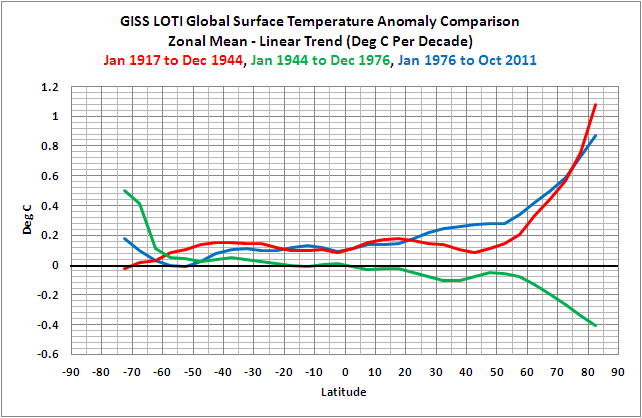

Figure 8
Note: Areas in white in the GISS map have no data or they don’t have sufficient data to perform the trend analyses, which I believe is a threshold of 50% in the KNMI Climate Explorer.
EARLY COOLING PERIOD – 1880 TO 1917
If the data back this far in time is to be believed (that’s for you to decide), surface temperatures cooled, Figure 9, but the model simulations show they should have warmed slightly.

Figure 9
The observations-based map in Figure 10 shows land and sea surface temperature trends seeming to be out of synch during this period—sea surface temperatures show cooling while land surface temperatures show warming in many areas.

Figure 10
If GISS had kept HADISST as their sea surface temperature dataset for this period, the disparity between land and ocean trends would not have been as great. That is, the HADISST data they formerly used does not show that much cooling during this period.

A MAJOR FLAW IN THE HYPOTHESIS ON HUMAN-INDUCED GLOBAL WARMING
The observed warming rate during the early warming period is comparable to the trend during the recent warming period. See Figure 11.

Figure 11
But according to the models, Figure 12, if global temperatures were warmed by greenhouse gases, global surface temperatures during the recent warming period should have warmed at a rate that’s more than 4 times faster than the early warming period—or, more realistically, the early warming period should have warmed at a rate that’s 22% of the rate of the late warming period—yet the observed warming rates are comparable.

Figure 12
That’s one of the inconsistencies with the hypothesis that anthropogenic forcings are the dominant cause of the warming of global surface temperatures over the 20th Century. The failure of the models to hindcast the early rise in global surface temperatures illustrates that global surface temperatures are capable of warming without the natural and anthropogenic forcings used as inputs to the climate models.
Another way to look at it: the data also indicate that the much higher anthropogenic forcings during the latter later warming period compared to the early warming period had little to no impact on the rate at which observed temperatures warmed. In other words, the climate models do not support the hypothesis of anthropogenic forcing-driven global warming; they contradict it.
THE OTHER MAJOR FLAW IN THE HYPOTHESIS ON HUMAN-INDUCED GLOBAL WARMING
Ocean heat content data since 1955 and the satellite-era sea surface temperatures indicate the oceans warmed naturally. Refer to the illustrated essay “The Manmade Global Warming Challenge” (42mb).
CLOSING
Climate models cannot simulate the observed rate of warming of global land air plus sea surface temperatures during the early warming period (1917-1944), which warmed at about the same rate as the recent warming period (1976-2012). The fact that the models simulate the warming better during the recent warming period does not indicate that manmade greenhouse gases were responsible for the warming—it only indicates the models were tuned to perform better during the recent warming period.
The public should have little confidence in climate models, yet we are bombarded by the mainstream media almost daily with climate model-based conjecture and weather-related fairytales. Climate models have shown little to no ability to reproduce observed rates of warming and cooling of global temperatures over the term of the GISS Land Ocean Temperature Index. The IPCC clearly overstates its confidence in model simulations of the climate variable most commonly used to present the supposition of human-induced global warming (e.g., surface temperature). After several decades of development, models continue to show no skill at establishing that global warming is a response to increasing greenhouse gases. No skill whatsoever.
SOURCE
The GISS LOTI data and the outputs of the CMIP5-archived models are available through the KNMI Climate Explorer.
UPDATE 1
DIFFERENCE
The difference between the GISS land-ocean temperature index data and the CMIP5 multi-model mean (Data Minus Model) is shown in Figure Supplement 1. The recent divergence of the models from observations has not yet reached the maximum differences that exist toward the beginning of the data—maybe in a few more years.

Figure Supplement 1
The differences do of course depend on the base years used for anomalies. As noted in the post, I’ve used the base years of 1961-1990 to be consistent with the base period used by the IPCC in their model-data comparison in Figure 10.1 from the Second Order Draft of AR5. Using the base years of 1880 to 2012 (the entire term of the GISS data) does not help the models too much. Refer to Figure Supplement 2. The recent divergence is still considerable compared to those of the past.

Figure Supplement 2.
garymount: A few quick comments about the post you linked.
http://blog.hotwhopper.com/2013/04/tisdales-tricks.html?spref=tw
We’ve discussed the “tricks” the author of the post is complaining about in the comments on this thread. My choice of break years makes the models look worse in some periods, better in others.
The anonymous author of that post starts his second paragraph:
“Looks not bad, doesn’t it. The models have picked up Pinatubo very well. While they appear to be less closely aligned to earlier periods that is where there is greater uncertainty in the record. They are pretty close from the mid-twentieth century onwards.”
I’m growing more and more convinced that proponents of human-induced global warming can’t read and comprehend comparison graphs. So I’ve provided an update to this post that shows the difference between the observations and the models.
And the author’s focus on the response to Mount Pinatubo is humorous. I wonder if he/she understands that the models in 1991 are responding to a decrease in sunlight caused by the temporary increase volcanic aerosols, and that a decrease in sunlight (downward shortwave radiation) is different (has a different impact on global temperatures) than an increase in downward longwave radiation from greenhouse gases.
This is why I think GISS temp is crap:
http://stevengoddard.wordpress.com/2012/07/11/smoking-gun-that-giss-temperatures-are-garbage/
http://stevengoddard.wordpress.com/2010/10/19/why-giss-temperatures-are-too-high/
Bob Tisdale: I had not read much of your post when I ran into a criticism of it while browsing Twitter. I have subsequently finished reading it and formed some ideas of addressing the criticism but as you mention, you discussed it in comments. I have also had some time to browse the blog I linked to and find that site has no merit. In fact it is just plain silly.
I enjoy reading your posts but oddly find them often to be the most difficult ones to get through. This post was an easy one for me because computer climate models are currently my top area of research and study. I am a computer scientist. When I read your ocean phenomena articles (Enso, etc.) my mind wanders into thoughts of how I could computer model and visualize such phenomena, since like I say I’m a computer scientist and I design and build software.
When this global warming / climate change stuff if finally over with, I am going to switch my attention to how to write better 🙂
That’s a clever addition you added to the end of your post.
Bob B:
At April 21, 2013 at 5:38 am you say
Oh, it is easier to see than that. This shows it at a glance
http://jonova.s3.amazonaws.com/graphs/giss/hansen-giss-1940-1980.gif
Richard
Bob B: There’s little difference between GISTEMP and the datasets from the Hadley Centre and NCDC.
http://bobtisdale.files.wordpress.com/2013/04/04-comparison1.png
From the monthly update here:
http://bobtisdale.wordpress.com/2013/04/01/february-2013-global-landsea-surface-temperature-anomaly-update/
Or looking at the long-term:
http://bobtisdale.files.wordpress.com/2013/02/figure-31.png
From the following post:
http://bobtisdale.wordpress.com/2013/02/17/a-look-at-the-new-and-improved-giss-land-ocean-temperature-index-data/
Bob Tisdale:
At April 21, 2013 at 5:38 am Bob B. provided evidence which he claimed shows GISS temperature reconstructions are what he called “crap”.
I responded at April 21, 2013 at 5:53 am with evidence which shows those reconstructions of the past have often been adjusted to alter their indications of global temperatures in past decades.
At April 21, 2013 at 6:09 am you have replied saying (with evidence)
With respect, your reply does not address the point made by Bob B. It merely says that HadCRUT and NCDC data sets are similar to GISTEMP.
Your answer could be taken to be agreement that GISTEMP is “crap” and to be saying the HadCRUT and NCDC data sets are also “crap”.
Richard
richardscourtney says: “At April 21, 2013 at 5:38 am Bob B. provided evidence which he claimed shows GISS temperature reconstructions are what he called ‘crap’.”
Bob B’s first link…
http://stevengoddard.wordpress.com/2012/07/11/smoking-gun-that-giss-temperatures-are-garbage/
…addressed United States surface temperatures, not global temperatures. Global temperatures are the subject of this post, not US temperatures.
Bob B’s second link…
http://stevengoddard.wordpress.com/2010/10/19/why-giss-temperatures-are-too-high/
…included an illustration of the impact of the GISS smoothing 1200km versus 250km smoothing and the deletion of sea surface temperature in the Arctic. I’ve discussed this in past posts:
http://bobtisdale.wordpress.com/2010/05/31/giss-deletes-arctic-and-southern-ocean-sea-surface-temperature-data/
But as shown in the post I linked, the 1200km smoothing over the Arctic doesn’t cause GISS to have a significantly different trend than the other two datasets.
http://bobtisdale.files.wordpress.com/2013/04/04-comparison1.png
From the monthly update here:
http://bobtisdale.wordpress.com/2013/04/01/february-2013-global-landsea-surface-temperature-anomaly-update/
And you continued: “I responded at April 21, 2013 at 5:53 am with evidence which shows those reconstructions of the past have often been adjusted to alter their indications of global temperatures in past decades.”
Agreed, the post you linked…
http://jonova.s3.amazonaws.com/graphs/giss/hansen-giss-1940-1980.gif
…does show that.
And my post discussed and illustrated the recent changes to GISS data, which resulted from a switch of sea surface temperature datasets: http://bobtisdale.wordpress.com/2013/02/17/a-look-at-the-new-and-improved-giss-land-ocean-temperature-index-data/
I wasn’t contradicting your comment, Richard. I was providing additional information. Did it change past data? Yes. Does it impact the long-term trend? Yes. The change in sea surface temperature datasets increased the GISS LOTI trend from 1900 to 2011 by about 9%.
Regards
If we’re attacking the models then IMO the graphs should consistently be = “Model Minus Empirical Data” to thus display the model error as being warm not the other way round.
Bob Tisdale:
Thankyou for the clear clarification you provide at April 21, 2013 at 7:30 am.
It is a pity that you were not contradicting me because then I may have learned something. But I only asked for a clarification and you provided it. Thankyou.
Indeed, your concluding point is – I think – very important in the context of your comparison of model data with quasi-empirical temperature data. I repeat it here to draw the attention of others to your point.
[snip]
As all your articles, your above article is good, informative, and thought-provoking. I again take this opportunity to thank you for it.
Richard
Bob your posts are always interesting, but this post suffers from a deficiency which would greatly increase its impact for the reader. Can you draw a vertical line on your graph to show the reader when the model runs were done or if that is not known exactly then a vertical line to show when the models were initialised to. My guess is that this was around 2005 but can you confirm that only model results after this date are true predictions/forecasts.
Mike M says: “If we’re attacking the models then IMO the graphs should consistently be = ‘Model Minus Empirical Data’ to thus display the model error as being warm not the other way round.”
Hi Mike: That’s how I originally plotted the difference:
http://i36.tinypic.com/vmyi43.jpg
But I was thinking of an upcoming post. With the way I presented it in the update, it will be easier for me to write and for readers to see that the models were not able to explain the cooling from 1880 to the 1910s or the warming from the 1910s to the 1940s.
In the upcoming post, I’ve also plotted the difference between the older version of the GISS LOTI data (thru 2011). It actually matches the models better during the early period–but diverges a little more in recent years.
Bob, GISS Temp has been constantly adjusting the past cooler and recent hotter.
I believe Hadcrut:
http://wattsupwiththat.com/2010/05/18/gistemp-vs-hadcrut/
John B says: “Can you draw a vertical line on your graph to show the reader when the model runs were done or if that is not known exactly then a vertical line to show when the models were initialised to.”
I believe individual ensemble members for the historical runs are initialized at different years. And the years they used are chosen by the modeling groups. As you noted, the historical simulations end in 2005 and the projections start in 2006.
The Director of the Climate Institute keeps his reputation at yahoo climateskeptic…
“And where are you with respect to Lake Superior, etc., and might it be free of ice rather than covered over. The shorter ice in time of the Great Lakes has meant that there is more time for lake effect snowstorms to dump even more snow than decades ago. And the lakes are open more due to warming, so, yes, there can be contradictory outcomes—global warming can lead to more snow in some areas.
Mike”
LOL, when the Great Lakes have less ice this is of course because of “global warming” and cannot be regional warming induced by circulation strengthening… Keep the game up Mikey, you’ll get a medal from the IPCC or the Climate Institute! LOL
Your Figure Supplements 1 & 2 (Models vs Observations) appear to coincide largely with a 60 year (approx) sine wave (except for the 70s).
1. Is this because the models ignore ENSO, and
2. Why do you think the 70s don’t match up.
Thanks for another fine post.
Bob B: FYI, both GISTEMP and HADCRUT have been changed since 2010, so the post you linked is kind of behind the times. The Hadley Centre added more surface stations, many toward the high latitudes of the Northern Hemisphere to their CRUTEM land surface air temperature data. This brought them more into line during recent decades with GISS and NCDC data. The Hadley Centre also revised their HADSST sea surface temperature data, primarily in the 1940s and 1950s.
Regards
Bob Shapiro, I wouldn’t want to speculate about the wiggles in the difference between the observations and models. As you’ll see in an upcoming post, the curve changes with what appears to be the sea surface temperature dataset used in the observations.
This is just dishonest.
To say that models, of this type, can reproduce their training sets is hardly a surprise nor is it vindication particularly since they don’t even do that good a job. This is science done by PR and marketing.
Good post. Test the models by their projection not their hindcasts + projections.
I like the new rating system. Now I’ll get the recognition I deserve round here – be careful what you wish for I hear you say 🙂