
Image Credit: Photobucket.com – GISP2 – Moberg – Keigwin – HadCRUT3
By WUWT regular “Just The Facts”
During the first crowdsourcing thread for the under construction WUWT Paleoclimate Reference Page, we had a number solid recommendations and WUWT moderator D.B. Stealey dropped a virtual mountain of links into comments here and here. The result is that the original WUWT Paleoclimate Reference Page has more than doubled in size and continues to grow as more comments from the prior crowdsourcing thread are added. Given the large number of additions and the fact that we now have a number of near-duplicate graphs, it seemed prudent to continue this crowdsourcing exercise to gain further input on the validity and value of each and all of the graphs.
There will likely be at least one more crowdsourcing thread for the WUWT Paleoclimate Reference Page, in order to assess a number of the currently disputed, questionable and falsified graphs, including Briffa et al., 1998, Jones et al., 1998, Mann et al., 1998, Pollack et al., 1998, Jones et al., 1998, Mann et al., 1999, Mann et al., 2000, Briffa et al., 2001, Esper et al., 2002 and Jones and Mann 2004, AR4 section 6.6.1.1 2007 and Marcott et al. 2013. Note that two (1, 2) of the graphs currently on the Paleoclimate page have a Disputed label, as per this comment and Alley’s own graph, the x axis label should read Years Before Present (1950 AD) not (2000 AD)


However, disputes aside, a gigantic thank you to D.B. Stealey, and all of those who have contributed to the WUWT Paleoclimate Reference Page. The following are some of the new additions to the WUWT Paleoclimate Reference Page:
472 Years – CET Extended Graph – Tony Brown – Graph Background

1,205 Years 800 – 2005

2,000 Years

2,100 Years – Law Dome O18

2,500 Years

3,000 Years
4,000 Years

10,000 Years GISP2 Ice Core

10,000 Years Vostok Ice Core

10,000 Years

10,000 Years Vostok Ice Core

10,000 Years GISP Hadley

10,000 Years GISP Hadley

10,000 Years GISP Hadley

10,000 Years GISP

12,000 Years – Vostok Anatarctica

20,000 Years

110,000 Years GISP2

110,000 Years GISP2

120,000 Years

140,000 Years Antarctic/Vostok

140,000 Years

140,000 Years
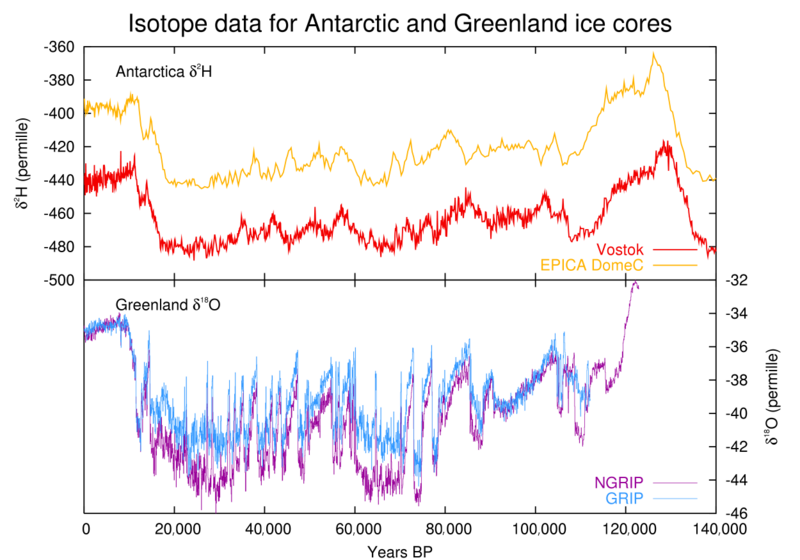
400,000 Years Antarctica/Vostok

420,000 Years

423,000 Years Antarctic/Vostok

450,000 Years

450,000 Years

740,000 Years

800,000 Years (Click the Pic and zoom in)

65,000,000 Years

108,000,000 Years – Cramer et al., 2011

545,000,000 Years

570,000,000 Years

750,000,000 Years

4,500,000,000 Years

(Please note that WUWT cannot vouch for the accuracy of the data/graphics within this article, nor influence the format or form of any of the graphics, as they are all linked from third party sources and WUWT is simply an aggregator. You can view each graphic at its source by simply clicking on it.)
Please post your thoughts, recommendations, graphs, links, research, suggested graph titles, etc., for the WUWT Paleoclimate Reference Page in comments. Thanks JTF
justthefactswuwt says: March 30, 2013 at 7:33 pm
“They haven’t been corrected, I’ve simply placed a “Disputed” label on them. The authors of the graphs should either provide convincing evidence that 2000 years before present is in fact accurate, or they should issue corrections to their graphs.”
The GISP2 data sure is popular here, so it would be worth getting the data at least consistent. 2500 years marks it correctly. 3000 yrs isn’t explicit, but seems right. 4000 yrs doesn’t number the x-axis at all, or identify the data, but it seems to be GISP2. 10000 yrs gets it wrong, in marking the last 100 years; however adding the recent warming counters the effect. Then Easterbrook at 10000 yrs has it explicitly wrong, but 2 plots down there’s another 10000 yrs that gets it right, and the one below also seems right. Then the animated gets it wrong, but below that Esper getting it right, with 1855 explicitly marked. I saw five more GISPS at longer times, but then it hardly matters.
Incidentally, do you really want to fill your page with umpteen people graphing Alley’s data?
Nick
Not snark, but which of the graphics showing data from 3000 years ago or more do you believe to be correct? its not easy to follow the ones you mean. Could you actually link to them? Thanks
tonyb
Mike McMillan says:
March 30, 2013 at 10:56 pm
I’ve reduced the 110,000 yr “gisp2temperature.png” source image to 8-bit color, so it should be easier to display and download. Annotated as “after:
Who made that image?
————–
I did.
It is based on how the dO18 isotopes actually vary with temperature at the Greenland Summit. There is an actual measured formula which is consistent with how these isotopes typically change with temperature, altitude, proximity to the poles and proximity to the oceans in all other locations around the world and with the internationally recognized VSMOW-world standard.
The other GISP2 temperature charts have recalibrated the exact same dO18 isotope data but this time based on borehole thermometry models. It is theoritical and faulty in my opinion.
Or one could look at it another way. The Antarctica isotopes vary by almost exactly the same amount as Greenland in the ice ages. But the Antarctic temperature changes are only -10.0C at the last glacial maximum (as in polar amplification) while the Greenland borehole calibrated temperature change is -25.0C (as in polar amplification gone wild). The north Atlantic temperature estimates are about -4.0C at the last glacial maximum while 500 kms away at the summit, it is -25.0C?
In addition, now that the ice cores have been extended back to the beginning of the Eemian interglacial, (NEEM just published) we see that Greenland got to +8.0C in the Eemian at 128,000 years ago based on the borehole methodology and much more of the glacial ice should have melted at these temps. Its just not accurate.
The Antarctic ice core scientists (and there alot more of them) have not fallen for the borehole models and use the real dO18 isotope temperature conversion formula. The Greenland ice core scientists lead by Cuffey, Clow, Dahl-Jensen and Alley have distorted the actual temperature changes.
You can remove the two charts labelled “GISP2 temperatures from dO18 isotopes” if you want to stick with the typically used GISP2 borehole-calibrated temperatures. But maybe one might want to see another probably more accurate view.
I have an updated chart of the one labelled “Temperature versus CO2 over the last 570 million years” – I did this one as well. The current chart goes back a little farther, includes more CO2 estimates and probably has improved resolution.
http://s4.postimg.org/5nwu2ppdp/Temp_CO2_750_Mya.png
The third graph from BioCab seems to be wrong for its CO2 scale at the right: starting at 210 ppmv, which is too low for the Holocene (270-280 ppmv at minimum).
cementafriend says:
March 30, 2013 at 5:28 pm
and
justthefactswuwt says:
March 30, 2013 at 7:06 pm
While I do admire the tremendous amount of work that the late Ernst Beck has done, his compilation has little to do with the real “background” CO2 levels of that time. Think about that: a peak around 1942 of 80 ppmv in a decade or so up and in a decade down. That is equivalent to burning down and regrowth of 30% of all land vegetation on earth… Even if the oceans may release such an amount in short time (be it not from temperature changes, but from external acidification), there is no sink on earth that can capture that amount in only a decade…
Moreover, not any other direct measurements in ice cores or proxies like coralline sponges or the – by some – much beloved stomata index data show such a huge change around 1942. Here the stomata data calibration against ice cores / firn / direct measurements over the past century:
http://www.ferdinand-engelbeen.be/klimaat/klim_img/stomata.jpg
The 1942 CO2 data officially were around 320 ppmv (ice cores). If the real data were at 380 ppmv, then the stomata index datapoints should be near the bottom of the chart.
Further the Kaplan chart shows a change of 0.2°C. According to Henry’s Law, that is good for a maximum increase in seawater CO2 pressure of 3 microatm. That is fully compensated by an increase of ~3 ppmv CO2 in the atmosphere.
See further:
http://www.ferdinand-engelbeen.be/klimaat/beck_data.html
There has to be real doubt that proxy data from ice-cores which show less than 280pmm are correct.
Let the late Jaworowski rest in peace, together with his opinions about ice cores. What he wrote after many of the initial drillings in ice cores might have been true in part, but most of his objections were already refuted by the work of Etheridge e.a. in 1996. That was by drilling 3 ice cores at Law Dome with a high accumulation rate with three different drilling techniques (wet and dry), measuring CO2 levels top down in firn and ice, etc… See:
http://onlinelibrary.wiley.com/doi/10.1029/95JD03410/abstract
unfortunately, the full article is behind a paywall.
If any values below 280 ppmv are unreliable, can anybody show me how CO2 measurements of the ice core air (after over 99% sublimation and cryogenic separation) can be as low as 180 ppmv, while the outside air in the atmosphere is near 400 ppmv and beyond (in the lab…)? See further:
http://www.ferdinand-engelbeen.be/klimaat/jaworowski.html
I may try that, have a condition (fibromyalgia with its memory/attn issues) that makes it hard but I may just give it a try.
just afraid I would make more work for others by messing up.
Ben Wouters says:
March 30, 2013 at 11:54 pm
Ben, I read the http://principia-scientific.org/supportnews/latest-news/124-real-global-warming.html article, and agree that a major subsea eruption event as described may be the PETM cause. However, the article then goes on to explain how the insulation effect of a blanket of atmosphere removes the need for a greenhouse gas to explain the present 33 C excess temperature. This is wrong. An insulation effect needs to radiate from to space at some altitude to cause a temperature rise at the surface. Without optically absorbing atmospheric components (called greenhouse gases and clouds), the radiation would be directly from the surface, and thus the atmosphere would not be effectively insulating. It does not matter if the air is a thermal insulator to conduction or convection, it is the boundary location of radiation to space that results in the greenhouse effect.
Bill Illis says:
March 31, 2013 at 6:12 am
The difference between borehole temperature reconstructions and ice core d18O is that the first represents only the local temperature at the top of the ice core over time, while the second represents the temperature mostly at the origin of the water vapour and partly where the vapour condensates to snow. That area is much larger than the point source of the borehole. In the case of the Greenland borehole, the top of the inland ice may show far larger temperature variations that the North Atlantic, where most of the water vapour of the ice originates.
The same is true for the Antarctic ice cores: the low level, high accumulation coastal ice cores capture snow originating from the nearby Southern Ocean and shows opposite trends between the Peninsula and East-Antarctic coastal ice cores (Law Dome, Siple Dome), directly related to ENSO and the SAM (southern annual mode). The high level, low accumulation inland ice cores (Vostok, Dome C) capture snow originating from most of the SH oceans and show similar variations as the Greenland ice core…
Thus the borehole temperatures are pure local, the ice core dO18 temperatures are from a wider area, depending of where the water vapour originated.
Mike McMillan says: March 30, 2013 at 10:56 pm Imageshack.com – RockyHigh66.Org – Mike McMillan – Click the pic to view at source[/caption]
 JoNova.com – RockyHigh66.Org – Mike McMillan – Click the pic to view at source[/caption]
 ImageShack.us – Click the pic to view at source[/caption]
Mike McMillan says: March 30, 2013 at 11:38 pm
Mike McMillan says: March 31, 2013 at 12:10 am
I’ve reduced the 110,000 yr “gisp2temperature.png” source image to 8-bit color, so it should be easier to display and download. Annotated as “after: http://img827.imageshack.us/img827/4488/gisp2temperature.png”
Who made that image?
http://www.rockyhigh66.org/stuff/gisp2temperature.png
…
My first one should be the100,000 yr, not 110,000 yr GISP2.
http://www.rockyhigh66.org/stuff/gisp2temperature.png
Thank you, not sure who made the image, but now that I can see it clearly, I think 110,000 Years is actually right. I’ve added your version into this article and onto the Paleoclimate page, i.e.:
110,000 Years GISP2
[caption id="" align="alignnone" width="578"]
Also reduced the 118,000 yr GISP2 to 8-bit color, and annotated the source image.
http://www.rockyhigh66.org/stuff/gisp2temperaturexaxispr.png
Added your version into this article and onto the Paleoclimate page, and now that I can see it clearly, it actually looks like 120,000 years, i.e.:
120,000 Years
[caption id="" align="alignnone" width="578"]
Here’s the 570 million yr chart color reduced and annotated.
http://www.rockyhigh66.org/stuff/tempco2570mlefttoright.png
Added your version into this article and onto the Paleoclimate page, i.e.:
570,000,000 Years
[caption id="" align="alignnone" width="578"]
Thank you very much for your contributions.
Bill Illis says: March 31, 2013 at 6:20 am S4.Posting.org – Click the pic to view at source[/caption]
I have an updated chart of the one labelled “Temperature versus CO2 over the last 570 million years” – I did this one as well. The current chart goes back a little farther, includes more CO2 estimates and probably has improved resolution.
http://s4.postimg.org/5nwu2ppdp/Temp_CO2_750_Mya.png
Added into this article and onto the Paleoclimate page:
750,000,000 Years
[caption id="" align="alignnone" width="578"]
Thank you
A true skeptic will always ask, “What if I’m wrong and they’re right?”
Obviously this question would never occur to a warmist.
Not enough skeptics ask themselves this question. People, we’re skeptics because we’re saying, “Extraordinary claims require extraordinary proof. Prove it then I’ll believe it.”
We’re not skeptics because we have an alternative belief, which is equally subject to being falsified.
Only if you’re truly brilliant and a Richard Feynman or Albert Einstein will you ask, “What if I’m wrong and everybody else is also wrong?”
Alec Rawls says: March 30, 2013 at 8:33 pm Climate Audit – Law Dome – Click the pic to view at source[/caption]
1. J. Storrs Hall offers progressively longer looks at GISP2 (central Greenland) temp proxy:
http://wattsupwiththat.com/2009/12/09/hockey-stick-observed-in-noaa-ice-core-data/
Those are valuable graphs, but not labeled well for inclusion on the reference page.
2. From Anthony, 2000 years of Law Dome O18 (still unpublished):
http://wattsupwiththat.com/2012/06/12/the-longest-most-high-resolution-most-inconvenient-paleoclimate-data-that-hasnt-been-published/
Added the Law Dome graph into this article and onto the Paleoclimate page:
2,100 Years – Law Dome O18
[caption id="" align="alignnone" width="542"]
However, I am inclined to give this chart a Disputed label, .e.g. Disputed Graph – This time series and graph are unpublished and thus have not been peer reviewed.
Please let me know if anyone disagrees with this label.
Thank you
Ben Wouters says: March 30, 2013 at 11:54 pm JOURNAL OF GEOPHYSICAL RESEARCH – Cramer et al., 2011 – Click the pic to view at source[/caption]
A recent paper on DEEP ocean temperatures going back 108 myears:
http://www.agu.org/pubs/crossref/pip/2011JC007255.shtml
The graph: http://onlinelibrary.wiley.com/store/10.1029/2011JC007255/asset/supinfo/jgrc12191-sup-0010-fs09.pdf?v=1&s=79e93e124ca1fd8a33753fc667ff17deaa20b3e6
Notice that DEEP ocean temperatures were ~17K higher around 83mybp then today !
Here’s a Nature article trying to explain the PETM with CO2 thawing permafrost. Bad luck there wasn’t any permafrost around in that period 😉
Here’s the real explanation: http://principia-scientific.org/supportnews/latest-news/124-real-global-warming.html
Yes, added the Cramer et al. graph into this article and onto the Paleoclimate page:
108,000,000 Years – Cramer et al., 2011
[caption id="" align="alignnone" width="578"]
Thank you
tonyb says: March 31, 2013 at 1:38 am Tony Brown – Climate Etc. – Click the pic to view at source[/caption]
You kindly referenced my CET extended graph to 1538. The article it is derived from is here;
http://judithcurry.com/2011/12/01/the-long-slow-thaw/
The references and research from which the figures are compiled is here;
http://curryja.files.wordpress.com/2011/12/long-slow-thaw-supplementary-information.pdf
I updated the graph title updated accordingly:
472 Years – CET Extended Graph – Tony Brown – Graph Background
[caption id="" align="alignnone" width="542"]
Please let me know if there are any additional modifications you’d recommend. Thanks
oldseadog says: March 31, 2013 at 2:11 am
How about putting in the Mann Hockey Stick for comparison?
It will definitely end up on the page, the questions are only what will it’s label say and will it be relegated to a section at the bottom for Questionable/Falsified graphs. We will have a separate crowdsourcing thread on the Disputed/Questionable/Falsified graphs to assure that each one is given a fair evaluation before we determine how to label and handle it.
Or would that be too cruel?
There is no cruelty in exposing the facts, the cruelty occurs when an erroneous graph is created and when someone is mislead by it.
Jimbo says: March 31, 2013 at 3:03 am
The last link after your post does not work – leads to “page not found”
Corrected, thanks.
justthefactswuwt says:
March 30, 2013 at 7:33 pm
Nick Stokes says: March 30, 2013 at 5:57 pm
I see that after all the argument over Lappi’s GISP2 plot marked Years before present (2000), finally corrected, you have Easterbrook’s same data with the same marking.
They haven’t been corrected, I’ve simply placed a “Disputed” label on them. The authors of the graphs should either provide convincing evidence that 2000 years before present is in fact accurate, or they should issue corrections to their graphs.
You have as the 2000 yr plot Dr Loehle’s 2007 paper data. He subsequently issued a correction, which made substantial changes.
http://multi-science.metapress.com/content/82l462p2v37h7881/
Authors
Craig Loehle, J. Huston McCulloch
Abstract
A climatic reconstruction published in E&E (Loehle, 2007) is here corrected for various errors and data issues, with little change in the results. Standard errors and 95% confidence intervals are added. The Medieval Warming Period (MWP) was significantly warmer than the bimillennial average during most of the period 820 – 1040 AD. The Little Ice Age was significantly cooler than the average during most of 1440 – 1740 AD. The warmest tridecade of the MWP was warmer than the most recent tridecade, but not significantly so.
I haven’t read the paper, as I refuse to pay 18 Pounds to read someones correction;
https://multiscience.metapress.com/content/82l462p2v37h7881/resource-secured/?target=fulltext.pdf&sid=caxasoc5s4ybdjupub4ns1ov&sh=multi-science.metapress.com
but the graph certainly seems deserving of a Disputed label, unless someone disagrees?
As one of those who pitched in on CA to fix the errors in the original version, if Nick hadn’t posted that I would have. The original graph is not disputed it’s acknowledged to be in error by the author (it’s not ‘someone’ who corrected it it’s the original author). To save you the money you can access the paper here: http://www.econ.ohio-state.edu/jhm/AGW/Loehle/Loehle_McC_E&E_2008.pdf
The data in the corrected graph extend to 1935 due to misdating in the original paper.
tonyb says: March 31, 2013 at 4:55 am
” which of the graphics showing data from 3000 years ago or more do you believe to be correct? its not easy to follow the ones you mean. Could you actually link to them?”
Tony, here are the links. Numbering would help, though.
2500 years marks it correctly. 3000 yrs isn’t explicit, but seems right. 4000 yrs doesn’t number the x-axis at all, or identify the data, but it seems to be GISP2. 10000 yrs gets it wrong, in marking the last 100 years; however adding the recent warming counters the effect. Then Easterbrook at 10000 yrs has it explicitly wrong, but 2 plots down there’s another 10000 yrs that gets it right, and the one below also seems right. Then the animated gets it wrong, but below that Esper getting it right, with 1855 explicitly marked.
Justthe facts
That is great, thank you
Tonyb
justthefactswuwt says:
March 30, 2013 at 7:33 pm
Nick Stokes says: March 30, 2013 at 5:57 pm
I see that after all the argument over Lappi’s GISP2 plot marked Years before present (2000), finally corrected, you have Easterbrook’s same data with the same marking.
They haven’t been corrected, I’ve simply placed a “Disputed” label on them. The authors of the graphs should either provide convincing evidence that 2000 years before present is in fact accurate, or they should issue corrections to their graphs.
They’re not disputed, they’re wrong. Any graph that claims to use Alley’s GISP2 data must either finish at 95 years Before Present (BP=1950) or AD1855 because that is the final date in his database which is on-line and freely available to us all. Lappi’s graph mistakes Present for 2000 as does Easterbrook, they should have a note added pointing out their error or be excluded.
I don’t think one can reliably use sea level to calibrate ice volume (especially over the last 100 million years). (maybe the last 5 million years but not over the last 100 million years).
The problem is that sea level has been falling for (almost) that entire period as the Atlantic Ocean has formed and has deepened and widened.
It started out as a simple Rift Valley (with lots of volcanoes) about 200 million years ago as North America split from Pangea, with Europe in tow. One day, the ocean invades the rift and we have a Persian Gulf or a Red Sea rift sea. If the rift continues widening, then the depth slowly increases as the ocean sinks in the mantle (it really does). But it can take 50 million years to 100 million years for one of these new oceans to reach a mature ocean depth of 5000 metres.
As the Atlantic really opened up, with South America splitting off and then Europe from North America (60 million years ago), the average depth of all the oceans on the planet was lower. The ocean had nowhere to go except onto the land.
A shallow ocean covered North America from Texas to Inuvik to Hudson Bay. Europe and the Middle East were nearly completely flooded. Sea level was probably 265 metres higher 94 million years ago.
It would be impossible to infer ice volume and glacial ice from sea level in that situation. In fact, there probably was no ice because all that warm shallow ocean covered so much of the planet. One could even imagine a nice warm current flowing up from the then Gulf of Mexico through Texas to the Arctic ocean. Indeed, crocodiles have been found in Alaska dating from this sea level high stand.
The estimates in the Cramer paper are probably just another attempt to jack up the CO2 sensitivity estimates from the paleoclimate by playing around with sea level/ice volume correlations.
You are showing a number of GISP2 plots that go back over 100, 000 years. The Alley data only goes back about 49,000 years.
http://www.ncdc.noaa.gov/paleo/pubs/alley2000/alley2000.html
http://www.ncdc.noaa.gov/paleo/icecore/greenland/greenland.html
The only graph going back 110,000 years I could find is Bender, et al., Nature, 1994 . However, that dating appears to be very old since a feature shown as 80,000 bp is now shown as about 45,000 bp in alley 2000.
The official dating for GISP2 goes back to 110,000 bp. However, I am not able to find an analysis that far back – Alley only goes back 49,000 years.
Therefore, unless there is a link to the more complete record, I think the graphs of older data need to be marked as suspicious.
GISP2 actually has some ice in it that has been dated at 250,000 years ago. There is just so much distortion at the bottom of this particular core at bedrock that people don’t feel confident in using the oldest data. Its not easy to find all the data which has been used.
The NGRIP ice core has less distortion at the bottom (and matches GISP2 very closely over the whole period) so it has generally been used the most recently. It has been carefully extended back to 122,750 years ago. On this page.
http://www.iceandclimate.nbi.ku.dk/data/
The new NEEM ice core extends the confirmed Greenland data back to 128,000 years ago, into the Eemian interglacial. Data here.
http://www.nature.com/nature/journal/v493/n7433/full/nature11789.html#supplementary-information
So here is a chart showing NGRIP-extended, NEEM, Epica DomeC Antarctica and the estimated Global temperature going back 135,000 years ago.
Could probably add this chart to the Reference page.
http://s12.postimg.org/9ctilkusd/NGRIP_NEEM_EDC_Global_135kya.png
How about the IPCC graph from AR1. It showed the typical depiction of temperature reconstructions of at least the 40 years prior to its being published.
http://i39.tinypic.com/bgemm9.jpg
I’d like to submit this graph from GISS:
http://suyts.files.wordpress.com/2013/02/image_thumb265.png?w=636&h=294
I think it tells the whole story.