Over at The Conversation Andrew Glikson asks Fact check: has global warming paused? citing an old Skeptical Science favorite graph, and that’s the problem; it’s old data. He writes:
As some 90% of the global heat rise is trapped in the oceans (since 1950, more than 20×1022 joules), the ocean heat level reflects global warming more accurately than land and atmosphere warming. The heat content of the ocean has risen since about 2000 by about 4×10²² joules.
…
To summarise, claims that warming has paused over the last 16 years (1997-2012) take no account of ocean heating.
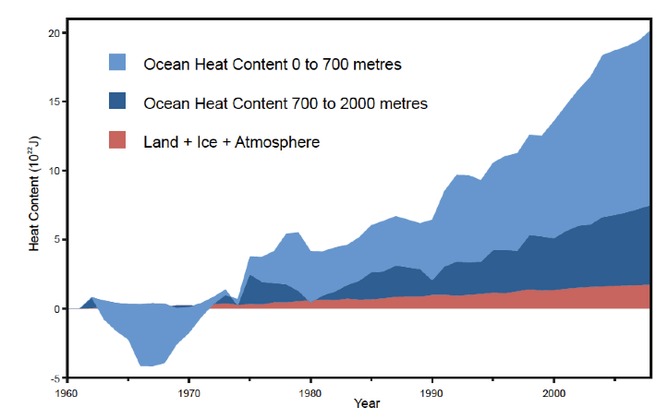
Hmmm, if “…ocean heat level reflects global warming more accurately than land and atmosphere warming…” I wonder what he and the SkS team will have to say about this graph from NOAA Pacific Marine Environment Laboratory (PMEL) using more up to date data from the ARGO buoy system?
Sure looks like a pause to me, especially after steep rises in OHC from 1997-2003. Note the highlighted period in yellow:

From PMEL at http://oceans.pmel.noaa.gov/
The plot shows the 18-year trend in 0-700 m Ocean Heat Content Anomaly (OHCA) estimated from in situ data according to Lyman et al. 2010. The error bars include uncertainties from baseline climatology, mapping method, sampling, and XBT bias correction.
Historical data are from XBTs, CTDs, moorings, and other sources. Additional displays of the upper OHCA are available in the Plots section.
As Dr. Sheldon Cooper would say: “Bazinga!“
h/t to Dr. Roger Pielke Sr. for the PMEL graph.
UPDATE: See the above graph converted to temperature anomaly in this post.
Evan Bedford says:
February 28, 2013 at 7:48 pm
“Can anyone do any better than the greenhouse gas correlation that is the current scientific consensus?”
The question is, can any do worse? Go hammer your nails with your tuna fish (see earlier comment if you are perplexed). We’re busy.
Phobos says:
February 28, 2013 at 7:38 pm
@D.B. Stealey: If humans are shoveling up carbon and burning it, why does the atmospheric level depend on the surface temperature?
It is a temperature modulation of continuous flows into and out of the surface system. It is exactly the kind of thing you expect for continuous transport models.
OK, that’s really it for tonight. Good night, all.
Evan Bedford says:
February 28, 2013 at 7:54 pm
Dang it. One more got in.
“Most of ‘em look like this.”
That’s land only.
All right. Nite all.
D.B. Stealey says: “CO2 has no measurable effect.”
To be clear: it is your position that the global average surface temperature is dependent on, and only dependent on, average atmospheric CO2 level?
Do I have that right?
Bart says: “It is a temperature modulation of continuous flows into and out of the surface system. It is exactly the kind of thing you expect for continuous transport models.”
People, did you notice how Bart threw in that term “continuous transport model” to try and snow everyone else into thinking he was oh-so-smart??
We are independent actors digging up fossil fuels and burning them. How, then, does the atmospheric level depend on temperature? It seems to me it depends on how fast we shovel….
MiCro says: “What exactly part of that temp trend is due to Co2?”
The answer requires a little bit of thinking — are you OK with that?
“Global temperature evolution 1979–2010”
Grant Foster1 and Stefan Rahmstorf2
Environ. Res. Lett. 6 (2011) 044022
http://iopscience.iop.org/1748-9326/6/4/044022/pdf/1748-9326_6_4_044022.pdf
By the way, you never responded about those papers I showed you that measured changes in downward longwave radiation. How should I interpret your silence?
Phobos says:
February 28, 2013 at 8:13 pm
“We are independent actors digging up fossil fuels and burning them.”
So what? It’s a drop in the bucket of global flows.
The mistake people make is that they do not understand that this is a feedback system. CO2 is well regulated by natural sources and sinks. Feedback naturally attenuates the inputs of small disturbances, which is what our contribution is. That is the magic of feedback. That is why we use it so extensively in electronic and electro-mechanical, hydraulic, chemical, and a host of other systems. The proof is in the plot which I will share again in just a moment.
“How, then, does the atmospheric level depend on temperature?”
I explained it. When you have continuous transport of CO2 into and out of the system, and the differential rate between the two is modulated by temperature, then you get a relationship of the form
dCO2/dt = k*(T – To)
which is precisely what is seen in the real data here. Sorry if you are uncomfortable with the nomenclature, but is this really so hard to understand?
Phobos says:
February 28, 2013 at 8:26 pm
“The answer requires a little bit of thinking — are you OK with that?”
Bob Tisdale already debunked it, but it requires thinking. Are you OK with that?
“By the way, you never responded about those papers I showed you that measured changes in downward longwave radiation. “
Well, I did.
Guys, there’s really no point in “debating” with Phobos.
If you noticed, earlier in the thread he stated outright that “this decade’s average temperature is higher than last decade’s average temperature” counts as evidence that the climate is still warming. In fact, as far as i can see reading back this morning, that is the ONLY straight answer to a straight question he has given in the entire thread.
When he was shown the falacy in that belief, his first reaction was to try and characterise my point as the obviously wrong “a 15 year pause means no warming”. Since I pointed out his (no doubt completely genuine) misunderstanding of my point, he’s ignored my last post and moved on to other things.
That demonstrates several unequivocable things about our friend Phobos, some of them even by logical inference!
(1) He’s easily suckered into genuinely and openly believing an AGW “talking point” that’s demonstrably wrong with very little thought or effort.
(2) Given (1) it’s extremely unlikely that he actually UNDERSTANDS any of the other “scientific” points he’s discussing. His arguments are simply picked up, flown in and dumped on the page like a child using Wikipedia for their homework. If he was capable of understanding them, he would never have fallen for such a simple fallacy!
(3) When something that he believes is shown, clearly and beyond any doubt, to be a fallacy, he first tries to distort what’s been show and then ignores the matter when that doesn’t work. That’s unscientific in the extreme. The fact he doesn’t recognise his own lack of scientific thinking in this context reinforces the inference at (2)
So why waste bandwidth on him? Apart from the fact it’s fun of course 😉
Phobos says:
February 28, 2013 at 8:26 pm
This doesn’t answer my question, and the R2 values aren’t very good.
I only got a chance to look at them this morning.
I can only see the Abstract of the first one:
So I’m not sure why they only subtracted 2/3’s. But, even if we assume the 1.8Wm-2 is real, how much of a temp change is that going to make on the zenith temp? So instead of it being -43C, it’ll be -41.8C?
This what I expected to find with my experiments, so let’s assume this is correct. So what?
The second paper was looking for ozone, and the third link was to papers on OLR from satellite measurements.
MiCro says:
March 1, 2013 at 7:05 am
This is what I get when I get distracted by work.
The “So What” is in relationship to the fact that the surface temperature record shows that temperatures go down at night as much as they went up during the day. This hasn’t change since the 50’s.
I have started to look at the rate of change of the daily difference between Rising temp – Falling temp, for both spring-fall as the rate difference goes from rising temps to falling temps, and fall-spring as the rate goes from falling temps to rising temps. And there is a trend in the rate of change, that seems to peak around 1970, and falls both going back into the 50’s as well as till about 2000, where the 10 year running average appears to be changing direction again. So it looks like there’s a ~60-70 year cycle that the rate of change is cycling, which fits the temperature cycle the data shows. Unfortunately the number of station readings before the 50’s is insufficient.
What this leaves is what is causing a 60-70 year cycle in the rate of change in temperature as the ratio of day/night changes with the seasons.
So Evan, when I say I don’t know, this is what i don’t have an answer to, but I do know it’s not Co2.
Phobos says:
February 28, 2013 at 6:12 pm
@Mark Bofill:
So, what you’re saying is that you really have no idea if burning 10,000 GtC will cause a runaway greenhouse effect. Yet you criticize those who’ve worked on planetary climates for decades and do have some idea about it.
—————————–
Sorry Phobos, I think I missed this last night due to cross posting.
You are absolutely correct that I really have no idea if burning 10,000 GtC will cause a runaway greenhouse effect. Whether or not I ‘criticize those who’ve worked on planetary climates for decades’ is beside the point. I’m glad for any and all scientific research that gets done. I’m happy that people are looking at climate. I’m certain scientists have been working very hard for decades, and it’s admirable that they’re working hard on it.
Unfortunately, the fact that they have been working very hard for decades does not excuse them from having their results subject to the same criteria I apply to all scientific results. Working hard on a problem for decades doesn’t mean I blindly accept your claims about the problem. At the end of the day I ask do you have a theory that is useful in making accurate predictions, can I see it please. If the theory can be used to make accurate predictions, I’m inclined to accept it. If not, well, keep working at it then, let me know when and if you sort it out.
Do you see some problem with this?
Phobos says:
February 28, 2013 at 5:04 pm
But, where did NOAA make this claim?
And who said NOAA was the last word in climate science? That their words are holy writ?
Who said ANYBODY was the last word in ANY science?
Here is what was said:
PDF document @NOAA.gov. For anyone else who wants it, the exact quote from pg 23 is:
”The simulations rule out (at the 95% level) zero trends for intervals of 15 yr or more, suggesting that an observed absence of warming of this duration is needed to create a discrepancy with the expected present-day warming rate.”
http://www1.ncdc.noaa.gov/pub/data/cmb/bams-sotc/climate-assessment-2008-lo-rez.pdf
By the way, Santer said something similar to NOAA, but he used 17 years. But this may not be the last word either. Some people would rather move the goal posts than admit their theory is wrong.
Phobos says:
February 28, 2013 at 5:06 pm
What do you mean by “catastrophic?”
I did not come up with that word. However James Hansen wrote the following book so the title may give you an idea what he has in mind:
Storms of My Grandchildren: The Truth About the Coming Climate Catastrophe and Our Last Chance to Save Humanity
Werner Brozek says:
March 1, 2013 at 8:28 am
[…]
PDF document @NOAA.gov. For anyone else who wants it, the exact quote from pg 23 is:
”The simulations rule out (at the 95% level) zero trends for intervals of 15 yr or more, suggesting that an observed absence of warming of this duration is needed to create a discrepancy with the expected present-day warming rate.”
http://www1.ncdc.noaa.gov/pub/data/cmb/bams-sotc/climate-assessment-2008-lo-rez.pdf
—————————————————————————————————
But Werner, the settled science has moved on since that was said in 2008. In the intervening years they’ve refined the models, which now allow for zero trends of any (as yet undetermined) length without altering the conclusions. That’s not goalpost moving, it’s just taking account of the improved models’ improved ability to take anything inconvenient that nature does and square it neatly with the consensus.
And they’ll ultimately be proved right – one day in the distant future the sun will expand and cook the planet, at which point they’ll be able to say “you see, the warming was just delayed!” 😉
MiCro says:
March 1, 2013 at 7:05 am
“This doesn’t answer my question, and the R2 values aren’t very good.”
And, it has no physical basis. It’s just a simplistic, deceptive, and meaningless curve fitting exercise. In Von Neumann’s words: “With four parameters I can fit an elephant, and with five I can make him wiggle his trunk.” Meh.
Phobos says:
“Do I have that right?”
So far, you don’t have anything right.
Evan Bedford says:
“Can anyone do any better than the greenhouse gas correlation that is the current scientific consensus?”
Of course. Wake up and pay attention:
Get up to speed on the Null Hypothesis, and you might begin to understand that there is nothing unusual happening. Natural variability fully explains the current climate.
Bart says: “So what? It’s a drop in the bucket of global flows.”
Nature absorbs as much as she puts in — actually a little more than that. It’s man’s contribution that is causing the atmospheric buildup.
D.B. Stealey says:
Richard Lindzen says: “For small changes in climate associated with tenths of a degree, there is no need for any external cause. The earth is never exactly in equilibrium. The motions of the massive oceans where heat is moved between deep layers and the surface provides variability on time scales from years to centuries. Recent work suggests that this variability is enough to account for all climate change since the 19th Century.”
If the heat were coming from the ocean, the stratosphere would be warming. Instead, it is cooling — as expected if AGW is taking place.
15-yr rates of cooling for lower stratosphere:
UAH: -0.09 (0.04) C/decade
RSS: -0.12 (0.05) C/decade
@Werner: “Catastrophic” is not a scientific term, but one of values. Hence, everyone defines it according to their values.
So how do you define it?
Phobos says:
“It’s man’s contribution that is causing the atmospheric buildup.”
And an unmitigated good thing it is, too. More CO2 is better. There is no downside, either at current or projected concentrations.
Those demonizing “carbon” are hopeless scientific illiterates.
Finally, Phobos is arguing with Prof Lindzen? Really? That is like a retarded child arguing with Albert Einstein.
[Also, I have already defined ‘catastrophic’. Pay attention: catastrophic is when the grant gravy train gets derailed.]
@Mark Bofill: So you have no idea of the consequences of burning 10,000 GtC, yet criticize someone who has done a lot of work on Venus and who says that, in their opinion (not fact — opinion), doing it here would risk a runaway greenhouse effect.
I think that shows your criticism is meaningless.
Joe says: “In the intervening years they’ve refined the models, which now allow for zero trends of any (as yet undetermined) length without altering the conclusions.”
Do you really not understand that a lot of evidence supports the enhanced greenhouse effect, while uncertainties in other factors that influence surface temperatures (aerosols, ENSOs, clouds, deep ocean dynamics, feedbacks) leave ample room for a flat trend over short time intervals?
And that ENSO fluctuations of plus-or-minus 0.2-0.3 C can easily combine with an underlying 0.15-0.2 C/decade GHG warming to give a 15-yr period of zero trend for the surface, like when a large El Nino is in the early part of the interval and a large La Nina is in the latter part of the interval?
Do you not understand these, or are you pretending not to? Because it’s rather simple reasoning….
Phobos says:
“Do you really not understand that a lot of evidence supports the enhanced greenhouse effect…”
Wrong.
There is no testable, empirical measurement that quantifies a ‘greenhouse effect’. If there were, then the question of the climate sensitivity number would be resolved.
D.B. Stealey says:
“There is no testable, empirical measurement that quantifies a ‘greenhouse effect’. If there were, then the question of the climate sensitivity number would be resolved.”
You’re wrong, because climate sensitivity depends on much more than the enchanced greenhouse effect — it depends on feedbacks, which are very difficult to calculate.
The links I’ve given above (Harries et al, and the others) are direct measurements of the enhanced greenhouse effect.
Phobos commented
” You’re wrong, because climate sensitivity depends on much more than the enchanced greenhouse effect — it depends on feedbacks, which are very difficult to calculate.”
Not only difficult to calculate, they don’t show up in the temp record. Very elusive.
Phobos says:
March 2, 2013 at 11:18 am
@Mark Bofill: So you have no idea of the consequences of burning 10,000 GtC, yet criticize someone who has done a lot of work on Venus and who says that, in their opinion (not fact — opinion), doing it here would risk a runaway greenhouse effect.
I think that shows your criticism is meaningless.
————————————
🙂 Phobos I missed you.
In fact, if you review my comments I posted no criticism of Dr. Hansen in this context in this thread, I cited Dr. Hansen to refute your argument that ‘nobody is predicting runaway global warming.’ If anything, it was you who were disregarding the opinion of someone who has done a lot of work on Venus, not me. But who cares about that; it was an irrelevant point when I first raised it. Taking the word ‘runaway’ out of Stealey’s original post and your response to it doesn’t really change the discussion at all. I was making a stupid point.
But I like your trick. If Dr. Hansen states something as fact, it’s OK for me to ask for a verifiable theory, but since it’s his ‘opinion’, what? I need to accept it as if it were scientific fact without the verifiable theory?
I don’t think so.
Phobos – hey, on a much more interesting note. I’ve heard rumor that you’re an SkS regular. Do you know anything about John Cook’s twitterbots, or any other bots he might use? I’ve read about AGW_AI (or was it AI_AGW), but apparently that twitter account has been suspended. Can you point me towards any info about them?