Guest Post by Willis Eschenbach
Reading my Sunday paper today, I find the following:
Customers Can Sell Back Solar Power.
The Los Angeles District of Water and Power will allow customers to sell back excess solar energy created on their own equipment.
Described as the largest urban rooftop solar program of its kind in the nation, the so-called feed-in-tariff program would pay customers 17 cents per kilowatt hour for energy produced on their own equipment. The DWP has already accepted more than a dozen applicants and will be taking dozens more as it accepts contracts for up to 100 megawatts of solar power through 2016.
My prediction is that this whole thing is going to turn into what we used to call a “righteous goat-rope” when I worked in Alaska. The problems with the proposal were spelled out before the vote by the Ratepayers Advocate, Fred Pickel. According to reports, he “told commissioners that 17 cents per kilowatt hour was above market rates and could force significant rate increases on DWP customers. Higher DWP bills could drive jobs away.”
Well yeah, duh. The Commissioners knew that, so they were careful to give Fred a fair trial before they executed him and voted for their proposal instead. This shows that it’s good for the LA DWP to have a “ratepayers advocate”, it gives the Commissioners someone to ignore, which is always fun, and that way they can say that they considered all sides of the question.
 Figure 1. Retail electricity rates, in US cents, for 2010. SOURCE
What is wrong with the moronomic math of the Commissioners of the Los Angeles District of Water and Power? Figure 1 suggests some of the answers.
The problem is that in order to break even, the Los Angeles District of Water and Power (DWP) has to sell the power at more than it cost the DWP to buy it, transport it, buffer it with adequate backup, and deliver it to the eventual customer. As a result, their sale price will be more than seventeen cents per hour.
How much more? Well, that’s kind of difficult to calculate. But we can look at some of the issues and make some first-cut estimates.
First, getting the power from the rooftops. Certainly for some installations the DWP will have to install interconnects to their main backbones. And even for residential installations, a sunny day can put a huge load on a local distribution network. Remember, that network was never designed to handle excessive amounts of power, particularly heading upstream. In addition, DWP will have to install a variety of wireless reporting instrumentation for the control of the intelligent network, to keep it from going off the rails. I’d guess the cost to upgrade local networks and provide intelligent interconnects and controls would be on the order of a cent per kWh.
Then we have to look at the question of backup. Solar is notoriously variable. When the clouds come over, output drops massively and pretty instantaneously. That power needs to be replaced, immediately, from some other source. That means that you will have to both purchase and install peaking power that is equivalent to the amount of solar that you are adding to your system. This need for immediate response is often met these days by huge diesels, which can respond much faster than gas turbines to power variations. But whether the backup is gas or diesel, it is going to be two things—inefficient and expensive. It has to be inefficient because you have to keep it running, at minimum load and in an inefficient range for the engine/turbine, all the time. Engines are designed to run at maximum efficiency under full load conditions, and elsewhere in the range they are much less efficient. You can’t shut the backup off, and to make it worse, most of the time you’re running at maybe 10% of the nameplate capacity. No bueno.
I discuss the levelized cost of various generation systems in “The Dark Future of Solar Electricity“. I’ll use the costs of conventional combined cycle gas as an example for the backup of the solar. The capital costs for CCG are about two cents per kWh, and the running costs are given as five cents per kWh. It won’t be running all the time, though, so we’ll take running costs at two cents per kWh. That’s a combined cost of four cents per kWh for the backup.
Finally, the electricity has to be delivered to the ultimate customer. The price of operating this transmission network is usually referred to as a “wheeling cost”. I would expect the wheeling cost to be on the order of a cent or two per kWh.
So we have seventeen cents for the power purchase. We have a penny for the intelligent network upgrade to handle the power, about four cents capital plus running costs for the backup generator, and we’ll call it another penny for wheeling costs to be conservative, although if their network is old the wheeling cost may be higher.
That gives a total out-of-pocket power cost to the DWP of about twenty-three cents per kWh of power delivered to the ultimate customer … but wait, it gets worse. The DWP still needs to both cover their administration costs, and to have funds to re-invest in upgrading plant and equipment as the years go by. So they’ll need maybe 20% above the raw costs to cover overheads and investments, which puts the sale price for the power on the order of twenty-seven, twenty-eight cents per kilowatt hour … might be a bit more, might be a bit less, this is an estimate, but that’s the range.
Of course, they likely won’t ask any single customer to pay that much. Instead, they’ll quietly spread the expense over all of their customers near and far, and it will be reflected in a price increase across the board.
Unfortunately, as you can see by the colors in Figure 1, California already has the most expensive electric power with the exception of the New England states, and this will only make it worse. Power in CA is far more costly than in any of its western neighbors. This is a result of California’s colossally foolish policy of requiring a certain percentage of renewables … plus an even more idiotic policy of not counting hydroelectric power as a renewable.
But wait, it gets worse. We used to have the “20% renewable by 2020” goal for our electricity, which is why the California power cost is already up to fourteen cents per kWh as shown in Fig. 1, and part of why people were fleeing the state even then.
But when Jerry Brown assumed the imperial governorship, he decided by fiat that the new policy should be:
20% renewable by December 31, 2013
25% renewable by December 31, 2016
33% renewable by December 31, 2020
And that, dear friends, that means that you can stick a fork in California, we’re done. By the time that the 33% renewable policy is implemented statewide, all Californians will be paying the twenty-five cent per kilowatt-hour price that the LA folks are test-marketing right now. And meanwhile, the neighboring states are ending up with the businesses that are fleeing California like cockroaches from the light, in part because electricity and fuel costs are so high that a business can no longer afford to run a factory in California.
As I have mentioned elsewhere, expensive energy is always a bad idea. It turns out that in California, it’s a lethal idea, it will both kill businesses dead and be very hard on the poor.
w.
Willis also wrote “You see that part about the “utility-side network upgrade costs”? That’s the penny per kWh in the costing. You can claim that is too little or too much. But your claim that there will be no utility-side network upgrade costs is nonsene.”
Not nonsense. And potentially negative in actual fact. ie in the short term we may *save* money by distributing generation.
Upgrades to distribution networks are driven from the network being no longer able to cope with the load (as well as adding additional feeders for redundancy and so on but those reasons are unrelated to this discussion) and that happens when the people on that network consume more than it can handle. Addition of distributed generation (ie solar PV) throughout that network decreases the load and puts off the need for upgrades.
A. Scott says:
January 15, 2013 at 4:58 pm
That is the same asinine claim that the power companies are making. WHY DO YOU THINK THE AVERAGE ENERGY COST IN LA IS 14.1 CENTS PER KWH?
It is because of congenitally innumerate folks like you that the price is so hight.
You are so out of it that you think that when we can put in a new power plant for a levelized cost of 6 cents per kilowatt hour, you blithely claim that it’s a brilliant plan to put in a plant costing 17 cents an hour.
You’re so out of touch, you think 13 cents an hour is a good deal for electricity, simply because LA has a worse deal. And in an amazing feat of self-referential ignorance, it is your same kind of inane stupidity, repeated over and over for the last decade, that is the reason LA charges 14 cents per kWh … and you are hell-bent on perpetuating it.
Yes, LA charges 14.1 cents per kWh. BUT THAT DOESN’T MAKE 13 CENTS A GOOD DEAL, A. Scott, that’s just your misguided fantasy of how prices work. All a 13 cent deal is good for is to highlight that 14.1 cents is a really really bad deal.
Please do try to catch up, these kinds of repeated nonsensical statements are doing serious damage to your reputation.
w.
Bull poop Willis – I said nothing of the sort – neither was there “bluster” nor did I ever say back up generation was not required. And I was correct about running plants at partial capacity as I ALSO explained right above.
You – as usual – didn’t bother to read what was said, but that certainly did nothing to stop you from making boorish and denigrating attacks..
On backup power – I AGREED WITH YOU “its a significant cost factor and issue” … but I went on to note that there was already EXISTING reserve generation capacity, AND that because this solar was a supplement to existing production (and not a fulltime primary source) it could use existing generating reserve.
You ignored that I posted exactly those details – that there is existing 1,000+ megawatts reserve capacity:
On running plants at “partial capacity” – as I showed above I was correct on that as well. SOME plants operate as you note – BASE LOAD PLANTS running steadily at fixed capacity to cover the minimum base power loads – nuclear and coal primarily.
But there are also the necessary PEAK LOAD PLANTS that operate on an on demand basis. Typically natural gas, and things like the pumper storage type plants. I was correct that MANY plants DO operate in a partial load status – including even some base load coal type plants that are cycled throughout the day based on load status. Energy demand is NOT static and thus you MUST have the ability to manage generation capacity to demand.
You were wrong in each of your attacks and the denigrating comments you included as a result Willis.
And if you read my posts immediately above you will see it appears you were also wrong about your base premise as well. Implementing the solar buy back tariff costs just 4 center per month per customer.
And with a rate paid between 13 cents and 17 cents at max, considering the majority of solar would be available and purchased at peak afternoon demand times – when rates are as high as 30 cents per kWh – the fees paid for customer generated solar fed to the system seem VERY reasonable. Even if we use YOUR estimate of the addtl costs – at 13 to 17 cents per kWh base this energy likely represents a net profit for the utility and it customers.
A. Scott, you say:
I will leave it to the readers to decide if it is true that it doesn’t matter whether the efficiency of the Castaic power storage and generation is 5% or 100%, and thus whether Mr. A. Scott has a clue, or needs desperately to purchase two double fistfuls of same …
Me, I say it matters doubly what the efficiency of the Castaic plant might be, because it loses energy going up as well as going down. But then I’m just a guy who has built hydroelectric power plants, what the hell would I know? Engineers in the crowd, what say ye? Is it true as A. Scott says that
Because I say, no way, he doesn’t have a clue what he’s talking about.
I await the wisdom of the vox pop …
w.
Quote from the increasingly hysterical (see CAPS!) A. Scott:
“The 4 cents a month to implement this solar does provide benefits to all customers as well. Not the least being it frees up 150 megawatts of their excess capacity – which could minimize or eliminate rolling brown and/or blackouts in the next big heat wave – just as ONE example.”
———————————————————-
A. Scott, I know next to nothing about energy production and use in California. But, I do know a bit about how energy grids work in advanced countries.
It may be that home solar installations reduce the demand on conventional power sources on hot, sunny days. But, your characterisation of peaks is just wrong. Peak energy demand is after people get home from work, when they start to cook dinner, wash themselves and their kids, switch on the TV and other appliances, etc. That is in the late afternoon/early evening. Solar is not much help at that time.
The other peak is in the early morning, when similar activities are happening. Again, solar is not contributing anything useful at 7 am.
Solar does not address the regular, predictable peaks in any way. If it helps out on very hot days now and then, so what? The important thing is that when people come home from work, or get up in the morning, when they switch something on, it works. That means 100% backup.
Running conventional plants at less than peak efficiency because it happens to be sunny, or windy, is ruinous economically and can only be justified by some sort of quasi-religious belief.
.
A. Scott says:
January 15, 2013 at 6:41 pm
Again your lack of even rudimentary math shines through.
The fact that LA charges 30 cents at peak doesn’t make 13 cent power a good deal, not not when you can buy 6 cent per kWh power generation capabilities all day long.
Let me say it again. The fact that LA charge a huge amount for power doesn’t mean that expensive power is a good deal. That is a child’s vision of the market. Wake up, my friend, you’ve drunk the koolaid. When you can buy generation at a levelized cost of 6 cents per hour, with falling costs for the natural gas it runs on, at that point 7 cents an hour is a bad deal, and 13 or 17 cents is ALMOST DOUBLE THE MARKET COST. It’s a mystery to me how you can claim that paying double the market cost for anything is a good deal … but then as we’ve all observed, math is not your strong suit.
Sure, LA charges 30 cents per hour, but all that means is that LA DWP is getting ripped off by their power suppliers, like the jokers you approve of charging 17 cents per hour. Thirty cent power doesn’t mean that 17 cent power is a good deal, that’s backwards thinking.
w.
PS—You reveal your innumeracy even more when you claim this is a good deal “for the utility and its customers” … really?
Buying expensive power, and then selling it for an even more expensive rate to the customers, is a good deal for the the customers?
Really expensive power is a good deal for the customers … man, that takes the cake. I’m glad you’re not running a business for me … that kind of colossal ignorance is dangerous.
Simple question Willis. How much will it cost and how long will it take to design, finance, permit and build new plants that can produce electricity at your 6 or 11 cents per kWh?
Regardless – your post did not bring up this post at all. You did briefly refer to the costs for BACKUP generation – which I have shown already exists in sufficient capacity to handle this small 150 megawatts or solar.
“Moving the Goal Posts” … penalty …. 10 yards and loss of down Willis. THAT would be the subject perhaps of another post – but it is NOT the subject you wrote about here.
Your entire post was about the foolishness of paying more for solar than you could sell it for. How in California, as you proclaim; “it’s a lethal idea, it will both kill businesses dead and be very hard on the poor.”
Yet we find out by reading the entire article that it does neither. It costs a few cents on the average customers bill.
And a few minutes research on my part shows the recent rate hike – which addresses many important issues and requirements INCLUDING the renewables requirement – costs a few dollars a month.
And that same few minutes of research showed any of those customers that are poor already get CONSIDERABLE assistance from LADWP. They are not likely to be affected in any meaningful way.
As far as businesses – they all know the score. Nothing is in any way new or different. They have had many, many years of exactly the same kind of issues to deal with. They always do have the choice of moving. Funny thing Willis – and I know many, many business owners in LA – they almost all seem to think the other benefits outweigh the fact they pay a little more.
Your post was about the foolishness of pay 17 cents for solar. By simply reading the entire story I showed it was not 17 cents – it was a blended rate between 13 and 17 cents. I made the case, supported with research and facts – as did others – that because this power is available at peak time of need – when rates are at peak levels as well – that the utility is very likely selling that power for at or more than they are paying. And that these prices ARE by all appearances a GOOD deal … especially when considering there is no capital cost for the equipment generating the power.
Which was the topic of your post.
Willis – please try not being a pompous jerk just for once. I said “it would seem” the efficiency of a pumping plant in generation mode would have little bearing … not a statement of fact, simply my impression. If you actually HAVE some useful insight then please simply post it and educate us and stop acting like a boob.
Willis … is a pumped storage plant a good peak load source of generation or is it not?
Johanna – I suggest you do your research again on peak demand. Perhaps read LADWP’s comments – or those of most any other source. Including Willis. Peak demand is afternoons, when people are at work, plants are operating, and air conditioners are running full blast. There are lesser peaks at different times.
Willis, higher electricity charges relative to other states are a great way to get rid of poor people California. Maybe that’s what the rulers are really trying to achieve? As we know, Green = elitist.
Willis – again, simply put – here is your premise for this post:
I showed, contrary to your assertion, the problem you claim does not appear to exist. I showed it appears highly likely they are selling the power for more, possibly far more, than the 13 to 17 cents per kWh they are paying for it. I supported this with documented information and facts
You admit this yourself … “Sure, LA charges 30 cents per hour..”
All the rest of your protestations, while they may well be worthy of another post, are irrelevant to your original post and premise. Which, even by your admission, seems to be largely refuted.
A. Scott,
“Willis … is a pumped storage plant a good peak load source of generation or is it not?”
I am not Willis, but I can translate his answer into a simple form for you.
From a cost / energy efficiency stand point, NO.
Aussie – there appear to be many reasons for California’s higher rates. In large part it a function of a very large dense population in a somewhat large geographic area for generation and transmission.
Another, perhaps the biggest, issue it seems is the aging and increasingly fragile infrastructure. Many/most of their lines are above ground and are 60+ years old.
But are they really that high? From Willis map there is an entire large area in the NE with as high or worse rates there.
A. Scott says:
January 15, 2013 at 7:18 pm
Thanks, A. Depends on the efficiency of the plant. Remember, however, that pumped storage is not a source of power, just a transfer of power from one part of a day to another. If you can do it efficiently, it’s a good deal.
w.
A. Scott – your assumption that peak demand has anything to do with air conditioners says it all. Firstly, there is winter to be taken into account; secondly, not everyone lives in a climate where aircon is a necessity; and thirdly, here is an example of what I was talking about:
http://arrow.dit.ie/cgi/viewcontent.cgi?article=1065&context=dubencon2&sei-redir=1&referer=http%3A%2F
%2Fwww.google.com.au%2Furl%3Fsa%3Dt%26rct%3Dj%26q%3Dtypical%2520pattern%2520daily%2520demand%2520electricity%26source%3Dweb%26cd%3D7%26ved%3D0CGUQFjAG%26url%3Dhttp%253A%252F%252Farrow.dit.ie%252Fcgi%252Fviewcontent.cgi%253Farticle%253D1065%2526context%253Ddubencon2%26ei%3Ddib2UJWKN66UiAe6kIG4Bw%26usg%3DAFQjCNHdwI0MXbnUU8TvU8gVS0o3Wnr4VQ#search=%22typical%20pattern%20daily%20demand%20electricity%22
Sorry about the ungainly link – but it is a typical paper from the ‘we’re all going to fry’ crowd which documents the appalling fact that, when people come home from work, energy use rises. That is why we are all being asked to get ‘smart meters’. It is a way of punishing us for daring to cook our dinner or wash our kids when it is convenient. Gaia is angry!
Seriously, A. Scott, if you think that there are no energy peaks when people come home or when they get up in the morning, I am just glad that I wasn’t the unfortunate teacher who tried to explain why 2 + 2 = 4 (for practical purposes).
A. Scott says:
January 15, 2013 at 7:11 pm
We’re talking off-the-shelf plants, so no design time. The main holdups have nothing to do with power plants, and everything to do with the dysfunctional state of regulations in California. Any power plant except subsidized solar has been so demonized that you can guarantee a fistful of lawsuits before you even get started. Estimated time to production? Probably some time between five years and fifteen lawsuits. However, the fact that California’s regulations are dysfunctional is not the issue here.
No, you have claimed that there is sufficient backup capacity to add the solar. While this is theoretically possible, most power systems in California are strained to capacity. In general, to increase the actual capacity of your system, you have to provide additional backup equal to the renewables you are adding to the system. Otherwise, clouds roll in on a hot day and you have a brownout … no bueno.
And regarding whether I brought it up in the head post or not, really? That’s your objection? It’s not a college course, it’s a blog post. Don’t pretend to be surprised and try to bust me because it didn’t cover everything, or because it didn’t include what you wanted. You want the post that covers that, you write it. Otherwise, as always, it gets discussed here in the comments …
I’m sure that has meaning to you. Me, not so much …
Good god, is my writing really that bad?
My post was about (or at least I thought it was about) the foolishness of paying more for solar power than you would pay for fossil fuel power.
And you quote only half my statement above, so it seems like I’m talking about paying more than you can sell it for, but I’m not talking about that at all.
Here’s my full statement (my emphasis):
So as you can see, that particular quote was about expensive energy, and not about “the foolishness of paying more for solar than you could sell it for” as you claim. Heck, in LA that could be almost any amount, LA sells power for up to thirty cents a kWh which covers a multitude of sins … but that doesn’t make 17 cent or even 13 cent power a good deal, not when you can buy 6 cent power.
w.
MattS
Why not? It in effect stores energy that can be quickly released on demand. It can, as far as I can tell, relatively easily scale how much energy it produces.
The energy is sold for far more than the cost of the energy to pump the water back into the upper reservoir – which comes from far off peak nite rates – and sometimes from essentially free electricity if they need “load” at night for base load plants. .
It provides 22% of LA’s energy, and in a scalable fashion.
johanna says:
January 15, 2013 at 8:21 pm
Well, yes, but:
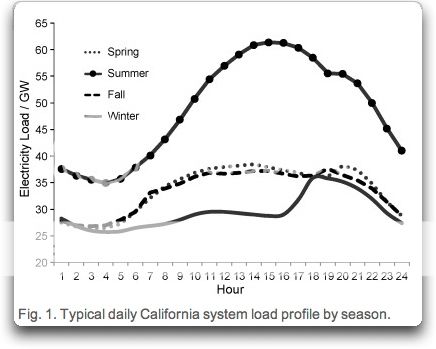
SOURCE
In all seasons except the summer, the evening peak is larger than the afternoon peak. However, when we are looking at the peak demand for the year, which is the demand that you need to size your system for, the summer demand is much larger than any other season.
w.
Thanks, Willis, and no doubt the graph would have a similar shape in many parts of the world. However, in cold climates, in winter, it would look a bit different. In the UK, where people have to switch on the lights at 4 or 5pm in the middle of winter, it would be certainly be a different story. The same goes for where I live, where night (and frost) falls at 5pm in winter.
The ‘smartmeters’ that are being rolled out across various countries are all accompanied by the same message. It is that profligate use of electricity between the hours of 6pm and 8pm is a sin which will shortly be punished with higher charges.
I wouldn’t mind if this was a reflection of the true costs – but, guess what – when I use electricity in the middle of the night they still charge me at full rates.
It’s a happy convergence of interests between power companies, greenies and politicians. Everybody wins a prize, except consumers.
Johanna – we are talking about LA here – not other parts of the world. And as Willis confirms the afternoon summer peak demand is the important part. It is significantly higher than the other peaks which I acknowledged. And it is the peak demand the system must be able to accommodate.
Willis – I’ll repeat – you posted about a specific issue – LADWP paying more for this small slice of solar than you believed they could get for it:
The rest of your commentary was directly related to looking at some of the issues and making some estimates.
I showed that your premise they would take a big loss on reselling this solar was wrong. I supported that claim with sourced information and facts.
Upon pointing this out you changed the conversation – admitting they would likely be able to sell that peak produced solar energy, which they paid between 13 and 17 cents for, for peak electric rates, as much as 30 cents and more per kWh.
You then changed the discussion and your claim – that it was stupid to pay 13 to 17 cents for this solar, even though they will make a profit on doing so, because the energy can be produced much less expensively with new generation.
This is a wholly different topic – well worth discussion – but not related to your original position and claims. It isn’t about busting you for not “covering everything” in your original post – its about changing the topic and discussion.
But lets look at your new proposition anyway – that its terrible to pay 13 to 17 cents for this solar, even if LADWP makes money doing so – because that energy can be produced much less expensively.
That claim certainly would have merit … if it could actually be done – if you actually COULD provide new generation capacity at the rates you note:
The simple fact – as you acknowledge – is you cannot produce new energy at the rates you claim. You cannot build a plant. Thus your proposition – that 13 – 17 cents is too expensive because you can provide this energy far cheaper with new plants is moot and of no value in this discussion.
Which brings us back to my position. You initially said it was terrible the utility was paying so much for this solar because they could never get back what they paid. After I pointed out they were providing peak time of use energy and could sell for peak rates, you acknowledged that was correct.
Absent the ability to construct new lower cost options this deal is good for the utlity and good for its customers as it likely generates a profit. They obtain this energy without any capital cost for the generation (saving appx 20 cents per kW according to your EIA link) – and likely make a profit, which would lower overall energy costs. And also help meet renewable laws.
What is funny Willis is I agree with you on most of your comments. But I also believe we have a strong burden to be accurate – to find out the real data and true answers – and give credit where due.
Here, by all appearances – you were simply wrong. It is not the bad deal you implied. And 4 cents a month to implement is not a significant expense.
Nor honestly is the entire 2011-2014 rate increase – which includes the costs regarding the renewable standard and the many other things. A $3.65 increase on a $65 bill is not significant nor a huge hardship to anyone. Nor is it a significant burden on a small business – which will see a $14.95 increase over 2 years on a $137 bill. Even a larger commercial user using 50,000 kWh a month will see a $750 increase over 2 years on a $6200 bill – a 10.7% increase over 2 years – certainly not catastrophic. I’m guessing there also has not been a rate increase for several, or even many, years.
Whether its 4 cents a month to implement this solar program, or $3.65 cents a month for the full rate increase or even the $750 a month increase for the larger 50,000 kWh a month commercial using already paying $6,200 none of these increases are highly significant let alone lethal to anyone.
It would be great Willis if it was as simple as snapping your fingers and building new plants – but it is not. If you COULD readily buy “6 cent power” I would be the first to agree with you. But as you admit – you cannot.
LADWP it would appear has been no friend of solar in the past either:
http://www.solarforward.com/back-to-the-future-dwp-shuts-down-solar-again/
http://losangeles.cbslocal.com/2011/06/13/customers-furious-dwp-is-stalling-their-plans-to-go-green/
And Willis – it would appear those living in LA WANT more solar – at least according to this poll:
http://votesolar.org/2012/05/la-poll/
I have not read this but looks interesting “New study shows that net metering is a financial benefit, not burden, to ratepayers” January 15th, 2013
http://votesolar.org/2013/01/new-study-shows-that-net-metering-is-a-financial-benefit-not-burden-to-ratepayers/
Take with a grain of salt – coming from solar proponents …
One more for Willis – you oughta be thrilled with the LADWP …. here is a powerpoint about all the things they are doing with the 2012-14 rate increase – including building a whole lotta new Combined Cycle Natural Gas generation capacity.
You’ll be pleased to know they’ll spend $2.2 billion on plant replacement Willis – and a whopping total $196 million on the solar tariff program ….
http://tinyurl.com/LADWP-ratePwrPoint
LADWP also has had no energy rate or fuel cost adjustment changes since July 2010. Makes the $3.65 a month increase for typical residential customer look like an even better deal.
All in all an impressive and easy to understand guide – well worth a read.