
Guest post by Alec Rawls
When he argues that a reduction in forcing will cause cooling Dana Nuccitelli is not actually talking about drinking. He is talking about the solar forcing of global temperature, but the drinking analogy is a handy way to understand where his argument goes off the rails.
Mr. Nuccitelli, who blogs for the consensus-approved Skeptical Science website, was writing about Henrik Svensmark’s GCR-cloud theory of indirect solar forcing, where Galactic Cosmic Rays are hypothesized to seed cloud formation. If Svensmark is right then a strong solar wind, by deflecting some GCR from reaching the earth, in-effect blows some of the clouds away, letting more sunlight through to warm the planet’s surface.
That can’t possibly explain late 20th century warming says Nuccitelli, because GCR deflection has been estimated (see the Krivova-Solanki graph above) to have peaked by 1980. The raw data suggests the actual GCR minimum was ten years later, but set that aside. Nuccitelli thinks it is the change in the level of forcing, not the level of forcing, that determines whether the climate system warms or cools:

So, if GCRs really do amplify the solar influence on global temperatures, since 1980 they are amplifying a cooling effect.
Cooling begins when a forcing passes its peak? Fail. Daily temperatures don’t start falling at noon. They continue rising until mid-afternoon. The hottest time of the year isn’t the first day of summer (the summer solstice, after which the days start getting shorter), the hottest time is mid-summer. To think cooling should start when forcing passes its peak is like thinking you can sober up by drinking just a little more slowly.
Here’s a tip for Dana to keep in mind on New Year’s eve: it is the level of alcohol forcing that matters. If you are drinking alcohol faster than you body is excreting it (not exactly the way the earth excretes heat, but similar enough), then your blood alcohol is rising. You are getting drunker, even if you have lowered the rate of your drinking! That’s right, putting a little less rum in your egg nog will not sober you up! Your increasing inebriation will just be a little less rapid, and it is the same for solar forcing.
When the peak level of forcing appears in the rearview mirror, the downward trend in the forcing that begins at that point does not cause cooling. It just causes warming to be a little less rapid. Only when the energy pouring into the climate system falls to the level of the energy escaping back out does the system stop warming. Empirically, that turns out to be mid-afternoon, mid-summer, and approximately the first decade of the 21st century.
Three blind mice
Dana Nuccitelli produced one of three widely cited rebuttals to my suggestion that a new sentence that was added to the Second Order Draft of AR5, a sentence that admits strong evidence for some substantial mechanism of solar amplification, is a “game changer.” That admission is on page 7-43 of the SOD:
Many empirical relationships have been reported between GCR or cosmogenic isotope archives and some aspects of the climate system … The forcing from changes in total solar irradiance alone does not seem to account for these observations, implying the existence of an amplifying mechanism such as the hypothesized GCR-cloud link.
That’s a game changer because the only solar forcing included in the IPCC computer models is the very slight variance in solar irradiance (also known as TSI, or “the solar constant”). If there are other solar forcings in play, working through variables that actually vary substantially as solar activity ramps up and down, that kills the report’s key finding (on page 8-4) that we can have “very high confidence that natural forcing is a small fraction of the anthropogenic forcing.”
The two most widely cited rebuttals, which I answered last week, were both by lead authors from the IPCC. Steven Sherwood, one of 15 lead authors of chapter 7, pretended that the admission of evidence for “an amplifying mechanism” was only about GCR-cloud. He then proceeded to claim that the evidence for GCR-cloud points to a weak mechanism, and used that as a grounds for dismissing the idea that any substantial solar forcing beyond TSI could be at work.
Doesn’t follow. The evidence for “an amplifying mechanism” (emphasis added) is entirely separate from the evidence for the GCR-cloud mechanism. The former is paleo evidence, where numerous studies of the geologic record have found strong correlations between solar activity and climate going back many thousands of years. The evidence for the GCR-cloud mechanism is from cloud-chamber experiments and ongoing observations of cloud micro-physics.
It doesn’t matter how unconvinced Sherwood is by the evidence for the GCR-cloud mechanism. That evidence does nothing to counter the paleo evidence, cited in the draft report, that some mechanism of enhanced solar forcing must be at work. By using his discontent with the GCR-cloud theory as an excuse to dismiss the paleo evidence, Sherwood is inverting the scientific method, and he is lying to the public about what the report says, making him a seriously bad guy.
Apparently weak minds think alike because Nuccitelli did the same thing Sherwood did, only a day earlier. Dana’s post only looks at the GCR-cloud mechanism and completely ignores the draft report’s admission of strong evidence for some mechanism of solar amplification. It is in the context of that more fundamental mistake that Nuccitelli goes on to completely misinterpret the evidence for the GCR-cloud mechanism itself, claiming that anything less than peak forcing causes cooling, arguing in-effect that he can sober up by drinking a little slower. Just tell that to the officer Dana. He won’t even need to give you a breathalyzer.
More evidence that weak minds think alike is the second semi-official rebuttal to my “game change” claim, issued by Joanna Haigh, a lead author of the IPCC’s third report. Haigh proceeds on the same dishonest pretence as Sherwood, telling NewScientist magazine that the new sentence in the draft report is only about GCR-cloud, which she then dismisses with the same drinking-game mistake that Dana makes, claiming that if climate were being driven by solar activity then the planet would have started cooling when solar activity was at its peak:
Haigh points out that the sun actually began dimming slightly in the mid-1980s, if we take an average over its 11-year cycle, so fewer GCRs should have been deflected from Earth and more Earth-cooling clouds should have formed. “If there were some way cosmic rays could be causing global climate change, it should have started getting colder after 1985.”
Sober up Joanna. Have a single shot instead of a double. Works every time.
Which theory has more trouble with flat 21st century temperatures?
It is amusing how Dana Nuccitelli, through sheer incompetence, was able to prefigure the highly credentialed malfeasance of both of these IPCC fraudsters. Still, Nuccitelli has to be credited with at least a bit of misfeasance of his own because he wasn’t satisfied with just assuring his gullible readers that cooling commences when forcing is at its peak. That only supplied an excuse for dismissing a solar explanation for late 20th century warming, leaving the conspicuous lack of 21st century warming still to be dealt with. Dana’s solution? Pretend that the flat 21st century temperature record militates against a solar driver of climate:
In fact, GCRs reaching Earth recently hit record high levels (Figure 4), yet temperatures are still way up.

Temperatures have merely flattened out, they haven’t gone down yet, and no Skeptical Science reader will ever learn that this is just what the discovered correlations between solar activity and climate predict. The strongest temperature response to a change in solar forcing is seen with a lag of about ten years (Usoskin et al. 2005), or one solar cycle (Solheim et al. 2012). The theory that is discomfited by flat 21st century temperatures is the CO2-warming theory, which predicts ever more rapidly increasing temperatures.
Dana might actually think that the flat 21st century temperature record causes trouble for the solar-warming theory but there is no way he can think it causes less trouble for the CO2-warming theory. For him to pretend that 21st century temperatures favor the CO2-warming theory is inexcusably dishonest, but as usual, the professionals are even worse. Note this little gem from the SOD (p. 7-44):
The lack of trend in the cosmic ray intensity over the last 50 years (Agee et al., 2012; McCracken and Beer, 2007) provides another strong argument against the hypothesis of a major contribution of cosmic rays to ongoing climate change.
That’s 15 IPCC lead authors all accepting the crackpot idea that you can only get drunk if your rate of drinking is going up. Steady exposure to the high 1950’s level of solar activity will keep you from warming, just as steady swilling of a high level of booze will keep you stone-cold sober. But where Dana only said that “temperatures are still way up” (implicitly acknowledging that they are no longer going up), the draft report here claims that temperatures are still going up (“ongoing climate change”).
Must be a Steven Sherwood sentence. He needs to look at page 10-3 of the SOD (emphasis added):
While the trend in global mean temperature since 1998 is not significantly different from zero, it is also consistent with natural variability superposed on the long-term anthropogenic warming trends projected by climate models.
Note that the “consistent with natural variability” part is a near call, after NOAA admitted in 2008 that 15 years of no warming would falsify current models. But yeah, let’s pretend it is the solar theory that has trouble with the lack of recent warming.
The Guardian, Andrew Sullivan, DeSmog, Romm etcetera, all pwned by Dana Nuccitelli’s error-filled AR5 post
The ensuing Skeptical Science newsletter bragged about how many eco-propagandists picked up on nutty Nuccitelli’s non-stop nonsense and the list is indeed impressive, a glaring testament to the total absence of due diligence on the part of these “journalists,” none of whom thought to question Dana’s advice on how to sober up quick. Here is the SkS tally of eco-scalps:
This was a very big week for SkS in the news. Dana’s IPCC Draft Report Leaked, Shows Global Warming is NOT Due to the Sun was re-posted and/or linked to by The Guardian, New York Times Green, New York Times Dot Earth, Huffington Post, Climate Progress, Mother Jones, Climate Crocks, Carbon Brief, Grist, Daily Beast, DeSmogBlog, Graham Readfearn, Der Spiegel, Maribo, Learn from Nature, Alternative Energy in the 21st Century, and Motherboard. It was also Tweeted by Michael Mann and Chris Mooney, among many others.
The only “consensus” journalist on this list who showed any integrity was Andrew Revkin, who had already written a post on my leak of the draft report. After updating that post with a link to Nuccitelli, Revkin updated again later with a link to the rebuttal that Jo Nova and I wrote about Seven Sherwood. Thanks Andrew, for being an actual journalist.
To put their “big week” in perspective the folks at Credulous Science reached high for sufficient words:
Winston Churchill once said: “A lie gets halfway around the world before the truth has a chance to get its pants on.” Not this time; we got the truth’s pants on in record time and nipped this myth in the bud before the contrarians were able to misinform the public.
The “truth” in their rendering is whatever patent falsehoods can be used to fool the ignorant into thinking they should fear CO2. No, nutty ones. You did not forge an exception to Churchill’s dictum. You provided a textbook example of it.
Dana is a poster child for those who feel a moral imperative to “believe the scientists”
For the last two years I have had a lot of fun exposing the large number of top climate scientists who claim that it is not the level of forcing that causes warming, but the trend in the forcing. They are all looking at the wrong derivative (one instead of zero).
Given the enormous pressure on the eco-left to accept what these government-funded climatologists are saying it is not surprising that someone like Dana Nuccitelli would swallow the idea that temperature really is driven by the trend in the forcing, and one super-wacky segment in Dana’s post indicates that he really is accepting that this is how physics works. If you leave a pot of water on a steady flame it won’t heat. If you want to heat the water you have to keep turning the flame up. The segment is titled, “Physical Reality Intrudes on Rawls”:
Rawls has argued to the contrary by claiming that the climate is still responding to the increase in solar activity from the early 20th century, and that GCRs are amplifying that solar warming from over 60 years ago. This argument is simply physically wrong. As Figure 2 illustrates, when solar activity rises, temperatures follow suit very soon thereafter. In fact, during the mid-20th century, solar activity and global surface temperatures both flattened out. Are we to believe that the planet suddenly began responding to the pre-1950 solar activity increase in 1975—2012, after not warming 1940—1975? The argument makes no physical sense.
Obviously I never said that late 20th century warming was caused by solar activity from the early 20th century and Dana does not give a citation for what argument of mine he is referring to but its easy to figure out. I have argued many times that if one combines the strong paleo correlations between solar activity and climate with the fact that solar activity was at what Ilya Usoskin calls “grand maximum” levels from 1920 to 2000 then it is certainly plausible that much of 20th century warming, including late 20th century warming, could have been caused by the sun. 80 years of a high level of enhanced solar forcing just might warm the place up a bit (and it only did warm a bit, about 0.8 °C over the century).

If I am attributing late 20th century warming to the high solar activity that persisted through 2000, why does Dana think I am attributing it to solar forcings from 60 years earlier? He must be fixed on the idea that only a change in the level of solar forcing can cause warming. That’s what all of these top scientists have been telling everyone and there was no rise in solar activity after 1950, hence any solar-caused warming would have to stem from the pre-1950 rise in solar activity.
But come on Dana. That is not what I am saying. That is what they are saying, and I have been trying my darnedest to expose it as a blatant misrepresentation. I’m not attributing late 20th century warming to the pre-1950 rise in solar activity. I’m attributing it to the fact that solar activity remained at close to the same high 1950’s level until 2000 (or 2003). It is the level of the forcing that causes warming, not the trend in the forcing.
I have to feel bad for Dana on this point. It isn’t his fault. He has been systematically duped by this parade of so-called scientists all telling him that a persistent high level of forcing can’t cause continued warming. Makes me want to put him on a milk carton. The poor guy isn’t just lost, he was kidnapped. Want a piece of candy little boy? Credulous Science indeed.
Philip Bradley
December 28, 2012 at 2:03 pm
####
I’m sorry your drinking analogy rebuttal fails on 2 counts.
1. The rate of elimination of alcohol is partially dependent on the concentration of alcohol.
2. The rate of elimination of alcohol is far less then even the rate of very moderate consumption.
The Cosmic Ray versus temperature graph is as misleading as a Mann hockey stick as it has a tricky 11 year average. Why 11 years? Why not 10 years? Is that supposed to be a sun-cycle? It all gives a completely wrong impression as to what is really happening. Add to this that the he temperature line is based on a totally manipulated, augmented and corrupted data set fabricated to show continual warming where none exists. Reality is better represented at:
http://www.woodfortrees.org/plot/gistemp/from:1990/plot/gistemp/from:1990/mean:132/plot/gistemp/from:2001.33/trend
Trend is generally flat since 1998, and even flatter since 2005.
Changes, always changes, why with regard to so called “global temperature” is average now more important than rate of change?
Is the defense coach in the ascendancy?
Is it possible that the “divergence problem” associated with tree ring data is because they react to solar activity and not temperature? Perhaps Michael Mann would be interested in the graph that Alec Rawls provided.
I realize that there are problems with the GCR-temperature graph: the time-distorting 11 year averages, the fact that it uses non-updated data from 2003 (figure 8 on page 7 of 10 here), but it is the graph Nuccitelli used, and as I note, the timing of the actual GCR peak is a secondary issue. So is the likely exaggeration of warming in the GISS plot. The main point is Dana’s wacky ideas about how physics works, where he thinks that temperature is driven by the trend rather than the level of the forcing.
Not all his fault though. The “milk carton” reference, for anyone who is too young to remember what was printed on the once prevalent cardboard milk cartons, throughout the 80’s it was always pictures of kidnapped children, which is probably why kids today mostly get shuttled around by their parents. The milk-carton campaigns, scared a whole generation of parents into not letting their kids go anywhere by themselves. Most of the “kidnappings” were a product of custody battles. Not REAL kidnappings. Kind of like the not-really-kidnapped Nuccitelli.
Alec Rawls says:
December 28, 2012 at 3:24 pm
“Not all his fault though. The “milk carton” reference, for anyone who is too young to remember what was printed on the once prevalent cardboard milk cartons, throughout the 80′s it was always pictures of kidnapped children, which is probably why kids today mostly get shuttled around by their parents. ”
You had pictures of handcuffed, blindfolded children in trunks of cars on your milk cartons in America in the 80ies?
America can be weirder than Germany.
I have said this before on other threads a few times, I’m fairly sure – but basically, the drinking analogy Alec uses is all about the time lag from change to effect. This is applicable to EVERY climatic cause and effect, from the OHC to the CO2 value, from the ‘midday’ sun to the midnight clear skies. Each and every one of these effects is not instantaneous. Is this not one of the reasons for TOD observation ‘adjustments’? etc, etc. And although it’s slightly OT – this is one of the reasons I still believe in solar forcing being the primary driver (note the term ‘driver’ is intentional) – because quite simply, a gnats hairs worth of increase (or decrease) in solar forcing over a period of years amounts to a sh&tload of energy. But this is also virtually impossible to detect amongst the inherent climate variability without intense measurement (and I mean something like a sensor within every sq kilometer of the earths surface – which we DONT HAVE!) and is even further difficult to detect if there is an inherent time lag delay in measurement some time after the cause actually happened. I tend to use the central heating analogy, because everyone knows how that works – basically it takes an hour or two for your house to heat up when switched on and an hour or two to cool when turned off – and this is for a very small volume/mass that comprises your house and furnishings! Contrast that to the lag effect on something many gazillions of times bigger and with a ‘thermal mass’ that is constantly ‘swapping’ heat between its constituent parts and it clearly becomes a somewhat futile exercise to try and pinpoint a ’cause’!
When you sit down and think about it like that – I still find it amazing that people want to quote a ‘global temperature’ at all!
OIC.
D Böehm says:
December 28, 2012 at 2:53 pm
Thank you!
The inverse relationship between cosmic rays and temperature definitely seems to be strong, especially with the graph with the millions of years. However it is not perfect. But then again, we cannot expect any trend to be perfect since there are many variables controlling climate and not just one.
I think we all agree that if cloud cover dropped 25%, surface temp would rise. However after a time the earth would reach a new higher stable temp, and stop rising. The arguement is about time required to approach this new temp. If the assumed time constant is a year or less, absolute temp would track cover – solar forcing. If the time constant is 100 years, at the decade scales we are looking at temp CHANGE would follow solar forcing. So as far as I can see one person is not clearly stating the time constant, and another is asumming a value that suits his purpose., . . .
Correct me if I’m wrong (and I’m positive someone will), but it seems that Dana Nuccitelli’s argument is based solely on lag rates. The central assumtion seems to be that Earth’s environmental system reacts quickly to changes. Inertia, “thermal” or otherwise, is discounted.
As with any assumption, that has to be tested. The null hypothesis would be that there *is* a lag. Prove there is, and Mr. Nuccitelli’s theory is disproved/falsified. Simple. No boiling water analogies needed, just physics.
As for his understanding of “basic physics”, well – like it or not – I believe he’s demonstrated a clear understanding of it, or he wouldn’t have attained a degree, master’s degree, or anything else (not sure if he has a PhD, so my apologies if he has attained that level). Stop attacking the person, and start working on the argument.
Nuccitelli thinks it is the change in the level of forcing, not the level of forcing, that determines whether the climate system warms or cools:
So, if GCRs really do amplify the solar influence on global temperatures, since 1980 they are amplifying a cooling effect.
———–
Alec is mis-stating Dana’s position. Standard debating trick.
As for Alec’s delayed heating argument this makes sense depending on the heat capacities of parts of the system being heated. Since the heating effect of solar radiation on the top layers of the ocean is pretty much immediate and the time scale for the warm ocean heating the air above it is quite short all we need to know what that time scale is exactly.
I reckon the timescale for transferring heat from the ocean surface to the air is like days not years like Alec reckons. So where can I get an actual figure for the ocean to air transfer rate?
The lack of trend in the cosmic ray intensity over the last 50 years (Agee et al., 2012; McCracken and Beer, 2007) provides another strong argument against the hypothesis of a major contribution of cosmic rays to ongoing climate change.
The lack of trend in the cosmic ray intensity over the last 300 years provides another strong argument against the hypothesis of a major contribution of cosmic rays to ongoing climate change…
I have argued many times that if one combines the strong paleo correlations between solar activity and climate with the fact that solar activity was at what Ilya Usoskin calls “grand maximum” levels from 1920 to 2000
There has been no modern grand maximum. Solar activity in the 18th and 19th centuries was just as grand. The ‘modern maximum’ is an artifact in the sunspot data series.
Nuccitelli produces the least objective / most distorted charts of anyone involved in the climate change debate. And that is saying something because there are many others out there doing their best to keep the followers believin’. Normally, one would be too embarassed to produce such nonsense but he seems to think it is okay if it is for the cause.
Just disregard anything produced at Skeptical Science and especially anything produced by Nuccitelli.
If Nuccitelli told me it was raining I would still go outside to check , such is the degree of ‘reliability ‘ of their claims . Frankly like their master at SS these wannabe ‘Team ‘ members and not worth the time of day if you actual want to deal in reality .
Bill Illis says:
“Nuccitelli produces the least objective / most distorted charts of anyone involved in the climate change debate.”
From someone who constructs excellent charts, Nuccitelli should take that criticism seriously.
It is as easy to lie with charts as it is to lie with statistics. The standard deceptive trend charts use a zero [or an arbitrary temperature] baseline, when they should be using a trend line. They use a zero baseline chart because it fabricates a hockey stick-shaped warming trend. But the hockey stick shape is simply an artifact of a zero baseline chart.
In fact, the long term global warming trend has remained within well defined parameters for hundreds of years. Global warming has not accelerated. As a matter of fact, global warming has stalled for the past decade and a half, while CO2 has continued it’s rise. Draw your own conclusions.
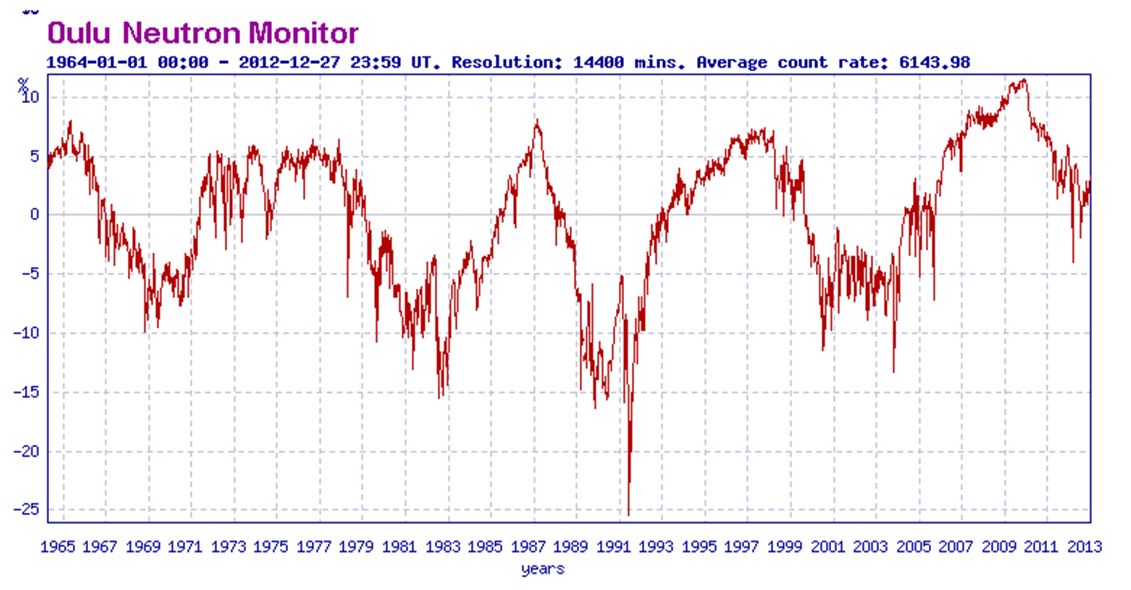
http://cosmicrays.oulu.fi/webform/query.cgi?startday=18&startmonth=07&startyear=1964&starttime=00%3A00&endday=28&endmonth=12&endyear=2012&endtime=00%3A00&resolution=Automatic+choice&picture=on
Need more be said about that graph at the top of the page?
No mention of Climate Change when it doesn’t suit them.
http://www.vancouversun.com/technology/Record+number+raptors+needing+help+Lower+Mainland/7750111/story.html
http://www.cbc.ca/news/canada/new-brunswick/story/2012/12/28/nb-bird-count-finches.html
@D Böehm
Slightly OT but what is the zero baseline various organisations use based on?
1. Is it the average temperature of all the data?
2. Is it the average temperature of a random period?
3. Is it completely random?
Why are there often no definitions-explanations of the baseline for the given graphs?
If GCR’s are forcing clouds, can we see this in cloud cover levels when GCR’s were at their highest through 1995-97 and 2007-09?
http://i191.photobucket.com/albums/z36/AlecRawls/Environment%20and%20climate/NeutronCount_Oulu_1964-2012_large_zps7997e229.png
http://climate4you.com/images/CloudCoverAllLevel%20AndWaterColumnSince1983.gif
DesertYote says:
December 28, 2012 at 2:55 pm
I’m sorry your drinking analogy rebuttal fails on 2 counts.
1. The rate of elimination of alcohol is partially dependent on the concentration of alcohol.
2. The rate of elimination of alcohol is far less then even the rate of very moderate consumption.
Point 1 is only true for the 5% not metabolized by the liver.
If point 2 were true (it isn’t), a couple of hundred years ago when most people in Europe drank weak beer rather than water, everyone would have died of alcohol poisoning or at least been falling down drunk all the time, and we know they weren’t.
What we may know and what we may not know.
1. Dr. Svalgaard has stated numerous times that TSI has been constant for the past 300 years.
2. With TSI being flat, we have had two occurrences in climate of note.
a. We left the LIA period
b. There was an accelerated warming in the early 20th Century that no one has a clue as to why it happened.
1. WE know the warming of the early 20th Century was not CO2 induced. No matter what metric one uses as far as concentrations, there was not enough of a deviation to force any type of temperature increase. We also know that the temps of the Arctic Area were very similar to today’s temperatures from physical measurements.
2. We know from Proxy data, (Greenland, Sargasso Sea, Antarctica) that there was a world wide Medieval Warm Period. No one knows why with any degree of confidence why this happened.
3. We know there is a solar connection and large river basin drainage flows. From the Nile, The Amazon, the Mississippi that solar connection has been well established.
4. We know , from a chemical basis, that UV and Ozone in the Stratosphere have climatic effects via Jet Stream location and the perennial blocking highs such as the Greenland High placement.
Since no one can explain with any certainty why some of the climatic changes occurred in the past, we keep investigating to find the cause.
Certain items come to mind.
1. There has been no statistical warming for the past 16 years. This is well known. This is not cherry picking, as the parameters of the past 16 present this fact very clearly.
2. We know the ocean heat content, via ARGO, is not showing an accumulation of heat. In fact, it may have a negative bias, but statistically it is flat at this time.
3. We know that we are in a Modoki type of ENSO pattern.
http://www.agu.org/pubs/crossref/2007/2006JC003798.shtml
4. We know from established satellite data, that the earths atmosphere is much clearer to incoming solar. The trend from less clear to clear changed in 1994 and has resulted in 5% less particulates in the atmosphere.
From this knowledge base, we learn that we know that CO2 is a minor driver of climate, if in fact it is a driver at all. Past Geological studies concerning CO2 and the end of interglacials, show that temperature cools and CO2 continues to rise for 800 years or longer.
Conclusion:
We don’t know nearly enough about climate and the drivers, short and long term, to make any type of decision concerning remedial action.
Mr. Nuccitelli is doing the best that he can with what he has…..which in all honesty…..isn’t much.
The certainty of the Science of Climate, as presented by Mr. Nuticelli
, reminds me of Dr. Alfred Wegener and his fight over plate tectonics. The consensus was that he was a lunatic, which we all know for a fact that he wasn’t. Mr. Nuccitelli represents the consensus at this time, and they are just flat out wrong.
.
On ya’ bike Dana.
Concering WG1 Report 5 IPCC
There has been debate concerning the accuracy of models verses observed temp metrics.
Some of the debate has used http://iopscience.iop.org/1748-9326/6/4/044022 (Grant Foster1 and Stefan Rahmstorf 2012) as a basis to show that the models projections and the temperature are really in concert.
However, this is like comparing apples to oranges…..or maybe even a lime.
Foster/Rahmstorf 2012 remove short term (potentially long term) climate drivers to achieve a continued increase in temperature.
The models, themselves, do NOT include these drivers, such as ENSO, because they just can’t predict when and to what extent, these will happen.
The reality is that temps have been flat for 16 years, the models are over 2 sigma removed from reality…..and no one knows why……..or do they?
There are forces at play that are not recognized, and for certain, not understood in regards to climate.
Can the sun be one of the misunderstood players? Evidence most certainly would indicate that it is.
Svensmark proposes that it is only the high energy cosmic rays that cause the cloud seeding. What energy range is used in the graph derived from Krivova and Solanki in the above figure?