
Guest post by Alec Rawls
When he argues that a reduction in forcing will cause cooling Dana Nuccitelli is not actually talking about drinking. He is talking about the solar forcing of global temperature, but the drinking analogy is a handy way to understand where his argument goes off the rails.
Mr. Nuccitelli, who blogs for the consensus-approved Skeptical Science website, was writing about Henrik Svensmark’s GCR-cloud theory of indirect solar forcing, where Galactic Cosmic Rays are hypothesized to seed cloud formation. If Svensmark is right then a strong solar wind, by deflecting some GCR from reaching the earth, in-effect blows some of the clouds away, letting more sunlight through to warm the planet’s surface.
That can’t possibly explain late 20th century warming says Nuccitelli, because GCR deflection has been estimated (see the Krivova-Solanki graph above) to have peaked by 1980. The raw data suggests the actual GCR minimum was ten years later, but set that aside. Nuccitelli thinks it is the change in the level of forcing, not the level of forcing, that determines whether the climate system warms or cools:

So, if GCRs really do amplify the solar influence on global temperatures, since 1980 they are amplifying a cooling effect.
Cooling begins when a forcing passes its peak? Fail. Daily temperatures don’t start falling at noon. They continue rising until mid-afternoon. The hottest time of the year isn’t the first day of summer (the summer solstice, after which the days start getting shorter), the hottest time is mid-summer. To think cooling should start when forcing passes its peak is like thinking you can sober up by drinking just a little more slowly.
Here’s a tip for Dana to keep in mind on New Year’s eve: it is the level of alcohol forcing that matters. If you are drinking alcohol faster than you body is excreting it (not exactly the way the earth excretes heat, but similar enough), then your blood alcohol is rising. You are getting drunker, even if you have lowered the rate of your drinking! That’s right, putting a little less rum in your egg nog will not sober you up! Your increasing inebriation will just be a little less rapid, and it is the same for solar forcing.
When the peak level of forcing appears in the rearview mirror, the downward trend in the forcing that begins at that point does not cause cooling. It just causes warming to be a little less rapid. Only when the energy pouring into the climate system falls to the level of the energy escaping back out does the system stop warming. Empirically, that turns out to be mid-afternoon, mid-summer, and approximately the first decade of the 21st century.
Three blind mice
Dana Nuccitelli produced one of three widely cited rebuttals to my suggestion that a new sentence that was added to the Second Order Draft of AR5, a sentence that admits strong evidence for some substantial mechanism of solar amplification, is a “game changer.” That admission is on page 7-43 of the SOD:
Many empirical relationships have been reported between GCR or cosmogenic isotope archives and some aspects of the climate system … The forcing from changes in total solar irradiance alone does not seem to account for these observations, implying the existence of an amplifying mechanism such as the hypothesized GCR-cloud link.
That’s a game changer because the only solar forcing included in the IPCC computer models is the very slight variance in solar irradiance (also known as TSI, or “the solar constant”). If there are other solar forcings in play, working through variables that actually vary substantially as solar activity ramps up and down, that kills the report’s key finding (on page 8-4) that we can have “very high confidence that natural forcing is a small fraction of the anthropogenic forcing.”
The two most widely cited rebuttals, which I answered last week, were both by lead authors from the IPCC. Steven Sherwood, one of 15 lead authors of chapter 7, pretended that the admission of evidence for “an amplifying mechanism” was only about GCR-cloud. He then proceeded to claim that the evidence for GCR-cloud points to a weak mechanism, and used that as a grounds for dismissing the idea that any substantial solar forcing beyond TSI could be at work.
Doesn’t follow. The evidence for “an amplifying mechanism” (emphasis added) is entirely separate from the evidence for the GCR-cloud mechanism. The former is paleo evidence, where numerous studies of the geologic record have found strong correlations between solar activity and climate going back many thousands of years. The evidence for the GCR-cloud mechanism is from cloud-chamber experiments and ongoing observations of cloud micro-physics.
It doesn’t matter how unconvinced Sherwood is by the evidence for the GCR-cloud mechanism. That evidence does nothing to counter the paleo evidence, cited in the draft report, that some mechanism of enhanced solar forcing must be at work. By using his discontent with the GCR-cloud theory as an excuse to dismiss the paleo evidence, Sherwood is inverting the scientific method, and he is lying to the public about what the report says, making him a seriously bad guy.
Apparently weak minds think alike because Nuccitelli did the same thing Sherwood did, only a day earlier. Dana’s post only looks at the GCR-cloud mechanism and completely ignores the draft report’s admission of strong evidence for some mechanism of solar amplification. It is in the context of that more fundamental mistake that Nuccitelli goes on to completely misinterpret the evidence for the GCR-cloud mechanism itself, claiming that anything less than peak forcing causes cooling, arguing in-effect that he can sober up by drinking a little slower. Just tell that to the officer Dana. He won’t even need to give you a breathalyzer.
More evidence that weak minds think alike is the second semi-official rebuttal to my “game change” claim, issued by Joanna Haigh, a lead author of the IPCC’s third report. Haigh proceeds on the same dishonest pretence as Sherwood, telling NewScientist magazine that the new sentence in the draft report is only about GCR-cloud, which she then dismisses with the same drinking-game mistake that Dana makes, claiming that if climate were being driven by solar activity then the planet would have started cooling when solar activity was at its peak:
Haigh points out that the sun actually began dimming slightly in the mid-1980s, if we take an average over its 11-year cycle, so fewer GCRs should have been deflected from Earth and more Earth-cooling clouds should have formed. “If there were some way cosmic rays could be causing global climate change, it should have started getting colder after 1985.”
Sober up Joanna. Have a single shot instead of a double. Works every time.
Which theory has more trouble with flat 21st century temperatures?
It is amusing how Dana Nuccitelli, through sheer incompetence, was able to prefigure the highly credentialed malfeasance of both of these IPCC fraudsters. Still, Nuccitelli has to be credited with at least a bit of misfeasance of his own because he wasn’t satisfied with just assuring his gullible readers that cooling commences when forcing is at its peak. That only supplied an excuse for dismissing a solar explanation for late 20th century warming, leaving the conspicuous lack of 21st century warming still to be dealt with. Dana’s solution? Pretend that the flat 21st century temperature record militates against a solar driver of climate:
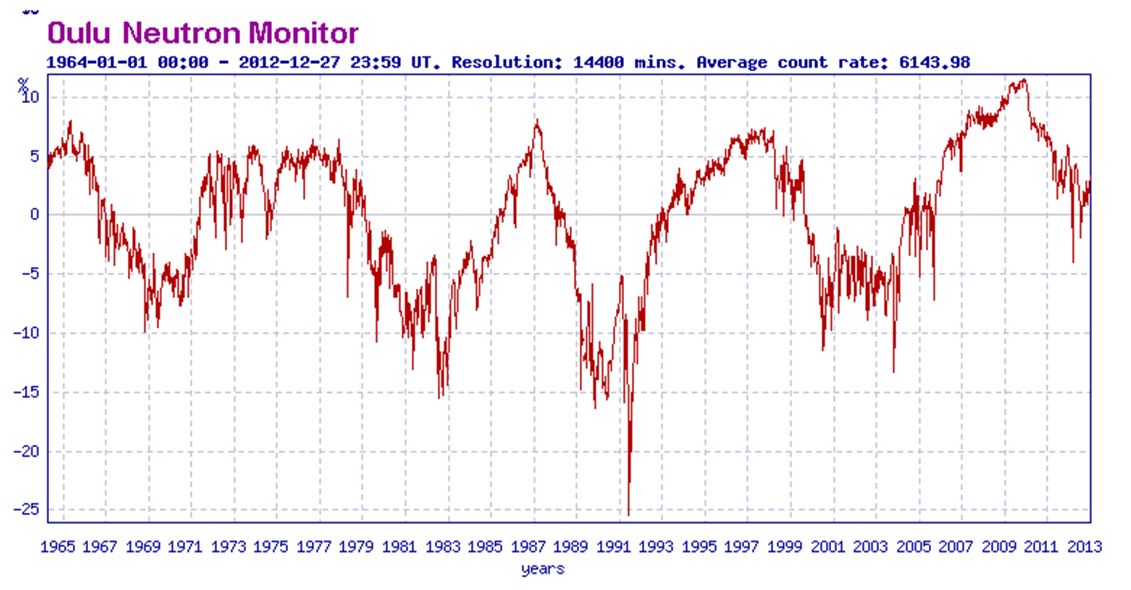
In fact, GCRs reaching Earth recently hit record high levels (Figure 4), yet temperatures are still way up.

Temperatures have merely flattened out, they haven’t gone down yet, and no Skeptical Science reader will ever learn that this is just what the discovered correlations between solar activity and climate predict. The strongest temperature response to a change in solar forcing is seen with a lag of about ten years (Usoskin et al. 2005), or one solar cycle (Solheim et al. 2012). The theory that is discomfited by flat 21st century temperatures is the CO2-warming theory, which predicts ever more rapidly increasing temperatures.
Dana might actually think that the flat 21st century temperature record causes trouble for the solar-warming theory but there is no way he can think it causes less trouble for the CO2-warming theory. For him to pretend that 21st century temperatures favor the CO2-warming theory is inexcusably dishonest, but as usual, the professionals are even worse. Note this little gem from the SOD (p. 7-44):
The lack of trend in the cosmic ray intensity over the last 50 years (Agee et al., 2012; McCracken and Beer, 2007) provides another strong argument against the hypothesis of a major contribution of cosmic rays to ongoing climate change.
That’s 15 IPCC lead authors all accepting the crackpot idea that you can only get drunk if your rate of drinking is going up. Steady exposure to the high 1950’s level of solar activity will keep you from warming, just as steady swilling of a high level of booze will keep you stone-cold sober. But where Dana only said that “temperatures are still way up” (implicitly acknowledging that they are no longer going up), the draft report here claims that temperatures are still going up (“ongoing climate change”).
Must be a Steven Sherwood sentence. He needs to look at page 10-3 of the SOD (emphasis added):
While the trend in global mean temperature since 1998 is not significantly different from zero, it is also consistent with natural variability superposed on the long-term anthropogenic warming trends projected by climate models.
Note that the “consistent with natural variability” part is a near call, after NOAA admitted in 2008 that 15 years of no warming would falsify current models. But yeah, let’s pretend it is the solar theory that has trouble with the lack of recent warming.
The Guardian, Andrew Sullivan, DeSmog, Romm etcetera, all pwned by Dana Nuccitelli’s error-filled AR5 post
The ensuing Skeptical Science newsletter bragged about how many eco-propagandists picked up on nutty Nuccitelli’s non-stop nonsense and the list is indeed impressive, a glaring testament to the total absence of due diligence on the part of these “journalists,” none of whom thought to question Dana’s advice on how to sober up quick. Here is the SkS tally of eco-scalps:
This was a very big week for SkS in the news. Dana’s IPCC Draft Report Leaked, Shows Global Warming is NOT Due to the Sun was re-posted and/or linked to by The Guardian, New York Times Green, New York Times Dot Earth, Huffington Post, Climate Progress, Mother Jones, Climate Crocks, Carbon Brief, Grist, Daily Beast, DeSmogBlog, Graham Readfearn, Der Spiegel, Maribo, Learn from Nature, Alternative Energy in the 21st Century, and Motherboard. It was also Tweeted by Michael Mann and Chris Mooney, among many others.
The only “consensus” journalist on this list who showed any integrity was Andrew Revkin, who had already written a post on my leak of the draft report. After updating that post with a link to Nuccitelli, Revkin updated again later with a link to the rebuttal that Jo Nova and I wrote about Seven Sherwood. Thanks Andrew, for being an actual journalist.
To put their “big week” in perspective the folks at Credulous Science reached high for sufficient words:
Winston Churchill once said: “A lie gets halfway around the world before the truth has a chance to get its pants on.” Not this time; we got the truth’s pants on in record time and nipped this myth in the bud before the contrarians were able to misinform the public.
The “truth” in their rendering is whatever patent falsehoods can be used to fool the ignorant into thinking they should fear CO2. No, nutty ones. You did not forge an exception to Churchill’s dictum. You provided a textbook example of it.
Dana is a poster child for those who feel a moral imperative to “believe the scientists”
For the last two years I have had a lot of fun exposing the large number of top climate scientists who claim that it is not the level of forcing that causes warming, but the trend in the forcing. They are all looking at the wrong derivative (one instead of zero).
Given the enormous pressure on the eco-left to accept what these government-funded climatologists are saying it is not surprising that someone like Dana Nuccitelli would swallow the idea that temperature really is driven by the trend in the forcing, and one super-wacky segment in Dana’s post indicates that he really is accepting that this is how physics works. If you leave a pot of water on a steady flame it won’t heat. If you want to heat the water you have to keep turning the flame up. The segment is titled, “Physical Reality Intrudes on Rawls”:
Rawls has argued to the contrary by claiming that the climate is still responding to the increase in solar activity from the early 20th century, and that GCRs are amplifying that solar warming from over 60 years ago. This argument is simply physically wrong. As Figure 2 illustrates, when solar activity rises, temperatures follow suit very soon thereafter. In fact, during the mid-20th century, solar activity and global surface temperatures both flattened out. Are we to believe that the planet suddenly began responding to the pre-1950 solar activity increase in 1975—2012, after not warming 1940—1975? The argument makes no physical sense.
Obviously I never said that late 20th century warming was caused by solar activity from the early 20th century and Dana does not give a citation for what argument of mine he is referring to but its easy to figure out. I have argued many times that if one combines the strong paleo correlations between solar activity and climate with the fact that solar activity was at what Ilya Usoskin calls “grand maximum” levels from 1920 to 2000 then it is certainly plausible that much of 20th century warming, including late 20th century warming, could have been caused by the sun. 80 years of a high level of enhanced solar forcing just might warm the place up a bit (and it only did warm a bit, about 0.8 °C over the century).

If I am attributing late 20th century warming to the high solar activity that persisted through 2000, why does Dana think I am attributing it to solar forcings from 60 years earlier? He must be fixed on the idea that only a change in the level of solar forcing can cause warming. That’s what all of these top scientists have been telling everyone and there was no rise in solar activity after 1950, hence any solar-caused warming would have to stem from the pre-1950 rise in solar activity.
But come on Dana. That is not what I am saying. That is what they are saying, and I have been trying my darnedest to expose it as a blatant misrepresentation. I’m not attributing late 20th century warming to the pre-1950 rise in solar activity. I’m attributing it to the fact that solar activity remained at close to the same high 1950’s level until 2000 (or 2003). It is the level of the forcing that causes warming, not the trend in the forcing.
I have to feel bad for Dana on this point. It isn’t his fault. He has been systematically duped by this parade of so-called scientists all telling him that a persistent high level of forcing can’t cause continued warming. Makes me want to put him on a milk carton. The poor guy isn’t just lost, he was kidnapped. Want a piece of candy little boy? Credulous Science indeed.
For the leif of me I donot get why anyone would want to rely on sunspot numbers and other stupid sun data to evaluate the heat coming through the atmosphere. Obviously you have a combination of factors influencing heat coming through, some of which depend on the sun and some depend on earth.
Much better to look at maxima of which we have reasonable accurate records going back 40 years.
Remember that I have done a fit from all measurements of maxima obtained from 47 weather stations selected randomly but balanced by latitude and 70/30 @sea and inland (longitude does not matter as earth turns every 24 hours and the seasonal shift in earth’s axis does not matter either if you look at yearly average temperature results).
The summary of all these results is that the speed of warming/cooling for maxima in degrees C/ annum now is: 0.036 from 1974 (38 yrs), 0.029 from 1980 (32 yrs), 0.014 from 1990 (22 years) and -0.016 from 2000 (12 years).
If you try a binomial plot (parabolic) with these particular data you get very high correlation (0.998) but it would mean tremendous cooling rates in the decades ahead, such as we have not seen before.
If anyone of you can come up with any other plot for the above data then this one,
http://blogs.24.com/henryp/2012/10/02/best-sine-wave-fit-for-the-drop-in-global-maximum-temperatures/
that would be better or just as good as the sine wave with 88 years wave length, be my guest!
I would appreciate your help
So long as nobody comes up with another fit, I would say that by putting the Gleisberg solar cycle into a chart, as I have done, (and others can follow and copy??), I think it is possible for me to estimate that all observed warming is natural or very nearly completely natural.
Consider the fact that we really do not have a global temp. record to speak of since at least around 1925. In those days they just manufactured thermometers, never realizing that after time they need to be re-calibrated…..I have challenged anyone to bring me the calibration certificates of thermometers used in weather stations from before that time, with no response.
This means that if we look at my global sine wave chart above for energy in
(not to be confused with energy-out)
we must rather look at the absolute value (positive) of the increase in the heat coming through the top of the atmosphere from 1927 (85 years ago) until 1950. This means an increase of ca. 0.037/2 (roughly integrated) x 23 = 0.43 degrees K. In the next period from 1950 to 1995, when records were firmly established we are seeing the warming that everyone started to fear, namely 0.037/2 (roughly integrated) x 45 = 0.83 degrees K. From 1995 until 2012 it looks we went down on the maxima by ca. 0.037/2 x 17 = 0.31
So I have 0.43 + 0.83 -0.31= 0.95 degrees K up on the maxima since 1927
I have had a look now at CET maxima and found it rising by 0.0105 degree K per annum from 1927 – 2012. A total of 0.89 K from 1927 which confirms the correctness of my global estimate.
I also had a look now at the increase of CET means and found it increasing by 0.0088 degree C per annum since 1927. This means the ratio of maxima/means is therefore estimated as 1.19.
This leaves me with an estimate of 0.95/1.19 = 0.8 up on the means which even is 0.1 K higher than the actual observed increase, as here,
http://www.woodfortrees.org/plot/hadcrut4gl/from:1927/to:2013/plot/hadcrut4gl/from:1927/to:2013/trend/plot/hadcrut3vgl/from:1927/to:2013/plot/hadcrut3vgl/from:1927/to:2013/trend/plot/rss/from:1927/to:2013/plot/rss/from:1927/to:2013/trend/plot/gistemp/from:1927/to:2013/plot/gistemp/from:1927/to:2013/trend/plot/hadsst2gl/from:1927/to:2013/plot/hadsst2gl/from:1927/to:2013/trend
I think an error of +0.1 is not that bad, for a rough estimate, so all of this leaves me with no warming caused by human beings, as I had suspected, from the very beginning,
http://blogs.24.com/henryp/2011/08/11/the-greenhouse-effect-and-the-principle-of-re-radiation-11-aug-2011/
End of story. There is no man made warming. There never was.
Wishing you all the best for 2013!
Charles Gerard Nelson says:
December 30, 2012 at 9:10 pm
……and the cosmic ray intensity in 1880 too…using proxies from ice core samples apparently….
And we’re arguing with them about this…sheesh!
Ice Core Samples….
Any chemist who does analytical work has to be aware of how chemicals can migrate and contaminate glass, plastic and even metal. When doing GC work you have to be aware of the hydrogen embrittlement process by which various metals, most importantly high-strength steel, become brittle and fracture following exposure to hydrogen and be sure your tanks and valves are retired after the ‘expiration date’
One of the commenters here had noted that because of this chemical migration problem, ice cores have the effect of a filter clipping off the high peaks of the CO2 data. In other words smearing and leveling the data.
Svalgaard said:
“To help your five-year old I have global temperatures since 1850 on the Ap-graph: http://www.leif.org/research/Comparison-Ap-Global-Temps-1850-2012.png
He will have a hard time finding any meaningful correlation:
http://www.leif.org/research/Correlation-Ap-Temp-Not.png ”
That’s OK, I had fully positive results with your first graph:
http://www.leif.org/research/Ap-1844-now.png
which is impressive considering how compressed the Y-axis is!
Obviously the correlation is not lock-step year by year because of ENSO making short term peaks in temperature when Ap drops strongly, nonetheless the decadal trends are all too obvious.
D Boehm says:
Actually, for the graph you show, it is in fact quite clear who is lying: It is the person who produced that graph. By my calculation, they have chosen to scale the data for CO2 and temperature so that the CO2 rise corresponds to a temperature increase of ~0.94 C per decade, which is about five times or more the increase that has been seen during the previous decades and has been predicted for the near future. If they had scaled their graph correctly, it would have been obvious that the temperature fluctuations are just too large to conclude much of anything in regards to whether the temperature is or is not following the expected relationship. (It also conveniently ends during the strong 2008 La Nina.)
The fact that this graph has continued to fool you despite the fact that the error in this and previous similar graphs has been pointed out by me countless times also says something about the complete inability of some people to alter their discredited arguments even when they can’t defend them.
HenryP says:
December 31, 2012 at 12:16 am
For the leif of me I do not get why anyone would want to rely on sunspot numbers and other stupid sun data to evaluate the heat coming through the atmosphere.
As long as there was a Modern Grand Maximum (MGM) then the sun nuts would happily rely on stupid sun data to explain global Warming. If there is no MGM then they have a problem, which explains their denial of the non-existence of MGM.
And Gail still does not have courage to look through Galileo’s telescope.
Ulric Lyons says:
December 31, 2012 at 5:03 am
nonetheless the decadal trends are all too obvious
Including the all to obvious drop during two of the strongest cycles in the 1940-1950s. What matters is the centennial trend.
http://www.specola.ch/drawings/2012/loc-d20121229.JPG = 12 plus two faint/smug?
http://www.specola.ch/drawings/2012/loc-d20121105.JPG = 6 plus one faint smug
Migraines are not recommended when you want to really see something. Darn flashes make it hard even to read.
lsvalgaard said:
“Including the all to obvious drop during two of the strongest cycles in the 1940-1950s. What matters is the centennial trend.”
The 1950’s was warming again, and the drop in temp’s in the mid 50’s is right on the Ap drop:
http://1.2.3.10/bmi/www.woodfortrees.org/graph/hadcrut3gl/from:1920
http://www.leif.org/research/Ap-1844-now.png
After the almost continuous El Nino from 1939-42, the big drop in the 1940’s is again on the Ap drop. And moreover, we were not discussing the size of the cycles as such, SC 8 for example was a larger cycle, but there were very cold episodes through mid to late 1830’s.
http://www.solen.info/solar/cycl8.html
Gail Combs says:
December 31, 2012 at 8:43 am
http://www.specola.ch/drawings/2012/loc-d20121229.JPG = 12 plus two faint/smug?
http://www.specola.ch/drawings/2012/loc-d20121105.JPG = 6 plus one faint smug
Thank you, Gail.
As you can see the simple single count compared to the official counts were 12 vs. 20 and 6 vs. 17. This inflation is the result of the weighting introduced by the Zurich observers in the 1940s. Before that time weighting was not used, so Wolfer, for example would have reported 12 and 6 just as you, I, and Anthony do. Careful study of the inflation shows that it happened equally to both low and high solar activity. We can thus undo the weighting by a simple, single scale factor. This is the revision we are talking about. There is no doubt in anybody who has spent any time at all on this problem that the revision is necessary and possible. No corruption of archives or loss of information is implied. I’m glad you now can realize this and wholeheartedly endorse the revision.
Migraines are not recommended when you want to really see something. Darn flashes make it hard even to read.
The flashes are you seeing the light 🙂
Seriously, I hope the migraine will let up and let you enjoy the New Year.
Ulric Lyons says:
December 31, 2012 at 8:53 am
SC 8 for example was a larger cycle, but there were very cold episodes through mid to late 1830′s.
And the solar wind magnetic field was strong in the 1830s:
http://www.leif.org/research/“Radial Component of HMF 1835-2010.gif”
So, when they fit it is good, when they don’t we are not discussing them. Fair enough.
HenryP
I doubt there is a 88 years component in the temperature record. There are ~60 and ~20 yrs components pointed out several times.
http://virakkraft.com/60+20.png
But note there is also a long term trend which could be the solar MGM (yes Leif, you still have to look at the integral, not the individual peaks) or man made or both.
lsvalgaard said:
“So, when they fit it is good, when they don’t we are not discussing them. Fair enough.”
It wasn’t fair enough to bring SSN into the discussion in the first place.
Gail Combs says:
December 31, 2012 at 8:43 am
http://www.specola.ch/drawings/2012/loc-d20121229.JPG = 12 plus two faint/smug?
The smudges are by convention never counted. Here is a comparison of weighted vs. unweighted counts for the year 2012: http://www.leif.org/research/Comparison-2012-Weighted-Unweighted.png You, I, and Anthony would produce counts very close to the blue symbols. Here is the comparison for the first 4 months of 2012 between my counts and that of Marco Cagnotti [the main observer at Locarno] http://www.leif.org/research/Comparison-Locarno-Svalgaard-Cagnotti.png. Again, there can be no doubt. Again, revision is needed and possible.
henry@leif
don’t need any MGM.
figured it all out.
next 3 decades will be cold/colder/coldest
I am visiting Holland at the moment and I am getting a bit depressed about that.
Although I should not be worried much about that seeing as that I live in Africa…..
lgl says:
December 31, 2012 at 9:29 am
you still have to look at the integral
An definite integral involves an interval over which the integral is taken. What is your interval?
Ulric Lyons says:
December 31, 2012 at 9:32 am
It wasn’t fair enough to bring SSN into the discussion in the first place.
Who brought in SC8?
lgl says:
December 31, 2012 at 9:29 am
you still have to look at the integral
Perhaps you should integrate your EMB-AM ‘effect the same way:
lgl says:
December 30, 2012 at 7:23 am
And Jupiter-Earth-Venus driving it all: http://virakkraft.com/EMB-AM.png
henry@lgl
previous response (by Gail)
see
http://blogs.24.com/henryp/2012/10/02/best-sine-wave-fit-for-the-drop-in-global-maximum-temperatures/
either way, can you fit my data in a 60 year wavelength sine wave?
lsvalgaard says:
December 31, 2012 at 9:57 am
“Who brought in SC8?”
It was merely a suitable example to terminate your diversionary tactic.
Ulric Lyons says:
December 31, 2012 at 10:27 am
It was merely a suitable example to terminate your diversionary tactic.
so now you stoop to playing games.
henry@lgl
also remember I was looking at maxima
it seems your graph is looking at means?
lsvalgaard said:
“so now you stoop to playing games.”
That was your game, and I nipped it in the bud.
Ulric Lyons says:
December 31, 2012 at 10:48 am
That was your game, and I nipped it in the bud.
???
You mean you don’t want to discuss the failures of your claims. Fair enough.
Good heavens! Must every thread be invaded by solarists, (who fail completely to rule out the null hypothesis which is adequately and mechanistically explained by the highly variable and leaky-roofed planet we stand on), just to be “burned” by Leif’s Sun? Do what I did. When I first thought this temperature trend must be related to the Sun, I was advised to read a book about the Sun’s properties. I read it closely and I refer to it often when I read comments here so I can discern those comments with a good dose of skepticism.
Get a grip on the mechanics of the Sun’s affect on Earth and a grip on the Earth’s affect on incoming Solar properties. Then come back and debate your stance.
HenryP says:
December 31, 2012 at 10:16 am
—–
60 year, 66 year, or 88 year short cycle. Or, as I asked earlier in a related thread, why should we be “forced” – or limited to – into a simple assumption that a single, fixed-period, short year climate cycle is correct at all: Is there any reason to assume that the climate short cycle is limited to a single constant period over longer time frames?
Certainly “our” simple sine-wave plots ARE “easier to write” if we limit ourselves (our plots of past temperatures) to simple summations of forever-constant simple sine waves …. but a humble observer at this point in time cannot give an absolute physically-based “reason” from first principles “why” the climate seems to be composed of a long-term and short term cycles as it resonates in the interval between deep ice ages.
So be it. Don’t try to make the climate “simple” …
Look for a short term cycle of varying periodicity in the past data, find that periodicity – IF it exists at all – THEN start looking for the root cause of the variance. There is – from today’s satellite data of the entire global – a known random variation just under +/- 0.2 degrees C between any three sequential months.
Start looking for a short term cycle of more than +/- 0.3 degrees from a long-term baseline cycle, assuming such a short term cycle will itself vary between 66 to 88 years at different times. Once you know that short term cycle exists – IF it exists at all – then you can start looking for the causes of such a cycle.
Henry@lgl & racookpe1978
I am looking at maxima which is not the same as looking at means.
Means depend on many more factors than maxima, causing lags or enhancements on the observed cycle for maxima. That the 80-100 year weather cycle exists is explained here
http://blogs.24.com/henryp/2012/10/02/best-sine-wave-fit-for-the-drop-in-global-maximum-temperatures/#comment-192
I don’t trust UAH or satellites as I don’t know how it is calibrated and how they referenced for zero.
Bottomline, you can clearly see we are cooling
http://www.woodfortrees.org/plot/hadcrut4gl/from:2002/to:2013/plot/hadcrut4gl/from:2002/to:2013/trend/plot/hadcrut3vgl/from:2002/to:2013/plot/hadcrut3vgl/from:2002/to:2013/trend/plot/rss/from:2002/to:2013/plot/rss/from:2002/to:2013/trend/plot/gistemp/from:2002/to:2013/plot/gistemp/from:2002/to:2013/trend/plot/hadsst2gl/from:2002/to:2013/plot/hadsst2gl/from:2002/to:2013/trend
and I can see that we will continue to cool until 2040.