Global Cooling – Climate and Weather Forecasting.
Guest post by Dr. Norman Page
Introduction.
Over the last 10 years or so as new data have accumulated the general trend and likely future course of climate change has become reasonably clear. The earth is entering a cooling phase which is likely to last about 30 years and possibly longer. The major natural factors controlling climate change have also become obvious.Unfortunately the general public has been bombarded by the scientific and media and political establishments with anthropogenic global warming – anti CO2 propaganda based on the misuse and misrepresentation of already shoddy IPCC “science” for political ,commercial and personal ends.
The IPCC climate science community largely abandoned empirical Baconian inductive scientific principles and built worthless climate models based on unfounded assumptions designed to show that anthropogenic CO2 was the driving force behind changing climate. Most of the IPCC output is useless as a tool for predicting future climate trends and their impacts and in particular the IPCC Summaries for Policymakers can be safely ignored for practical purposes. The divergence between the IPCC Hansen projections and the observed trends is shown below.
Fig 1 ( From Prof. Jan-Erik Solheim (Oslo) )

Fortunately, however , the basic data is now easily available so that any reasonably intelligent person can check on line daily or monthly to see what the incoming empirical data actually is and draw ones own conclusions.
Here’s how to do it in a few simple steps. I have put in CAPITALS the main empirical observations on which one can draw conclusions re climate change ,its causes and future trends and also get a good idea of weather patterns and trends for the next year or so.
1. Check the Temperature Trends and Data.
Because of the Urban Heat Island effect ,the built in local variability of the NH land data and the thermal inertia of the oceans, Sea Surface Temperatures are the best measure of global temperature trends. These show that the global warming trend ended in about 2003. THERE HAS NOW BEEN NO NET WARMING SINCE 1997 -15 YEARS WITH CO2 RISING 8.5% WITH NO GLOBAL TEMPERATURE INCREASE. SINCE 2003 THE TREND IS NEGATIVE.
To check the past years go to
ftp://ftp.ncdc.noaa.gov/pub/data/anomalies/annual.ocean.90S.90N.df_1901-2000mean.dat
and for monthly updates go to.
ftp://ftp.ncdc.noaa.gov/pub/data/anomalies/monthly.ocean.90S.90N.df_1901-2000mean.dat
The 2012 average NCDC SST anomaly thru Sept was .4438 versus the 1997 annual anomaly of .4575.
The peak anomaly was .5207 in 2003.
An excellent site for reviewing all the basic temperature data is http://www.climate4you.com/
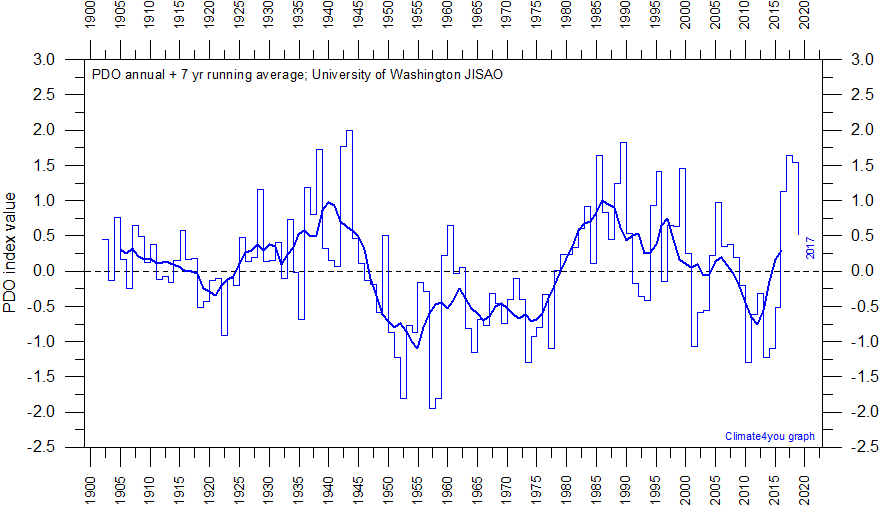
2. Check the current phase of the Pacific Decadal Oscillation.
Here is a plot and suggested projection based on the Hadley SST3 from Tallbloke.

(See: http://tallbloke.wordpress.com/2012/10/23/the-carbon-flame-war-final-comment/) He says “I have put together a simple model which replicates sea surface temperature (which drives global lower troposphere temperature and surface temperatures a few months later). The correlation between my model and the SST is R^2=0.874 from 1876 FOR MONTHLY DATA.” The model is shown with predictions to 2050 (blue) along with the HADsst3 (red).
I included Fig 2 because an approximate 60 year cycle is obvious by inspection and this coincides well with the 30 year +/- positive (warm) and 30year +/ negative (cold) phases of the Pacific Decadal Oscillation. Figure 2 shows warming from about 1910 – 1940-45 , cooling from then to about 1975 -.warming to about 2003-5 and cooling since then. Total warming during the 20th century was about 0.8 degrees C. For a complete discussion and review of the data relating the PDO to the other oceanic cycles and temperatures see
For latest PDO data see http://jisao.washington.edu/pdo/PDO.latest
IT IS CLEAR THAT WE ARE IN THE EARLY STAGES OF A THIRTY YEAR NEGATIVE (COOLING ) PDO CYCLE.

3. Check Solar Activity – where are we at?
The major ice age climate cycles are controlled by the sun – earth orbital eccentricity,and the earth’s obliquity and precession. These cycles are approximately 100,000, 41,000 and 21000 years in length respectively and are well documented in the ice core and geological record. It is useful to keep in mind that the warmest temperatures in the current interglacial occurred about 7500+/- years ago and the GENERAL TREND IS NOW A COOLING TOWARDS THE NEXT ICE AGE.
Fig 4 http://colli239.fts.educ.msu.edu/1999/07/11/vostok-1999/

These long term cycles are modulated by quasi cyclic trends in solar activity which may be decadal ,centennial or millennial in length.Of particular interest in deciding where we are with regard to the solar cycles is the approximately 1000 +/- year cycle which produced succesively the Roman Warm Period, the Dark Ages,the Medieval Warm Period, the Little Ice Age and the recent 20th century warming.
Fig 5 (From http://www.theregister.co.uk/2012/07/10/global_warming_undermined_by_study_of_climate_change/ )

The red line shows the continuing cooling trend from the Holocene optimum and the 1000yr +/- solar cycle is clearly seen.
NOTE – A REASONABLE CASE CAN BE MADE THAT THE WARMING PEAKS OF A 60 YEAR PDO CYCLE AND THE 1000 YEAR SOLAR CYCLE COINCIDED AT 2000 +/- AND WE ARE LIKELY ON THE COOLING SLOPE OF BOTH.
The clearest empirical measure of solar activity is the solar magnetic field strength. On an empirical basis Livingston and Penn have shown that the decline in solar magnetic field strength suggests that sunspots could disappear by about 2015 signalling THE START OF A NEW MAUNDER MINIMUM WITH SIGNIFICANT COOLING.
For a semi-empirical estimate of the possible cooling if a Maunder Minimum does develop see http://pubs.giss.nasa.gov/docs/2001/2001_Shindell_etal_1.pdf
Note the abstract of the Shindell paper (Mann is one of the et als) says “THIS LEADS TO COLDER TEMPERATURES OVER THE NORTHERN HEMISPHERE CONTINENTS ESPECIALLY IN WINTER (1 to 2 C), IN AGREEMENT WITH HISTORICAL RECORDS AND PROXY DATA FOR SURFACE TEMPEERATURES
“For a good review of the latest sunspot and magnetic data see
http://wattsupwiththat.com/2012/09/03/the-sun-still-slumping/ and to keep with the decline in solar magnetic field strength and the liklihood of a Maunder Minimum check monthly the Livingston and Penn thread at
http://solarcycle24com.proboards.com/index.cgi?board=general&action=display&thread=855
Perhaps the best indicator of the effect of the declining solar magnetic field can be seen in the Galactic Cosmic Ray flux.
This can be checked on a daily basis at http://cosmicrays.oulu.fi/#database
Fig 6 Neutron count since 1964 from the Oulu data base.

The Dec 2009 neutron maximum ( solar cycle 23 -24 minimum) is greater than anything seen previously and the neutron count is now (Nov 2012) higher than at any comparable time in previous cycles since we are only 12 -18 months away from the cycle 24 solar maximum.There was a secular change in solar magnetism in 2005 – check the WUWT link posted earlier. The neutron count ties to earths climate via cloud cover and albedo. Simply put – the lower the neutron count the lower the cloud cover and the warmer the temperature. Because of the enthalpy and thermal inertia of the oceans there is a 10 – 12 year lag between the neutron troughs and global SSTs. The short term temperature record is variable over shorter times than 12 years because of El Ninos and La Ninas and volcanic and lunar effects but the increasingly lower counts on the three troughs from 1970 – 1991 are well matched by the temperature rise from 1981 – 2003. THE RELATIVELY HIGH NEUTRON COUNT IN 2012 COMPARED WITH 1970 SUGGESTS THAT BY 2024 GLOBAL TEMPERATURES WILL BE BELOW THOSE OF 1970 WHICH WERE ALREADY BELOW 2012 BY ABOUT 0.36 C.
4. Check the Southern Oscillation Index.
Fig 7 http://www.bom.gov.au/climate/enso/

In Fig 7 values above +8 indicate La Ninas, values below -8 are El Ninos and values in betwen are neutral or La Nadas.
Figure 7 also has some predictive value relative to global temperatures. ( Mclean et al JGR 2009) Global temperatures appear to lag the SOI by about 7 months.
5. Climate , Weather and Extreme Events.
Sections 1 – 4 above show that the earth has entered a cooling trend which will continue for at least 30 years and perhaps longer. To get some idea of possible extreme weather events we might look at extremes found between the MWP and the Little Ice Age. It is unlikely however that any future extremes will be “unprecedented”.There is a large literature on this topic which interested parties can consult.Some general empirical observations can be made.
On a cooling earth there is a steeper temperature gradient from the Tropics to the Poles. This produces instabilities with the jet stream swinging meridionally further south and north. Thus blocking high pressure systems develop with extremes of cold and heat and sharp temperature gradients between air masses with for example Sandy type blizzards or tornado swarms. A cooler world will be a generally drier world with increasing droughts globally and in e.g the USA corn belt and in the USA in general When combined with shorter growing seasons and possible early and late frosts this is likely to threaten world food production as population increases.
The PDO and SOI indices are the main ocean climate and weather indicators.Obviously ,for regional analyses at particular times, the phases of other ocean systems relative to the first two – for the U.S for example the AMO and NAO need to be considered. These are easily checked by looking from time to time at the work of the best climate and weather interpreters Joe D’Aleo and Joe Bastardi on http://www.icecap.us/
6.Summary of some Future Trends and Policy Suggestions.
The empirical observations highlighted in CAPITALS above indicate that the global warming temperature trend has peaked .The peak is broad with only a little cooling to date but this will likely accelerate from 2015 or 2016 on reflecting the beginning of the increase in the cosmic ray count already seen from 2004 – 2009 in Fig 6. The cooling will last until 2030- 2040. Often the signal for a climate direction change is a see saw effect between Arctic and Antarctic sea ice. The Arctic is still reflecting the peak in the warming trend with low summer ice values.
The first indication of a cooling event is however the increase in Antarctic sea ice which has already occurred.
This alters the oceanic deep water circulation patterns and spreads the cooling world wide. The Arctic ice will begin to catch up in a five years or so.
With a cooling world sea levels will stop rising and begin to fall as glaciers and ice caps begin to increase and the oceans compress with cooling.Eventually the rate of CO2 increase will slow and may even reverse even if human emissions continue to rise .
Because the error bars in our rough estimates of natural temperature variations are larger than any possible
Sorry, I believe in the Global Cooling prophecy as much as I believe in the Global Warming prophecy.
I think we need some way to forecast the natural cycles.
It looks like the Sun is slowing down (but the TSI numbers are just slightly below that expected and, technically, our Sun is a very, very stable Star). Its surface temperature only varies between 5,779.5K and 5,780.5K. I don’t see the Sun having the type of impact needed to produce a significant cooling trend.
The PDO and, actually much more importantly, the cooler waters at depth in the wide-equatorial Pacific looks to leave the ENSO in La Nina / Neutral conditions for the next year or so but beyond that, there is no way to forecast it. Maybe it will stay cool for an extended period and then cool off the planet (which it would do if it stayed La Nina / Neutral for an extended period) but we just can’t forecast that.
The AMO is just as important as the ENSO and it has been quite high recently but we have no way to really forecast the downturn that is expected. And the AMO is expected to cool down but we might as well just call that an instinct equivalent to “what goes up, must come down”.
The southern ocean and especially the far south, southern ocean has been cooling down alot for the last several years and this might be one thing to look at in terms of predicting how the rest of the world’s oceans will respond. But maybe it is temporary blip.
There does appear to be some type of 60 year natural cycle in the Earth’s climate over the last 150 years (and this is very, very clear) but we do not know if it stays that regular or varies by a large amount.
We need something more solid to forecast the downturn(s).
Ron Manley says:
November 19, 2012 at 6:20 pm
There seems to be a growing understanding in the wider climate science community that temperature increases have been driven mainly by CO2 and natural cycles with volcanoes and sun spots playing a lesser role….
1. Half of the rapid warming at the end of the last century was natural….
2. I don’t imagine many of those behind realclimate.org and kindred sites will find it easy to admit that only half the warming was anthropogenic….
_________________________________
I CALL logical fallacy.
CO2 is not all from humans. Only a small amount is. As the oceans warmed from the increased sunlight during the Holocene interglacial they RELEASED CO2.
Both Beck’s compilation of early CO2 measurements and plant stomata data show the CO2 levels are higher and more variable.
Mike Mann is not the only one who constructed a hockey stick. The accepted CO2 readings are too. A layman’s read of the mess can be found here.
1. Half of the rapid warming at the end of the last century was natural.
And half was spurious – unpainted Stevenson screens and minimum temperatures increased by decreased aerosols and aerosol seeded clouds.
I read a blog by Gavin today that he said 20 year haitus would be a 2% chance occurrence. Granted that’s not 100% disproof but if they modify the models to include cyclic phenomenon like the 60 year PDO and the 1000 year cycle then they might be able to fudge a way to say that CO2 is still important but its going to take longer and still keep their high feedback models and alarmist statements.
The problem is if they take back a word they said 10 years ago they are in deep trouble. They said the science was “settled.” They said they were 95% to 98% certain that CO2 was dominant factor in the temperature. They said 3C by 2100 (+- 1.5C). They said all this and if they withdraw one thing they will be in terrible shape with the public. Suddenly all the climate-gate all the theories of the “idiot” denialists anti-science will look not so bad. There will be investigations to find out how people said these things. People won’t believe them and there will be scorn. We see this in Britain against the MET already. The brits have been besieged with cold years so many times in a row when the MET said the opposite they’ve now become an object of derision.
That’s the problem I see they must in AR5 keep all the things they said before because they have vilified anyone who doesn’t believe every word they spout that as soon as one of their “promises” turns out to be something they have to retract then I believe the heads will fly. So, somehow they have to justify a 3C change by 2100. They will have to keep the rhetoric. Extreme weather may play fine with the public but the damage will be done if we don’t see temps move in the next year or two and they say in AR5 things are going swimingly. They are constrained to raise the stakes in the ponzi game they are running.
Tonight I got the following message from a friend:
” While reading Macleans with my lunch I came across the following item (page 8 Oct. 29th issue – “Good News” item as follows: “Cool It” New climate data from the U.K.’s meteorological office show that between 1997 and 2012 there was a pause in global warming, reported the Daily Mail. Scientists were quick to discount the newspaper’s declaration that “global warming stopped 16 years ago,” but the data has raised questions about just how fast global warming is happening and whether dire forecasting models are taking into account periods of reduced warming.”
So, I think congratulations are in order for Macleans, as they probably the only news outlet in north America to give the ‘other side’ of the global warming story.
Gail Combs says:
November 19, 2012 at 7:28 pm
Thank you Gail
Now my next question is do we have data as to sample rates over time with respect to global sites used for such Global Temp assessments ?
I seem to recall a time when we had many thousands more than we use now. A trend if you will?
With respect to the meridional jets in your other post,,,,,,, was the Russian Heat Wave, that some claimed were the worst for 1,000 years in that area, some of the same symptom?
On Farceboek I commented:
stimulated by reading Bicentennial Decrease of the Total Solar Irradiance Leads to Unbalanced Thermal Budget of the Earth and the Little Ice Age (PDF)
Leif Svalgaard,
In Usoskin’s figure 2, there are 2 curves showing a Grand modern maximum, the group sunspot number and 10Be from Greenland. What is, in your opinion, wrong with the latter ?
http://cc.oulu.fi/~usoskin/personal/Sola2-PRL_published.pdf
Hoser says:
November 19, 2012 at 7:27 pm
…. Well, here’s that little house:
http://www.kansastravel.org/littlehouseontheprairie.htm
Now tell me that’s where you really want to live.
____________________________
Looks like the old tobacco sheds that dot the landscape in my neck of the woods.
Having rented a house in upper state New York built in the 1830’s with no central heating and no way to heat the upstairs at all – NO THANK YOU! I do not like wearing stocking caps to bed and freezing my feet off every morning. Perhaps if more activists had spent a lot of time following the north end of a south facing mule they would not be so fascinated by the ‘simple life’ and more appreciative of energy saving devices. Heck some of the more idiotic want to do away with domestic animals as well as CO2. How the heck do they think fields are going to get plowed without internal combustion engines or at least a team of mules or oxen, like this?
David A. Evans says:
November 19, 2012 at 4:28 pm
I know you have problems with the Oulu readings and that they are an outlier. Are the other stations with problems on a similar latitude?
Is there any other reason than that it is an outlier that you have problems with it?
Other stations don’t show such high counts at the latest minimum:
http://www.leif.org/research/Kiel-Cosmic-Rays-and-Solar-Cycles.png
http://www.leif.org/research/Oulu-and-Thule.png the red curve is Oulu
http://www.leif.org/research/Oulu-and-Hermanus.png
http://www.leif.org/research/Neutron-Monitor-Thule-Newark.png
etc
leif, looks like 3 of 5 of your cosmic ray plots look surprisingly similar to Oulu…you should have stuck with the top one. Biased?
Are you inferring that the accepted CO2 readings are somehow ‘constructed’? What is your basis for making this statement?
.
Sorry, but there is no global temperature. So your premise is just as wrong as anyone saying the non-existent metric is getting higher.
Talk about hedging your bets, prior to the global warming scare climate scientists (some of the same ones now predicting catastrophic warming) were predicting an ice age.
You would think they would be happy their gravy train will continue with another climate scare.
There’s no pleasing some people!
On a more sensible note, I personally agree with most of the article and prediction of cooling. It is incredible that Governments have not been encouraging research into effects of cooling, cheaper energy production and the growth of crops resistant to a cooling climate – which will be far more devastating than any predicted global warming.
You can call me a “Coolist”
Or just Cool. : >)
Hmmm … isn’t this just seasonal in nature? For instance, we in Texas don’t get cold fronts moving through here (as a rule) in July *but* we do start getting them starting about September …
Comparisons, then need to be taken along a baseline, comparing how this year differs from some average derived from previous years.
.
Would love to see a plot of all cosmic ray monitoring stations and thier locations to see which locations are similar to oulu and which are not. Geomagnetic variability by location?
I don’t want to put you all down or something, but I think dr. Page forgot the most important parameter. What earth does with incoming energy is a bit of a puzzle, because of there being so many factors that influence this. But by looking at maximum temperatures you get a sense of what change is happening in the amount of energy coming in.
here is my best fit for maxima:
http://blogs.24.com/henryp/2012/10/02/best-sine-wave-fit-for-the-drop-in-global-maximum-temperatures/
Note that we are on a cooling curve since 1995 but obviously there is some lag on the means because of a number of factors. However, it seems earth stores of energy are getting a bit empty now and cooler weather is happening already. Acceleration of cooling is now at its highest rate which means that we will have some extreme weather events like big storm and big freezes… .
If you think it about it, my sine wave suggests an uptrend warming curve from 1927,
I ask: do we really have an accurate global record base to speak of from before 1927? If you think we do, show me a calibration certificate of a thermometer, from say, around 1920?
My best fit sine wave also suggests that between 1950-1972 there was no cooling. If there was, it did not come from the sun but from something that happened on earth (perhaps the exploding of atomic bombs?). People started using better equipment (recorders!) and perhaps they still measured some lag from the negative warming from 1927-1950
To prove this is fairly easy;
http://wattsupwiththat.com/2008/03/16/you-ask-i-provide-november-2nd-1922-arctic-ocean-getting-warm-seals-vanish-and-icebergs-melt/
Sounds familiar?
count back 2012-88= 1924.
By 1945 all that ice lost was back.
it will happen again. Mark my words. In two decades from now, all the arctic ice losses reported will be back.
In hindsight, though, looking back, I realize now that I have been extremely lucky. For some odd reason I could only get complete reliable daily data going back to 1974 from most stations. That is just after the tipping point of 1972 which is now apparent from my sine waves. So when analyzing these data from 47 weather stations and putting it together in a global result I found a beautiful relationship of the speed in warming degrees C/ year versus time curving down, like as if somebody was throwing me a ball. Had I taken data from before 1972 everything would have been totally mixed up and I might never have picked up any relationship at all…..no ball to catch… Although, lucky…. as you know I don’t believe in luck, so let me say that I was extremely blessed.
Note that every weather station has its own sine wave. Note the sine wave of Anchorage which I have published now below my global curve. Now ask the tomatoes farmers in Anchorage about their crops?
Don’t think it it going to get better soon. Like dr. Page says, the next two or three decades will be cold, or colder, or coldest…..especially in winter.
but count back 88 years and you will realize that we have been there before and we all came through…..
Don’t worry about the carbon, start worrying a bit about the coming common cold…..
Hot under the collar says:
November 19, 2012 at 9:16 pm
You can call me a “Coolist”
Or just Cool. : >)
Sorry… I can’t resist… Just don’t be a culo.
logiclogiclogic says:
November 19, 2012 at 4:54 pm
Up, down, or about the same
David A. Evans says:
November 19, 2012 at 6:04 pm
Me? I don’t know. Add that as theory four..
Now: up, down, about the same, and “don’t know” logically complete, except for more or less random for a while yet.
Now five cases: up, down, about the same, “don’t know”, and wandering.
And don’t forget cheating.
Everyone voting and counting on global cooling: “Don’t count your hatching before they chick.” Global temperature is variable enough to confuse the issue for years more yet.
IPCC? Surely they can * more than a CC. Probably an old unfunny joke, but I just though of it.
And I must thank Gail Combs on yet another thread for finding things for me.
logiclogiclogic, I don’t think you are accurate when you use “logic” to conclude, There’s no point in debating this anymore. The predictions are cast in stone.
If its cool then I think the agw folks have to have a come to Jesus confession and admit that their religion has some serious flaws and apparently co2 isn’t the devil they believe it is.
If we get a soaring hot year next year and the year after worldwide then nothing in the other theories could explain that they would have to admit that co2 must be having a big effect.
The problem is that the warmists are not logical. Much of the data is tampered with and much is not data at all. So even if its getting slightly cooler, which some of the untampered data suggest, and next year is cooler, we’re still going to hear about it the 5th warmest year in such and such had the driest, hottest year globally since 1856 (something along those lines).
Like Mario Lento says: This series is already using the modified numbers with the “cooled past” right? So, even with the cooled, past, the last dozen to 16 or so years seem to have deviate from the “follows CO2″ mantra. Can anyone tell me if this is the new and improved NOAA data??? Are they going to cool, 1998 through 2005 to show we are still warming?
Come on, what were the figures from this last season? 137 high temperatures broken is all we heard about in the news, when the real story in that same period was over 3000 low temperatures were broken!
It’s hard to wade through the incredibly creative ways to misrepresent what is really happening–the 137 record highs was truthful–its what they didn’t mention that told the real story! So don’t count on the academics who receive grants or the complicit media to give the real picture with real data—it may well be much cooler this year and next but we will still hear about how hot it is and all the high records broken—We’re going to need ice invading us from both poles and many many crop failures and deaths due to cold before we see an honest about face.
Thank you Dr.Page for a hard-hitting no-nonsense Summary For Policy Questioners. The links you provide are extremely valuable and drilling down on them very fruitful. Thank you again.
I believe this is as wrong as the global warming. Looking at the very long term trend not as linear but as cyclic we are on the slowly rising part of a sine wave but the period is so long that man is clearly totally irrelevant in its existence. The Roman , Medieval and current warm periods are a secondary or even tertiary cyclic wave superimposed. If you forget the fact it is climate and just treat it as you would an signal you had intercepted that you were looking to see if it concealed any information then look for any regular patterns as part of the exercise, the results suggest very little change either way compared to the changes resulting from the sixty year and nine hundred or so year cycles. It seems a strange thing that every climate science article seems to assume linear trends even after showing the dominant shorter term ones are basically sinusoidal.
Dear Dr. Page,
I dont believe the statement “THERE HAS NOW BEEN NO NET WARMING SINCE 1997 -15 YEARS WITH CO2 RISING 8.5% WITH NO GLOBAL TEMPERATURE INCREASE. SINCE 2003 THE TREND IS NEGATIVE. ”
is correct. Please look at Lucia’s excellent posts on her blog for that topic in order to learn what can be said about recent trends with what statistical basis. Most people in this debate are growing more and more tired of unsustainable claims.
All the best regards,
LoN
eco-geek says: (November 19, 2012 at 5:15 pm)
“It will be clear that the recent “good years” surpluses should have been preserved and stored for the decades of low food production which lie on our immediate horizon.”
The greens will one day be trialed for that, since they promoted to make biofuel of food.