
Nothing definitive, but interesting. The area plot above is from NANSEN. The extent plot also shows a turn:

DMI also shows it…
 Danish Meteorological Institute (DMI) – Centre for Ocean and Ice – Click the pic to view at source
But JAXA does not….suggesting a difference in sensors/processes.
 Japan Aerospace Exploration Agency (JAXA) – International Arctic Research Center (IARC) – Click the pic to view at sourceOf course NSIDC has a 5 day average, so we won’t see a change for awhile. Time will tell if this is just a blip or a turn from the new record low for the satellite data set.
More at the WUWT Sea Ice reference page
The storm that broke up ice gave global warmers a false sense of victory.
James Abbott says:
September 4, 2012 at 4:14 pm
———————————————————
I am very sympathetic to your comments. As a follower of WUWT I have noticed the redirection away from this amazingly low Arctic ice extent. Talk about Antarctica, talk about an end to the melting for this year – but ignore the record low extent.
However, I remain a skeptic that the Arctic ice is to disappear for the summer forever starting in 2013 because of CO2. So next year when we are nowhere near a record low, I look forward to James Abbott discussing why the dire predictions of no summer ice are not coming true.
Who cares if the ice area falls to a low in mid September? That is what it does. If it was to stay low throughout the winter then maybe that would be a reason to worry.
And not a word about what is happening at the Antarctic, eh? I thought it was GLOBAL warming they were worried about?
Where I live, down in the SW desert of CA, flocks of birds have been heading SOUTH since early August. Not just a few, BIG flocks… We’ve already had two frontal systems come in across the coast of CA when normally at this time of year they’re still harassing those fools up in Seattle. Why all the flockign south so early this year? Don’t know…
What was the cause of the August storm, btw, and what happens if a storm like that happens to whip up after the daytime temp has dropped below the freezing mark once more.
I am still amazed that climate scientists are all lathered up over a fractional rise in temperature when they still cannot determine how the Northern Hemisphere becomes one giant snowball during an Ice Age. Of the two I am far more concerned with massive snowfalls and crop-killing hard freezes than I am of being three-tenths of a degree warmer than I was last year or the decade before.
kadaka (KD Knoebel) says: September 4, 2012 at 7:51 pm
This chart?
http://www.metoffice.gov.uk/hadobs/hadisst/charts/NHEM_extanom.png
Yes, that was where Henry Clark claims to have cited it from, i.e.:
http://www.webcitation.org/6AKKakUIo
Info on the HADISST dataset is here, has major caveats on recent years due to satellite failure, note at the bottom says they are planning a new version:
http://www.metoffice.gov.uk/hadobs/hadisst/
Thank you, that’s good stuff, i.e.:
It appears that the MET data diverges from the other datasets below around 2009, when “SSM/I satellite that was used to provide the data for the sea ice analysis in HadISST suffered a significant degradation in performance through January and February 2009.” Cryosphere Today – Arctic Climate Research at the University of Illinois – Click the pic to view at source[/caption]
 National Snow & Ice Data Center (NSIDC) – click to view at source[/caption]
Northern Hemisphere Sea Ice Area Anomaly:
[caption id="" align="alignnone" width="640"]
Northern Hemisphere Sea Ice Extent Anomalies for March:
[caption id="" align="alignnone" width="640"]
The MET’s reprocessed data can be found here;
http://www.metoffice.gov.uk/hadobs/hadisst/data/download.html
and the old data set is archived here;
http://www.metoffice.gov.uk/hadobs/hadisst/old_versions.html
in case someone wants to graph it out.
BTW-Why does the “Ice Area, NORSEX” chart show an average for “1979-2006” and exclude 2007, 2008, and 2009? Because, if they included those three years in the 30 year average, said average would be far closer to the “dramatic, unprecedented” drop that those years represent. It just wouldn’t look “newsworthy”, now would it?
Second thought, during the run up to a solar maximum, as weak as it is, I would expect to see a more aggressive summer melt if total solar irradiance is a little higher at the right time. A little more sunlight and a little fewer clouds, and voila, instant record ice melt. Haven’t we also had a few CMEs slapping the atmosphere around in the last few months?
Regards this chart:
http://earthobservatory.nasa.gov/Features/ArcticIce/Images/arctic_temp_trends_rt.gif
Source is this old NASA piece, “Dwindling Arctic Ice”, October 24, 2003:
http://earthobservatory.nasa.gov/Features/ArcticIce/
Graph on page 3 with this caption:
Yes, they’re talking about a “25-year warming trend” using a graph showing a 20 year warming trend.
Besides the displayed trends lacking the last 11+ years of temperature numbers, with whatever “data” went into the graph likely having been “cooked” (“adjusted”) into different numbers since it came out…
Isn’t that graph just another example of picking endpoints for trend lines to show basically whatever you want? Haven’t we been warned before about using shorter and shorter periods this way?
The sea ice may be low, but this year will not set any records globally. On all five of the data sets below, for their latest anomaly average, the 2012 average so far is close to that of 2011. If present trends continue, 2012 will be, for the most part, close to 2011, and a record is out of reach on all sets. My projection for the five sets below is that 2012 will come in 10th on 4 of the sets, but 5th on UAH.
2012 in Perspective so far on Five Data Sets
2012 started off rather cold but has warmed up since then. So the present rank is not the most meaningful number. Therefore I will also give what the ranking would be assuming the latest month’s anomaly will continue for the rest of the year. I will also indicate what is required for the rest of the year in each case to set a new record.
Note the bolded numbers for each data set where the lower bolded number is the highest anomaly recorded so far in 2012 and the higher one is the all time record so far. There is no comparison.
With the UAH anomaly for July at 0.28, the average for the first seven months of the year is (-0.089 -0.111 + 0.111 + 0.299 + 0.289 + 0.369 + 0.28)/7 = 0.164. If the average stayed this way for the rest of the year, its ranking would be 9th. This compares with the anomaly in 2011 at 0.153 to rank it 9th for that year. On the other hand, if the rest of the year averaged the July value, which is more likely if the El Nino gets stronger, then 2012 would come in at 0.212 and it would rank 5th. 1998 was the warmest at 0.428. The highest ever monthly anomalies were in February and April of 1998 when it reached 0.66. In order for a new record to be set in 2012, the average for the last 5 months of the year would need to be 0.80. Since this is above the highest monthly anomaly ever recorded, it is virtually impossible for 2012 to set a new record.
With the GISS anomaly for July at 0.47, the average for the first seven months of the year is (0.34 + 0.40 + 0.47 + 0.55 + 0.66 + 0.56 + 0.47)/7 = 0.493. This is about the same as in 2011 when it was 0.514 and ranked 9th for that year. 2010 was the warmest at 0.63. The highest ever monthly anomalies were in March of 2002 and January of 2007 when it reached 0.88. If the July anomaly continued for the rest of the year, 2012 would end up 10th. In order for a new record to be set in 2012, the average for the last 5 months of the year would need to be 0.82. Since this is close to the highest monthly anomaly ever recorded, it is virtually impossible for 2012 to set a new record.
With the Hadcrut3 anomaly for July at 0.477, the average for the first seven months of the year is (0.217 + 0.194 + 0.305 + 0.481 + 0.474 + 0.477 + 0.446)/7 = 0.371. This would rank 11th if it stayed this way. This is slightly above the anomaly in 2011 which was at 0.34 to rank it 12th for that year. 1998 was the warmest at 0.548. The highest ever monthly anomaly was in February of 1998 when it reached 0.756. If the July anomaly continued for the rest of the year, 2012 would end up 10th. In order for a new record to be set in 2012, the average for the last 5 months of the year would need to be 0.796. Since this is above the highest monthly anomaly ever recorded, it is virtually impossible for 2012 to set a new record. One has to back to the 1940s to find the previous time that a Hadcrut3 record was not beaten in 10 years or less.
With the sea surface anomaly for July at 0.386, the average for the first seven months of the year is (0.203 + 0.230 + 0.241 + 0.292 + 0.339 + 0.351 + 0.386)/7 = 0.292. This would rank it 11th compared to 2011 when it was 0.273 and ranked 12th for that year. 1998 was the warmest at 0.451. The highest ever monthly anomaly was in August of 1998 when it reached 0.555. If the July anomaly continued for the rest of the year, 2012 would end up 10th. In order for a new record to be set in 2012, the average for the last 5 months of the year would need to be 0.67. Since this is above the highest monthly anomaly ever recorded, it is virtually impossible for 2012 to set a new record.
With the RSS anomaly for July at 0.292, the average for the first seven months of the year is (-0.058 -0.121 + 0.073 + 0.332 + 0.232 + 0.339 + 0.292)/7 = 0.156. If the average stayed this way for the rest of the year, its ranking would be 12th. This compares with the anomaly in 2011 at 0.147 to rank it 12th for that year. 1998 was the warmest at 0.55. The highest ever monthly anomaly was in April of 1998 when it reached 0.857. If the July anomaly continued for the rest of the year, 2012 would end up 10th. In order for a new record to be set in 2012, the average for the last 5 months of the year would need to be 1.10. Since this is above the highest monthly anomaly ever recorded, it is virtually impossible for 2012 to set a new record.
http://drtimball.com/2012/2012-arctic-ice-melt-claims-distorted-and-inaccurate-its-the-wind-stupid/
Just The Facts,
Then there’s this:
click1
click2
click3 [Antarctic has TEN TIMES more ice than the Arctic]
The ultimate cherry-pick is only looking at Arctic ice.
Those dang goal posts will just keep shifting. If that ice doesn’t disappear this year… well, next year… No wait, the year after. 2015? What about 2020, anyone? How about 2025? By 2050 for sure.
It’s always out of reach, always after a few more years of funding, always the next generation will see it (or its lack). Shoot, if we all wait long enough and live long enough, we’ll watch the sun explode and that might just melt that nuisance ice once and for all.
You’d think as those goal posts shift like mirages forever into the distance, a few more warmists would wake up and become a touch skeptical themselves… Actually, I think many do.
David Ball says:
September 4, 2012 at 9:05 pm
http://drtimball.com/2012/2012-arctic-ice-melt-claims-distorted-and-inaccurate-its-the-wind-stupid/
Great article Dr. Ball. Those large yellow areas NATICE calls ‘marginal ice’ on Aug. 31 must be what I am seeing between the clouds north of the Chukchi Sea in the Sept. 3rd satellite photos linked in my comment above. Is it really at less than 15% concentration? Sure doesn’t appear to be that sparse at all in the photos.
@Werner Brozek
I find your analysis interesting, but I do wonder why the global average rises and falls noticeably with the Northern Hemisphere seasons. Especially this year when the Southern Hemisphere has experienced:
– The coldest winter in 14 years in Australia
– Snow across all of South Africa (an extremely rare event)
– South America has experienced a colder and longer than normal winter
Would I be correct in saying that this shows a lack of monitoring in the Southern Hemisphere? Or a case of the warmists trying to hide the decline?
kadaka (KD Knoebel) says: September 4, 2012 at 9:03 pm Remote Sensing Systems (RSS) – Microwave Sounding Units (MSU) – Click the pic to view at source[/caption]
Regards this chart:
http://earthobservatory.nasa.gov/Features/ArcticIce/Images/arctic_temp_trends_rt.gif
Source is this old NASA piece, “Dwindling Arctic Ice”, October 24, 2003:
http://earthobservatory.nasa.gov/Features/ArcticIce/
Damn you’re good. So that chart is originally from page 3508 of this article, Warming Trends in the Arctic from Clear Sky Satellite Observations, by JOSEFINO C. COMISO, in the Journal of Climate:
http://www.geobotany.uaf.edu/library/pubs/ComisoJC2003_jcli_16_3498.pdf
It would be nice if someone would update that graph to current. It is quite compelling, even with the increase during the last decade, i.e. Northern Polar Temperatures ;
[caption id="" align="alignnone" width="578"]
it seems that current Arctic Temperatures are the same or less than they were in the 1930s, and the rise from 1920 – 1935 seems as steep, if not steeper, than anything we’ve seen in the last several decades.
Smokey says: September 4, 2012 at 9:06 pm Remote Sensing Systems (RSS) – Microwave Sounding Units (MSU) – Click the pic to view at source[/caption]
 Cryosphere Today – University of Illinois – Polar Research Group – Click the pic to view at source[/caption]
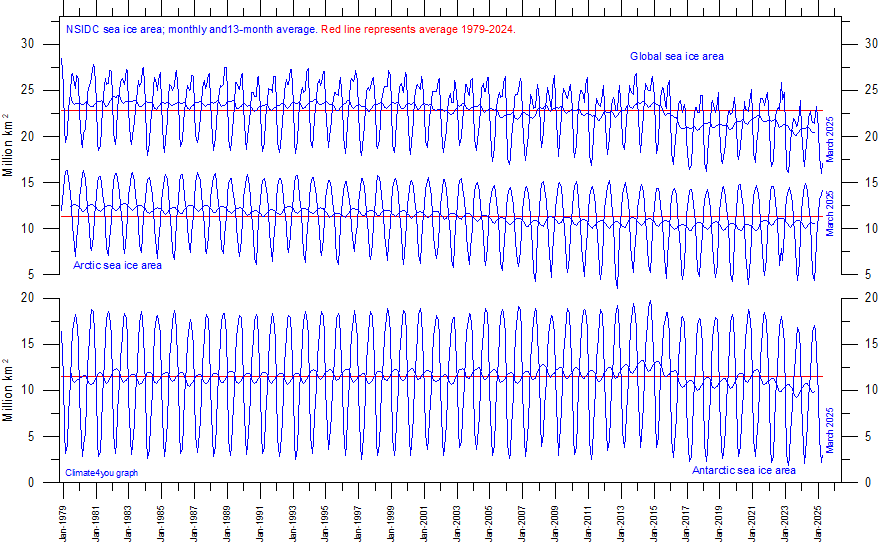 climate4you.com – Ole Humlum – Professor, University of Oslo Department of Geosciences – Click the pic to view at source[/caption]
The ultimate cherry-pick is only looking at Arctic ice.
Completely agree, Arctic Sea Ice seems like an awful proxy for “Global Temperature”:
[caption id="" align="alignnone" width="578"]
I am not sure that we should be using Sea Ice as proxy for “Global Temperature” at all given the multitude of other factors involved in Sea Ice change, e.g.;
http://wattsupwiththat.com/2012/06/16/the-economist-provides-readers-with-erroneous-information-about-arctic-sea-ice/
http://wattsupwiththat.com/2012/09/02/sea-ice-page-upgrades-observations-and-questions/
but if we are going to use Sea Ice, then Global Sea Ice would be most logical, i.e.:
Global Sea Ice Area and Anomaly
[caption id="" align="alignnone" width="578"]
Global, Arctic & Antarctic Sea Ice Area
[caption id="" align="alignnone" width="578"]
‘Completely agree, Arctic Sea Ice seems like an awful proxy for “Global Temperature”:
Nobody would suggest that you should. And nobody who understands Global warming would suggest that the ice WAS a proxy for global temperature.
Now, some people may suggest that Frost fairs in England are a good proxy for global temperatures.. Some people may suggest that Grapes growing on one place are a good global proxy.. but nobody would understands AGW would suggest that ‘ice is a good proxy for global temps.
What metric would you use? area? extent? volume?
It’s pretty simple guys. In a warming world we expect less ice floating in the warmer water.
Like duh. And looking a the fluxes into the arctic basin.. well go figure increase the heat flux into that region and the damn ice melts! rocket science!
Of course its not that simple every place on the globe because the system is pretty complex.
heat moves one place.. means…you will, you must find other places with the opposite effects.. over short times at least.
It does not take a BELIEF in AGW to note the obvious. If you put more heat into the arctic you will get less ice. Sometimes denying the obvious makes you look unscientific
http://www.intellicast.com/Global/Temperature/Maximum.aspx
http://www.intellicast.com/Global/Temperature/Minimum.aspx
how can the coast around siberia not be freezing?
It is perhaps better to look at anomilies rather thab sst on DMI which shows that it colder around the coast of Siberia than around the edge of the ice pack.
http://ocean.dmi.dk/arctic/satellite/index.uk.php
I repeat.Why is the coastline of Siberia not freezing?
Steven Mosher;
It does not take a BELIEF in AGW to note the obvious. If you put more heat into the arctic you will get less ice. Sometimes denying the obvious makes you look unscientific
>>>>>>>>>>>>>>>>>
I think that’s an unfair comment Mosh. Most commenters seem to be of the view that the importance of the current low ice area is being over stated by alarmists and others are pointing out that much of the low may be due to unusual storm activity. Both are reasonable comments in my view.
But as you yourself state, it is a system, and a complicated one with many feedbacks. In this case, we’re talking a monster feedback. Water exposed to air emitts a lot more energy to space than does ice. It absorbs a lot less energy from insolation than one would suppose also, because angle of incidence is quite low for most of the day, resulting in a lot of insolation being reflected back out to space, as much or more than would have been by ice. That has consequences that I don’t think we’re even close to knowing how to quantify.
Can we expect that when ice starts to recover in the next few weeks that it will recover more rapidly because the water beneath it is colder than it otherwise would have been? Will the colder water wind up dropping temperatures in lower latitudes as it is recirculated back toward the tropics by existing undersea currents? Will the currents themselves be modified in strength and path due to the change in temperature gradient? I think these are the more interesting questions.
The average skeptic accepts that the world had been warming for 400 years and that this must translate into less ice at some point. We just don’t consider it remarkable. The only remarkable thing about it is the attention it gets from the MSM and alarmists. If they didn’t shout it from the rooftops as evidence of their belief system, then I doubt we would remark on it in any great detail either.
AndyG55 says:
September 4, 2012 at 2:27 pm
I suspect that the scattered ice will reform quite quickly. We will see.
———————————————————————————————
Agreed.
Steven Mosher says: September 4, 2012 at 10:05 pm
In a warming world we expect less ice floating in the warmer water.
I agree, but the question is how much of the decrease in Global Sea Ice do you think is attributable to the ~.44 degree C increase in “Global Temperature” during the last several decades versus the multitude of other factors involved?
It does not take a BELIEF in AGW to note the obvious. If you put more heat into the arctic you will get less ice. Sometimes denying the obvious makes you look unscientific
I am not sure what this means, i.e. who is “denying the obvious”? I see this as similar to AGW in the sense that AGW likely exists, but there is significant question as to how much of the ~.44 degree C increase in “Global Temperature” during the last several decades is due to AGW. Similarly, some portion of the decrease in Global Sea Ice is likely attributable to the ~.44 degree C increace in “Global Temperature” during the last several decades, but some portion is likely due to the multitude of other factors involved. Until we have reasonably accurate estimates of the portions attributable, Sea Ice seems more like a distraction to keep people scared while “Global Temperature” goes nowhere fast…
From the comments anyone would think that this was the first ever recorded summer Arctic storm, or even that this was the first year weather, rather than climate, affected the melt.
Ammonite;
The arctic is telling us all something very important, if we will just listen.
>>>>>>>>>>>>>>>>>>
This quote just made me laugh. This is science? We “listen to the arctic.”…..
Steven Mosher:
It’s pretty simple guys. In a warming world we expect less ice floating in the warmer water.
Like duh. And looking a the fluxes into the arctic basin.. well go figure increase the heat flux into that region and the damn ice melts! rocket science!
IS anyone debating whether the arctic is warmer today then say 30 years ago? This is not rocket science as you say.
You must have missed the fact that we sceptics were already told above like I showed you “that the arctic is telling us something very important if we will just listen.” Its right there…..I don’t make this stuff up, and something like that makes me think that lots of warmists really do believe that “Arctic sea ice extent” is a good proxy for temperature. Talk to them and tell them its not first. No idea why you are harping on sceptics for being unscientific first and foremost.
If somebody wants a fun project
SAT from the arctic
http://iabp.apl.washington.edu/data_satemp.html
Steven Mosher says: September 4, 2012 at 10:05 pm
In a warming world we expect less ice floating in the warmer water.
So why is Antarctic sea ice increasing?
By your logic, it follows the world isn’t warming and the seas aren’t getting warmer.
You have to explain all the data. Just ignoring some of it, because you can’t explain it isn’t science.
BTW, my embedded black carbon theory easily explains the Arctic/Antarctic difference. Antarctic sea ice has much lower levels of embedded BC, because atmospheric BC levels are much lower in the SH and very little Antarctic sea ice is multi-year and hence doesn’t accumulate embedded BC the way multi-year Arctic ice does.