
By WUWT regular “Just The Facts”
I recently came across a January 21st, 2012 Peter Gleick article 2011 Climate Change in Pictures and Data: Just the Facts, which appears to mimic the format and approach of my January 1st, 2012 article A Big Picture Look At “Earth’s Temperature”.
What I find particularly amusing about Peter’s article is that a week after noting that, “Lost in this verbal debate are often the simple facts and data of climate change and the immense and definitive global observations of the ways in which our climate is actually changing around us.” Peter Gleick was perpetrating Fakegate. Why, if the “simple facts and data” support his viewpoint, would Peter resort to subterfuge and fakery?
If you read through Gleick’s article, you’ll see some of his “immense and definitive global observations”, like “anyone watching or reading the news or looking out the window probably had a sense that 2011 was a weird year with one bad, extreme weather disaster after another”…
Anyway, in honor Peter’s reinstatement as President of the Pacific Institute I figured that an update on the “simple facts and data” was in order.
Please note that WUWT cannot vouch for the accuracy of the data/graphics within this article, nor influence the format or form of any of the graphics, as they are all linked from third party sources and WUWT is simply an aggregator. You can view each graphic at its source by simply clicking on it.
Global Surface Temperatures:
Generally, when referring to Earth’s “climate” warming, proponents of the Catastrophic Anthropogenic Global Warming (CAGW) narrative, refer to Earth’s Surface Temperature, e.g. “Global warming is the unusually rapid increase in Earth’s average surface temperature over the past century primarily due to the greenhouse gases released by people burning fossil fuels.” NASA Earth Observatory
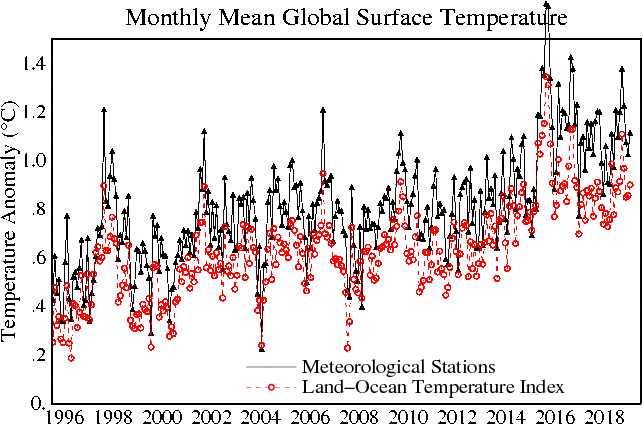
As such, here’s NASA’s Goddard Institute for Space Studies (GISS) Monthly Mean Surface Temperature Anomaly – 1996 to Present;
NOAA’s National Climate Data Center (NCDC) Annual Global Mean Temperature Anomaly Over Land & Sea – 1880 to Present;

Note: The chart above hasn’t been updated with 2011 data for unknown reasons. The chart resides here and the data to update it is here.
It appears that a significant decline in temperatures occurred during the last 17 months:
2010 1 0.6335
2010 2 0.6708
2010 3 0.7815
2010 4 0.7518
2010 5 0.7064
2010 6 0.6764
2010 7 0.6581
2010 8 0.5783
2010 9 0.4975
2010 10 0.5655
2010 11 0.7182
2010 12 0.4226
2011 1 0.3962
2011 2 0.4200
2011 3 0.5226
2011 4 0.5894
2011 5 0.5093
2011 6 0.5882
2011 7 0.5687
2011 8 0.5401
2011 9 0.5264
2011 10 0.5739
2011 11 0.4347
2011 12 0.4800
2012 1 0.3630
2012 2 0.3678
2012 3 0.4477
2012 4 0.6514
(Source: NOAA NCDC)
UK Met Office’s – Hadley Center – Climate Research Unit (CRU) Annual Global Average Land Temperature Anomaly – 1850 to Present;

and the UK Met Office – Hadley Center – Climate Research Unit (CRU) Monthly Global Average Land Temperature – 1850 to Present

Depending on the time frame, it certainly seems that Earth’s Surface Temperature has increased, but it does not appear to be warming rapidly and there is no indication of acceleration. Furthermore, the surface temperature record is burdened with issues of questionable siting, changes in siting, changes in equipment, changes in the number of measurement locations, modeling to fill in gaps in measurement locations, corrections to account for missing, erroneous or biased measurements, and the urban heat island effect. Thus to see the big picture on the temperature “Earth’s Temperature”, it also helps to look up.
Atmospheric Temperatures:
Since 1979 Earth’s “temperature” has also been measured via satellite. “The temperature measurements from space are verified by two direct and independent methods. The first involves actual in-situ measurements of the lower atmosphere made by balloon-borne observations around the world. The second uses intercalibration and comparison among identical experiments on different orbiting platforms. The result is that the satellite temperature measurements are accurate to within three one-hundredths of a degree Centigrade (0.03 C) when compared to ground-launched balloons taking measurements of the same region of the atmosphere at the same time.” NASA
The following are 4 Temperature Anomaly plots from Remote Sensing Systems (RSS), each one increases in altitude as is illustrated here:
RSS Temperature Lower Troposphere (TLT) – Brightness Temperature Anomaly- 1979 to Present;

RSS Temperature Middle Troposphere (TMT)- Brightness Temperature Anomaly- 1979 to Present;

RSS Temperature Troposphere / Stratosphere (TTS) -Brightness Temperature Anomaly- 1987 to Present;

RSS Temperature Lower Stratosphere (TLS) – Brightness Temperature Anomaly – 1979 to Present:

According to Remote Sensing Systems, “For Channel (TLT) (Lower Troposphere) and Channel (TMT) (Middle Troposphere), the anomaly time series is dominated by ENSO events and slow tropospheric warming. The three primary El Niños during the past 20 years are clearly evident as peaks in the time series occurring during 1982-83, 1987-88, and 1997-98, with the most recent one being the largest.” RSS
Also, the 2009 – 10 El Niño event is also called out on this RSS Latitudinal Temperature Lower Troposphere (TLT) Brightness Temperature Anomaly from 1979 to Present;

and the 1998 El Niño event, along with the tropospheric cooling attributed to the 1991 eruption of Mt Pinitubo, is called out on this University of Alabama – Hunstville (UAH) Lower Atmosphere Temperature Anomalies – 1979 to Present:

Note: Per John Christy, RSS and UAH anomalies are not comparable because they use different base periods, i.e., “RSS only uses 1979-1998 (20 years) while UAH uses the WMO standard of 1981-2010.”
The May UAH Lower Atmosphere Temperature Anomaly was 0.29 degrees C above the 30 year average. Keep this mind the next time you see claims that recent weather was caused by Global Warming.
There are also regional variations in Lower Troposphere that contribute nuance to the picture. For example, RSS Northern Polar Temperature Lower Troposphere (TLT) Brightness Temperature Anomaly;

shows a .337 K/C per decade increase, whereas the The RSS Southern Polar Temperature Lower Troposphere (TLT) Brightness Temperature Anomaly;

shows a .011 K/C per decade decrease. I am still not aware of a compelling explanation for the significant divergence in the Lower Troposphere temperature trends between the poles.
The satellite record seems to show slow warming of Lower and Middle Tropospheric temperatures, overlaid with the El Niño/La Niña Southern Oscillation (ENSO) cycle, including four comparatively large El Niño events. Lower Tropospheric temperatures appear to have flattened since the large El Niño in 1998 and offer no indication of Earth warming rapidly.
Moving higher in the atmosphere, RSS Temperature Troposphere / Stratosphere (TTS) – Brightness Temperature Anomaly- 1987 to Present;


has been incredibly flat since, with a trend of just -.010 K/C per decade. The 1997-98 and 2009 – 10 El Niño events are still readily apparent in the plot, as is a spike from the 1991 eruption of Mt. Pinatubo. Note that the effect of Mt. Pinatubo is the opposite in the Lower and Middle Troposphere versus the Troposphere / Stratosphere (TTS), i.e. “Large volcanic eruptions inject sulfur gases into the stratosphere; the gases convert into submicron particles (aerosol) with an e-folding time scale of about 1 year. The climate response to large eruptions (in historical times) lasts for several (2-3) years. The aerosol cloud causes cooling at the Earth’s surface, warming in stratosphere.”
Ellen Thomas, PHD Wesleyan University
It is interesting that, incorporating the impact of three significant surface driven warming events, Troposphere / Stratosphere Temperatures (TTS) have been quite stable, however there is nuance to this as well.
RSS Northern Hemisphere Temperature Troposphere / Stratosphere (TTS) – Brightness Temperature Anomaly- 1987 to Present;

has been increasing by .046 K/C per decade, whereas the RSS Southern Hemisphere Temperature Troposphere / Stratosphere (TTS) – Brightness Temperature Anomaly- 1987 to Present;

has been decreasing by -.066 K/C per decade.
Moving higher still in the atmosphere, the RSS Temperature Lower Stratosphere (TLS) – Brightness Temperature Anomaly – 1979 to Present;
“is dominated by stratospheric cooling, punctuated by dramatic warming events caused by the eruptions of El Chichon (1982) and Mt Pinatubo (1991).” RSS
The eruptions of El Chichon and Mt Pinatubo are readily apparent in the Apparent Atmospheric Transmission of Solar Radiation at Mauna Loa, Hawaii:

“The stratosphere” … “in contrast to the troposphere, is heated, as the result of near infrared absorption of solar energy at the top of the aerosol cloud, and increased infra-red absorption of long-wave radiation from the Earth’s surface.”
“The stratospheric warming in the region of the stratospheric cloud increases the latitudinal temperature gradient after an eruption at low latitudes, disturbing the stratospheric-troposphere circulation, increasing the difference in height of the troposphere between high and low latitudes, and increasing the strength of the jet stream (polar vortex, especially in the northern hemisphere). This leads to warming during the northern hemisphere winter following a tropical eruption, and this warming effect tends to be larger than the cooling effect described above.” Ellen Thomas, PHD Wesleyan University
The Lower Stratosphere experienced “dramatic warming events caused by the eruptions of El Chichon (1982) and Mt Pinatubo (1991).” RSS “The long-term, global-mean cooling of the lower stratosphere stems from two downward steps in temperature, both of which are coincident with the cessation of transient warming after the volcanic eruptions of El Chichon and Mt. Pinatubo.” … “Here we provide observational analyses that yield new insight into three key aspects of recent stratospheric climate change. First, we provide evidence that the unusual step-like behavior of global-mean stratospheric temperatures is dependent not only upon the trend but also on the temporal variability in global-mean ozone immediately following volcanic eruptions. Second, we argue that the warming/cooling pattern in global-mean temperatures following major volcanic eruptions is consistent with the competing radiative and chemical effects of volcanic eruptions on stratospheric temperature and ozone. Third, we reveal the contrasting latitudinal structures of recent stratospheric temperature and ozone trends are consistent with large-scale increases in the stratospheric overturning Brewer-Dobson circulation” David W. J. Thompson Colorado State University
Above the Stratosphere we have the Mesosphere and Thermosphere, neither of which have I identified current temperature time series for, but of note is that on “July 15, 2010” “A Puzzling Collapse of Earth’s Upper Atmosphere” occurred when “high above Earth’s surface where the atmosphere meets space, a rarefied layer of gas called “the thermosphere” recently collapsed and now is rebounding again.”

“This is the biggest contraction of the thermosphere in at least 43 years,” says John Emmert of the Naval Research Lab, lead author of a paper announcing the finding in the June 19th issue of the Geophysical Research Letters (GRL). “It’s a Space Age record.”
The collapse happened during the deep solar minimum of 2008-2009—a fact which comes as little surprise to researchers. The thermosphere always cools and contracts when solar activity is low. In this case, however, the magnitude of the collapse was two to three times greater than low solar activity could explain.
“Something is going on that we do not understand,” says Emmert.
The thermosphere ranges in altitude from 90 km to 600+ km. It is a realm of meteors, auroras and satellites, which skim through the thermosphere as they circle Earth. It is also where solar radiation makes first contact with our planet. The thermosphere intercepts extreme ultraviolet (EUV) photons from the sun before they can reach the ground. When solar activity is high, solar EUV warms the thermosphere, causing it to puff up like a marshmallow held over a camp fire. (This heating can raise temperatures as high as 1400 K—hence the name thermosphere.) When solar activity is low, the opposite happens.” NASA
In summary, Earth’s Lower and Middle Troposphere appear to have warmed slowly, overlaid with the El Niño/La Niña Southern Oscillation (ENSO) cycle, including four comparatively large El Niño events, and tempered by the cooling effects of the eruption of El Chichon (1982) and Mt Pinatubo (1991). Lower and Middle Tropospheric temperatures appear to have flattened since the large El Niño in 1998 and offer no indication of warming rapidly or warming at an accelerating rate. Tropospheric / Stratospheric temperatures appear to have been influenced by at least three significant surface driven warming events, the 1997-98 El Niño, and the eruptions of El Chichon in 1982 and Mt Pinatubo in 1991, but to have maintained a stable overall trajectory. Stratospheric temperatures appear to have experienced two “dramatic warming events caused by the eruptions of El Chichon (1982) and Mt Pinatubo (1991).”, and “unusual step-like behavior of global-mean stratospheric temperatures” which has resulted in a significant stratospheric cooling during the last 30 years. Lastly, “during deep solar minimum of 2008-2009” “the biggest contraction of the thermosphere in at least 43 years” occurred and “The magnitude of the collapse was two to three times greater than low solar activity could explain.”
Ocean Temperatures:
“The oceans can hold much more heat than the atmosphere. Just the top 3.2 metres of ocean holds as much heat as all the world’s air.” Commonwealth of Australia – Parliamentary Library
As such, changes inOcean Heat Content are important in understanding Earth’s “Temperature”. Here is NOAA’s NODC Global Ocean Heat Content from 0-700 Meters – 1955 to Present;

and here is the same from Ole Humlum’s valuable climate data site Climate4you.com, NODC Global Ocean Heat Content – 0-700 Meters – 1979 to Present:

It seems apparent from the plots above that Global Ocean Heat has increased over the last several decades, however Global Ocean Heat doesn’t appear to be warming rapidly. Furthermore, there is no evidence or indication of an accelerating rate.
Sea Level:
“Global sea level is currently rising as a result of both ocean thermal expansion and glacier melt, with each accounting for about half of the observed sea level rise, and each caused by recent increases in global mean temperature. For the period 1961-2003, the observed sea level rise due to thermal expansion was 0.42 millimeters per year and 0.69 millimeters per year due to total glacier melt (small glaciers, ice caps, ice sheets) (IPCC 2007). Between 1993 and 2003, the contribution to sea level rise increased for both sources to 1.60 millimeters per year and 1.19 millimeters per year respectively (IPCC 2007).” Source NSIDC
Global Mean Sea Level Change – 1993 to Present:

Global Mean Sea Level Change Map with a “Correction” of 0.3 mm/year added May, 5th 2011, due to a “Glacial Isostatic Adjustment (GIA)” – 1993 to Present:

Snow and Ice:
A proxy often cited when measuring “Earth’s Temperature” is amount of Snow and Ice on Earth. According to the United States Geological Survey (USGS), “The vast majority, almost 90 percent, of Earth’s ice mass is in Antarctica, while the Greenland ice cap contains 10 percent of the total global ice mass.” Source USGA
However, there is currently there is no generally accepted measure of ice volume, as Cryosat is still in validation and the accuracy of measurements from Grace are still being challenged. Sea Ice Area and Extent are cited as proxies for “Earth’s Temperature”, however there is significant evidence that the primary influences on Sea Ice Area and Extent are in fact wind and Atmospheric Oscillations. With this said, here are
Global, Arctic & Antarctic Sea Ice Area from 1979 to Present;

Global Sea Ice Area Anomaly – 1979 to Present:

Northern Hemisphere Sea Ice Area Anomaly, 1979 to Present;

Southern Hemisphere Sea Ice Area Anomaly, 1979 to Present;

Arctic Sea Ice Extent – 15% or greater

Antarctic Sea Ice Extent – 15% or Greater

There appears to have been a negative trend in Northern Hemisphere Sea Ice Area and Extent and a positive trend in Southern Hemisphere Sea Ice Area and Extent, thus the resultant Global Sea Ice Area trend appears to be slightly negative.
In terms of land based data, here is 20 Year Northern Hemisphere Snow Cover with 1995 – 2009 Climatology from NCEP/NCAR;

Northern Hemisphere Snow Cover Anomalies 1966 – Present from NCEP/NCAR;

Northern Hemisphere Winter Snow Extent – 1967 to Present from Rutgers University;

Northern Hemisphere Spring Snow Extent – 1967 to Present:

Northern Hemisphere Fall Snow Extent – 1967 to Present:

While none of the Snow plots offers a global perspective, when looking at the Northern Hemisphere, there appears to have been a slight increase in Snowcover and Winter Snow Extent, a decrease in Spring Snow Extent and no change in Fall Snow Extent over the historical record.
Based on the limited Global Ice and Snow measurements available, and noting the questionable value of Sea Ice Area as a proxy for temperature, not much inference can currently be drawn from Earth’s Ice and Snow measurements. However, there does not appear to be any evidence of rapid warming in Earth’s Ice and Snow measurements.
Conclusion:
“Earth’s “Temperature” appears to have increased during the last several decades, but there does not appear to be any evidence of rapid or accelerating warming.
Additional information on “Earth’s Temperature” can be found in the WUWT Reference Pages, including the Global Temperature Page and Global Climatic History Page
Discover more from Watts Up With That?
Subscribe to get the latest posts sent to your email.
Drawing a straight line through a non-linear temperature curve as several examples above do is an invalid representation of what really happens to temperature. In particular, it hides the fact that there was no warming in the eighties and nineties which was then followed by a step warming initiated by the super El Nino of 1998. That step is totally hidden by an upsloping straight line. It deceives us into thinking that temperature rise was smooth and continuous which is false. In fact there were two standstills separated by a step warming. Secondly, the presence of El Nino peaks is wiped out by this procedure. In the eighties and nineties there were five of them but they go unacknowledged. You will find the correct representation of the average temperature in the presence of the ENSO oscillation in my book “What Warming?” The ENSO oscillation is an integral part of all temperature curves at all times. BEST gives a a good idea of it when it compares four different sources of global temperature going back to 1880. It is actually amazing how well the El Nino peaks register from these disparate sources.
JohnB says: @ur momisugly June 10, 2012 at 9:54 am
So, is this the first sighting of a new “skeptic” meme? “Yes, it’s warming, but at least it’s not getting any faster”.
Of course, it if does get faster, you can always move on to “yes, it’s getting faster, but the rate of increase isn’t increasing.” And so on to ever higher differentials…
____________________________________
No it means we are well aware that 1300-1850 was the Little Ice Age. Even the Council on Foreign Relations says The Little Ice Age: The Prelude to Global Warming, 1300-1850 Note how the second, third and fourth graphs of temperature START at the end of the Little Ice Age and warm at pretty much the same rate until know when we are plateauing. (Note Dr. Feynman’s validation of the 200 yr cycle)
What the CAGW alarmists forget to mention is the Ice Age was a miserable time for humans, plants and animals. It was a time of failed crops, and starvation. The Black Death in the 14th Century is thought to have wiped out up to 60% of Europe’s population.
Earth’s climate is cyclical so if we didn’t warm coming out of the Little Ice Age the other option is repaid cooling into another glacial.
One commenter here who is a Geologist said that while the cycles do not always lift the earth out of an Ice Age they ALWAYS dump it into one. (sorry no link)
Gerry Roe’s 2006 paper In Defense of Milankovitch, Geophysical Research Letters fine tunes the Milankovitch model and get a very good match with the ice core data. See In Defense of Milankovitch by Gerard Roe over at Luboš Motl website for an easy to read article and pointers to the paper.
Dr Feynman – Maunder Minimum Evidence of a Chaotic Sun: http://resources.metapress.com/pdf-preview.axd?code=x176761610l512x3&size=largest
Why did the author not choose to use Cruv4 but instead Cruv3? That seems like a major issue?
JohnB says:
June 10, 2012 at 9:54 am
Conclusion:
“Earth’s “Temperature” appears to have increased during the last several decades, but there does not appear to be any evidence of rapid or accelerating warming.
=====================================================================
Excuse me, but isn’t all the fuss based on Hansen’s predictions? MAN made CO2 rises and a catastrophic rise in global temperatures is the result? Have his predictions come true? We should be seeing it happen by now, according to him. All we’ve seen is the ol’ “bait and switch” from “global warming” to “climate change”. If it’s cold in a particular area, the news there is “climate change”. If it’s warm in a particular area, the news there is “global warming”. Some of us sheep have a shepherd who’s name isn’t Mann.
JTF, you repeatedly say that temperatures do not “appear to be warming rapidly”. Could you please define “rapid warming” for us?
You also say, “It appears that a significant decline in temperatures occurred during the last 17 months…” Could you please provide a baseline reference for that statement? JP
JohnB says:
So, is this the first sighting of a new “skeptic” meme? “Yes, it’s warming, but at least it’s not getting any faster”.
~ Since when has ANY skeptic said it hasn’t been warming since the end of the Little Ice Age? Your ‘new meme’ idea is about 5 decades out of date.
Of course, it if does get faster, you can always move on to “yes, it’s getting faster, but the rate of increase isn’t increasing.” And so on to ever higher differentials…
~ Too bad for you it is DECLINING, now, eh? No acceleration in temperatures. NO acceleration ins sea-level rise, in fact, it is going the other way. No ‘death spiral’ in the arctic; no ‘death spiral’ in the polar bear population, NO increase in severe hurricanes… You just don’t seem to be having any luck. And your luck is going to get worse.
Buy a clue. And a brain.
Just as an addendum to my previous comment (June 10, 2012 at 10:14 am): JohnB has on many previous occasions given me the impression that he is a man who knows for sure that atmospheric CO2 causes the Earth to warm up. And here he is again (June 10, 2012 at 9:54 am) saying: “So, is this the first sighting of a new “skeptic” meme? “Yes, it’s warming, but at least it’s not getting any faster”.
Of course, it if does get faster, you can always move on to “yes, it’s getting faster, but the rate of increase isn’t increasing.” And so on to ever higher differentials…”
================
I am open minded myself and kind of hoping the warmists are, at least, partially right and that CO2 really does have some warming potential in order that the next “Ice Age”, be it a big or a little one, can be averted. – Data show that the Earth has slowly been cooling ever since “The Holocene Optimum” many thousands of years ago. Unless a miracle happens the Earth will continue cooling.
So then JohnB, as you are clearly not a “skeptic” I can only assume you are a person known as a “warmist” (AGW or CAGW believer). Please tell me what makes you so certain that CO2 is capable of causing “Global Warming”. – And don’t tell me CO2 is the miracle happening.
What should that “fingerprint” look like?
Steven Mosher says: June 10, 2012 at 10:55 am
Here you wrote:
” however there is significant evidence that the primary influences on Sea Ice Area and Extent are in fact wind and Atmospheric Oscillations.”
There you wrote:
“I can help to alleviate these concerns. There is abundant evidence that wind and atmospheric oscillations have a major influence on Arctic Sea Ice. In this October, 1 2007 NASA article;
http://www.nasa.gov/vision/earth/lookingatearth/quikscat-20071001.html
Son V. Nghiem of NASA’s Jet Propulsion Laboratory, said that “the rapid decline in winter perennial ice the past two years was caused by unusual winds. “
Do you not understand the difference between explaining that the rapid decline in TWO years
is not the same as explain the decline over the whole period.
Did you read the entire comment you reference?, i.e.;
http://wattsupwiththat.com/2011/12/02/hurricanes-and-global-warming-opinion-by-chris-landsea/#comment-816893
as it clearly addresses “the decline over the whole period” versus “TWO years” as you erroneously infer, i.e.;
“Observations reveal a strong correlation between the ice fluxes through the Fram Strait and the cross-strait air pressure difference.”
“Although the 1950s and 1990s stand out as the two decades with maximum flux variability, significant variations seem more to be the rule than the exception over the whole period considered.”
“A noticeable fall in the winter air pressure of 7 hPa is observed in the Fram Strait and the Barents Sea during the last five decades.”
“The corresponding decadal maximum change in the Arctic Ocean ice thickness is of the order of 0.8 m. These temporal wind-induced variations may help explain observed changes in portions of the Arctic Ocean ice cover over the last decades. Due to an increasing rate in the ice drainage through the Fram Strait during the 1990s, this decade is characterized by a state of decreasing ice thickness in the Arctic Ocean.”
http://journals.ametsoc.org/doi/abs/10.1175/1520-0442%282001%29014%3C3508%3AFSIFAA%3E2.0.CO%3B2
“Perennial-ice extent loss in March within the DM domain was noticeable after the 1960s, and the loss became more rapid in the 2000s when QSCAT observations were available to verify the model results. QSCAT data also revealed mechanisms contributing to the perennial-ice extent loss: ice compression toward the western Arctic, ice loading into the Transpolar Drift (TD) together with an acceleration of the TD carrying excessive ice out of Fram Strait, and ice export to Baffin Bay.”
http://seaice.apl.washington.edu/Papers/NghiemEtal2007_MYreduction.pdf
The arctic has warmed, most significantly the surrounding SST has warmed over this period.
That contributes to a decline in ice cover.
As I point out in my article, Northern Polar Lower Troposphere temperatures;
http://wattsupwiththat.files.wordpress.com/2012/06/rss_ts_channel_tlt_northern-polar_land_and_sea_v03_3.png?w=640
have increased by approximately 1 degree Celsius during the last three decades, which likely contributed to a decline in Arctic ice cover. In terms of Arctic Sea Surface temperatures, according to this 2007 paper Arctic Ocean surface warming trends over the past 100 years by Michael Steele, Wendy Ermold and Jinlun Zhang;
http://www.polarwinds.org/UpTempO/docs/2007GL031651.pdf
“Ocean temperature profiles and satellite data have been analyzed for summertime sea surface temperature (SST) and upper ocean heat content variations over the past century, with a focus on the Arctic Ocean peripheral seas. We find that many areas cooled up to _0.5_C per decade during 1930–1965 as the Arctic Oscillation (AO) index generally fell, while these areas warmed during 1965–1995 as the AO index generally rose. Warming is particularly pronounced since 1995, and especially since 2000. Summer 2007 SST anomalies are up to 5_C. The increase in upper ocean summertime warming since 1965 is sufficient to reduce the following winter’s ice growth by as much as 0.75 m. Alternatively, this heat may return to the atmosphere before any ice forms, representing a fall freeze-up delay of two weeks to two months.”
The fact that winds played a significant role in the record year is NOT evidence that the winds explain all of the decline from 1979 on.
Your words not mine, I wrote that, “the primary influences on Sea Ice Area and Extent are in fact wind and Atmospheric Oscillations.”, not that ” winds explain all of the decline from 1979 on.” Clearly there are numerous secondary influences, including atmospheric and sea surface temperatures, however the body of evidence indicates that the primary influences are in fact wind and Atmospheric Oscillations, not atmospheric and sea surface temperatures.
Just as CAGW folks often try to attribute all warming to C02, do not make the same mistake of simplifying what is happening in the arctic.
I don’t see how you can read my comment as “simplifying”. “CAGW folks often try to attribute all Warming to CO2” and try to attribute the entire decline in Sea Ice Area and Extent to warming. I am pointing out that the primary influences on Sea Ice Area and Extent are in fact wind and Atmospheric Oscillations, how does that make anything simpler?
Earle Williams says: June 10, 2012 at 10:57 am
Erratum:
USGS Refers to the the United States Geological Survey, not Geographical.
Sorry, being a geologist it sort of jumps out at me.
Corrected, thank you.
Phil says: June 10, 2012 at 11:04 am
Regarding the second chart (http://www.ncdc.noaa.gov/sotc/service/global/global-land-ocean-mntp-anom/201001-201012.gif), the link (ftp://ftp.ncdc.noaa.gov/pub/data/anomalies/annual.land_ocean.90S.90N.df_1901-2000mean.dat) to the relevant data shown in the paragraph directly below the graph appears to be incorrect. The correct link : ftp://ftp.ncdc.noaa.gov/pub/data/anomalies/monthly.land_ocean.90S.90N.df_1901-2000mean.dat is shown below the last 17 month anomalies.
I think that’s what I meant, i.e. the first link;
ftp://ftp.ncdc.noaa.gov/pub/data/anomalies/annual.land_ocean.90S.90N.df_1901-2000mean.dat
shows the annual data, i.e. “2011 0.5100”, which would be used to update the NOAA annual chart through 2011, the second link;
ftp://ftp.ncdc.noaa.gov/pub/data/anomalies/monthly.land_ocean.90S.90N.df_1901-2000mean.dat
shows the monthly data, which helps to illustrate the decrease over the last 17 months.
In order to avoid confusion I’ve added a break in the article between these two points.
Regarding the NOAA 0-70 m Global Ocean Heat Content – how can the top 700m contain -50,000,000,000,000,000,000,000 joules?
It doesn’t say so but I assume this must be an anomaly?
Thats minus fifty thousand million million million ( the word wrap was funny on scren for such a big number ). Epic post, positively “Tisdalian”!
John Peter says: June 10, 2012 at 11:07 am
I think “Justthefactcs” forgot to add http://www.esrl.noaa.gov/gmd/ccgg/trends/#mlo_full
Not forgetting, this article is just focused on measurements of “Earth’s Temperature” versus measurements of potential climatic variables. If I included CO2, then I’d be inclined to include various Oceanic Oscillations, Atmospheric Oscillations, Cloud Cover, etc. and this article would become more unwieldy.
Oh please please please will this never end? Do these people really think that anyone believes this nonsense about the temperature of the Earth unless their livelihood depends on it. The EARTH !!! ??. I could not tell you the temperature of my house !! I have three thermometers in my living room, three in my study, one each in my kitchen, my bathroom ,my bedroom, and my carport. I carefully calibrated them against each other and they are all showing different temperatures.
And these people tell me they can measure the temperature of the EARTH!!! in tenths of one degree. 0.8 degree increase in 150 years !! Look stop it –you make fools of yourselves. This worrying about minute increases in the temperature of the EARTH !!! is more stupid than discussing how many fairies can stand on the head of a pin.
Where I live some months are hotter than usual and some years they are cooler.
And guess what? We survive no matter what. Like humans survive in Greenland or Gabon.
I’m losing interest in this navel gazing twaddle now because it is nonsense and corrupt distorted manipulated twaddle at that. I despair. Sorry.
Robert says: June 10, 2012 at 12:24 pm
Why did the author not choose to use Cruv4 but instead Cruv3? That seems like a major issue?
The only HadCRUT4 chart I’ve seen is this one;
http://www.metoffice.gov.uk/hadobs/hadcrut4/diagnostics.html
which only contains data through 2010, and thus not acceptable for these purposes. If you have a current HadCRUT4 chart please post a link to it in comments for consideration.
Re. the change from “GW” to “CC”:
It ‘s been the IPCC (not the IPGW) since it was formed in 1988. And who do you think suggested that the term CC should be used in preference to GW (because it is less scary):
http://en.wikipedia.org/wiki/Frank_Luntz
“Although Luntz later tried to distance himself from the Bush administration policy, it was his idea that administration communications reframe “global warming” as “climate change” since “climate change” was thought to sound less severe. Luntz has since said that he is not responsible for what the Bush administration did after that time. Though he now believes humans have contributed to global warming, he maintains that the science was in fact incomplete, and his recommendation sound, at the time he made it.”
But that’s just a distraction. Really, take another look at those graphs (e.g. 2nd, 3rd and 4th graphs) and tell me, honestly, that you cannot see that late 20th century to present day warming is not “anomalous”. Then, even if you are only slightly suspicious that there may be something to AGW (nobody on the science-accepting side uses the term “CAGW”, only “skeptics” do that) go look at some science.
Cue Smokey’s cherry-picks and inappropriate linear trends…
Posted this before but can’t resist a re-posting…
atarsinc says: June 10, 2012 at 12:31 pm
JTF, you repeatedly say that temperatures do not “appear to be warming rapidly”. Could you please define “rapid warming” for us?
No, I will leave that up to those who claim rapid warming to try to define it. Do you think it’s warming rapidly? If so, please indicate the data/charts that support this point of view.
You also say, “It appears that a significant decline in temperatures occurred during the last 17 months…” Could you please provide a baseline reference for that statement? JP
The 12 months prior, i.e. 2010. The question here is why hasn’t NOAA/NCDC updated their temperature chart to reflect the temerpature decline that occured in 2011?
Oops.
“tell me, honestly, that you cannot see that late 20th century to present day warming is anomalous”
A lot of hard work, but I can not trust anything that NASA or NOAA has to say. Period.
Whatever reason they wish to state for modifying historical data is, in my opinion, total bullshit. Using any product from their archive now leaves me with questions as to it’s integrity.
How can you trust it?
John Peter says:
June 10, 2012 at 11:07 am
I think “Justthefactcs” forgot to add http://www.esrl.noaa.gov/gmd/ccgg/trends/#mlo_full
showing CO2 increase from 310ppm in 1960 to 394.16ppm in May 2012….
___________________________
Speaking of CO2 Kaplan’s Graph is interesting. He found an increase in CO2 lagged an increase in Sea Surface Temp by about a year. link
Tony Brown, who sometimes comments here did a nice history of CO2 measurement over at The Air Vent If I recall correctly he has access to a really good library. I found this bit of information interesting
atarsinc says:
June 10, 2012 at 12:31 pm
JTF, you repeatedly say that temperatures do not “appear to be warming rapidly”. Could you please define “rapid warming” for us?
You also say, “It appears that a significant decline in temperatures occurred during the last 17 months…” Could you please provide a baseline reference for that statement? JP
____________________________________
That is kind of hard to do when the raw data has been manipulated to show warming now isn’t it?
Here is a data set they forgot to manipulate: http://www.terradaily.com/reports/Study_finds_stream_temperatures_dont_parallel_warming_climate_trend_999.html
http://notrickszone.com/2012/03/01/data-tamperin-giss-caught-red-handed-manipulaing-data-to-produce-arctic-climate-history-revision/
THe Goat Ate my Homework (now where have we heard that one before Mr. Jones?) http://briefingroom.typepad.com/the_briefing_room/2010/02/breaking-news-niwa-reveals-nz-original-climate-data-missing.html
http://jonova.s3.amazonaws.com/graphs/giss/hansen-giss-1940-1980.gif
http://cdiac.ornl.gov/epubs/ndp/ushcn/ts.ushcn_anom25_diffs_urb-raw_pg.gif
http://wattsupwiththat.com/2012/04/07/an-update-on-my-climate-reference-network-visualization-project/
http://joannenova.com.au/2012/03/australian-temperature-records-shoddy-inaccurate-unreliable-surprise/
http://diggingintheclay.files.wordpress.com/2010/04/canadadt.png
http://diggingintheclay.files.wordpress.com/2010/04/canadadt.png
http://chiefio.wordpress.com/2009/08/17/thermometer-years-by-latitude-warm-globe/
http://regator.com/p/238474965/which_nasa_data_to_believe/
Analysis of error in the temperature Record: http://strata-sphere.com/blog/index.php/archives/11420
At this point there are not any “official” data sets where the actual warming can be figured out with any degree of certainty.
JohnB says: June 10, 2012 at 1:33 pm
“tell me, honestly, that you cannot see that late 20th century to present day warming is anomalous”
Honestly, I’m not seeing it, please point it out for me. On this NOAA NCDC chart;
http://www.ncdc.noaa.gov/sotc/service/global/global-land-ocean-mntp-anom/201001-201012.gif
doesn’t the warming from 1975 to 2005, look almost identical to the warming that occurred from 1910 – 1940?
Matt says:
June 10, 2012 at 1:13 pm
Oh please please please will this never end? Do these people really think that anyone believes this nonsense about the temperature of the Earth unless their livelihood depends on it. The EARTH !!! ??. I could not tell you the temperature of my house !! I have three thermometers in my living room, three in my study, one each in my kitchen, my bathroom ,my bedroom, and my carport. I carefully calibrated them against each other and they are all showing different temperatures.
=================================================================
Those behind this aren’t interested in the temperature in your bathroom but the money in your wallet. (And in telling you when you’re allowed to use your bathroom.)
You can’t meaningfully say whether there is or is not an acceleration unless you specify a time interval. Over 1950-2010 there is an acceleration. Over 1990-2010 there is not. From 1880 to 2010 it seems that there is because we had cooling for the first 30 years.