There’s a new paper in PNAS worth having a look at. It seems the authors found some very strong evidence for a comet or asteroid impact during the period known as the Younger Dryas. According to Wikipedia:
The Younger Dryas stadial, also referred to as the Big Freeze, was a geologically brief (1,300 ± 70 years) period of cold climatic conditions and drought which occurred between approximately 12,800 and 11,500 years BP (Before Present). The Younger Dryas stadial is thought to have been caused by the collapse of the North American ice sheets, although rival theories have been proposed.
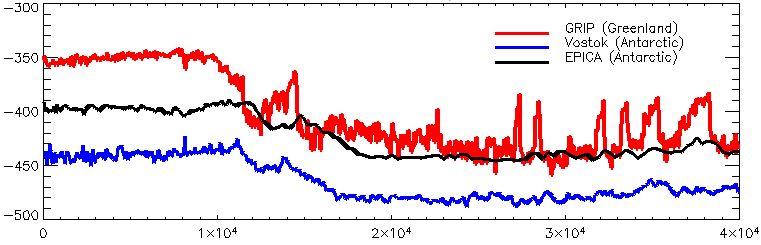
With this new paper, this may be one of those “case closed” moments in science showing that “climate change”/ice sheet collapse itself wasn’t to blame for the cold event, but the climate changed due to the impact event. This rather undoes the claims last year covered on WUWT in the story Sudden Clovis climate death by comet – “bogus”. I’d say it is pretty hard to argue with micro magnetic impact spherules dated to the time.
Evidence from central Mexico supporting the Younger Dryas extraterrestrial impact hypothesis

Abstract
We report the discovery in Lake Cuitzeo in central Mexico of a black, carbon-rich, lacustrine layer, containing nanodiamonds, microspherules, and other unusual materials that date to the early Younger Dryas and are interpreted to result from an extraterrestrial impact. These proxies were found in a 27-m-long core as part of an interdisciplinary effort to extract a paleoclimate record back through the previous interglacial.
Our attention focused early on an anomalous, 10-cm-thick, carbon-rich layer at a depth of 2.8 m that dates to 12.9 ka and coincides with a suite of anomalous coeval environmental and biotic changes independently recognized in other regional lake sequences.
Collectively, these changes have produced the most distinctive boundary layer in the late Quaternary record. This layer contains a diverse, abundant assemblage of impact-related markers, including nanodiamonds, carbon spherules, and magnetic spherules with rapid melting/quenching textures, all reaching synchronous peaks immediately beneath a layer containing the largest peak of charcoal in the core. Analyses by multiple methods demonstrate the presence of three allotropes of nanodiamond: n-diamond, i-carbon, and hexagonal nanodiamond (lonsdaleite), in order of estimated relative abundance.
This nanodiamond-rich layer is consistent with the Younger Dryas boundary layer found at numerous sites across North America, Greenland, and Western Europe. We have examined multiple hypotheses to account for these observations and find the evidence cannot be explained by any known terrestrial mechanism. It is, however, consistent with the Younger Dryas boundary impact hypothesis postulating a major extraterrestrial impact involving multiple airburst(s) and and/or ground impact(s) at 12.9 ka.
…

…
Summary
Synchronous peaks in multiple YDB markers dating to 12.9 ka were previously found at numerous sites across North and South America and in Western Europe. At Lake Cuitzeo, magnetic impact spherules, CSps, and NDs form abundance peaks within a 10 cm layer of sediment that dates to the early part of the YD, beginning at 12.9 ka. These peaks coincide with anomalous environmental, geochemical, and biotic changes evident at Lake Cuitzeo and in other regional records, consistent with the occurrence of an unusual event. Analyses of YDB acid-resistant extracts using STEM, EDS, HRTEM, SAD, FFT, EELS, and EFTEM indicate that Lake Cuitzeo nanoparticles are dominantly crystalline carbon and display d-spacings that match various ND allotropes, including lonsdaleite. These results are consistent with reports of abundant NDs in the YDB in North America and Western Europe.
Although the origin of these YDB markers remains speculative, any viable hypothesis must account for coeval abundance peaks in NDs, magnetic impact spherules, CSps, and charcoal in Lake Cuitzeo, along with apparently synchronous peaks at other sites, spanning a wide area of Earth’s surface. Multiple hypotheses have been proposed to explain these YDB peaks in markers, and all but one can be rejected. For example, the magnetic impact spherules and NDs cannot result from the influx of cosmic material or from any known regular terrestrial mechanism, including wildfires, volcanism, anthropogenesis, or alternatively, misidentification of proxies. Currently, only one known
event, a cosmic impact, can explain the diverse, widely distributed assemblage of proxies. In the entire geologic record, there are only two known continent-wide layers with abundance peaks in NDs, impact spherules, CSps, and aciniform soot, and those
are the KPg impact boundary at 65 Ma and the YDB boundary at 12.9 ka.
If you’re interested, the paper is published with unrestricted access on the PNAS website.
Or, you can read a full PDF copy that’s been mirrored on Dropbox.com at: http://dl.dropbox.com/u/2268163/Mexico%20YD%20Paper.pdf
h/t to reader Dennis Cox
Ah! Found it! (Having good “Google Foo” tonight, or rather, “Duckduckgo Foo” as I’m using their ‘non-spying’ search engine lately 😉
http://cometstorm.wordpress.com/2011/04/27/a-different-kind-of-climate-catastrophe-2/
The search actually turned up a discussion of it at Tallbloke’s place:
http://tallbloke.wordpress.com/2011/06/24/comet-storm-a-hypothesis-explaining-megafauna-extinction-and-the-younger-dryas/
that had the link in it.
At any rate, it is a pretty good geology oriented look at the ‘facts in the ground’… and answers a lot of the issues folks here raised about things like the Carolina Bays. ( BTW, per carbon dating them: what happens if a rock fall brings with it some anomalous carbon?…)
Bill,
That flooding occurred during every major glacial interstadial throughout the Pleistocene. The Pleistocene section is more than 20,000′ thick in parts of Garden Banks and Green Canyon. The section is loaded with massive turbidite, basin floor fan and other high energy low stand sequences. Thick (>200′), blocky sand units with 30% porosity and >1 Darcy of perm are common in ecological zone 5 (outer slope) settings. Unless that was all comet dust, it came from glacial outwash during glacial stages via the Mississippi River drainage system.
Prior to the BA-YD and the Holocene transgression, the megafauna didn’t have to deal with the floods and humans at the same time.
Optically stimulated luminecsence dating is fairly accurate (+/-5%) for sediments subaerially deposited from ~300 to ~100,000. Carolina Bay features are often dated with OSL.
Dennis Cox says:
March 13, 2012 at 9:04 pm & 5.50pm
=============
No question that these are obvious signatures of an impact event. The unanswered question relates to the extent of their contribution to the Younger Dryas climate shift.
Ed Mertin says:
March 13, 2012 at 8:40 pm
=============
Great comment, thanks and I’m looking forward to reading more.
feet2thefire says:
March 13, 2012 at 5:45 pm
=============
Thanks, I’m going to take you up on the offer to join in the chat at George Howard’s http://www.CosmicTusk.com, which is all about the YD impact event.
Alexandra Cairns says:
March 13, 2012 at 2:13 pm
==========
One of your questions related to the frequency of meteor strikes. You’ll find a partial answer beginning on page 8 of the study cited in the original post.
Evidence from central Mexico supporting the Younger Dryas extraterrestrial impact hypothesis
http://dl.dropbox.com/u/2268163/Mexico%20YD%20Paper.pdf
excerpt from the summary:
Although the origin of these YDB markers remains specula- tive, any viable hypothesis must account for coeval abundance peaks in NDs, magnetic impact spherules, CSps, and charcoal in Lake Cuitzeo, along with apparently synchronous peaks at other sites, spanning a wide area of Earth’s surface. Multiple hypotheses have been proposed to explain these YDB peaks in markers, and all but one can be rejected. For example, the mag- netic impact spherules and NDs cannot result from the influx of cosmic material or from any known regular terrestrial mechan- ism, including wildfires, volcanism, anthropogenesis, or alterna- tively, misidentification of proxies. Currently, only one known event, a cosmic impact, can explain the diverse, widely distributed assemblage of proxies. In the entire geologic record, there are only two known continent-wide layers with abundance peaks in NDs, impact spherules, CSps, and aciniform soot, and those are the KPg impact boundary at 65 Ma and the YDB boundary at 12.9 ka.
Continuing with the extinction of megafauna. This started in Euurope, so that by the time our cousins the Neandertals vanished, so to had the European elephant, rhino and hippo. The wooly rhino lasted longer as did the giant deer, and the iconic cave bear, but they too disappeared. The last stand of megafauna in Eurasia was in Siberia where the mammoth survived until about the same time as the N.A. mammoth. Oddly enough these extinctions seem to coincide with the arrival of well adapted stone age hunters.
In Australia, where the climate was rather nice, the arrival some 50,000 years ago of humans led to the rapid demise of many large animals previously present there. Same with the giant Moa of New Zealand and the arrival of humans.
Hi Ed Mertin –
Ah yes, the Mammoth (and Mastodon) – grandfather of the Buffalo. You left out that Elephants migrate annually, with their routes favoring mucks (for insect control and cooling in heat) and salt licks. The key here is adequate fodder – thanks for the note on Mammoth fat storage, as the climate collapse from the dust load had to span several years. And their fodder was multiple plants and trees, and none of them grew – the climate collapse was that bad.
My current thinking is that as the food supply was so bad they would venture into dangerous grounds, hence the peaks in preserved carcases.
Hi once again Ed, for when you return –
In this case you have multiple speices going extinct at exactly the same time everywhere all around the Earth, including South America. For those animals of large size, it must be quantities of food they require. For the smaller animals, it must the lack of specific kinds of food. There were also other predators besides man at the time. Why did Buffalo survive? They are quite tasty. But the horse died off in North America at the same time.
You need to restate your observations on the appearance of man in Siberia, since its more than likely that earlier remains have simply not been found yet, rather than that they don’t exist. “bushbabbty”‘s comments about the time of appearance of boats in hominid evolution are now known to be “off”.
I guess I should have included this link in my last comment. But it occurs to me that Han Kloosterman’s A Catastrophist Manifesto is becoming more appropriate every day.
@bushbunny 8:55 pm:
“Hang on folks, no humans inhabited North America until about 11000 years ago maximum.”
bushbunny, you stepped in it that time. You happen to be talking to people who know a bit more than you apparently do. And you kind of blow all your cred when you say something like that, especially in that way.
You are about 15 years behind the times.
Never heard of Monte Verde in Chile?
Topper in SC?
Meadowcroft in PA?
Buttermilk Creek, TX?
Cactus Hill, VA?
Taima Taima in Venezuela?
And there are more… All older than Clovis.
De ice-free corridor jes’ ain’t true no mo’. Clovis First died in 1997. I hate to tell ya.
And you also missed the new finds on the Delmarva Peninsula, some of it under water, that pushes back humans in the Americas to about 21,000 to 25,000 years ago. Last I looked 21,000 years ago is longer ago than your 11,000 years ago maximum.
Also, ever heard of mitochondrial DNA? According to mtDNA there were no fewer than FIVE human incursions into the New World, with Clovis being the last. The first? As I recall it was Polynesian, but I might be wrong on that. After that I think it was Solutreans from France/Spain.
After what you said in your opener, it is kind of hard to take what else you say seriously. Honestly, you should actually look stuff up before you come in with guns ablazing spouting Clovis First dogma that is way, WAY out of date. But look it up on an internet newer than 1996.
Steve Garcia
I recommend that everybody scrolls up to “”Myrrh Mar12, 4:39 pm and read
first the Kendall files on how the flash frozen mammoths with buttercups in the
mouths and penis up were discovered……
That was flash freezing, as comets are able to….
….. Bear in mind, we want the real truth ….. but there are bad guys out there
[CAGW: “Catastrophic AGW] clinging to false ocean stream assertions, such
as Rahmstorf, Broecker, Dalton. a.s f……trying to BS that rapid/flash temperature
swings are caused by ocean flowing North or South in “SEE SAW”-
style to the Southpole and the Gulfstream turns around its belt conveyor flow
and instantly freezes the Mammoths, as well as the city of New York (see the big freeze movie
some years ago, inspired by the “Streamlers”, who, of cause, will deny any
authorship and responsibility)
……. Fact is: The discussion about YD can be described as:
“(1) Cosmic impact pitted vs. (2) Streamler reversed flow BS”
and if we win, research money would go to (1) , and (2) would loose …..
this is the reason why persons as Middleton [scroll up] remain obstinate
to any new/latest YD reseach results……
JS
Dennis, your southern “impact features” have been looked at by professional geologists, by Richard at Tallboys, and by Paul on the meteorite list. They tried to explain to you why they are not impact features.
The multiple craters surrounding the main crater at Odessa are well known in the meteorite collecting community. Their dates are pretty well known as well, though of course more work needs to be done They are not from the Holocene Start Impact Event.
Two possible impact structures, Ilturalde Crater and the Llyodminster structure, await confirmation and dating. It is possible that neither of them dates to the HSI.
While we know that the HSI was cometary, we do not know with any certainty which comet was responsible yet It may be possible that the progenitor of the Draconid meteor stream was involved.
@Grondine:
The crater search is just one possibility, even the search for ET materials….
There can be Ice/CO2 comets which do not leave craters such as the 1906
Siberian comet or the Starogga comet, where 300 miles of Norwegian coastline
was hit….8,200 BP….. it the comet goes fully/partially into the ocean, then an
overdimensional tsunami wave would be what we have to look for in history…..then
there would not be dust in the air, but water vapour…….
In any case, the ocean stream guys today still occupy the paleoscene with their
vexed interests,
once again only for not repeating myself too often….
Sufficient is the following, this is what I did: looking at the ice core diagrams
for spotting unusual broken/missing/damaged temp spikes (not all oscillations
are broken, damaged.)….but the obviously faulty ones are the ones and here
you can discover the impacts, large or small, depending…..The impact type can
also vary: ….single, double, multiple, shotgun effects….the planet Earth may fly
through a comet containing celestial section…..
The geological proof of the dates in field studies AFTERWARDS [concerning me],
without knowing beforehand, makes a good feeling to be on the right track…..
JS
It seemed to me that I had seen some time ago the original report of the contents of the Berezovka mammoth’s stomach. A search today found it once more at http://tiny.cc/49g6aw.
No mention of buttercups. It makes one wonder where such an assertion began.
This is not the last word, because it does not include the lab report (which Watkin endeavored to obtain without luck), but I will attempt to find it.
An interesting note in the report about “mamoth” having only one “m”:
Steve Garcia
Ed Grondine said:
Please note that I have not mentioned my theories of ablative airburst geomorphology in this thread. To do so would be off topic. And outside the range of this discussion. Also, since those extremely radical theories of mine remain unproven, this is not the time or place to bring them up anyway.
But I am well aware that what I think the planetary scarring of a very large, multiple geo-ablative airburst impact event looks like is completely outside the realm of anything in the standard uniformitarian/gradualist paradigm. And I am also well aware that what I interpret as multiple geo-ablative impact topography has been interpreted by generations of geologists in the past as ordinary basin and range topography. I happen to disagree with them.
I am also well aware that many mainstream geologists were still saying that Barringer Crater in Arizona was volcanogenic until Gene Shoemaker proved conclusively that it was caused by an impact event back in the ‘60s.
It is my opinion that the 19th century view of the geo-history of this world world as expressed in Sir Charles Lyell’s ‘The principles of Geology’ and that he wrote back in the 1830s is horribly outdated. And on many points, especially anything related to sudden catastrophic events it is just plain wrong.
The simple fact is that with regards to the events of the Pleistocene/Holocene transition, understanding the present is not the key to understanding the past at all.
I also think that the standard assumptions that impact events only happen one fragment at a time, and that the only possible planetary scarring for an impact event is a ballistic-kinetic impact crater is as naïve as a children’s bedtime story.
That I am in almost complete disagreement with mainstream geologists about the potential geo-ablative properties of very large airbursts, and the nature of the resulting planetary scarring is not news to me Ed. I’ve lived outside the box all my life.
And while you are using the members of the meteorite list as the final authority on impact science, I’m not.
I happen to be in the camp of people like Bob Kobres who are of the opinion that since impact research is only just beginning to be taken seriously by mainstream science, there are no real impact ‘experts’ anywhere.
On the subject of geochronology:
Thinking that the USGS should represent the state of the science, I downloaded a copy of the USGSs geochronological database. What I got was a huge spreadsheet in MS Excel format that would cover a whole wall if printed out. But with most of the cells left empty. And with no entries for anywhere at all in the ‘Age Since Melt’ column.
They explain all the empty cells with the disclaimer that they haven’t included any of the “anomalous data”. But without any explanation of what they consider anomalous, or why.
Without such an explanation, we are forced to the conclusion that either 90% of their data is screwy, or 90% of their sample collection/preparation protocols are screwy, or 90% of their assumptions of what constitutes an anomalous age, or date are. Since almost all of the squinty eyed lab folks I know are downright obsessive about the quality of their procedures, and without free access to the whole database, warts and all, my money is on faulty assumptions.
Either way, geochronology is nowhere near the ‘settled science’ folks are making it out to be.
Dennis, I think that you and Ed do have common ground. Obviously, like you say, the YD impact scenario slaps Lyell and Uniformitarianism upside the head. Ed understands that fully – he has been battering his head against that steel door for a long time. But at the same time, an impact of a comet into a planet – as witnessed in July of 1994 – IS, in fact, now part of ‘what is known now to happen, every bit as much as an avalanche or earthquake are. And anything that is seen to happen in the present must be also allowed to be considered as what might have happened in the past. People like Holliday, Pinter, Paquay and Daulton never got the memo. But you and Ed did.
The near future of impact studies will have to derive from the evidence on the ground (literally) what kinds of impacts have occurred and might occur – at pretty much any time. There will be false starts, and there will be disputes among the academic researchers and among the non-credentialed researchers, too. Incomplete evidence leads to hypotheses that may not be true, but which need to be considered, even if only fleetingly. Your geo-ablation has some merit and explains some of the evidence better than what is out there now. It may not exactly tie in with YD, but in the big picture that doesn’t matter. Ed will be the first one (maybe besides Bill Napier) to yell and scream that we’ve been hit more than one time, so if yours applies to another air burst all the better. And it really IS important to understand that KT and YD are not the only two times we’ve played planetary billiards. The astronomers’/geologists’ claim of how often we get hit is just not correct. And if we have been hit more often we need to consider if there is anything we can do about keeping it from happening again.
You both are on the same page there. The whole field is ‘out of the box’. Ed has beaten his head on it so long his head hurts. Ed won’t be the last to give you a hard time. But you have contributions to make, just like he does. If you two would work together it would get things moved along better. Hahaha – like that is gonna happen!…LOL But, hey, I can try!
Steve Garcia
Sorry Steve, there is no common ground, and I need to make this perfectly clear to anyone who might stumble in here in the future gets confused.
Several of Mr’s Cox’s “Boslough Impact features” were looked at by professional geologists, and they were proved to be “illusory”
Just to make it perfectly clear, Mr. Cox was not a member of this team, and their publication of their data in no way indicates any endorsement by them of Mr. Cox’s “hypotheis”. Neither should Mr. Cox’s quotes from Firestone et al be read as an endorsement by them of Mr. Cox’s hypothesis.
Mr. Cox is not a member of the Holocene Impact Working Group.
Aside from that, while this is a new field of research, work on the processes cometary impact have been studied for decades, including work on other astroblemes. Mr. Cox does not represent the views of others working on recent impacts, either, despite his mention of their names here.
The posting of links to that team’s work here in no way implies that they support or deny any hypothesis concerning CO2 warming, or any views on the processes of the end of the last ice age..
Whether this new data support the First People’s memories of what occurred here then, is a question that the readers will have to judge for themselves.
I need to add that my views are my views, and my work is my work.
I simply did and do my best to pass on what was passed on earlier by others.
And while it can be asserted with a fair degree of assurance that what occurred was a comet impact, we are by no means certain that that comet was the progenitor of the Taurid meteors; it can not be excluded yet that it may have been the progenitor of the Dradonic meteors.
But once again, that is simply my opinion at the present time.
Ed Grondine said:
This may be true. But as it stands now, and with Bill Napier’s work on the Taurid complex cited in this new paper as the preferred astronomical model. Then it’s official, the current state of the Younger Dryas Impact hypothesis, as written, is that the culprit in the catastrophic events of the Pleistocene Holocene transition was the progressive breakup over a period thousands of years of the Taurid Progenitor.
Since the Clube and Napier astronomical model of coherent catastrophism implies annual multiple airburst impact storms over a period of thousands of years both before, and after the YD event, and with the YD event being simply the worst of them, then this new version of the hypothesis would seem to be supportive of almost everything you’ve been saying about multiple events all along.
So what’re you still fussin’ about Ed?
But if you can provide references that show a better fit to the hypothesis and the new data at hand, by all means please do!
I believe I have made it abundantly clear that my unproven ideas are my own. I have also made it abundantly clear that I am in almost complete disagreement with the standard model for the geomorphology of this continent; especially the western half. So of course most mainstream geologists disagree with me. I think Sir Charles Lyell was horribly wrong at worst, and childishly naïve at best. Which is about the same as telling a group of Southern Baptist ministers that I think Jesus was a fraud.
But then again my radical thinking isn’t what this post is about is it? That’s pretty much why I haven’t mentioned a single word of it except to respond to Mr Grondine’s ad hominem attacks.
I didn’t start participating in this discussion to sell my thinking to anyone. Or to even talk about it for that matter. Nor did I give that tip to Anthony about this new paper with any such agenda in mind. I gave him the tip about this new paper to invite talk about the data in the new paper. That’s all
I have never mentioned my ideas of planetary scarring in this forum. So Mr Grondine’s persistence in bringing them up, and then trashing me by implying that I make claim to endorsements by the scientists I cite in my work is a classic example of his typically disingenuous ad hominem style of invalidation.
But since Mr Grondine’s unique style of disingenuous ad hominem is going to color the rest of this discussion, From here on out it’s life in the world according to ED. Any further participation by me is pointless.
Where to start with the impact search?
Waiting until some geologist reckons : This is the one? No, this is
not the right way because some impacts do not leave ET material when the comet is
made of ice/CO2 mass…..A milleniums tsunami is another indication, see Starogga
event….or a super dust cloud as of AD 536, when the comet landed, I guess this
time in the Sahara where there is plenty of sand…..
……. The real way is to take glacial temp graphs, put them into an IDEAL regular
shape, comprizing all natural cycles and then look for impact features along
the curves….
All impacts lead to abrupt/instant temp drops and one can detect various forms
of instant drops depending on size, singularity or shot gun impacts…..
THe most amazing drop happened in the second to the present interglacial, were
temps dropped from the interglacial peak almost right down to the glacial bottom
a larger drop then the Clovis drop…..here we have “impact climate change” at its
best……
lets not whine along with Warmist crowd about warming….cooling is the
enemy….. lets ask a Warmist: How many Hockey sticks (flat millenium temps)
were there in paleo- history? Plenty of them?
Meteorite Impacts and consequent cooling …..this is what has to be studied
…..and here we find the answers for the paleoclimate…..
JS
Shame that this topic has run off the front page. Its a classic example of the wonder of WUWT.
A post about the extinction of Mammoths leads to a new understanding of the functioning of the THC and a simple rebuttal of the oft made claim regarding the catastrophic effect of the invasion of fresh water into the North Atlantic from ice melt. One that I will use no doubt often in my own battles with the Watermelons
Again thanks
And again, I will put my nuts in the fire. It was a plasma discharge that did the damage. Reading all the above and the links makes it very clear. No other option answers all the questions.
Ed and Dennis –
Guys will you just STOP IT.
Ed, you two ARE on the same side. You pissed me off starting all that up again. You didn’t have to point out the differences. On THIS issue – the YDB itself – you both are adherents to it, regardless of which particulars you pick as important or more valid. Most of our particulars will need to be adjusted, anyway, as more evidence comes in – so nobody has all the truth about it.
Steve Garcia
detailed careful fair critique of most cases of purported impact
causes of extinctions, Grzegorz Racki, Silesian U., Poland, 64 p:
Rich Murray 2012.03.13
http://rmforall.blogspot.com/2012/03/detailed-careful-fair-critique-of-most.html
http://tech.groups.yahoo.com/group/astrodeep/message/97
[ I’m grateful to find this posted on
http://cosmictusk.com/tree-falls-in-forest-and-one-hand-claps-science-press-picks-the-new-mexican-black-mat-study/comment-page-1/#comments
as a link given in a comment by Thomas Lee Elifritz
March 8, 2012 at 4:33 pm
I was impressed by how difficult it is to gather and mobilize evidence
in this very complex research.
Really courteous, patient, open-minded, detail oriented collaboration
is essential.
Grzegorz Racki, like many experts, in this review accepted the recent
refutation of the YD impact hypothesis — I wonder how he will respond
to the new wave of confirming evidence. ]
http://www.app.pan.pl/archive/published/app57/app20110058_acc.pdf 64 pages
This manuscript is a part of a special issue titled
“Thirty odd years after Alvarez’s discovery:
Faunal evolution and principal bio-events of the
Cretaceous Period – recent progress and future
directions” (guest editors: Elena A. Jagt-Yazykowa
and John W.M. Jagt).
The Alvarez impact theory of mass extinction; limits to its
applicability and the ‘great expectations syndrome’
GRZEGORZ RACKI
Racki, G. 201X.
The Alvarez impact theory of mass extinction; limits to its
applicability and the ‘great expectations syndrome’.
Acta Palaeontologica Polonica 5X (X): xxx–xxx.
http://dx.doi.org/10.4202/app.2011.0058
[ abstract ]
For the past three decades, the Alvarez impact theory of mass
extinction, causally related to catastrophic meteorite impacts, has
been recurrently applied to multiple extinction boundaries.
However, these multidisciplinary research efforts across the globe
have been largely unsuccessful to date, with one outstanding
exception: the Cretaceous-Paleogene boundary.
The unicausal impact scenario as a leading explanation, when applied
to the complex fossil record, has resulted in force fitting of data
and interpretations (‘great expectations syndrome’ of Tsujita).
The misunderstandings can be grouped at three successive levels of the
testing process, and involve the unreflective application of the
impact paradigm:
(i) factual misidentification, i.e., an erroneous or indefinite
recognition of the extraterrestrial record in sedimentological,
physical and geochemical contexts,
(ii) correlative misinterpretation of the adequately documented impact
signals due to their incorrect dating, and
(iii) causal overestimation when the proved impact characteristics are
doubtful as a sufficient trigger of a contemporaneous global cosmic
catastrophe.
Examples of uncritical belief in the simple cause-effect scenario for
the Frasnian–Famennian, Permian–Triassic and Triassic–Jurassic (and
the Eifelian–Givetian and Paleocene–Eocene as well) global events
include mostly item-1 pitfalls (factual misidentification), with Ir
enrichments and shocked minerals frequently misidentified.
Therefore, these mass extinctions are still at the first test level,
and only the F–F extinction is potentially seen in the context of
item-2, the interpretative step, because of the possible causative
link with the Siljan Ring crater (53 km in diameter).
The erratically recognized cratering signature is often marked by
large timing and size uncertainties, and item-3, the advanced causal
inference, is in fact limited to clustered impacts that clearly
predate major mass extinctions.
The multi-impact lag-time pattern is particularly clear in the Late
Triassic, when the largest (100-km diameter) Manicouagan crater was
possibly concurrent with the end-Carnian extinction (or with the late
Norian tetrapod turnover on an alternative time scale).
The relatively small crater sizes and cratonic (crystalline rock
basement) setting of these two craters further suggest the strongly
insufficient extraterrestrial trigger of worldwide environmental
traumas.
However, to discuss the kill potential of impact events in a more
robust fashion, their location and timing, vulnerability factors,
especially target geology and
palaeogeography in the context of associated climate-active volatile
fluxes, should to be rigorously assessed.
The current lack of conclusive impact evidence synchronous with most
mass extinctions may still be somewhat misleading due to the predicted
large set of undiscovered craters, particularly in light of the
obscured record of oceanic impact events.
K e y w o r d s: Bolide impacts, extraterrestrial markers, impact
craters, mass extinctions, Cretaceous–Paleogene boundary,
Triassic–Jurassic boundary, Frasnian–Famennian boundary.
Grzegorz Racki [ racki@us.edu.pl ],
Department of Earth Sciences,
Silesian University,
Będzińska Str. 60, PL-41-200 Sosnowiec, Poland.
Received 9 July 2011, accepted 18 December 2011, available online 24
February 2012.
10 m broken rock hill with black glazes, W of Rancho Alegre Road, S of
Coyote Trail, W of Hwy 14, S of Santa Fe, New Mexico, tour of 50
photos 1 MB size each via DropBox: Rich Murray 2011.07.28 2011.08.03
http://rmforall.blogspot.com/2011/08/10-m-broken-rock-hill-with-black-glazes.html
http://rmforall.blogspot.com/2011/08/35479730-106085926-1865-km-el-top-10-m.html
photos 3-5 of 50
http://tech.groups.yahoo.com/group/astrodeep/message/92
With dendritic patterns I would say that could be the sign of a very large thunderbolt…. Say if 2 planets came close to each other…
(cross-posted at http://www.cosmictusk.com)
The more things change, the more things stay the same.
I had cause to go see Luis Alvarez’s 1980 K-T dinosaur killer paper at
http://www2.coloradocollege.edu/dept/GY/ISES/docs/alvarez_et_al_1980.pdf
Here is what Alvarez says he had to deal with – what the hypotheses were that weren’t getting the job done in explaining the K-T Extinction:
Even in 1980 the ice dam/Lake Agassiz scenario was in play. Apparently different scientists who read the Alvarez paper in re the YD then picked the one that fit their discipline best – then worked up grant proposals accordingly.
Steve Garcia