
WUWT Readers may remember in 2006 Al Gore announcing on national television one morning that:
The earth has a fever…
He of course was pushing his book, An Inconvenient Truth as the cure. Now, almost six years later, other symptoms have been reported, including spots, which might be from Chicken Little Pox.
Dr. Clive Best writes in with his findings on The Earth running hot and cold !
He writes: (updated 3/8 to fix some typos and clarify the time period for the map)
There has been quite a debate over at WUWT regarding temperature measurements and temperature anomalies. The AGW crew argue that only anomalies can be relied on to track global warming. These anomalies calculated at each individual weather station are the deltas between the measured temperatures and the mean temperatures over a fixed period – just for that station. The anomalies from ~4000 stations all over the globe are then combined to give one global anomaly, yielding the familiar graph we know and love which shows ~0.6 deg.C rise since 1850. Looking in more detail however we discover that some parts of the world are not warming at all and some are even cooling.
Thus motivated I went off in search of the “hot stations” and the “cold stations” from the Hadley/CRU provided station data.
Here we define “hot stations” as those yielding an average anomaly increase since 1990 > 0.4 degrees. “Cold stations” are defined simply as those with an average anomaly < 0.1 degrees. since 1990. Had/CRU anomalies are relative to the period 1960-1989 so they all measure warming/cooling relative to that baseline.

The map above shows in red the “hot stations” and in blue the “cold stations”. In both cases the larger the point the stronger the warming/cooling. This is an active flash map so you can zoom in by dragging a rectangle, and view the data by clicking on any station, (zoom out by clicking anywhere else).
It immediately becomes obvious that the bulk of observed warming is concentrated in the Northern Hemisphere : Eastern Europe, Russia, central Asia, India, China, Japan, Middle East, North Africa. These are all areas of rapid population increase, development and industrialisation. There is essentially no warming at all in the Southern Hemisphere. Bolivia, Peru, Paraguay and Argentina all appear to be cooling. Even Australia and Zealand are static or cooling.
More at The Earth running hot and cold !
– Clive Best
===============================================================
Hmmm, UHI Much? Maybe there’s a solution:

From the Uranus, 2007
Don’t understand “more cowbell” as it relates to fever? Read this.
Watch the SNL video here (low quality) and a high quality excerpt from NBC here.
Here we define “hot stations” as those yielding an average anomaly since before 1960 of more than 0.4 degrees C. “Cold stations” are defined as those showing a zero or a negative temperature anomaly since 1960.
————–
Would anyone like to justify the asymmetric temperature range? The only ones I can think of involve cheating.
Verity Jones and myself wrote about this cooling some 18 months ago in an article carried here.
http://wattsupwiththat.com/2010/09/04/in-search-of-cooling-trends/
BEST then confirmed that around one third of stations were cooling. There are many factors at play here including statistical analysis, change of stations, micro climates and uhiand of course genuine changes in the climate.
I would observe that it appears that the warming is taking place in many of those regions that have had industrial developmet and/or have had temperature records for longest . The Russian situation is a whole study in its own right.
Very few records are ‘raw.’ Many of the old temperatures have been thoroughly reappraised, for example I am reading two books at present on early temperature readings by Phil Jones and D Camuffo who received substantial EU funding to look at seven old temperature records dating back to the 1700’s.
They believe that records often show a ‘warm bias’ and as they did not agree with their computer models they revised the observational material downwards. I’m trying to discover how often this happened and whether it has any impact on the stations shown in the excellent graphic created by Clive Best in the article.but its a very specialist area with very few researchers-key amongst them being Phil Jones.
tonyb
So the author biased his study towards cold by his definition what is cold and what is hot:
“Here we define “hot stations” as those yielding an average anomaly since before 1960 of more than 0.4 degrees C. “Cold stations” are defined as those showing a zero or a negative temperature anomaly since 1960.”
I suppose “since before 1960” is a typo and should read “since 1960”.
Anyway, the blue/red dotted map has no value, it is total BS. It would have been interesting to see a map which shows for example those stations with more than 0.2 degree anomaly as a red dot and those stations with more than -0.2 degree cooling as a blue dot. Then the red/blue dots could be compared.
So the map is a hospital with red and blue patients. Are all these patients presently in the hospital? How many patients left the hospital? How many of the latter were red or blue? May I suggest to make a map of all stations that were closed before 1990 and those who survived 1990?
There is also an interesting relationship between the land area and temperature change which matches the pattern in this post and may suggest a solar contribution.
Using the satellite measures of Lower Troposhere Temperature changes and the area of land within 10o latitude bands the relationships are:
1) Mean Satellite Trop0sphere Temperature Trend as a Function of Land Area Centred on 10o Latitude bands (90S to 90N): y = 2.3717x – 0.0361 R2 = 0.4115
2) Mean Satellite Troposphere Temperature Trend as a Function of Land Area Centered on 10o Latitude bands (70S to 70N): y = 2.7006x – 0.0776 R2 = 0.8808
3) Mean Satellite Troposphere Temperature Trend as a Function of Land Area Centered on 10o Latitude bands (60S to 60N): y = 2.493x – 0.0577 R2 = 0.9087
I find it interesting that this map / data shows New Zealand cooling, yet the article just a couple before was about how it was actually flat while the ‘adjusted’ data showed a dramatic warming:
http://wattsupwiththat.com/2012/03/07/the-cold-kiwi-comes-home-to-roost/
So let me get this straight… For a place as small as New Zealand, with a technically competent population and roughly 7 to 11 total locations of recorded data (and them fairly static over time, so not a lot of ‘splice artifacts’ to worry about)… For this nearly IDEAL place and case, we don’t know if it is warming, cooling, or flat?
OK….
If we can’t say what’s really happening in New Zealand, then it’s pretty darned clear that Mongolia and Central Africa are not going to be better…
It looks to me like the thermometer records are junk at this point.
It is possible for the world’s average tempertature to increase by one degree and the world become less hospitable to man. It is possible for the world’s average temperature to increase by two degrees and the world become more hospitable to man. It all depends on where the heating occurs and whether it is a matter of the lows being less low or the highs more high and when.
Throw in the fact that the inhospitality of the Earth’s ‘inhospitable parts’ is not a natural given but is a cultural got. The resources of the Earth are nothing until human resourcefulness and ingenuity sees what they are good for and how to get them. It’s all been said by Julian Simon.
We are in no position to know whether a little warming, whatever the cause, is to be feared or welcomed.
Fact is, that the alleged global warming has not been global at all. Southern pole with surrounding ocean does not warm but slightly cools in last 50 years; big portion of Pacific has not been warming at all (see Bob Tisdale blog). The warming is concentrated in the Northern hemisphere and well correlated with AMO cycle. Average of steady SH and warming NH gives “global warming”, but it is still not global – it is still regional. Since CO2 is distributed evenly and its “radiative forcing” should be the same everywhere, this simple fact invalidates the basic premise of AGW.
“Bolivia, Peru, Paraguay and Argentina all appear to be cooling.”
Since the blue can represent 0°C anomaly you can’t make any such claim from your research. A fairer test would be calculate all stations showing >+0.09°C anomalies in red (I see no good reason fror excluding sations showing between +0.1°C and +0.3°C, if you are reasoning that instumental accuracy renders them invalid then it follows you should also exclude stations showing anomalies between -0.1°C and -0.3°C), all showing <-0.09°C anomalies in blue and ignoring those showing no anomalies or showing them in a neutral colour. But you won't, because if you use all the data, not your cherry pick, you won't get a result you like.
davidmhoffer – its crude, but here you go:
HotCold overlaid on Earthlights
http://goo.gl/7qyP4
IMO if the anomalies are people weighted, then the consensus would be there is Global Warming. Nice that you exposed AGW for basically what it is a Globall social movement and the A in AGW refers to not the cause but the felt effect.
I think the big blue dot over the Big Island of Hawai’i and the big red dot over adjacent Oahu and Maui show the report is not worth a whole lot. The Hawaiian islands are in the middle of a mass of ocean. Each of the main islands is almost uniformly exposed to the trade winds, and the trade winds are nearly constant. That is why there is a very small day and night temp gradient and a small winter/summer as well.
In my personal experience having spent much time there, if anything the westerly most island of Kaua’i would make the most sense for cooling, as it includes one of the wettest places on earth at its center – Mt. Wai’ale’ale with 450 inches of rain average annually (and almost 700 inches in 1982). Hanelei on the North Shore of Kaua’i saw almost 17.5 inches of rain in 24 hours a few days ago.
Interestingly, because of its makeup and topography, along with the trade winds, and trade wind inversion layer, Kaua’i has pretty much all different climate zone on one island about 50 miles across. Tropical monsoons on the North SHore and up onto Mt Wai’ale’ale, to near desert – with approx 20″ of rain annually on the West Shore in Mt. Wai’ale’ale’s shadow. If you visit choose Poipu Beach on the sunny South shore – the best of all worlds..
Whilst I am unsure as to the quality of this article, the thrust of the article is of utmost umportance.
It is viatally important to consider in detail local not global variations.
First because of a practical issue, what effect ‘global’ warming may have on a country is bound up by its local response. If a country is warming and getting wetter, or warming and getting drier, or cooling and getting wetter, or cooling and getting drier, or if there is no significant trend at all, the effect on that country and the response needed to cope with ‘new’ conditions will be different.
Second, it may shed considerable light on the CO2 radiative theory. If CO2 is a well mixed gas, if half (or whatever percentage it is) of the global stations show no warming or even a cooling, why is this? The so called basic physics is clear. Any increase in CO2 levels MUST result in more DWLWIR which MUST increase temperature.Does DWLWIR play a part only at some latitutes/longitudes, if so why? Does more CO2 effect the air circulation patterns?
There is a great deal to be learnt by examining mtters on a local basis and on a max/min basis and on a diurnal basis. The world data that we possess is of questionable quality but it has not been sufficiently analysed to tell us how each country is responding on an average response basis, a min.max response basis, a diurnal basis etc. We would have a much better grasp of what is going on if we were to more thoroughly scrutinise the record.
As I have said numerous times before, it is for political reasons that noone is examing the record at regional basis. The claims that we are all in it together and a global response is required would fall apart, if the record were to be looked at regionally. If the record was examined regionally, there would be a greater prospect that each country would be minded to act on the basis of its own self interests.
Philip Bradley says:
March 7, 2012 at 11:28 pm
//////////////////////////////////////////
I beg to differ. Asia/China etc has had a substantial increase in aerosols.
It was not until the 1970s that the clean air regulations put in place by the developed regions of the West significantly bore fruit.
That said, it may well be the case that if anthropogenic causes have had a bearing on ‘global’ temperatures during the latter part of the 20th century this is due to a reduction in aerosol emissions and not due to an increase in CO2 emissions.
@steven mosher says:
March 7, 2012 at 5:26 pm
“if it were uhi then uha and rss would not match the land trend as they both do.”
His second conclusion was this:
“2) Warming is observed in the Northern Hemisphere since 1950. This is concentrated in regions where rapid development and urbanisation are also occurring. It is therefore probable that some of these “hot stations” are affected by urbanisation warming rather than AGW. ”
After all it is seldom the truth that stuff is either or, so the conclusion is probably probable which he concludes. :p
@E.M.Smith
“It looks to me like the thermometer records are junk at this point.”
you ain’t whistlin’ dixie. !
and that helps makes them very open to manipulation.
Werner Brozek says:
March 7, 2012 at 9:43 pm
“steven mosher says:
March 7, 2012 at 5:26 pm
if it were uhi then uha and rss would not match the land trend as they both do.
Please explain why the land only slopes (red and purple) are steeper than the total slopes (green and blue).”
The heat capacity of the ocean is huge compared to the land. So the land will warm up faster then the ocean as a result of any heat flux imbalance.
http://www.dailymail.co.uk/news/article-2111618/The-new-Atlantis-Entire-Pacific-nation-plans-relocate-rising-sea-level.html
Citing the dire situation, they’ll try to get international financial assistance to make the purchase, grants (free money) preferred, which will be at sweetheart land prices since Fiji won’t want to be seen as (unduly) profiting from Kiribati’s impending catastrophe.
The skilled workers sent will undoubtedly be construction workers, there to build housing for the fleeing masses.
Then on the minuscule chance Kiribati is not destroyed by rising sea levels, Kiribati has prime vacation resort land on Fiji, with buildings already built and waiting for tourists, that they bought dirt cheap, most likely bought with large chunks of free money thus they hardly payed anything at all out of pocket.
Sweet deal if they can swing it. Global warming, the financial gift that keeps on giving, as long as the suckers keep on paying.
davidmhoffer says:
March 7, 2012 at 10:02 pm
‘Eric Adler;
Are Scandinavia, Alaska, and Siberia which have a great deal of warming really places of rapid population growth and industrialization compared to other areas of the globe? Why hasn’t the US, Mexico and Southern China, which have had substantial industrialization and population growth seen warming, if urbanization is the reason for warming. >>>>>>>>
1. Nobody said that UHI was the EXCLUSIVE influence on the temperature trend. This look at the data suggests however that it is a SIGNIFICANT influence on the trend.
2. High latitude regions show a larger temperature fluctuation because P (watts per square meter) varies with T^4 (T*T*T*T). So, it takes a LOT of watts to influence temperature in warmer areas and very FEW watts to influence temperature in cold areas. So, for any given increase in w/m2 on a global basis, not much change in the tropics, and even less to summer highs and even less to day time highs. Much change however to high latitudes, much more to winter lows, and more still to night time lows.”
1. If you look at the GISS temperature map I linked in my post, showing negligible temperature increases in southern china and the US, where there is close to zero warming, compared to the region close to the Arctic circle, one would not conclude that the UHI was a signiicant contibutor in the southern part of the NH. So why would it be significant in the region near the Arctic circle where the warming is much greater.
Also, studies, published in the peer reviewed literature, have shown that elimination of urban stations from the data base, makes a negligible difference in the global temperature average. I don’t understand why this is still regarded as an issue by anyone familiar with the facts.
2. A great deal of the warming in the far north occurs during the winter time. It can’t be due to the solar input, because the sun isn’t in the sky above the Arctic circle in winter. It must be due to suppression of outgoing radiation. Since the north is very sparsely inhabited, such large changes in temperature cannot be due to urbanization. Certainly the loss of sea ice which is a feedback mechanism, is not going to be a result of urban heat Island effects.
REPLY: Ah ignorance is bliss, isn’t it? Love that numbering system. for your #2 #2, everyone of those places where temperature is measured is a pocket of humanity, dependent on energy to stay alive and live during the winter. With the advent of the airplane and the Arctic bush pilot, even small communities have grown in population. Look at Nuuk Greenland for example,
The Wikipedia entry for Nuuk states:
Yeah, with people come energy use:
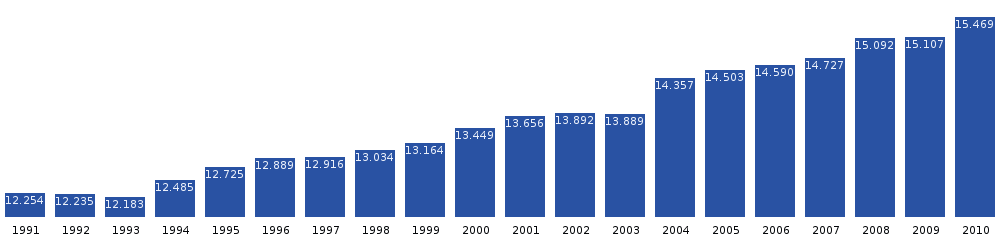

Nuuk population growth dynamics in the last two decades. Source: Statistics Greenland
And yet the boneheads at GISS think it is OK to cool the past there, and rewrite temperature history.
So not only is there a warming trend due to UHI/population growth, GISS dishonestly changes the past via homogenization and increases the temperature trend for Nuuk, and this goes on all through the Arctic. Recently such examples of blatant data dishonesty have been shown in New Zeland with the 7ss series, in Iceland with their data and in Australia where there’s a lawsuit build against BoM for this very reason.
If a stockbroker or investment firm pulled crap like this with performance data they’d be in jail.
Mr. Eadler, you can take and cite all the peer reviewed studies you want until you are blue in the face, but the fact is that data manipulations are going on, and the result is a trend greater than it would be due to lack of properly dealing with UHI issues, sattion issues, and homgenization. It stinks, and you are too weak minded (like many researchers) to care enough to look at what is being done to the base data, you are only interested in the results that fit your per-conceived notions. I’ve tossed you off WUWT before for constant mind-numbing trolling repeating the same things over and over again just like you are doing now. Why should I waste any more time on you, becaue I predict you won’t embrace any of what I’ve just shown you.
-Anthony
****
steven mosher says:
March 7, 2012 at 5:26 pm
if it were uhi then uha and rss would not match the land trend as they both do.
****
Doesn’t GHG theory predict more warming in the upper tropo than at the surface? If so, shouldn’t the surface trend be less than the avg troposphere’s? IIRC, something like 0.8 or so of the tropo’s trend?
Eric Adler says:
March 8, 2012 at 5:28 am
The heat capacity of the ocean is huge compared to the land. So the land will warm up faster then the ocean as a result of any heat flux imbalance.
That makes an excellent argument for just using sea surface temperatures to see what is going on with global temperatures lately. See the graphs below that shows no warming for 15 years and cooling for 10 years.
http://www.woodfortrees.org/plot/hadsst2gl/from:1990/plot/hadsst2gl/from:1997.08/trend/plot/hadsst2gl/from:2002.08/trend
Additionally, I think it has much to do with the Great Dying of the Thermometers. The Russians have asked pointedly why the coolest 40% of their weather stations (mostly in Siberia) have suddenly (since about ’96(?)) been excluded/ignored. No cogent answer has been offered. The remaining warm ones get extrapolated to “cover” the holes, of course. Same thing in northern Canada. And in the Andes. And …
My relatives in Helsinki will dispute that “warming” thing.
I’m comforted to find that my car and I are only heating the NH, where I live.
A big thank you to all who responded to my question.It seems human nature never changes,those that scream the loudest, get the most attention.