The sunspot number for February from SIDC is down again, to 33.1

Here’s the source of that data: http://sidc.oma.be/DATA/monthssn.dat
So far, cycle 24 is significantly lower in SSN number that the last three cycles, in addition to having a delayed start. While the delta of the drop in Feb 2012 is not unusual by itself, it is the lowest observed value of the last three cycles this far into a new cycle.
Compared to the entire data set back to 1749, which I’ve plotted below…

…it shows cycle 24 so far to be on par with cycle 12 and cycle 6 in amplitude.
While this drop in SSN number might appear to some as a signal for a possible peaking of cycle 24, there is other evidence that suggests otherwise. For example the Solar Polar Field Strength. Usually the polarity of the North and South solar hemispheres flips at solar max. As you can see in the graph we are close but not quite there yet. And, it has flattened out compared with previous recent transitions.

Source: http://wso.stanford.edu/gifs/Polar.gif
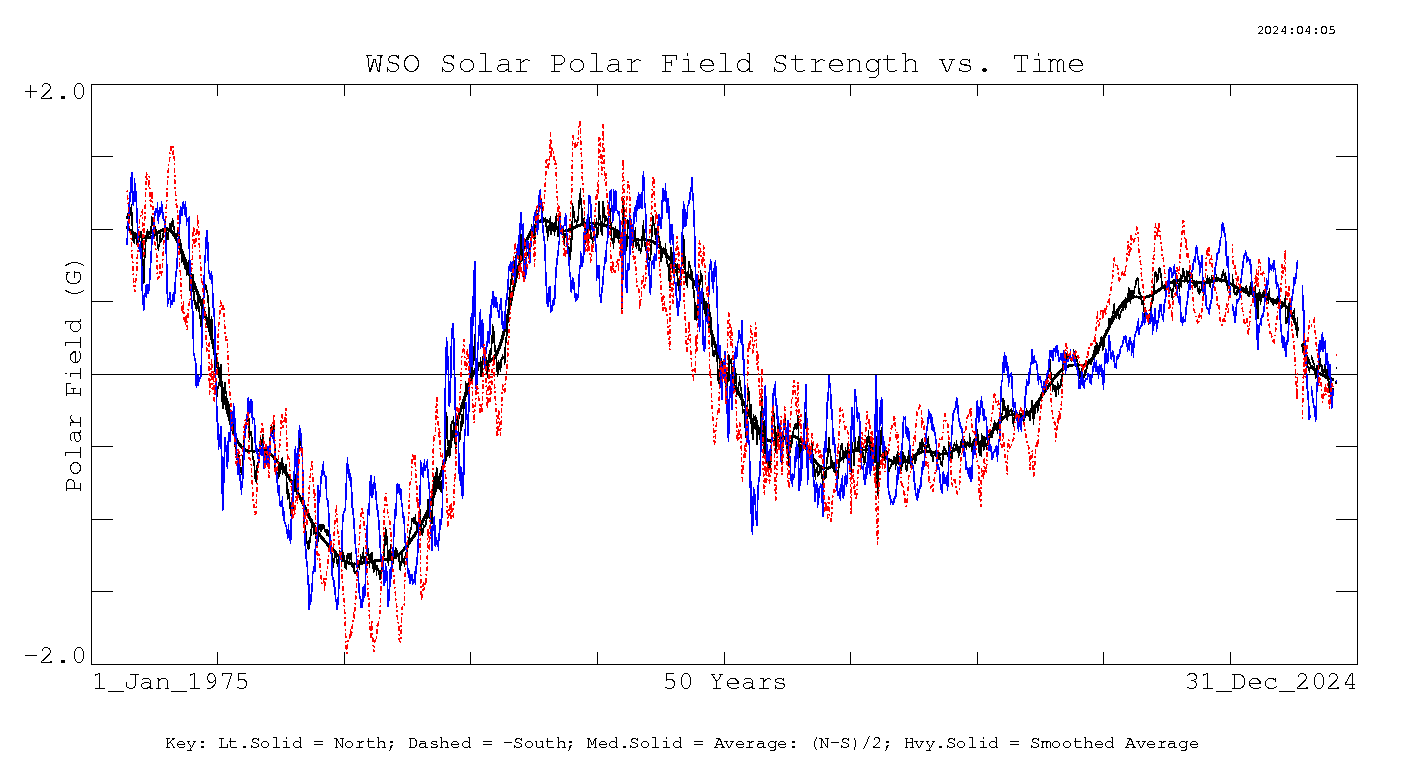
Leif Svalgaard also tracks this and here are a couple of his graphs:

Source: http://www.leif.org/research/Solar-Polar-Fields-1966-now.png


Source: http://www.leif.org/research/WSO-Polar-Fields-since-2003.png

Leif has previously suggested that he thinks for solar polar field will see the flip later 2012 or early 2013. We don’t have long to wait.
NOAA’s Space Weather Prediction Center (SWPC) has not yet updated their Solar Cycle Progression page, but will in a few days. In the meantime, here are the SSN and Ap index graphs manually updated with SIDC data to give you an idea of what they will look like compared to the forecast (in red):

The Ap Geomagnetic field index, just like the SSN, is down again, suggesting the sun’s magnetic dynamo is not winding up like it did near the peak of cycle 23 and previous cycles.

We live in interesting times.
John Day says:
March 2, 2012 at 5:15 pm
Exactly. There are more active regions now. The collective wise-crackers posting here seem to get in a lather whenever there is a peak or a trough of solar activity. Good grief. Look at the past cycles. The 30 day averages are not the same as the 13 month averages.
I have been following this topic at this website for years now and realize there is so much about this that I don’t understand. Can anyone Please recommend a good book to read that a layman can understand.
thanks mary
Henry@mer
Death from the Skies by Philip Plait was a good read
John Finn says:
March 2, 2012 at 12:52 pm
“I would suggest it’s the solarphiles who’ve painted themselves into a corner. We’ve had several years of low (relative to recent decades) solar activity and there has been no significant drop in UAH global temperatures.”
Atmospheric temperatures are experiencing step changes after significant La Niña / El Niño events. These events are discharges of stored energy imbalances; the imbalances accumulate over a decade – over the solar cycle before the event.
We see now the unwinding of the step change induced by the 1998 El Niño, being in a quasi-permanent La Niña. The last solar cycle was already weak, this lead to the current La Niña’s. But the current, even weaker cycle will lead to monster La Niña conditions 10 years from now.
If you think you’ve seen cooling – you ain’t seen nothing yet.
Liberty At’Stake says:
March 2, 2012 at 5:39 am
“So, the alarmists were right, after all … in the 70′s, when they were calling for the next ice age. They should have stuck with their original story. A lesson all crooks and grifters eventually learn the hard way.”
Those alarmists were the same people who later became Global Warming alarmists; Schneider and Hansen among them.Their defining characteristic is that they use EVERY possible scare to run the same kind of racket. The crooks and grifters, including the MSM, will switch effortlessly.
Der Spiegel for instance, always on the forefront of CAGW and sustainability and everything green, now decries the de-industrialization caused by extremely expensive and unreliable electricity. They operate without memory – they just produce a new narrative when the time is ripe. They do coordinate behind the scenes; google Journolist for an example, a now-defunct insider mailing list where leftist US journalists coordinated their narratives.
mer says, March 3, 2012 at 9:27 am
The Sun from Space (Second Edition) by Kenneth R Lang
Publisher: Springer; 2nd edition (4th Nov 2008)
ISBN: 978-3-540-76952-1
e-ISBN: 978-3-540-76953-8
I have no idea what any of this means, but It is among the most interesting of recent scientific observations. It gives one cause to get out of bed in the mornings; just to see where it is all leading.
And hopefully Dr Svalgaard will from time to time enlighten us on what it is all about (or appears to be).
Yes interesting times indeed.
Henry@Leif
It appears from some of my results that (the time of ) lower sunspot numbers coincides with the lowest temperatures in winter in the SH.
I am just picking up this,
might you perhaps have any idea as to why they could be a correlated?
HenryP says:
March 3, 2012 at 12:51 pm
It appears from some of my results that (the time of ) lower sunspot numbers coincides with the lowest temperatures in winter in the SH.
As you say: ‘coincidence’
David Archilbald predicted right here 3 or 4 years ago that SC24 would have a max SSN of 40 (Mean) he is so far spot on and everybody else has been way way off including Hathaway (150, originally), Svalgaard etc.
Dr. Svalgaard
Odd month of June in the CET land
– 350 years no temperature trend
– Highest spectral component at 22 yr (Hale cycle)
– 22 yr component increases in non-liner way with insolation
– and yet TSI has no significant 22 yr spectral component
Would this indicate that 22 yr input is not from TSI but from solar wind as a vector?
Any ideas?
http://www.vukcevic.talktalk.net/CET-adt.htm
See the above link for the relevant graphs.
Rogelio says: March 3, 2012 at 1:43 pm
……
except that SC24 max is at least 1-2 years away, unless you know otherwise.
MAVukcevic says:
March 3, 2012 at 2:03 pm
Would this indicate that 22 yr input is not from TSI but from solar wind as a vector?
Any ideas?
The solar wind had no influence on the climate, and in particular not its vector properties [sign of magnetic field]. No ideas needed.
MAVukcevic says:
March 3, 2012 at 2:03 pm
Would this indicate that 22 yr input is not from TSI but from solar wind as a vector?
The solar wind creates geomagnetic activity which has no strong 22-yr power:
http://www.leif.org/research/Ap-FFT.png
There is a weak 22-yr cycle in Ap, but it does not rise above the background noise using the [admittedly] poor FFT. If it had a climate influence it should, one would surmise.
Leif Svalgaard says
http://wattsupwiththat.com/2012/03/02/the-sun-is-still-in-a-funk-sunspot-numbers-are-dropping-when-they-should-be-rising/#comment-911776
No.
it is too much for a coincidence.
Is it not so that during low SSN there is more UV coming from the sun?
HenryP says:
March 3, 2012 at 9:43 pm
No. it is too much for a coincidence.
You can quantify that by statistical analysis, perhaps. Mere wishful thinking, hand waving or eyeballing ain’t enough
Is it not so that during low SSN there is more UV coming from the sun?
here is what we know about that: http://lasp.colorado.edu/sorce/news/2011ScienceMeeting/docs/presentations/1b_DeLand_Solar%20Cycle%20UV_NEW.pdf
The correlation of Low Sunspot Activity (and low solar activity) to colder climate does not necessarily mean that the Sun is the prime or lone source of causation.
After all, at the Galactic level, it is not yet known for certain why this Spiral Galaxy we call home is still in one piece. And that holds true for all the Spirals we have rotational gradient data for.
In both cases, we only know that it is so.
This proposed Dark Matter, and it’s counterpart Dark Energy, if that’s what it is that holds the Spirals together, might just be of a nature that it affects stellar activity as well. As in waves.
We cannot see or measure what holds the Milky Way together. Why should we presume to be able to see that which is affecting the Sun?
Leif Svalgaard says:
March 3, 2012 at 4:38 pm
…….
I have uploaded new composite spec (1880-2010), you might find it interesting:
http://www.vukcevic.talktalk.net/CET-adt.htm
(it appears that my ISP is doing some maintenance, so access is slow and intermittent at the moment).
MAVukcevic says:
March 4, 2012 at 4:01 am
I have uploaded new composite spec (1880-2010), you might find it interesting:
As I said, there is a weak 22-yr cycle, but it does not rise significantly above the background noise [there are lots of other peaks]. The dominant peak [which is significant is the normal solar cycle peak near 11 yr. If the solar wind is a driver, the 11-yr peak should be in the climate too.
MAVukcevic says:
March 4, 2012 at 4:01 am
I have uploaded new composite spec (1880-2010), you might find it interesting
Actually not.
The aa-index is the average of a northern aan index and a southern aas index. Here are the power spectra of those two separately http://www.leof.org/research/AaN-AaS-FFT.png
It is also not correct to call the 22-yr cycle in aa as a ‘Hale cycle’, as it has nothing to do with the Sun, but rather with the orientation of the Earth with respect to the Sun. If the Earth were in the equatorial plane of the Sun, there would be no 22-yr cycle in Aa.
LIef Svalgaard: Your link above is not loading. Perhaps it is incorrect. Ahh : that is why – – try http://www.leif.org/research/AaN-AaS-FFT.png Simple mis-spelling
By the way, you I believe that you have been far too kind to Hathaway and NASA about their horrid SunSpot Number Predictions … If it had not been for you and a precious few others sitting on the panel there, their predictions may have been over 200 due to their total misreading http://www.physorg.com/news86010302.html and they would likely have maintained that prediction for much longer than they did : In Nov 2008, Hathaway et al changed their scaling http://wattsupwiththat.com/2009/03/08/more-revisions-to-the-nasa-solar-cycle-prediction/ in an attempt to obfuscate the sudden revision from a 150 max to more like 100, and they have continually revised their prediction down since then.
Also, you have been too modest, I believe you made separate predictions.
I don’t recall exactly what your 2007 or so prediction was for this cycle, but I probably have it somewhere… possibly in the 90 area. I know the ~2007 predictions had bimodal distribution – some in the 150+, and other hump in the 80 range – using different prediction methods – I have a table of those saved somewhere but won’t look for it now. .The NASA group was absolutely wrong, and honestly, all their analysis now is not very convincing as a result. The prediction based on the planetary cycles is intriguingly good.
Of course – this whole post is based on a yet to be proven future – and that the maximum proves to be below 100 for Cycle24 – we’ll see.
@John from CA
@Andrew30 — this post may interest you both.
Leif – addendum to above note – if you can find it quickly, if there is a monthly average of AA data available, would you please link it?
Also – I wish I could edit my 10:00AM post to include that the planetary influence sunspot predictions for SC24 were made about 2004, which adds to the impressiveness of that feat.
Leif Svalgaard says
http://wattsupwiththat.com/2012/03/02/the-sun-is-still-in-a-funk-sunspot-numbers-are-dropping-when-they-should-be-rising/#comment-912083
I refer to page 18
Composite UV + Solstice
closely follows the low SSN
(below 200 nm)
But that implies less UV during low SSN?
Leif Svalgaard says: March 4, 2012 at 8:52 am
……………
Can’t win them all; still link for Aa North would be appreciated (thanks in advance).
Ken McCracken’s 10Be is something to admire:
http://www.vukcevic.talktalk.net/McCr.gif
It peaks around 60 years, so it should cheer up the 60yr-philes.
If you like to put something through this ‘spectrum mangle’ email file and I’l email back output data (best for input range up to 1k data points)
Ahh- Just found paper- Lief, Cliver and Kamide (2004) predicted SC24 to be max SSN of 75 +/- 8 in 2011. Significant miss (probably) in year due to the unexpectedly long SC23.