
By WUWT regular “Just The Facts”
Often in the climate debate, generalities are used to address more nuanced issues, e.g. “There is broad scientific consensus that Earth’s climate is warming rapidly and at an accelerating rate.” from the Wikipedia for Scientific Opinion on Climate Change. But is this true? Let’s take a look.
Global Surface Temperatures:
Generally, when referring to Earth’s “climate” warming, proponents of the Catastrophic Anthropogenic Global Warming (CAGW) narrative, refer to Earth’s Surface Temperature, e.g. “Global warming is the unusually rapid increase in Earth’s average surface temperature over the past century primarily due to the greenhouse gases released by people burning fossil fuels.” NASA Earth Observatory
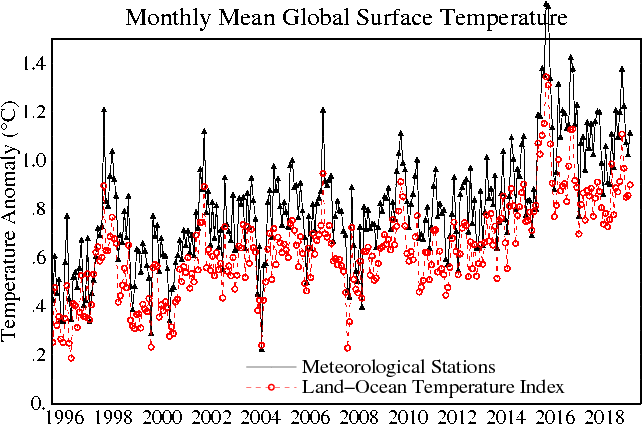
As such, here’s NASA’s Goddard Institute for Space Studies (GISS) Monthly Mean Surface Temperature Anomaly – 1996 to Present;
NOAA’s National Climate Data Center (NCDC) Annual Global Mean Temperature Anomaly Over Land & Sea – 1880 to Present;

the UK Met Office’s – Hadley Center – Climate Research Unit (CRU) Annual Global Average Land Temperature Anomaly – 1850 to Present;

and the UK Met Office – Hadley Center – Climate Research Unit (CRU) Monthly Global Average Land Temperature – 1850 to Present

Depending on the time frame, it certainly seems that Earth’s surface temperature has increased, though it does not appear to be “warming rapidly” and there are no indications of “an accelerating rate”. Furthermore, the surface temperature record is burdened with issues of questionable siting, changes in siting, changes in equipment, changes in the number of measurement locations, modeling to fill in gaps in measurement locations, corrections to account for missing, erroneous or biased measurements, and the urban heat island effect. Thus to see the big picture on the temperature Earth’s temperature, it helps to also look up.
Atmospheric Temperatures:
Since 1979 the temperature of Earth’s “climate” has also been measured via satellite. “The temperature measurements from space are verified by two direct and independent methods. The first involves actual in-situ measurements of the lower atmosphere made by balloon-borne observations around the world. The second uses intercalibration and comparison among identical experiments on different orbiting platforms. The result is that the satellite temperature measurements are accurate to within three one-hundredths of a degree Centigrade (0.03 C) when compared to ground-launched balloons taking measurements of the same region of the atmosphere at the same time.” NASA
The following are 4 Temperature Anomaly plots from Remote Sensing Systems (RSS), each one increases in altitude as is illustrated here:

RSS Temperature Lower Troposphere (TLT) – Brightness Temperature Anomaly- 1979 to Present;

RSS Temperature Middle Troposphere (TMT)- Brightness Temperature Anomaly- 1979 to Present;

RSS Temperature Troposphere / Stratosphere (TTS) -Brightness Temperature Anomaly- 1987 to Present;

RSS Temperature Lower Stratosphere (TLS) – Brightness Temperature Anomaly – 1979 to Present:

According to Remote Sensing Systems, “For Channel (TLT) (Lower Troposphere) and Channel (TMT) (Middle Troposphere), the anomaly time series is dominated by ENSO events and slow tropospheric warming. The three primary El Niños during the past 20 years are clearly evident as peaks in the time series occurring during 1982-83, 1987-88, and 1997-98, with the most recent one being the largest.” RSS
Also, the 2009 – 10 El Niño event is also called out on this RSS Latitudinal Temperature Lower Troposphere (TLT) Brightness Temperature Anomaly from 1979 to Present;

and the 1998 El Niño event, along with the tropospheric cooling attributed to the 1991 eruption of Mt Pinitubo, is called out on this University of Alabama – Hunstville (UAH) Lower Atmosphere Temperature Anomalies – 1979 to Present:

Note that in November the UAH Lower Atmosphere Temperature Anomaly was 0.12 degrees C above the 30 year average, and the RSS Lower Troposphere Brightness Temperature was 0.033 degrees C above the 30 year average. Keep this mind the next time you read that recent weather events were caused by Global Warming.

Furthermore, the Middle Troposphere, which follows a similar though flatter trend as the Lower Troposphere, recently dipped below the 30 year trend line i.e. RSS Temperature Middle Troposphere (TMT)- Brightness Temperature Anomaly- 1979 to Present:
There are also regional variations in Lower Troposphere that contribute nuance to the picture. For example, RSS Northern Polar Temperature Lower Troposphere (TLT) Brightness Temperature Anomaly;

shows a .338 K/C per decade increase, whereas the The RSS Southern Polar Temperature Lower Troposphere (TLT) Brightness Temperature Anomaly;

shows a .007 K/C per decade decrease. I am not aware of a compelling explanation for the significant divergence in temperature trends between the poles.
The satellite record seems to show slow warming of Lower and Middle Tropospheric temperatures, overlaid with the El Niño/La Niña Southern Oscillation (ENSO) cycle, including four comparatively large El Niño events. Lower Tropospheric temperatures appear to have flattened since the large El Niño in 1998 and offer no indication of “accelerating” warming.
Moving higher in the atmosphere, RSS Temperature Troposphere / Stratosphere (TTS) – Brightness Temperature Anomaly- 1987 to Present;
has been incredibly flat since, with a trend of just -.004 K/C per decade. The 1997-98 and 2009 – 10 El Niño events are still readily apparent in the plot, as is a spike from the 1991 eruption of Mt. Pinatubo. Note that the effect of Mt. Pinatubo is the opposite in the Lower and Middle Troposphere versus the Troposphere / Stratosphere (TTS), i.e. “Large volcanic eruptions inject sulfur gases into the stratosphere; the gases convert into submicron particles (aerosol) with an e-folding time scale of about 1 year. The climate response to large eruptions (in historical times) lasts for several (2-3) years. The aerosol cloud causes cooling at the Earth’s surface, warming in stratosphere.”
Ellen Thomas, PHD Wesleyan University
It is interesting that, incorporating the impact of three significant surface driven warming events, Troposphere / Stratosphere Temperatures (TTS) have been quite stable, however there is nuance to this as well.
RSS Northern Hemisphere Temperature Troposphere / Stratosphere (TTS) – Brightness Temperature Anomaly- 1987 to Present;

has been increasing by .054 K/C per decade, whereas the RSS Southern Hemisphere Temperature Troposphere / Stratosphere (TTS) – Brightness Temperature Anomaly- 1987 to Present;

has been decreasing by -.062 K/C per decade.
Moving higher still in the atmosphere, the RSS Temperature Lower Stratosphere (TLS) – Brightness Temperature Anomaly – 1979 to Present;
“is dominated by stratospheric cooling, punctuated by dramatic warming events caused by the eruptions of El Chichon (1982) and Mt Pinatubo (1991).” RSS
The eruptions of El Chichon and Mt Pinatubo are readily apparent in the Apparent Atmospheric Transmission of Solar Radiation at Mauna Loa, Hawaii:

“The stratosphere” … “in contrast to the troposphere, is heated, as the result of near infrared absorption of solar energy at the top of the aerosol cloud, and increased infra-red absorption of long-wave radiation from the Earth’s surface.”
“The stratospheric warming in the region of the stratospheric cloud increases the latitudinal temperature gradient after an eruption at low latitudes, disturbing the stratospheric-troposphere circulation, increasing the difference in height of the troposphere between high and low latitudes, and increasing the strength of the jet stream (polar vortex, especially in the northern hemisphere). This leads to warming during the northern hemisphere winter following a tropical eruption, and this warming effect tends to be larger than the cooling effect described above.” Ellen Thomas, PHD Wesleyan University
The Lower Stratosphere experienced “dramatic warming events caused by the eruptions of El Chichon (1982) and Mt Pinatubo (1991).” RSS “The long-term, global-mean cooling of the lower stratosphere stems from two downward steps in temperature, both of which are coincident with the cessation of transient warming after the volcanic eruptions of El Chichon and Mt. Pinatubo.” … “Here we provide observational analyses that yield new insight into three key aspects of recent stratospheric climate change. First, we provide evidence that the unusual step-like behavior of global-mean stratospheric temperatures is dependent not only upon the trend but also on the temporal variability in global-mean ozone immediately following volcanic eruptions. Second, we argue that the warming/cooling pattern in global-mean temperatures following major volcanic eruptions is consistent with the competing radiative and chemical effects of volcanic eruptions on stratospheric temperature and ozone. Third, we reveal the contrasting latitudinal structures of recent stratospheric temperature and ozone trends are consistent with large-scale increases in the stratospheric overturning Brewer-Dobson circulation” David W. J. Thompson Colorado State University
Above the Stratosphere we have the Mesosphere and Thermosphere, neither of which have I found current temperature time series for, but of note is that on “July 15, 2010” “A Puzzling Collapse of Earth’s Upper Atmosphere” occurred when “high above Earth’s surface where the atmosphere meets space, a rarefied layer of gas called “the thermosphere” recently collapsed and now is rebounding again.”

“This is the biggest contraction of the thermosphere in at least 43 years,” says John Emmert of the Naval Research Lab, lead author of a paper announcing the finding in the June 19th issue of the Geophysical Research Letters (GRL). “It’s a Space Age record.”
The collapse happened during the deep solar minimum of 2008-2009—a fact which comes as little surprise to researchers. The thermosphere always cools and contracts when solar activity is low. In this case, however, the magnitude of the collapse was two to three times greater than low solar activity could explain.
“Something is going on that we do not understand,” says Emmert.
The thermosphere ranges in altitude from 90 km to 600+ km. It is a realm of meteors, auroras and satellites, which skim through the thermosphere as they circle Earth. It is also where solar radiation makes first contact with our planet. The thermosphere intercepts extreme ultraviolet (EUV) photons from the sun before they can reach the ground. When solar activity is high, solar EUV warms the thermosphere, causing it to puff up like a marshmallow held over a camp fire. (This heating can raise temperatures as high as 1400 K—hence the name thermosphere.) When solar activity is low, the opposite happens.” NASA
In summary, Earth’s Lower and Middle Troposphere appear to have warmed slowly, overlaid with the El Niño/La Niña Southern Oscillation (ENSO) cycle, including four comparatively large El Niño events, and tempered by the cooling effects of the eruption of El Chichon (1982) and Mt Pinatubo (1991). Lower and Middle Tropospheric temperatures appear to have flattened since the large El Niño in 1998 and offer no indication of “accelerating” warming. Tropospheric / Stratospheric temperatures appear to have been influenced by at least three significant surface driven warming events, the 1997-98 El Niño, and the eruptions of El Chichon in 1982 and Mt Pinatubo in 1991, but to have maintained a stable overall trajectory. Stratospheric temperatures appear to have experienced two “dramatic warming events caused by the eruptions of El Chichon (1982) and Mt Pinatubo (1991).”, and “unusual step-like behavior of global-mean stratospheric temperatures” which has resulted in a significant stratospheric cooling during the last 30 years. Lastly, “during deep solar minimum of 2008-2009” “the biggest contraction of the thermosphere in at least 43 years” occurred and “The magnitude of the collapse was two to three times greater than low solar activity could explain.”
Ocean Temperatures:
“The oceans can hold much more heat than the atmosphere. Just the top 3.2 metres of ocean holds as much heat as all the world’s air.” Commonwealth of Australia – Parliamentary Library
As such, changes in Oceanic Oscillations, and Ocean Heat Content are critical to understanding “Earth’s Temperature”. Here is NOAA’s NODC Global Ocean Heat Content from 0-700 Meters – 1955 to Present;

and here is the same from Ole Humlum’s valuable climate data site Climate4you.com, NODC Global Ocean Heat Content – 0-700 Meters – 1979 to Present.

It seems apparent from the plots above that Global Ocean Heat has increased over the last several decades, however Global Ocean Heat doesn’t appear to be “warming rapidly”. Furthermore, there is no basis for the claim that warming is occurring at “an accelerating rate”. Decelerating would appear a more accurate label.
Ice:
A proxy often cited when measuring “Earth’s Temperature” is amount of Ice on Earth. According to the United States Geographical Survey (USGS), “The vast majority, almost 90 percent, of Earth’s ice mass is in Antarctica, while the Greenland ice cap contains 10 percent of the total global ice mass.” http://ga.water.usgs.gov/edu/watercycleice.html However, there is currently there is no generally accepted measure of ice volume, as Cryosat is still in validation and the accuracy of measurements from Grace are still being challenged.
As such, currently available global ice measurements are limited. Here is 20 Year Northern Hemisphere Snowcover with 1995 – 2009 Climatology

and here is Northern Hemisphere Winter Snow Extent – 1967 to Present:

While neither plot offers a global perspective, when looking at the Northern Hemisphere, there appears to have been a slight increase in Snowcover and Winter Snow Extent over the historical record.
Another ice based variable often cited as a proxy for “Earth’s Temperature” is Sea Ice Area, however there is significant evidence that the primary agent of change in Sea Ice Area is in fact wind and Atmospheric Oscillations. With this said, here are Global, Arctic & Antarctic Sea Ice Area from 1979 to Present;

Northern Hemisphere Sea Ice Area Anomaly, 1979 to Present;

Southern Hemisphere Sea Ice Area Anomaly, 1979 to Present;

and Global Sea Ice Area Anomaly – 1979 to Present:

There does appear to have been a negative trend in Northern Hemisphere Sea Ice Area, however there also appears to have been a positive trend in Southern Hemisphere Sea Ice Area. The resultant Global Sea Ice Area trend appears to be slightly negative, with no apparent acceleration. Based on the limited Global Ice measurements available, and noting the questionable value of Sea Ice Area as a proxy for temperature, not much inference can currently be drawn from Earth’s Ice measurements. However, there does not appear to be any evidence in Earth’s Ice measurements of rapid and/or accelerating warming.
Conclusion:
“Earth’s Temperature” appears to have increased during the last several decades, but there does not appear to be evidence that Earth’s climate is “warming rapidly”. Furthermore, there are no apparent signs of warming occurring “at an accelerating rate”.
Additional information on “Earth’s Temperature” can be found in the WUWT Reference Pages, including the Global Temperature Page and Global Climatic History Page
I hadn’t looked at the GISS chart in many moons, assuming that the integrity of someone with a growing arrest record might also extend into his data manipulation. Given that Hadley, UAH, and RSS all show 1998 as the last year of the Holocene, I’m not disappointed to find Dr H has doctored up three more years to be warmer. He’s had to be more selective in his station homogenization technique lately, throwing out a few Siberian stations and tossing in a few from Venus.
“A website should only be as credible as the information that it provides. Can you identify any error or omission in the article?”
Thank you. Names are little more than fodder for ‘appeals to authority’. This name is better than that name. Asking the name of the messenger is usually done by someone with a loaded gun in hand.
An atmosphere of ‘fear and repression’? Well, fear and loathing is more like it. When it becomes more widely known that the gas industry players, like Enron were financing CAGW propaganda through hirelings, the public may quite suddenly turn on those businesses hoping to profit from a diminution of the value of coal and oil and a global carbon tax. Plus the whole carbon futures trading scene. Ah, how the plans of mice and men are brought to naught.
Carry on messenger. Knowledge shared is a virtuous.
Nice article. Should add sea level changes to the presentation as well.
Just the Facts,
Thanks for the informative post and genteel manner, but as wermet more softly implied: hotlinking is rude. Just because it usually “works” doesn’t make it right.
http://climate-change-theory.com says:
January 1, 2012 at 7:16 pm
BTW, it would be good if we could insert HTML code in posts and have a preview as on SkS for example.
I have been using “greasemonkey”, an add on facility provided for/by Climate Audit which works here also, and gives the ability to use some html easily and a preview if asked.
Statements to keep in skepical tool kit regarding AGW:
‘accelerating rate’
‘rapidly accelerating rate’
‘ever accelerating rate’ (yes I have heard this one, which is physically impossible)
‘its worse than we thought’
‘unsustainable’ (how about useful, until we use something else)
‘environmentally unsustainable’
‘the rivers/forests/oceans/coral reefs are dying’ (how can a river die, actually, when it isnt alive in the first place?)
etc
So, if something is said to be environmentally unsustainable, occuring at an ever accelerating rate that is worse than we thought, and causing the rivers/oceans/forests/coral reefs/ to die, you can be sure the lunatics are running the asylum.
In 2008, I did some work using Surface Temperature (ST) and Satellite Temperature Lower Troposphere (LT) data.
I primarily used Hadcrut3 ST data and UAH LT data. Some of this data can be seen at
http://icecap.us/images/uploads/CO2vsTMacRae.pdf
There appears to be a significant warming bias of about 0.15C to 0.2C in ~30 years in the Hadcrut3 ST data, or about 0.05C to 0.07C per decade.
I would not use any ST data for serious analysis – ST coverage is sporadic, the data is often corrupted by poor instrument siting, and the satellite LT data has been independently verified by weather balloon radiosonde data.
When examining the UAH Lower Atmosphere temperature data as displayed in this article, and also recent solar activity (or lack thereof), it appears probable that Earth is exiting a naturally-caused warming half-cycle of ~30 years and is entering a cooling cycle that could also last several decades.
Let’s see if my prediction of imminent global cooling stands against all the dire predictions of runaway global warming from the IPCC and its acolytes.
BTW, I made this global cooling prediction in an article published in 2003.
Let’s compare track records:
To date, not one of the IPCC’s dire predictions of global warming and extreme weather have proven correct. To suggest otherwise is to rely upon clearly inferior data.
In 2002, I made 8 predictions related to the flawed Kyoto Protocol that have all proven correct to date.
Based on track record alone, I’d suggest that Earth’s immediate future is more likely to encounter global cooling rather than global warming.
I’m much more concerned about future food production shortfalls due to natural global cooling than any of the IPCC’s dire predictions related to global warming.
What i find rather interesting is in every thread recently there are a few posts and then a heavy IPCC following information line from one poster.. Strange that this same poster then wants real names of those delivering data and thoughts to the conversation which continue to rip apart the Global warming lie.
why would a scientist want names of those who disagree with them? what purpose would that serve? considering the history of intimidation, defunding, removal from staff, and other bully tactics used by the global warming alarmists I find this disturbing… now they are coming where discussion is actually happening and attempting the same thing.. to silence it…
instead of addressing the facts of the matter they are concerned with who is saying it….
The attacks on WUWT are now beginning… please dont give them what they want…
Here’s more information on the latest at GISS:
Here’s what I’ve detected from the new data:
The revised data in the new link has been adjusted upward within the current year, most notably in the four preceding months of July thru Oct. They were/are:
July 59/65
Aug. 61/65
Sep. 48/50
Oct. 54/55
The total anomaly for the first six months of the year is 292 under both methods, or a monthly average of 48.7.
The yearly figures for 2006 thru 2011 (6 years) are unchanged. The old/new figures for the earlier years in the noughties are:
2000 33/35 (Up 2 points)
2001 47/48 (Up 1 point)
2002 56/57 (Up 1 point)
2003 55/56 (Up 1 point)
2004 48/49 (Up 1 point)
2005 63/62 (The only decline in this group: 1 point)
Just The Facts,
Good Greetings,
In your third HadCrut figure please note that they use a 21-point or if you like, 20-year centre point smoothing that is rather unusual. (like GISS use 5 year smoothing). Notice that the final 10 years are depicted as a broken line which does not sensibly match what to me, an engineer, I can see in the trend of the raw data, or, put more bluntly, it is imaginative self serving crap. The background is that with a 20-year CPA smoothing, at the end of the available time series data you need an additional 10 years into the future to compute the 21-point smoothing to the end, which is impossible. So, what do they do? They make it up to what they would like it to be.
For more whoopsey information, see:
http://www.metoffice.gov.uk/hadobs/hadcrut3/smoothing.html
Rab McDowell says:
January 1, 2012 at 6:58 pm
WUWT is one of the most respected climate sites because of its credibility. I note that Justthefacts is a regular contributor and often posts quite technical information.
Two questions
Given that he is not prepared to put his name to his contributions, what credibility can I put on his work?
What credibility can I put on a website that publishes supposedly informed comment without informing us who the poster is?
______________________________________________________________
interestingly you want names… or you wont discuss the facts? why?
do not the facts speak for themselves? or is it you feel that someone who is beneath you shouldn’t be able to speak? this is a position that the IPCC and Climategate emails exposed in the game of who is the bigger bully…
the facts deny the “rapid” warming.. yet you dont want to discuss them… then to attack WUWT because they put out the facts for discussion.. all because YOU want a name….. how about we address the facts…. and stop the stupid game…
Just an opinon from someone who is tired of the liberal control games
As more and more years pass with no return to the halcyon days of rapid warming that characterized the end of the 20th century, more and more people of the 21st century are starting to drift away from the fear-mongery of the AGW alarmism movement.
Every month seems to bring more bad news for the warmists, and even politicians are starting to back away from the panic-stricken carbon strangulation policies so vehemently touted by special interest groups.
At some point those in the van of the AGW credo will have to follow Scheer’s example and perform their own Gefechtskehrtwendung to try to save their careers from the onslaught.
Well JTF, I am having a bit of difficulty assimilating my body to your graph scales. The first one for example, from NASA GISS shows ther Temperature wildly gyrating all over the map; yet I have no memories of my comfort having reacted in any such fashion over the years.
Perhaps you could redraw your graphs, using a more realistic Temperature scale; something that one might observe on an ordinary thermometer for example, which we are all familiar with.
I hesitate to suggest a scale referenced to zero Kelvins, since I have never actually experienced anything near that point, so I wouldn’t be able to put it in context.
Perhaps if you used a scale that ranged from the lowest (peer reviewed) earth surface Temperature to the highest (peer reviewed) earth surface Temperature, then we could put your graphs in proper perspective. You could use round numbers for the limits, which would then be from about -90 deg C to + 60 deg C. Temperatures over almost all of that range can always be found somewhere on earth at the same time; at least at the midwinter/midsummer times when the range is largest.
I think I could then see your graph data in a more realistic light. I know that I have personally experienced earth surface Temperatures at or above that max number; but I can’t say I have ever been below about half of the minimum number; but the major concern seems to be the high Temperatures anyway.
That would give your thesis a more hands on feeling that ordinary lay folks coud appreciate.
Ric Werme says: January 1, 2012 at 7:19 pm
Copy the images to wattsupwiththat.com is what I’d do. I can probably help, at least I think I can get images up that you can use.
I have had no luck in accomplishing this, your assistance, as well as a brief tutorial would be most appreciated.
justthefactswuwt says:
January 1, 2012 at 9:09 pm
Ric Werme says: January 1, 2012 at 7:19 pm
Copy the images to wattsupwiththat.com is what I’d do. I can probably help, at least I think I can get images up that you can use.
I have had no luck in accomplishing this, your assistance, as well as a brief tutorial would be most appreciated.
___________________________________________________
easier method…
Use the windows snipping tool and save the original window/graph as a Jpeg.. post it here as the base file to be seen and hyperlink it to the source…. that way the data can be seen and the source verified..
Bill
Warming? What warming? Hialeah FL (Miami) forecast for later this week is MINUS 80 degrees.
http://classic.wunderground.com/cgi-bin/findweather/getForecast?query=33010&hourly=1&yday=5&weekday=Friday
The issue should be credibility-that and competence. How hard could it possibly be for the NDFD have parameters programmed into it to reject (or at least flag) such obscenely erroneous results.
Bill H says: January 1, 2012 at 9:21 pm
easier method…
Use the windows snipping tool and save the original window/graph as a Jpeg.. post it here as the base file to be seen and hyperlink it to the source…. that way the data can be seen and the source verified..
Ok, so I did that for the first two RSS graphs and while it worked, the graphs/images are now blurry. I uploaded the TLT graph “Full Size” into WordPress, so I am not sure what I can do to avoid the blurriness. Any thoughts?
justthefactswuwt says:
January 1, 2012 at 9:48 pm
unfortunately size matters… reduce the overall size of the image and the blur will go away. or enlarge the image before snipping and save the bigger size. you can open JPEG’s in windows photo manager and sharpen the image as well..
its a bit cumbersome, i admit… but it works where i post data and images as well..
Bill
Jim Carson says: January 1, 2012 at 8:21 pm (Edit)
hotlinking is rude
I can see why hotlinking can cause issues in certain circumstances, such as RSS’, however in general, wouldn’t most data providers prefer hotlinks so that they can effectively track and measure usage of their data products?
justthefactswuwt says:
January 1, 2012 at 9:48 pm
Open PNG in web browser… ZOOM IN to size you want.. Snip the image and save JPEG.
sizing downward will prevent blur…
justthefactswuwt @ur momisugly January 1, 2012 at 9:09 pm
It’s late here in New Hampshire, I’ll poke around tomorrow. I won’t be able to edit your post, drop me a note via http://wermenh.com/contact.html , no need to clutter the dialog here.
George E. Smith; says: January 1, 2012 at 8:56 pm (Edit)
Well JTF, I am having a bit of difficulty assimilating my body to your graph scales.
Perhaps you could redraw your graphs, using a more realistic Temperature scale; something that one might observe on an ordinary thermometer for example, which we are all familiar with.
Perhaps if you used a scale that ranged from the lowest (peer reviewed) earth surface Temperature to the highest (peer reviewed) earth surface Temperature, then we could put your graphs in proper perspective. You could use round numbers for the limits, which would then be from about -90 deg C to + 60 deg C.
I think I could then see your graph data in a more realistic light. I know that I have personally experienced earth surface Temperatures at or above that max number; but I can’t say I have ever been below about half of the minimum number; but the major concern seems to be the high Temperatures anyway.</i<
That would give your thesis a more hands on feeling that ordinary lay folks coud appreciate.
But they’re not “my graphs” they are linked directly from their sources, hence the variations in graph scales, structures, etc. Please feel free to direct your graphing critiques directly to the sources, i.e.:
Cryosphere Today – Arctic Climate Research at the University of Illinois:
Home Page – http://arctic.atmos.uiuc.edu/
Products Page – http://arctic.atmos.uiuc.edu/cryosphere/
Images Indexed By Date – http://arctic.atmos.uiuc.edu/cryosphere/IMAGES/
DrRoySpencer.com – Dr. Roy Spencer
Home Page – http://www.drroyspencer.com/
Current Temperature Page – http://www.drroyspencer.com/latest-global-temperatures/
Uploads Page – http://www.drroyspencer.com/wp-content/uploads/
climate4you.com – Ole Humlum
Home Page -http://climate4you.com/
Ole Humlum Bibliography – http://climate4you.com/Text/BIBLIOGRAPHY%20OLE%20HUMLUM.pdf
Met Office – Hadley Center
Home Page – http://www.metoffice.gov.uk/
Products Page – http://www.metoffice.gov.uk/hadobs/
Global Temperature Products Page – Products Page – http://www.metoffice.gov.uk/hadobs/hadcrut3/diagnostics/comparison.html
National Oceanic & Atmospheric Administration (NOAA) – Climate Prediction Center (CPC)
Home Page – http://www.cpc.ncep.noaa.gov/
Products Page – http://www.cpc.ncep.noaa.gov/products/
Monitoring and Data Products Page – http://www.cpc.ncep.noaa.gov/products/MD_index.shtml
Atmospheric & SST Indices Page – http://www.cpc.ncep.noaa.gov/data/indices/
Regional Climate Maps – http://www.cpc.ncep.noaa.gov/products/analysis_monitoring/regional_monitoring/
Monitoring and Data Page – http://www.cpc.ncep.noaa.gov/products/monitoring_and_data/
FTP Page – ftp://ftp.cpc.ncep.noaa.gov/
National Oceanic and Atmospheric Administration (NOAA) – National Climatic Data Center (NCDC)
Home Page – http://www.ncdc.noaa.gov/oa/about/about.html?bandwidth=high
Products Page – http://www.ncdc.noaa.govgov/oa/ncdc.html?bandwidth=high
FTP Page – http://www1.ncdc.noaa.gov/pub/data/cmb/?bandwidth=high
National Aeronautics and Space Administration (NASA) Goddard Institute for Space Studies (GISS)
Home Page – http://data.giss.nasa.gov/gistemp/
Products – http://data.giss.nasa.gov/
National Oceanic & Atmospheric Administration – (NOAA) – National Oceanographic Data Center (NODC)
Home Pagehttp://www.nodc.noaa.gov/
Products Page – http://www.nodc.noaa.gov/General/NODC-About/NODC-Major-Products.html
Data Page – http://www.nodc.noaa.gov/General/getdata.html
Heat Content Page – http://www.nodc.noaa.gov/OC5/3M_HEAT_CONTENT/
Remote Sensing Systems (RSS)
Home Page – http://ssmi.com/?bandwidth=high
MSU Page – http://ssmi.com/msu/msu_browse.html?bandwidth=high
MSU FTP Page – ftp://ftp.ssmi.com/msu/?bandwidth=high
FTP Page – ftp://ftp.ssmi.com/?bandwidth=high
Rutgers University – Global Snow Lab (GSL)
Home Page – http://climate.rutgers.edu/snowcover/index.php?bandwidth=high
Products Page – http://climate.rutgers.edu/snowcover/chart_seasonal.php?ui_set=eurasia&ui_season=1?bandwidth=high
alcheson says: January 1, 2012 at 8:12 pm
Should add sea level changes to the presentation as well.
I thought about it, but was worried that I was getting too wide-ranging. According to the IPCC, as referenced by the NSIDC;
“Global sea level is currently rising as a result of both ocean thermal expansion and glacier melt, with each accounting for about half of the observed sea level rise, and each caused by recent increases in global mean temperature. For the period 1961-2003, the observed sea level rise due to thermal expansion was 0.42 millimeters per year and 0.69 millimeters per year due to total glacier melt (small glaciers, ice caps, ice sheets) (IPCC 2007). Between 1993 and 2003, the contribution to sea level rise increased for both sources to 1.60 millimeters per year and 1.19 millimeters per year respectively (IPCC 2007).”
http://nsidc.org/sotc/sea_level.html
Global Mean Sea Level Change – 1993 to Present:
http://climate4you.com/images/UnivColorado%20MeanSeaLevelSince1992%20With1yrRunningAverage.gif
Global Mean Sea Level Change Map with a “Correction” of 0.3 mm/year added May, 5th 2011, due to a “Glacial Isostatic Adjustment (GIA)” – 1993 to Present:
http://sealevel.colorado.edu/files/2011_rel4/sl_ns_global.png
Global Mean Sea Level Change Graph with a “Correction” of 0.3 mm/year added May, 5th 2011, due to a “Glacial Isostatic Adjustment (GIA)” – 1993 to Present:
http://sealevel.colorado.edu/files/current/sl.jpg
I will include Sea Level in the next version of this article.
Isn’t soot also playing a role in sea ice cover or is it not possible to give a good estimate of it’s effect? I remember there was an article here on soot in the past.
justthefactswuwt: Image problems? Be sure to turn off all settings such as Clear Type or text/image smoothing both on the desktop settings and in Advanced Settings within the browser. See if the blurring does not disappear. If clipping from PDFs, Adobe Reader also has such a setting. That has worked for me before to get a pixel-by-pixel copy.