
By WUWT regular “Just The Facts”
Often in the climate debate, generalities are used to address more nuanced issues, e.g. “There is broad scientific consensus that Earth’s climate is warming rapidly and at an accelerating rate.” from the Wikipedia for Scientific Opinion on Climate Change. But is this true? Let’s take a look.
Global Surface Temperatures:
Generally, when referring to Earth’s “climate” warming, proponents of the Catastrophic Anthropogenic Global Warming (CAGW) narrative, refer to Earth’s Surface Temperature, e.g. “Global warming is the unusually rapid increase in Earth’s average surface temperature over the past century primarily due to the greenhouse gases released by people burning fossil fuels.” NASA Earth Observatory
As such, here’s NASA’s Goddard Institute for Space Studies (GISS) Monthly Mean Surface Temperature Anomaly – 1996 to Present;
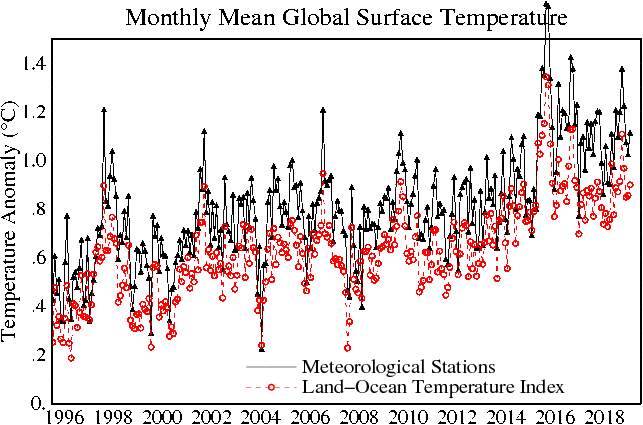
NOAA’s National Climate Data Center (NCDC) Annual Global Mean Temperature Anomaly Over Land & Sea – 1880 to Present;

the UK Met Office’s – Hadley Center – Climate Research Unit (CRU) Annual Global Average Land Temperature Anomaly – 1850 to Present;

and the UK Met Office – Hadley Center – Climate Research Unit (CRU) Monthly Global Average Land Temperature – 1850 to Present

Depending on the time frame, it certainly seems that Earth’s surface temperature has increased, though it does not appear to be “warming rapidly” and there are no indications of “an accelerating rate”. Furthermore, the surface temperature record is burdened with issues of questionable siting, changes in siting, changes in equipment, changes in the number of measurement locations, modeling to fill in gaps in measurement locations, corrections to account for missing, erroneous or biased measurements, and the urban heat island effect. Thus to see the big picture on the temperature Earth’s temperature, it helps to also look up.
Atmospheric Temperatures:
Since 1979 the temperature of Earth’s “climate” has also been measured via satellite. “The temperature measurements from space are verified by two direct and independent methods. The first involves actual in-situ measurements of the lower atmosphere made by balloon-borne observations around the world. The second uses intercalibration and comparison among identical experiments on different orbiting platforms. The result is that the satellite temperature measurements are accurate to within three one-hundredths of a degree Centigrade (0.03 C) when compared to ground-launched balloons taking measurements of the same region of the atmosphere at the same time.” NASA
The following are 4 Temperature Anomaly plots from Remote Sensing Systems (RSS), each one increases in altitude as is illustrated here:

RSS Temperature Lower Troposphere (TLT) – Brightness Temperature Anomaly- 1979 to Present;

RSS Temperature Middle Troposphere (TMT)- Brightness Temperature Anomaly- 1979 to Present;

RSS Temperature Troposphere / Stratosphere (TTS) -Brightness Temperature Anomaly- 1987 to Present;

RSS Temperature Lower Stratosphere (TLS) – Brightness Temperature Anomaly – 1979 to Present:

According to Remote Sensing Systems, “For Channel (TLT) (Lower Troposphere) and Channel (TMT) (Middle Troposphere), the anomaly time series is dominated by ENSO events and slow tropospheric warming. The three primary El Niños during the past 20 years are clearly evident as peaks in the time series occurring during 1982-83, 1987-88, and 1997-98, with the most recent one being the largest.” RSS
Also, the 2009 – 10 El Niño event is also called out on this RSS Latitudinal Temperature Lower Troposphere (TLT) Brightness Temperature Anomaly from 1979 to Present;

and the 1998 El Niño event, along with the tropospheric cooling attributed to the 1991 eruption of Mt Pinitubo, is called out on this University of Alabama – Hunstville (UAH) Lower Atmosphere Temperature Anomalies – 1979 to Present:

Note that in November the UAH Lower Atmosphere Temperature Anomaly was 0.12 degrees C above the 30 year average, and the RSS Lower Troposphere Brightness Temperature was 0.033 degrees C above the 30 year average. Keep this mind the next time you read that recent weather events were caused by Global Warming.

Furthermore, the Middle Troposphere, which follows a similar though flatter trend as the Lower Troposphere, recently dipped below the 30 year trend line i.e. RSS Temperature Middle Troposphere (TMT)- Brightness Temperature Anomaly- 1979 to Present:
There are also regional variations in Lower Troposphere that contribute nuance to the picture. For example, RSS Northern Polar Temperature Lower Troposphere (TLT) Brightness Temperature Anomaly;

shows a .338 K/C per decade increase, whereas the The RSS Southern Polar Temperature Lower Troposphere (TLT) Brightness Temperature Anomaly;

shows a .007 K/C per decade decrease. I am not aware of a compelling explanation for the significant divergence in temperature trends between the poles.
The satellite record seems to show slow warming of Lower and Middle Tropospheric temperatures, overlaid with the El Niño/La Niña Southern Oscillation (ENSO) cycle, including four comparatively large El Niño events. Lower Tropospheric temperatures appear to have flattened since the large El Niño in 1998 and offer no indication of “accelerating” warming.
Moving higher in the atmosphere, RSS Temperature Troposphere / Stratosphere (TTS) – Brightness Temperature Anomaly- 1987 to Present;
has been incredibly flat since, with a trend of just -.004 K/C per decade. The 1997-98 and 2009 – 10 El Niño events are still readily apparent in the plot, as is a spike from the 1991 eruption of Mt. Pinatubo. Note that the effect of Mt. Pinatubo is the opposite in the Lower and Middle Troposphere versus the Troposphere / Stratosphere (TTS), i.e. “Large volcanic eruptions inject sulfur gases into the stratosphere; the gases convert into submicron particles (aerosol) with an e-folding time scale of about 1 year. The climate response to large eruptions (in historical times) lasts for several (2-3) years. The aerosol cloud causes cooling at the Earth’s surface, warming in stratosphere.”
Ellen Thomas, PHD Wesleyan University
It is interesting that, incorporating the impact of three significant surface driven warming events, Troposphere / Stratosphere Temperatures (TTS) have been quite stable, however there is nuance to this as well.
RSS Northern Hemisphere Temperature Troposphere / Stratosphere (TTS) – Brightness Temperature Anomaly- 1987 to Present;

has been increasing by .054 K/C per decade, whereas the RSS Southern Hemisphere Temperature Troposphere / Stratosphere (TTS) – Brightness Temperature Anomaly- 1987 to Present;

has been decreasing by -.062 K/C per decade.
Moving higher still in the atmosphere, the RSS Temperature Lower Stratosphere (TLS) – Brightness Temperature Anomaly – 1979 to Present;
“is dominated by stratospheric cooling, punctuated by dramatic warming events caused by the eruptions of El Chichon (1982) and Mt Pinatubo (1991).” RSS
The eruptions of El Chichon and Mt Pinatubo are readily apparent in the Apparent Atmospheric Transmission of Solar Radiation at Mauna Loa, Hawaii:

“The stratosphere” … “in contrast to the troposphere, is heated, as the result of near infrared absorption of solar energy at the top of the aerosol cloud, and increased infra-red absorption of long-wave radiation from the Earth’s surface.”
“The stratospheric warming in the region of the stratospheric cloud increases the latitudinal temperature gradient after an eruption at low latitudes, disturbing the stratospheric-troposphere circulation, increasing the difference in height of the troposphere between high and low latitudes, and increasing the strength of the jet stream (polar vortex, especially in the northern hemisphere). This leads to warming during the northern hemisphere winter following a tropical eruption, and this warming effect tends to be larger than the cooling effect described above.” Ellen Thomas, PHD Wesleyan University
The Lower Stratosphere experienced “dramatic warming events caused by the eruptions of El Chichon (1982) and Mt Pinatubo (1991).” RSS “The long-term, global-mean cooling of the lower stratosphere stems from two downward steps in temperature, both of which are coincident with the cessation of transient warming after the volcanic eruptions of El Chichon and Mt. Pinatubo.” … “Here we provide observational analyses that yield new insight into three key aspects of recent stratospheric climate change. First, we provide evidence that the unusual step-like behavior of global-mean stratospheric temperatures is dependent not only upon the trend but also on the temporal variability in global-mean ozone immediately following volcanic eruptions. Second, we argue that the warming/cooling pattern in global-mean temperatures following major volcanic eruptions is consistent with the competing radiative and chemical effects of volcanic eruptions on stratospheric temperature and ozone. Third, we reveal the contrasting latitudinal structures of recent stratospheric temperature and ozone trends are consistent with large-scale increases in the stratospheric overturning Brewer-Dobson circulation” David W. J. Thompson Colorado State University
Above the Stratosphere we have the Mesosphere and Thermosphere, neither of which have I found current temperature time series for, but of note is that on “July 15, 2010” “A Puzzling Collapse of Earth’s Upper Atmosphere” occurred when “high above Earth’s surface where the atmosphere meets space, a rarefied layer of gas called “the thermosphere” recently collapsed and now is rebounding again.”

“This is the biggest contraction of the thermosphere in at least 43 years,” says John Emmert of the Naval Research Lab, lead author of a paper announcing the finding in the June 19th issue of the Geophysical Research Letters (GRL). “It’s a Space Age record.”
The collapse happened during the deep solar minimum of 2008-2009—a fact which comes as little surprise to researchers. The thermosphere always cools and contracts when solar activity is low. In this case, however, the magnitude of the collapse was two to three times greater than low solar activity could explain.
“Something is going on that we do not understand,” says Emmert.
The thermosphere ranges in altitude from 90 km to 600+ km. It is a realm of meteors, auroras and satellites, which skim through the thermosphere as they circle Earth. It is also where solar radiation makes first contact with our planet. The thermosphere intercepts extreme ultraviolet (EUV) photons from the sun before they can reach the ground. When solar activity is high, solar EUV warms the thermosphere, causing it to puff up like a marshmallow held over a camp fire. (This heating can raise temperatures as high as 1400 K—hence the name thermosphere.) When solar activity is low, the opposite happens.” NASA
In summary, Earth’s Lower and Middle Troposphere appear to have warmed slowly, overlaid with the El Niño/La Niña Southern Oscillation (ENSO) cycle, including four comparatively large El Niño events, and tempered by the cooling effects of the eruption of El Chichon (1982) and Mt Pinatubo (1991). Lower and Middle Tropospheric temperatures appear to have flattened since the large El Niño in 1998 and offer no indication of “accelerating” warming. Tropospheric / Stratospheric temperatures appear to have been influenced by at least three significant surface driven warming events, the 1997-98 El Niño, and the eruptions of El Chichon in 1982 and Mt Pinatubo in 1991, but to have maintained a stable overall trajectory. Stratospheric temperatures appear to have experienced two “dramatic warming events caused by the eruptions of El Chichon (1982) and Mt Pinatubo (1991).”, and “unusual step-like behavior of global-mean stratospheric temperatures” which has resulted in a significant stratospheric cooling during the last 30 years. Lastly, “during deep solar minimum of 2008-2009” “the biggest contraction of the thermosphere in at least 43 years” occurred and “The magnitude of the collapse was two to three times greater than low solar activity could explain.”
Ocean Temperatures:
“The oceans can hold much more heat than the atmosphere. Just the top 3.2 metres of ocean holds as much heat as all the world’s air.” Commonwealth of Australia – Parliamentary Library
As such, changes in Oceanic Oscillations, and Ocean Heat Content are critical to understanding “Earth’s Temperature”. Here is NOAA’s NODC Global Ocean Heat Content from 0-700 Meters – 1955 to Present;

and here is the same from Ole Humlum’s valuable climate data site Climate4you.com, NODC Global Ocean Heat Content – 0-700 Meters – 1979 to Present.

It seems apparent from the plots above that Global Ocean Heat has increased over the last several decades, however Global Ocean Heat doesn’t appear to be “warming rapidly”. Furthermore, there is no basis for the claim that warming is occurring at “an accelerating rate”. Decelerating would appear a more accurate label.
Ice:
A proxy often cited when measuring “Earth’s Temperature” is amount of Ice on Earth. According to the United States Geographical Survey (USGS), “The vast majority, almost 90 percent, of Earth’s ice mass is in Antarctica, while the Greenland ice cap contains 10 percent of the total global ice mass.” http://ga.water.usgs.gov/edu/watercycleice.html However, there is currently there is no generally accepted measure of ice volume, as Cryosat is still in validation and the accuracy of measurements from Grace are still being challenged.
As such, currently available global ice measurements are limited. Here is 20 Year Northern Hemisphere Snowcover with 1995 – 2009 Climatology

and here is Northern Hemisphere Winter Snow Extent – 1967 to Present:

While neither plot offers a global perspective, when looking at the Northern Hemisphere, there appears to have been a slight increase in Snowcover and Winter Snow Extent over the historical record.
Another ice based variable often cited as a proxy for “Earth’s Temperature” is Sea Ice Area, however there is significant evidence that the primary agent of change in Sea Ice Area is in fact wind and Atmospheric Oscillations. With this said, here are Global, Arctic & Antarctic Sea Ice Area from 1979 to Present;

Northern Hemisphere Sea Ice Area Anomaly, 1979 to Present;

Southern Hemisphere Sea Ice Area Anomaly, 1979 to Present;

and Global Sea Ice Area Anomaly – 1979 to Present:

There does appear to have been a negative trend in Northern Hemisphere Sea Ice Area, however there also appears to have been a positive trend in Southern Hemisphere Sea Ice Area. The resultant Global Sea Ice Area trend appears to be slightly negative, with no apparent acceleration. Based on the limited Global Ice measurements available, and noting the questionable value of Sea Ice Area as a proxy for temperature, not much inference can currently be drawn from Earth’s Ice measurements. However, there does not appear to be any evidence in Earth’s Ice measurements of rapid and/or accelerating warming.
Conclusion:
“Earth’s Temperature” appears to have increased during the last several decades, but there does not appear to be evidence that Earth’s climate is “warming rapidly”. Furthermore, there are no apparent signs of warming occurring “at an accelerating rate”.
Additional information on “Earth’s Temperature” can be found in the WUWT Reference Pages, including the Global Temperature Page and Global Climatic History Page
ferd berple says: January 1, 2012 at 5:59 pm
Feel free to use the one I posted above.
Do you know how to link directly to plots from Argo, or is the only access through a program like Global Marine Argo Atlas; http://classroom.oceanteacher.org/mod/page/view.php?id=2630&inpopup=1 ?
http://www.skepticalscience.com/What-causes-Arctic-amplification.html
For the first time my Android Asus TF-101 cannot see the charts: No applications can perform this action. I downloaded a picture viewer but no dice. What to do?
justthefactswuwt says:
January 1, 2012 at 6:35 pm
Do you know how to link directly to plots from Argo
No. I’ve not seen anything to indicate they produce any. At least not for the public. Makes sense. It isn’t the sort of message “climate science” wants to show the public.
Having spent a ton of $$ to implement Argo, they aren’t going to want to tell the governments involved: “oops we made a mistake – things aren’t warming after all”. The various ministers that approved the expenditure aren’t going to want the message publicized either. The very first question will be “who approved this expenditure in the first place?” It isn’t likely to play well with taxpayers struggling to make ends meet. So, no graphs should be expected.
justthefactswuwt responds to Alan Statham:
“Please indicate the particular graphs that you think demonstrate ‘an accelerating rate’.”
The problem is that by using a chart with an arbitrary baseline, it appears that there is accelerating warming. But that is just an artefact of that type of chart.
When a non-arbitrary trend line chart is used, we see that the gradual warming trend from the LIA remains intact. The same data, but when misused in a chart with an arbitrary baseline it looks as though temperatures are accelerating. But temperatures are are not accelerating, as Alan Statham mistakenly assumed.
Charts with arbitrary baselines are used deliberately, because they wrongly appear to show that temperatures are rising fast; they’re not. It is simply the natural warming trend from the LIA.
WUWT is one of the most respected climate sites because of its credibility. I note that Justthefacts is a regular contributor and often posts quite technical information.
Two questions
Given that he is not prepared to put his name to his contributions, what credibility can I put on his work?
What credibility can I put on a website that publishes supposedly informed comment without informing us who the poster is?
wermet says: January 1, 2012 at 5:44 pm
Cannot see/download about half of the charts. You seem to be directly linking to other websites’ graphic elements. This would seem to represent a “bad” practice. You might want to consider using a copy of the graphic located on WUWT and link to the source image location through clicking on the image itself.
I thought about saving all of the graphics on WUWT/Wordpress, but prefer to use live links to the data sources, so that people can easily validate the source and consider the accuracy of any chart. This is the way that all of the WUWT Reference Pages are set up and everything usually works fine. The current issue seems to be with RSS’s server, as all of the other images come up fine. I think we may need to let Remote Sensing Systems know how valuable their data is:
http://ssmi.com/terms_of_data_use/terms_of_data_use.html
and hopefully they will get more funding and a better server. 🙂
Rab McDowell,
One question: Would knowing the author’s identity change the truth of what he wrote?
Facts matter, not ad-homs.
Ron I can’t see 7 of the charts either as it seems the links are wrong.
BTW, it would be good if we could insert HTML code in posts and have a preview as on SkS for example.
steven mosher says: January 1, 2012 at 6:36 pm
http://www.skepticalscience.com/What-causes-Arctic-amplification.html
“The warming trend in the Arctic is almost twice as large as the global average in recent decades. This is known as Arctic amplification. What’s the cause? Changes in cloud cover, increases in atmospheric water vapour, more atmospheric heat transport from lower latitudes and declining sea ice have all been suggested as contributing factors.”
Well I think that the Arctic Oscillation and Arctic Polar Vortex are probably contributing factors as well, so now we have 6 to choose from. Which one’s do you like?
And that’s only Arctic Amplification, what about the Antarctic Dampening, i.e. why is there a .007 K/C per decade decrease in Southern Polar Lower Troposphere Temperature?
justthefactswuwt says:
January 1, 2012 at 4:52 pm
Copy the images to wattsupwiththat.com is what I’d do. I can probably help, at least I think I can get images up that you can use.
Elsewhere:
You created that page, right? I was looking at it yesterday and noticed that some NASA links are stale. E.g. Global Sea Surface Height – 30 Day Animation – Naval Research Laboratory (NRL):
http://www7320.nrlssc.navy.mil/global_ncom/anims/glb/ssh30d.gif
says “The requested URL /global_ncom/anims/glb/ssh30d.gif was not found on this server.” Hmm, worse than I thought! Yesterday it went to a new URL automatically, namely
http://www7320.nrlssc.navy.mil/global_ncom/glb8_3b/html/anims/glb/ssh12m.gif
See also http://www7320.nrlssc.navy.mil/global_ncom/glb8_3b/html/index.html for confirmation the URL should be available.
Rab McDowell says:
January 1, 2012 at 6:58 pm
Given that he is not prepared to put his name to his contributions, what credibility can I put on his work?
There is a long and noble history of “Nom de Plume” exposing the facts under an atmosphere of fear and repression.
The climategate emails have exposed what had previously only been surmised. Leading climate scientists from around the world conspiring to ruin the careers of those with opposing points of view.
As a result of this “State of Fear”, most of the scientists that have spoken out publicly are older. Either financially independent or retired. Younger scientists and technicians cannot be expected to publicly identify themselves under such conditions.
The problem re displaying some of the graphics in this article is that they are .png files which are not (yet) widely supported. See http://www.sitepoint.com/gif-jpg-png-whats-difference/
You could convert to .jpg by doing screen captures (ALT-PrntScr) and pasting to a new blank file in image software like MGI Photosuite. Then save as .jpg and load on your own site. Add an extra text link to the source.
Rab McDowell says: January 1, 2012 at 6:58 pm
Given that he is not prepared to put his name to his contributions, what credibility can I put on his work?
I would put none. I would verify every fact for myself. The point is that it should not matter who I am, the facts should stand on their own.
What credibility can I put on a website that publishes supposedly informed comment without informing us who the poster is?
A website should only be as credible as the information that it provides. Can you identify any error or omission in the article?
Steven Mosher: You need to understand that SkS is a very biased site. (See some of my posts which they deleted because they had no answer: http://climate-change-theory.com/SkS_errors.html )
If their “recent decades” started in the 1930’s the story would be very different as here: http://climate-change-theory.com/arctic1880.jpg
http://climate-change-theory.com says:
January 1, 2012 at 7:16 pm
Yes, it would be, but WordPress’ free blog host doesn’t offer it. The other choices are pay for a commercial service or run WordPress yourself. Anthony did that for a while – The heavy load and and potential DoS attacks are why WUWT is now set up as it is.
BTW, your “name” is http://climate-change-theory.com but clicking on that goes to different site of yours, http://earth-climate.com/ . Is that an error or are you trying to get two links in a single space?
You can joke with the Alan Statham’s comment above by the childish lack of arguments. Now try to read the discussions made in the reviewing process in the latest AR’s from the IPCC. You will see that counter-comments made by “unidentified persons from inside” to almost every comment from reviewers, that could be considered skeptical from the AGW thesis, are almost similar to Alan Statham’s ones. It’s an impressively distorted process, the should be deeply analysed.
It’s also interesting to see that, lately, there’s always a 1st or 2nd post in every article by someone deeply engaged with the AGW ideas. It’s interesting to see that they pay attention to WUWT.
That’s an interesting hypothesis, can you provide any empirical data or citations to support it?
There are significant issues in assessing aerosol impacts on the Arctic, including few surface stations, poor satellite coverage and that a very large proportion of the heat flux goes into melting/freezing ice. So air temperatures aren’t a reliable guide to warming and sea ice extent might be a better measure.
The Arctic, which had shown limited warming previously (see below), suddenly started rapid warming in 1995.
http://climatesanity.wordpress.com/2009/09/09/dmi-arctic-temperature-data-does-show-increasing-temperature-trend/
Its implausible that GHGs suddenly started warming the Arctic in this year and a consequence of the fall of the Soviet Union seems more likely.
The problem for my decreasing aerosol hypothesis is all the warming (in the surface temperatures) is in the autumn/winter, the exact opposite of what I would predict (but see below). Sea ice extent does support the aerosol hypothesis with larger reductions in summer than winter. The sea ice extent also casts doubt on the reliability of the Arctic temperatures
Perhaps there is another effect at work. Drilling and production of Siberian gas fields went thru a rapid expansion starting around 1995 with likely increases in methane emissions. There is evidence to support this.
http://www.aari.ru/projects/methane/docs/AtmEnv-34_5319.pdf
Its interesting to read analyses of the Arctic climate using data up to 1995, which are consistent with aerosol cooling, for example
The presented analysis shows that the observed variations in air temperature in the real Arctic (defined on the basis of climatic as opposed to other criteria, e.g. astronomical or botanical) are in many aspects not consistent with the projected climatic changes computed by climatic models for the enhanced greenhouse effect. The highest temperatures since the beginning of instrumental observation occurred clearly in the 1930s and can be attributed to changes in atmospheric circulation. The second phase of contemporary global warming (after 1975) is, at most, weakly marked in the Arctic. For example, the mean rate of warming for the period 1991–1995 was 2–3 times lower in the Arctic than the global average. Temperature levels observed in Greenland in the last 10–20 years are similar to those observed in the 19th century
http://www.arctic-predators.uit.no/biblio_IPYappl/PrzybylakIntJClim00.pdf
There is another issue which I have discussed previously, which is the minimum temperature is sensitive to changes in early morning solar insolation and this effect will be particularly large at high lattitudes in winter. Less aerosols = more solar insolation = higher minimum temperature. The higher winter temperatures post 1995 may be a spurious consequence of this effect.
All of this needs more detailed exploration, which I intend to do.
Nice work.
Rab McDowell says:
January 1, 2012 at 6:58 pm
“What credibility can I put on a website that publishes supposedly informed comment without informing us who the poster is?”
Your attack on the person shows that you can’t attack the content.
Argo 700 meter plot to compare with NASA
http://www.flickr.com/photos/57706237@N05/6617297363/in/photostream/lightbox
http://www.nodc.noaa.gov/OC5/3M_HEAT_CONTENT/heat_content55-07.png
long url shortened
http://is.gd/UIIQxE
Note the map of predicted temperatures by 1990 and 2020. It clearly shows the South Pole region as the warmest region on the globe. These were predictions made by Hansen & colleagues based on ‘GHE’ physics, which we’re told is settled science that nobody can be skeptical of.
This so called “science” of AGW is made up as it goes along. As observations disagree with predictions, the goal posts are moved and the rules change. The game is rigged.
Ric Werme says: January 1, 2012 at 7:19 pm
Copy the images to wattsupwiththat.com is what I’d do. I can probably help, at least I think I can get images up that you can use.
Yes, if you can get the pics up on RSS, please feel free to drop them in the article.
You created that page, right? I was looking at it yesterday and noticed that some NASA links are stale. E.g. Global Sea Surface Height – 30 Day Animation – Naval Research Laboratory (NRL):
http://www7320.nrlssc.navy.mil/global_ncom/anims/glb/ssh30d.gif
says “The requested URL /global_ncom/anims/glb/ssh30d.gif was not found on this server.” Hmm, worse than I thought! Yesterday it went to a new URL automatically, namely
http://www7320.nrlssc.navy.mil/global_ncom/glb8_3b/html/anims/glb/ssh12m.gif
See also http://www7320.nrlssc.navy.mil/global_ncom/glb8_3b/html/index.html for confirmation the URL should be available.
Yep, NRL changed their naming convention. Fixed. Thank you
NetDr says: January 1, 2012 at 5:54 pm
…there has been no warming for the last 13 years. How is that possible?
Hi NetDr. Please refer to Foster and Rahmstorf 2011 http://www.skepticalscience.com/foster-and-rahmstorf-measure-global-warming-signal.html. Temperature is affected by short term effects such as ENSO (El Nino’s, La Nina’s), volcanic eruptions and solar activity. It is also affected by longer term effects like changes in aerosol load and composition, green house gas concentration, orbital change etc. When short term changes are backed out, the underlying trend for global temperature is statistically significant (and consistent) at +0.16C/decade for both terrestrial and satellite based measurements since the beginning of the satellite era. The globe is warming, consistent with AGW theory.
On the AO
http://www.jstage.jst.go.jp/article/sola/6A/SpecialEdition/1/_pdf
I didn’t see that referenced over at unScrupulousScience