
Guest post by Alec Rawls
Here is the puzzle, as noted by Nigel Calder and others: how can BEST insist that a modicum of additional evidence of late 20th century warming should put skepticism of the CO2-warming theory to rest, while at the same time admitting that they never even tried to examine the possible causes of warming?
Elizabeth Muller’s press statement in support of anti-CO2 alarmism is extreme:
Elizabeth Muller, co-founder and Executive Director of Berkeley Earth, said she hopes the Berkeley Earth findings will help “cool the debate over global warming by addressing many of the valid concerns of the skeptics in a clear and rigorous way.” This will be especially important in the run-up to the COP 17 meeting in Durban, South Africa, later this year, where participants will discuss targets for reducing Greenhouse Gas (GHG)emissions for the next commitment period as well as issues such as financing, technology transfer and cooperative action.
She is strongly implying that BEST’s findings not only support the CO2 theory of late 20th century warming, but justify radical worldwide government action to reduce carbon emissions.
Richard Muller’s statement of ignorance on the cause of the observed warming is equally absolute:
What Berkeley Earth has not done is make an independent assessment of how much of the observed warming is due to human actions.
Contradictory, yes, but also explanatory. Muller et al. must be so ignorant of this climate science subject that they are brand-new to that they are not even aware that the leading competing climate theory, where solar-magnetic activity modulates cloud formation, also predicts and explains late 20th warming. All they know is that the CO2 theory predicts warming, prompting them to see evidence of warming as evidence for that theory.
This is the only logical explanation for Muller vs. Muller, and it would also explain why BEST made such a complete hash of the only part of their data that does have any power to discriminate between CO2-warming and solar-warming.
Opposite temperature predictions for quiet-sun era
If late 20th century warming was mostly caused by the industrial release of atmospheric CO2, then warming should be continuing apace, but if 20th century warming was mostly caused by the 80 year grand maximum of solar activity that waned in the 1990’s and ended in 2005, then planetary temperature (as measured by the heat content of the oceans) should have been falling for several years now. In a less smooth way, surface temperatures would also be passing the peak of the Modern Warm period.
Nature is right now conducting an ideal experiment for determining which theory is right, but on this crucial part of the temperature record—what happened when solar activity waned and then dropped into the cellar—BEST’s presentation is remarkably confused. The sample station analysis that they released shows substantially more post-98 cooling than any of the other land records, while their full data set has recent temperatures going up compared to the other records.
Here is a zoom-in on figure 1 from BEST’s “decadal variations” paper. It shows the most recent temperatures for a sub-sample of temperature stations (“[this] Berkeley Earth data were randomly chosen from 30,964 sites that were not used by the other groups”):
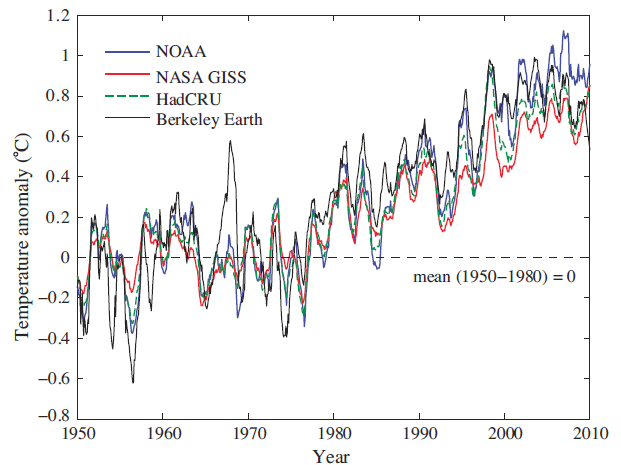

Wow, this sub-sample really favors the sun as the primary driver of climate, certainly compared to the NOAA, GISS and Hadley evidence. The BEST temperatures are equal or above the other temperature records throughout the 80’s and 90’s, then drop precipitously below them over the last ten years, as the sun has gone quiet.
BEST’s full data set tells the opposite story. Here is their 12 month average surface temperature (figure 8 from their “Temperature Averaging Process” paper):

The second part of figure 8 shows the differences. NOAA and GISS both drop off a couple of tenths of a degree relative to BEST after 2000, while Hadley drops off about a half a degree!

Wow, compared to the evidence provided by the other temperature records, BEST’s full sample really favors the CO2 theory over this critical period. Thus on the only part of the temperature record that is probative, BEST displays two strongly contradictory graphs without a word of commentary. That’s a pretty good sign that they are oblivious to the discriminatory power of this part of the record, indicating again that they are not even aware of the GCR-cloud theory and its implications. No wonder they can do such incredibly biased things as calling “the late part of the 20th century,” “the anthropogenic era” (p. 30). Anthropogenic warming is their premise.
BEST evidence is not best evidence
Almost all of the heat capacity of the biosphere is in the oceans. Thus climate change over time means a change in ocean heat content. Land surface temperature is a volatile expression of this global temperature, depending on whether colder or warmer ocean currents are at the surface. That volatility makes surface temperatures an iffy way to track climate change, and today, better evidence is available.
In recent years, ARGO’s automated fleet of temperature sounding devices provides much improved direct measurement of ocean temperature. According to NOAA, data from these floats show ocean heat content for the top 700 meters as close to flat for about 10 years now:

(Bob Tisdale says that NOAA has recently started reporting heat content for the top 2000 meters, but apparently it is still a work in progress, as they don’t display it on their heat content page.)
Ocean heat content can also be measured by sea level, which is determined by the thermal expansion of the oceans, plus net land-ice melt. Here is NOAA’s sea level data, compensated for land-ice melt and variations in salinity. It shows ocean heat content as roughly flat for about the last eight years:

This best evidence indicates that global warming has stopped, which militates against the CO2 theory of late 20th century warming, but the oceans do not show the global cooling that the solar-theory predicts, so it does not clearly favor the cosmic-ray-cloud hypothesis either. The very latest sea level data, however, may finally be telling the tale:

Steve Goddard, September 2011: “The latest sea level numbers are out, and Envisat shows that the two year long decline is continuing, at a rate of 5mm per year.”
That’s actual sea level, not steric sea level. Subtract out the ongoing land-ice melt from our currently warm climate and thermosteric sea level is falling even more rapidly. If cosmic-ray-cloud effects do dominate CO2 effects, we’ll probably have full proof within the next couple of years.
Can BEST actually be unaware of the cosmic-ray-cloud theory, or are they just accepting the CO2-alarmists’ excuses for dismissing solar effects?
Unless Muller is a world-class fruitcake, he can’t have waded into the climate arena without at least being aware of Svensmark’s theory. He must also know that the sun has gone quiet, and his Nobel-physics brain would be able to figure out how this natural experiment provides a test of which theory is right. Yet he might still act as if he is unaware of solar warming theory if he has been convinced by the alarmists’ bogus excuses for why recent warming can’t have been caused by the sun.
Over and over, these folks claim that late 20th century cannot have been caused by the sun because solar activity was not rising over this period. e.g. Rasmus Benestad, 2005:
A further comparison with the monthly sunspot number, cosmic galactic rays and 10.7 cm absolute radio flux since 1950 gives no indication of a systematic trend in the level of solar activity that can explain the most recent global warming.
That reasoning obviously requires an assumption that ocean temperatures had equilibrated to the high level of 20th century solar forcing by 1950. Otherwise the continued high level of solar forcing (the hypothesis under consideration) would cause continued warming until ocean equilibrium was reached. Yet Benestad did not even acknowledge this assumption, never mind make any case for it, and this has been the pattern.
I have written several posts on the alarmists’ excuses for dismissing the solar explanation and how they utterly fail to stand up to scrutiny. But without even going into those details, the more basic point is that the various rationales for dismissing the solar warming hypothesis are theoretical. They are, in effect, part of the CO2 warming theory. Our recently quiet sun offers a test of which theory makes the right prediction. To ignore that test because one already agrees with one of the theories, as BEST seems to be doing, is to put theory over evidence, the opposite of what scientists are supposed to do.
Gail Combs says:
October 29, 2011 at 3:39 pm
I was quoting from NASA links directly.
There are thousands of papers [going back to at least ~1630] claiming sun-weather-climate relationships. Including some of mine.
Gail Combs: Thanks for the links. I had run across them a while back. The Bago and Butler paper appears to show an agreement for almost one solar cycle (not a real convincing argument), with the low level clouds lasting a little longer. It would be interesting to extend this another decade/solar cycle. Also, the ISCCP Cloud Amount data was originally influenced by volcanic aerosols (the reason for the divergence in 1992-94 at mid and high levels?). It was also globally incomplete–a big slice of the Indian Ocean is missing through the late 1990s if memory serves me well. I’ll plot the ISCCP cloud amount data (1983-2006) tomorrow, and see if the agreement still holds.
Regards
Gail Combs: Curiosity got the best of me. Any correlation ended in the early 1990s. They appear to me to be so far out of line past then that there was no reason for me to download the data.
Global Total Cloud Amount Anomalies:
http://i40.tinypic.com/soa62h.jpg
Low Level (A shift after 1997/98 El Niño?):
http://i44.tinypic.com/s309jn.jpg
Mid Level:
http://i40.tinypic.com/2rq1468.jpg
High Level:
http://i41.tinypic.com/110kmpv.jpg
Gail (& Bob): No use hunting with the wrong markers.
Conjecture about clouds divorced from awareness of circulation isn’t sensible.
http://wattsupwiththat.files.wordpress.com/2011/10/vaughn1.png
Layman’s analogy:
It’s winter & it’s frigid outside. You’re wearing a thick, puffy jacket and you’re warm because you just stepped out from a toasty building, but you forgot to wear a hat and insulated boots…
See the cautionary notes I offered Mr. Rawls above Gail.
M.A.Vukcevic (October 29, 2011 at 12:49 am) wrote: “There is sun in the graphs, but is not what you see through your sunglasses: http://www.vukcevic.talktalk.net/CDr.htm “
Solar cycle acceleration/deceleration modulates the dominant temporal cycles for the variables you’ve plotted, but be mindful of confounding, maintaining an open mind to the possibility that common modulation is via parallel pathways. Multiple pinion sizes (trees) don’t matter; what matters is the common drive wheel (forest). The mechanic I’m discussing this stuff with intuitively & immediately picked up on the SCL’ metric as an indicator of the forest — i.e. the common driver of the whole system [ http://wattsupwiththat.files.wordpress.com/2011/10/vaughn4.png ], regardless of the varied cycles of the system’s internal components, many of which lie along different drive lines. http://wattsupwiththat.com/2011/10/29/new-wuwt-polar-vortex-reference-page/#comment-782132
Paul Vaughan says:
October 29, 2011 at 8:48 pm
the SCL’ metric as an indicator of the forest — i.e. the common driver of the whole system
Paul, this is total nonsense. It seems that the Kruger & Dunning conclusions apply to you as well.
The first post you made seemed to simply dismiss the entire idea, without qualifications. You seemed to dismiss the idea that a quiet sun may effect the climate and that we might be able to use this time of quiet sun and rising CO2 as a test of which idea was right entirely as “speculation”, As far as that went, simply stopping there and my post would have been true, simply dismissing all of it without reason would be unscientific. However, since you have eventually followed it up with actual reasons why you may believe that the specifics of this article may be non scientific (not data based) I can see your point, and I withdraw my earlier post.
However, concerning that idea, that a quiet sun may not produce the recent cooling, there are reasons, scientific ones (data), that may show you wrong. At least now we are talking science (data).
When I look at it, I see the following:
There is some cooling recently, this must have some cause.
Any cause must have something eventually to do with the sun, since the sun is where allwarming comes from.
Whether this short term cooling is caused by solar quietness certainly may be speculative.
It may be that the sun causes warming or cooling only over longer terms (through slow heating of the sea, or lack thereof).
However, there is some recent data which strongly suggests that the sun may have shorter term effects.
First, there is the now recently known fact that the UV radiation changes a lot with a quieter sun.
This could cause some heating of the upper atmosphere, and/or change jet streams and the like.
The CERN cloud experiment and another similar one showed that cosmic rays may indeed have a strong effect to create clouds, this data looks fairly conclusive.
There is also some data showing that short term increases in cosmic rays may result in short term increases in clouds (some data to back it up, possibly not conclusive).
Therefore this recent data about a fairly large change in UV radiation plus some fairly plausible data to suggest that a quiet sun may result in more cosmic rays and more clouds and shade strongly suggests that these theories may have some basis in fact.
Note, I reject, however, the idea that it is either only UV or cosmic rays, it could be some of both (or it may be something else as yet not known about).
About the specific data on clouds you presented, I see one problem with it. The temperature data only shows a large temperature drop very recently, within a year (before that and since 2000 or so, the drop is too gradual to be conclusive). The cloud data stops several years ago, thus, the cloud data does not cover the period when there is a great enough short term cooling that it may be able to show if cloud data has any bearing on that cooling. Needed is cloud data that covers all the way up through this cooling, I believe all the way to 2010 or even 2011. One could also say the same about UV, is there any radical change in UV around this time, what about increased cosmic rays, change in magnetics?
This is the data I was talking about in my last post. Note the very sharp drop right at the end of 2010, that is the place I would want to look for cosmic rays and possibly associated changes in clouds, and/or UV changes and/or anything else that might change short term temperatures
Legatus says:
October 29, 2011 at 9:55 pm
This is the data I was talking about in my last post.
=================================================
Legs., I thought I’d let you know I used some of the info you presented here….. http://suyts.wordpress.com/2011/10/29/the-mischaracterization-of-skepticism-and-the-misapplication-of-the-skeptic-label/ THANKS!
EOP content is bitterly inconvenient for some. Download those data & archive them. One never knows when publicly-available data might get vandalized.
http://upload.wikimedia.org/wikipedia/commons/3/3a/Simple_CV_Joint_animated.gif
http://wattsupwiththat.com/2011/10/29/new-wuwt-polar-vortex-reference-page/#comment-782252
@Legatus (October 29, 2011 at 9:50 pm)
Tip: Pay attention to Piers Corbyn’s commentary (filtering off the potentially-distracting politics / persuasive psychology inserted) on Svensmark’s ideas. Although very polite towards Svensmark, Corbyn disagrees fundamentally with Svensmark’s ideas (a ship eventually due for torpedoing in what some suspect is an alarmist set-up).
barry says:
October 29, 2011 at 4:09 pm
JPeden,
Have the WWF published peer-reviewed work on glaciers? I’m not aware of that.
In study after study at least 85% of monitored glaciers are receding/losing mass balance. Many studies show a greater percentage, but I think it’s better to lay out conservative values.
In answer to your first question, which then specifically reflects upon your following claim, No. But the WWF reports have made their way into the IPCC’s analyses at high and significant levels. The following link states the situation as pertaining to the ipcc’s report on Himalayan glaciers below and then gives an incomplete list of some of the other relevant WWF “papers” cited by the IPCC, which don’t look like they were “peer reviewed” either:
http://nofrakkingconsensus.blogspot.com/2010/01/more-dodgy-citations-in-nobel-winning.html
Similarly, the only reason the IPCC can declare that “Changes in climate are affecting many mountain glaciers, with rapid glacier retreat documented in the Himalayas, Greenland, the European Alps, the Andes Cordillera and East Africa” is because a WWF report makes this claim [about the Himalays]
The next link gives a little history of what happened in the case of the completely anecdotally derived WWF paper’s inclusion in the ipcc’s report on Himalayan glaciers and its dominant role there, also including the fact that an Indian glaciologist had recently published a paper refuting the ipcc’s claim:
http://wattsupwiththat.com/2010/01/17/told-ya-so-ipcc-to-retract-claim-on-himalayn-glacier-melt-pachauris-arrogance-claim-backfires/
James Sexton says Legs., I thought I’d let you know I used some of the info you presented here…..
Actually, you may have written it up a bit better than I did…
(Certainly shorter and sweeter anyway)
I kinda like the idea of being called “Legs”, “Ain’t there nobody that can shoot this guy so he don’t bounce back?”
Uh, where is this commentery going on?
As for commentary or disagreeing, I prefer to use the scientific method, that is, find a way to test it, then do so, all else is merely opinion.
What are the facts? Again and again and again-what are the facts? Shun wishful thinking, ignore divine revelation, forget what “the stars foretell,” avoid opinion, care not what the neighbors think, never mind the unguessable “verdict of history”–what are the facts, and to how many decimal places? You pilot always into an unknown future; facts are your single clue. Get the facts! Robert Heinlein
So far, such limited tests of Svensmark’s ideas seem to point to it being at least partially true.
Paul Vaughan says:
October 29, 2011 at 8:48 pm
………….
Hi Paul
I take a simple view (see my post http://wattsupwiththat.com/2011/10/29/uh-oh-it-was-the-best-of-times-it-was-the-worst-of-times/#comment-782381)
I agree, the Svensmark’s hypothesis may be a big ‘unprofitable’ detraction. There isn’t much there that hasn’t been known before.
Legatus says: “However, concerning that idea, that a quiet sun may not produce the recent cooling, there are reasons, scientific ones (data), that may show you wrong. At least now we are talking science (data).”
I never said that the “quiet sun” did not have an impact on climate; my research shows that the solar variability, in and of itself, is not the primary driver of the flattening of Surface Temperature in recent years or the primary driver of the rise in surface temperatures over the past century.
Are you aware that you can reproduce the underlying global temperature anomaly curve using the a common ENSO index, NINO3.4 SST anomalies?
http://bobtisdale.wordpress.com/2009/01/25/reproducing-global-temperature-anomalies-with-natural-forcings/
It simply requires a different mindset about what ENSO represents. ENSO is a process, not an index. I have in numerous other posts discussed and illustrated and animated the processes through which ENSO can and is responsible for that underlying curve–at least from 1982 to present, the era of satellite-based sea surface temperature data. In the post I linked above, I also used scaled sunspot number data as a means of accounting for the insignificant impact the solar cycle has on global temperatures…
http://i42.tinypic.com/k50pd0.jpg
…and used volcanic aerosol data for their short-term impacts.
http://i39.tinypic.com/w7fz7k.jpg
That curve follows quiet closely back to about 1905, better than what we’re seeing out of most general circulation models.
Regards
:
Bob Tisdale says:
October 30, 2011 at 6:59 am
While I agree Bob, the question is where did that extra energy come from to fuel the ENSO?
I can’t find a better explanation than global cloud albedo dropping 5 percent during the same period referred too in your post. Therefore, the sun did cause this indirectly with increasing solar radiation reaching the ocean surfaces. A prime example of a mechanism that can warm the ocean, but doesn’t have to change itself to do so. (at least by radiation energy wise externally)
The difficult part it was caused this albedo to decline and while there are possible ideas that include the polar vortex, that influence especially the AO and NAO. The question is what caused these changes and with these lately changing especially with regards to a quieter solar cycle. The current source could well be the sun, but can’t be sure at least at this moment of time. That’s why the Met Office recently reported quieter sun causing UK winters to become colder, but with some spin in it to keep global warming going.
The warming of the polar vortex, favourable AO, NAO and jet stream closer to the equator, increases the area around the globe where cold and warm air collides. These in turn increase instability and formation of clouds, so if stays more often nearer the equator cloud albedo increases. Closer to the pole as pre 2001 during the warming period cloud albedo declines.
@M.A.Vukcevic (October 30, 2011 at 2:28 am)
Try this [ http://wattsupwiththat.files.wordpress.com/2011/10/vaughn3.png ] on CET.
—
Bob Tisdale:
The spatiotemporal geometry isn’t what you (implicitly, not explicitly) assume with your solar comments.
Regards.
Paul Vaughan says:
October 30, 2011 at 9:58 am
The spatiotemporal geometry isn’t what you (implicitly, not explicitly) assume with your solar comments.
Whatever it is, it is not physics and does not bring anything worthwhile to the table.
The importance of Northern hemisphere rotation asymmetry in aliasing solar drive wheel shifts has been overlooked by the mainstream.
It’s not sensible to assume symmetric spatial kernels when aggregating from a field with such a high fractal dimension (length:area & area:volume ratios). A quick look at the north-south “waviness” vs. “straightness” of this [AnimMSLP http://i54.tinypic.com/swg11c.png ] (for a univariate example) should make this crystal clear, but we’re dealing with folks lacking the functional numeracy to see that they’re basing their statistical inference on patently untenable assumptions.
They’ve failed absolutely at data exploration. Normally collegiality & diplomacy would demand that such things not be said in public, but they’ve gone too far with their nature-denigrating data misinterpretations.
Multidecadal terrestrial oscillations are guaranteed by the spatiotemporal version of Simpson’s Paradox, the “unfair averaging” (in layman’s terms) of straight vs. loopy land-ocean heat-capacity contrasts with zonal vs. meridional jet shifts on an asymmetric planet.
A quick look at the north-south fractal dimension contrast (length:area ratio) of isolines here [ http://i54.tinypic.com/swg11c.png ] makes that crystal clear.
The changes are only tenths of a degree K, but they do account for the multidecadal terrestrial oscillations we observe, as I’ve shown [ http://wattsupwiththat.files.wordpress.com/2011/10/vaughn4.png ]. It’s just asymmetric aliasing of the solar drive wheel. If climate discussion participants had a better handle on complex numbers (high-school math) and correlation (1st year university intro stats) they’d realize it’s as simple as 1 + 1 = 2.
One of the challenges plaguing the media & the public in the climate discussion is the relentless mainstream direction of our attention to average anomalies where climate cannot be understood without maintaining vigilant cognizance of absolute gradients (differentially driving circulation & water states across hemispheres & basins).
Perhaps mainstreamers don’t want the public to develop a clue about asymmetric aliasing of solar-driven cumulative circulation because every department & disciplinary branch wants their share of the boat-loads of public climate research funding before everyone clues in to what we already know with crystal clarity from EOP. Is it atrophy from too many years on the gravy train or just the blinding carrot on the stick? Too costly for society & civilization either way. Checks & balances needed.
Don’t fall for the expensive CERN ‘cloud’ set-up.
Paul Vaughan says:
October 30, 2011 at 11:56 am
If climate discussion participants had a better handle on complex numbers (high-school math) and correlation (1st year university intro stats) they’d realize it’s as simple as 1 + 1 = 2.
It is an uphill struggle when you are the only one with full understanding of something and all the rest of the World is clueless. But take solace in the fact that scientists are fully cognizant and knowledgeable about complex numbers and correlations. This [as you point out] may not be the case with the average participant on WUWT – although many might disagree with your characterization of their ability].
It’s not knowledge of physics that’s the primary problem at present. It’s parameterization of constraints on spatiotemporal mass distribution and integrals of circulation.
In layman’s terms:
They haven’t got the circulatory geometry right in the models.
It’s absolutely not chaos at all scales. Aliasing & integrals are constrained spatiotemporally in ways the central mainstream has so far ignored.
Currently, the primary bottlenecks in the climate discussion are sampling theoretic. The modelers might have a relative cakewalk getting the models right once the spatiotemporal framework hurdle has been overcome.
As a minimum criteria for candidacy, a model should be able to reproduce all EOP (Earth Orientation Parameters). This means modelers have a lot of work to do.
And if they think they (very well paid workers) should get a free pass on this minimum modeling requirement, I recommend cautioning them as follows: Forget it. And be thankful for having interesting paid work to do at a time when so many are excluded from the economy.
Best Regards to All. (Off to work for the next 5 days…)
Paul Vaughan says:
October 30, 2011 at 2:12 pm
As a minimum criteria for candidacy, a model should be able to reproduce all EOP (Earth Orientation Parameters)
Those are consequences of climate [through poorly known mechanisms] so it is nonsense to try use those as criteria.
Legatus says:
October 29, 2011 at 9:55 pm
This is the data I was talking about in my last post. Note the very sharp drop right at the end of 2010, that is the place I would want to look for cosmic rays and possibly associated changes in clouds, and/or UV changes and/or anything else that might change short term temperatures
______________________________
Do not forget the erupting volcano Eyjafjallajokull on April 14, 2010. … The plumes have closed some of Europe’s busiest airports and the spring here in NC was very cool.