
Guest post by Alec Rawls
Here is the puzzle, as noted by Nigel Calder and others: how can BEST insist that a modicum of additional evidence of late 20th century warming should put skepticism of the CO2-warming theory to rest, while at the same time admitting that they never even tried to examine the possible causes of warming?
Elizabeth Muller’s press statement in support of anti-CO2 alarmism is extreme:
Elizabeth Muller, co-founder and Executive Director of Berkeley Earth, said she hopes the Berkeley Earth findings will help “cool the debate over global warming by addressing many of the valid concerns of the skeptics in a clear and rigorous way.” This will be especially important in the run-up to the COP 17 meeting in Durban, South Africa, later this year, where participants will discuss targets for reducing Greenhouse Gas (GHG)emissions for the next commitment period as well as issues such as financing, technology transfer and cooperative action.
She is strongly implying that BEST’s findings not only support the CO2 theory of late 20th century warming, but justify radical worldwide government action to reduce carbon emissions.
Richard Muller’s statement of ignorance on the cause of the observed warming is equally absolute:
What Berkeley Earth has not done is make an independent assessment of how much of the observed warming is due to human actions.
Contradictory, yes, but also explanatory. Muller et al. must be so ignorant of this climate science subject that they are brand-new to that they are not even aware that the leading competing climate theory, where solar-magnetic activity modulates cloud formation, also predicts and explains late 20th warming. All they know is that the CO2 theory predicts warming, prompting them to see evidence of warming as evidence for that theory.
This is the only logical explanation for Muller vs. Muller, and it would also explain why BEST made such a complete hash of the only part of their data that does have any power to discriminate between CO2-warming and solar-warming.
Opposite temperature predictions for quiet-sun era
If late 20th century warming was mostly caused by the industrial release of atmospheric CO2, then warming should be continuing apace, but if 20th century warming was mostly caused by the 80 year grand maximum of solar activity that waned in the 1990’s and ended in 2005, then planetary temperature (as measured by the heat content of the oceans) should have been falling for several years now. In a less smooth way, surface temperatures would also be passing the peak of the Modern Warm period.
Nature is right now conducting an ideal experiment for determining which theory is right, but on this crucial part of the temperature record—what happened when solar activity waned and then dropped into the cellar—BEST’s presentation is remarkably confused. The sample station analysis that they released shows substantially more post-98 cooling than any of the other land records, while their full data set has recent temperatures going up compared to the other records.
Here is a zoom-in on figure 1 from BEST’s “decadal variations” paper. It shows the most recent temperatures for a sub-sample of temperature stations (“[this] Berkeley Earth data were randomly chosen from 30,964 sites that were not used by the other groups”):
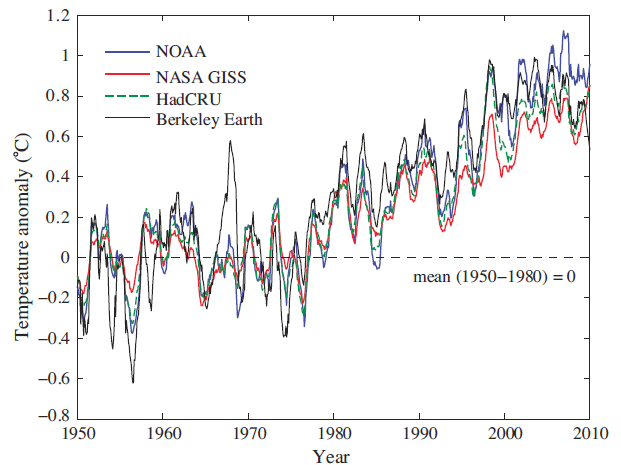

Wow, this sub-sample really favors the sun as the primary driver of climate, certainly compared to the NOAA, GISS and Hadley evidence. The BEST temperatures are equal or above the other temperature records throughout the 80’s and 90’s, then drop precipitously below them over the last ten years, as the sun has gone quiet.
BEST’s full data set tells the opposite story. Here is their 12 month average surface temperature (figure 8 from their “Temperature Averaging Process” paper):

The second part of figure 8 shows the differences. NOAA and GISS both drop off a couple of tenths of a degree relative to BEST after 2000, while Hadley drops off about a half a degree!

Wow, compared to the evidence provided by the other temperature records, BEST’s full sample really favors the CO2 theory over this critical period. Thus on the only part of the temperature record that is probative, BEST displays two strongly contradictory graphs without a word of commentary. That’s a pretty good sign that they are oblivious to the discriminatory power of this part of the record, indicating again that they are not even aware of the GCR-cloud theory and its implications. No wonder they can do such incredibly biased things as calling “the late part of the 20th century,” “the anthropogenic era” (p. 30). Anthropogenic warming is their premise.
BEST evidence is not best evidence
Almost all of the heat capacity of the biosphere is in the oceans. Thus climate change over time means a change in ocean heat content. Land surface temperature is a volatile expression of this global temperature, depending on whether colder or warmer ocean currents are at the surface. That volatility makes surface temperatures an iffy way to track climate change, and today, better evidence is available.
In recent years, ARGO’s automated fleet of temperature sounding devices provides much improved direct measurement of ocean temperature. According to NOAA, data from these floats show ocean heat content for the top 700 meters as close to flat for about 10 years now:

(Bob Tisdale says that NOAA has recently started reporting heat content for the top 2000 meters, but apparently it is still a work in progress, as they don’t display it on their heat content page.)
Ocean heat content can also be measured by sea level, which is determined by the thermal expansion of the oceans, plus net land-ice melt. Here is NOAA’s sea level data, compensated for land-ice melt and variations in salinity. It shows ocean heat content as roughly flat for about the last eight years:

This best evidence indicates that global warming has stopped, which militates against the CO2 theory of late 20th century warming, but the oceans do not show the global cooling that the solar-theory predicts, so it does not clearly favor the cosmic-ray-cloud hypothesis either. The very latest sea level data, however, may finally be telling the tale:

Steve Goddard, September 2011: “The latest sea level numbers are out, and Envisat shows that the two year long decline is continuing, at a rate of 5mm per year.”
That’s actual sea level, not steric sea level. Subtract out the ongoing land-ice melt from our currently warm climate and thermosteric sea level is falling even more rapidly. If cosmic-ray-cloud effects do dominate CO2 effects, we’ll probably have full proof within the next couple of years.
Can BEST actually be unaware of the cosmic-ray-cloud theory, or are they just accepting the CO2-alarmists’ excuses for dismissing solar effects?
Unless Muller is a world-class fruitcake, he can’t have waded into the climate arena without at least being aware of Svensmark’s theory. He must also know that the sun has gone quiet, and his Nobel-physics brain would be able to figure out how this natural experiment provides a test of which theory is right. Yet he might still act as if he is unaware of solar warming theory if he has been convinced by the alarmists’ bogus excuses for why recent warming can’t have been caused by the sun.
Over and over, these folks claim that late 20th century cannot have been caused by the sun because solar activity was not rising over this period. e.g. Rasmus Benestad, 2005:
A further comparison with the monthly sunspot number, cosmic galactic rays and 10.7 cm absolute radio flux since 1950 gives no indication of a systematic trend in the level of solar activity that can explain the most recent global warming.
That reasoning obviously requires an assumption that ocean temperatures had equilibrated to the high level of 20th century solar forcing by 1950. Otherwise the continued high level of solar forcing (the hypothesis under consideration) would cause continued warming until ocean equilibrium was reached. Yet Benestad did not even acknowledge this assumption, never mind make any case for it, and this has been the pattern.
I have written several posts on the alarmists’ excuses for dismissing the solar explanation and how they utterly fail to stand up to scrutiny. But without even going into those details, the more basic point is that the various rationales for dismissing the solar warming hypothesis are theoretical. They are, in effect, part of the CO2 warming theory. Our recently quiet sun offers a test of which theory makes the right prediction. To ignore that test because one already agrees with one of the theories, as BEST seems to be doing, is to put theory over evidence, the opposite of what scientists are supposed to do.
Resourceguy: I think there may have been one actually, somewhere in Denmark a couple of years ago. I think the plan was to demonstrate unseasonable warmth in high latitudes, as well as look at some pretty wind factories (er, I mean farms, of course), but events somewhat conspired against them.
They certainly won’t be making that mistake again though, hence going to Cancun and partying in the tropical heat of that part of the worl… oh, that didn’t quite turn out that way either, did it?
Still sceptical of the BEST project, with it showing a large difference compared with SST’s and also makes a very strong El Nino during 1997/98 look just almost ordinary. Muller so far as I have been aware has never been a sceptic, just spin to try and a fashion a turnaround breakthrough. I see with some media and political sources this is working so far. IMO an alarmist has been involved in another global data set and achieved the results he wanted too. (not sure what’s with the sharpe spike down at the end?)
http://www.woodfortrees.org/plot/best/from:1997.25/normalise/plot/best/from:1997.25/normalise/trend/plot/hadsst2gl/from:1997.25/normalise/plot/hadsst2gl/from:1997.25/normalise/trend
The trend through the last decade now shows a general slight increase with greater moderation of El Nino and La Nina events. I wondering if less locations strongly affected by El Nino and La NIna have been used?
http://www.woodfortrees.org/plot/best/from:2001/normalise/plot/best/from:2001/normalise/trend/plot/hadsst2gl/from:2001/normalise/plot/hadsst2gl/from:2001/normalise/trend
In November 1968 I sat examinations in Brisbane. The temperature hit ~ 104 F or 40 + C – we weren’t fully metric yet. Today I sit viewing weeks of cloudy skies – unusual for such prolonged periods – and temperatures that are barely getting into the mid twenties.
A few years later we had a major major La Nina event where widespread flooding happened – the 1974 floods in Brisbane were a bit higher than 2011 but a flood control dam probably caused that.
Seems it could be cyclical – 2009 was pretty warm here followed by cool wet rainy periods. The cool wet weather commenced in October 2010 when we had quite heavy rain early and it didn’t cease until April 2011. Didn’t even use our air conditioners the whole year.
1977 was quite dry here so we’ll see what happens in a few years.
Kind of seems there is a pattern.
Well, they did, sort of…
Basically, they made a lazy, token effort. Thye used statellite data of lights to see what places could be called urban, however, they have not actually done the real work, which would be to actually examine and test these stations to see if they were accurate. They have Anthony’s data which would help them do just that, they pretty much ignored it. Aquiring his data appears to heve been only an excuse to make it look like they were factoring in the UHI problem, they used the same lazy method to tell if a site was urban as the other temperature records. The satellite method is good if you want to stay in your nice comfortable bureaucrats office and not ever actually go out and do any real work, make any actual observations.
You will note, however, that even using this lazy method, their actual data shows that for the last 10 years (especially this year), the temperature has been dropping. Since this is happening at a time when CO2 is going up yet the sun is quite, this supports the idea that it is the sun, not CO2.
20th century warming was mostly caused by the 80 year grand maximum of solar activity that waned in the 1990′s
There is strong evidence that there was no Grand Maximum during the 20th century, see e.g.
http://www.leif.org/research/How%20Well%20Do%20We%20Know%20the%20Sunspot%20Number.pdf
One thing I came across when writing this post is just how large a financial stake Muller has in eco-money. It seems that his Muller & Associates company mostly consults with goverment entities. At least, that is the indication on his Our Team page:
Country/region/city would seem to mean government contracting where green spending hand over fist. As for the “or business,” even the Muller & Associates list of private industry projects is more than half green-tech.
Overall, it looks like more than half Muller’s business depends on anti-CO2 alarmism, so that could be playing a role.
Jeff D says:
October 28, 2011 at 12:42 pm
With what appears to be an ocean cooling cycle in the making is it possible that we will also see a drop in CO2 levels…..
_____________________________
I very very much doubt it because the CO2 record is just as “messaged” as the temperature record. All the way from the cherry picked historical numbers to the carefully selected test results from Mauna Loa Observatory as shown in step four below of the lab’s practice.
The assumption is MADE that the CO2 is steady and fits their curve, therefore “outliers are rejected !!!!!! (I would FIRE any lab tech that made this ASSumption)
4.In keeping with the requirement that CO2 in background air should be steady, we apply a general “outlier rejection” step, in which we fit a curve to the preliminary daily means for each day calculated from the hours surviving step 1 and 2, and not including times with upslope winds. All hourly averages that are further than two standard deviations, calculated for every day, away from the fitted curve (“outliers”) are rejected. This step is iterated until no more rejections occur.
http://www.esrl.noaa.gov/gmd/ccgg/about/co2_measurements.html
If you want the other side of the story so you can weigh both sides check out this web site run by a couple of scientists. http://www.co2web.info/
This particular pdf looking at the dogma and politics behind the 70 years of CO2 measurement as well as the science. It is a very interesting read. http://www.co2web.info/ESEF3VO2.pdf
”At the Mauna Loa Observatory the measurements were taken with a new infra-red (IR) absorbing instrumental method, never validated versus the accurate wet chemical techniques. Critique has also been directed to the analytical methodology and sampling error problems (Jaworowski et al., 1992 a; and Segalstad, 1996, for further references), and the fact that the results of the measurements were “edited” (Bacastow et al., 1985); large portions of raw data were rejected, leaving just a small fraction of the raw data subjected to averaging techniques (Pales & Keeling, 1965).
The acknowledgement in the paper by Pales & Keeling (1965) describes how the Mauna Loa CO2 monitoring program started: “The Scripps program to monitor CO2 in the atmosphere and oceans was conceived and initiated by Dr. Roger Revelle who was director of the Scripps Institution of Oceanography while the present work was in progress. Revelle foresaw the geochemical implications of the rise in atmospheric CO2 resulting from fossil fuel combustion, and he sought means to ensure that this ‘large scale geophysical experiment’, as he termed it, would be adequately documented as it occurred. During all stages of the present work Revelle was mentor, consultant, antagonist. He shared with us his broad knowledge of earth science and appreciation for the oceans and atmosphere as they really exist, and he inspired us to keep in sight the objectives which he had originally persuaded us to accept…..
Is this the description of true, unbiased research? “ http://www.co2web.info/ESEF3VO2.pdf
What plums has Muller given us, despite himself?
(1) the significant, anomalously low record of the longstanding weather stations – Michael Palmer’s paper
(2) the (unnoticed-by-Muller) significant difference between the low final temperature of the “sample” of stations unused by others, and the high final total of all stations
(3) the revelation of conflict-of-interests, and general upsurge of skeptical interest, in the wake of his faux pas of courting the media before peer-review
(4) the ire of both sides, which has nicely cracked open the “consensus” wallpaper.
The stations giving those anomalously low readings need to be checked individually for quality and consistency. It is very revealing to compare local stations, this demonstrates the reliability of individual stations and the presence of step changes or UHI divergences. I compared records around Salehard, Yamal. But this graph of Salehard’s seasonal anomalies suggests strongly that after 2003, Salehard’s record at least is seriously compromised by winter UHI.
I copied the study objectives from the BEST webpage. It is always good to go back and check to see if you accomplished what you were supposed to accomplish. Nothing in the objectives about parsing the causes. I see their 2 page summary contains some unsupported observations and some unfortunate phrasing. I don’t see how that added anything since it appeared to be entirely gratuitous.
The work has not yet been peer reviewed or “formally” published. The process they are following appear to be perhaps a climate science version of beta testing. If so, this might exemplify a new approach to climate research.
They might have handled the “release” differently. The media does not write dispassionately. Spin and hype is their stock in trade. Sso if beta testing is being initiated, it is not the time for spin.
It looks to me like they have, for the most part, accomplished their objectives but I could be wrong. I look forward to an evaluation by Steve McIntyre and others over the next few weeks..
Objectives
The Berkeley Earth Surface Temperature project has the following objectives:
1 To merge existing surface station temperature data sets into a new comprehensive raw data set with a common format that could be used for weather and climate research
2 To review existing temperature processing algorithms for averaging, homogenization, and error analysis to understand both their advantages and their limitations
3 To develop new approaches and alternative statistical methods that may be able to effectively remove some of the limitations present in existing algorithms
4 To create and publish a new global surface temperature record and associated uncertainty analysis
5 To provide an open platform for further analysis by publishing our complete data and software code as well as tools to aid both professional and amateur exploration of the data
Legatus says: October 28, 2011 at 2:34 pm
Legatus, I also disagree with Bob here, but I respect his views: he is a damn good scientist, and holds his own as a skeptic exceedingly well against consensus tosh in his sphere (oceans). And Alec Rawls doesn’t seem too phased either. Go easy, friend.
Legatus says regarding my earlier comment: “Your statement ‘little basis in science’ actually means ‘little basis in settled science’, or science by consensus.”
I wrote precisely what I meant. The “technical” portions of his posts are pure conjecture on his part.
Interesting as an outsider looking in on the USA, there is obviously divides developing in the CAGW thrust that has dominated the Climate Change debate, and signs that C02 may well slip off the scene as the driver of temperature, due to intense scrutiny of the significance of the BEST temperature data and Solar Cloud experiments at CERN.
What we need to be aware of is any attempt to divide the sceptical scientists away from the science or divert into side issues or any attempt to elevate one sceptical scientific group’s theory over another for whatever reason. Discussion great, argument and division No!
On Judith Curry’s site for some “unknown reason” the hot topic of religion is now under discussion and already there is division as sceptic engages with sceptic.
http://judithcurry.com/2011/10/28/is-there-any-good-news-for-the-environment-among-evangelicals/#more-5505.
The question I pose, is who or what group/team might benefit from this diversion or attempt to introduce side issues ?. Especially ones that passionately ignite and engage what otherwise has been a reasonably cohesive and calm scientific expose of the worst of the groupthink that gave rise to early claims of CAGW consensus, a claim we suspected to be false, and has proven to be false.
Do not fall for diversion and division if you want to see reform to climate science, the IPCC, or the political scene – just my though as just like Anthony was trusting and ethical in his dealing with BEST, we need to be alert to tactical manipulation, and be focussed on working with each other, putting aside any exploitable side issues and just concentrate on achieving the basic reforms that will prevent manipulation of scientist’s and science. This is a critical time as i see it, if we want to achieve that objective. Sorry if this is not strictly on topic.
I hope this post is acceptable on this thread, if not, I would ask the Moderators to bring this to the attention of Anthony.
I had noticed earlier I had used a period nearly 11 years long not quite a decade. So when I change this to include a decade period as close as possible a slight cooling with BEST is detected.
http://www.woodfortrees.org/plot/best/from:2001.8/normalise/plot/best/from:2001.8/normalise/trend/plot/rss/from:2001.8/normalise/plot/rss/from:2001.8/normalise/trend/plot/uah/from:2001.8/normalise/plot/uah/from:2001.8/normalise/trend
But, to me the sharpe trend down towards the end of the data set looks like a error to me, so when this is corrected may become slightly positive again. This is due to it couldn’t agree less than other satellite data sets. (there is a huge difference between them)
When compared with satellites (which are easily the best data sets) there is a big diaspointment with the qualitity of BEST. Satellites cover all the ocean and land extremely well so should respond to El Nino’s and La NInas very well. (which they do) Look how BEST compares with satellite data and to be honest looks very poor. Hadley’s global data set for ground instrument based, still easily remains king, nothing to worry about from BEST.
http://www.woodfortrees.org/plot/best/from:1997.25/normalise/plot/best/from:1997.25/normalise/trend/plot/rss/from:1997.25/normalise/plot/rss/from:1997.25/normalise/trend/plot/uah/from:1997.25/normalise/plot/uah/from:1997.25/normalise/trend
Harry Dale Huffman says: October 28, 2011 at 1:06 pm
…It is just the Sun, and only the Sun, because the atmosphere is warmed by absorption of incident solar infrared radiation, not from the surface, as my Venus/Earth comparison clearly shows. Clearly, the Standard Atmosphere rules, and there simply is no climate science worthy of the name.
Very interesting. You list a lot of figures there that fit. Certainly when I researched Venus, I found evidence of… duh… corruption and cover-ups in astrophysics too, probably about the time Hansen was there. Does Mars also fit the correspondence you demonstrate between atmospheric pressure and temperature?
Now just supposing you are right, and temperature depends on pressure and distance from the Sun, in atmospheres below – what? – ionosphere? Suppose that Earth had a much denser atmosphere in the past. It would have been warm enough to offset a cooler sun, and it would have been much easier for huge animals to move around, just like whales in the sea today.
I have to agree with Bob Tisdale.
The earth has had a decade or more of non-warming. The earth has also had changes in ocean oscillations. Frank Lansner has done preliminary work showing coastal temps follow ocean surface temps with his “Rural Unadjusted Temperature Index” (See: http://joannenova.com.au/2011/10/messages-from-the-global-raw-rural-data-warnings-gotchas-and-tree-ring-divergence-explained/ )
There has also been measurements that show changes in albedo/cloud cover such as the earthshine project and others. We have also seen some changes in the earth’s Magnetic field and seismic activity
Most here will agree with at least that. Where things get dicey is trying to figure out WHAT causes ocean oscillations and changes in cloud cover.
Some believe changes in the sun have a major impact some don’t. At this point I think all that can be said is the climate changes in a cyclical pattern (based on history) and we have a bunch of pieces of the puzzle but not enough real understanding to stand firm behind any one “Theory” At this point, with climate science in its infancy, we should be GATHERING DATA and not making idiotic statements to the Media “That the science is settled” or that “CO2 is the control knob”
Are these two related? How are things going in that household?
“Berkeley Earth Surface Temperatures (BEST)”
Perhaps it should have been named Berkeley Land Surface Temperatures.
What are they going to call their project when they incorporate the ocean (and sea? [is the artic floating ice land or ocean?]) temperatures; Berkeley Universe Surface Temperatures (BUST)?.
This best evidence indicates that global warming has stopped, which militates against the CO2 theory of late 20th century warmin
———–
And post 1980 the temperature record plateaued for a while as well. So in 1990 you could have said exactly the same thing using the same reasoning. Except the temperature then started to rise again.
And just after the 1998 el niño spike you were all running around claiming that cooling was just around the corner. Except the temperature started to rise again.
It seems you guys just can’t learn from your mistakes.
The lesson is really really simple. If there is a trend with a bunch of random variation superimposed on it, judging if the trend has reversed should be done with care.
One way to do this is to eyeball the amount of past random variation and then see if the latest change exceeds that by a factor of 2.
The latest end blip on the temperature graph is not any larger than the 1980 squiggly. So sorry guys you will have to wait another 10 years to see if the end blip is a REAL down trend.
At the moment it’s just Jiminy Cricket philosophy.
Mr. Rawls,
The “best” news cycle is an uninteresting & inconsequential sideshow. And it matters not what the results of cern’s “cloud” experiment will be.
EOP (Earth Orientation Parameters) are the arbiters of climate disputes and they’ve already spoken. What they’ve said to those listening with non-assumptive carefully-tuned ears:
Neutron count rates (which some interpret as cosmic ray flux) are modulated by circulation [ http://wattsupwiththat.com/2011/10/15/shifting-sun-earth-moon-harmonies-beats-biases/#comment-769231 ].
Discussion of clouds divorced from cognizance of circulatory regimes is inadvisable. Perhaps you’ll be receptive to Piers Corbyn’s caution:
“Jet stream shifts are the stuff of Climate Change and Cosmic Rays are nothing to do with them” http://sc25.com/?id=308
Beware confounding.
Climate politics are utterly boring; nature, on the other hand is quite the opposite.
Time travels in only one direction, but spatial gradients can turn in time. The signature of asymmetric driver-wheel aliasing by driven wheels, no matter the size of the driven wheels, will NECESSARILY be a function of driver-wheel acceleration/deceleration. THIS is the marker of the WHOLE system – the forest – which should not be confused with its spatially modulated (via relief) “interannual” trees.
Sun, Earth, Moon Harmony, Beat, & Bias Changes:
http://wattsupwiththat.files.wordpress.com/2011/10/vaughn-sun-earth-moon-harmonies-beats-biases.pdf
Regards.
Gail Combs says:
October 28, 2011 at 3:10 pm
Gail, we can start another round of discussion about the CO2 measurements, historical and current, but what Jaworowski/Segalstad and the late Ernst Beck wrote simply doesn’t hold. Humans add twice the amount of CO2 measured as increase in the atmosphere. The latter is measured not only at Mauna Loa, but at about 70 “background” places, ships and airplanes. See:
http://www.esrl.noaa.gov/gmd/ccgg/iadv/
That is by different persons, different labs and different organisations of different countries. All show the same CO2 levels within a few ppmv and the same trend. Outliers which are clearly influenced by volcanic vents (Mauna Loa) or mechanical problems (South Pole) are rightfully discarded, as we are interested in background CO2, not in local CO2 emissions.
Besides that, how can one validate a new measuring device, accurate to +/- 0.1 ppmv with wet chemical methods accurate to +/- 10 ppmv? Keeling therefore made his own calibrating device, accurate to 1:40,000, which was in use until recently at Scripps.
And it makes no difference for the average or the trend over a year beyond 0.1 ppmv if you look only at the “cleaned” data or all data, including the outliers. See the difference between raw and selected data for Mauna Loa and the South Pole for 2008:
http://www.ferdinand-engelbeen.be/klimaat/klim_img/co2_mlo_spo_raw_select_2008.jpg
One can discuss a lot about the (lack of) effect of CO2 on climate, but the discussion about the origin of the increase of CO2 in the atmosphere doesn’t make any sense anymore: the human origin fits all observations, including the material balance. Any alternative explanation conflicts with one or more observations. The oceans are not the source (13C/12C ratio too high, increased carbon measured, the oceans are net sinks for CO2) and the biosphere is not the source (more oxygen is produced by the biosphere than used, thus the biosphere is a net sink for CO2, the “greening earth”). All other sources are too small or too slow or have the wrong 13C/12C “fingerprint”…
LazyTeenager says:
October 28, 2011 at 4:04 pm
Cloud albedo wasn’t doing this in 1990 and from including the El Nino 1997/98 global datasets show either very slight cooling or very slight warming. (overall together show no trend ie the debate about the non warming period)
http://img854.imageshack.us/img854/5246/globaltempvglobalcloudb.png
Bob Tisdale.
Agreed.
Laegato “Thye used statellite data of lights to see what places could be called urban, however, they have not actually done the real work, which would be to actually examine and test these stations to see if they were accurate.’
What they really need to do is to look at the history of each station and its surrounding area. Unless they have satellite images from 40-50 years ago, then looking at satellite images now is a pointless exercise.. They need to know what the CHANGES have been at EACH STATION , and its surrounding area, over that period and try to determine how they might have affected the temperature reading. Until they do that, using station data is a pointless exercise,
I suspect that a very large proportion of the rise in the so-called “Global Average Temperature” during the 1976 – 1998 period is to do with the affect of increased urbanisation density in many areas, and the loss of many remote rural station, thus placing a much larger weighting on the encroached stations.
Untill someone has done the work to prove otherwise, which I doubt will ever happen because it is not in the interests of the AGW powers to so, then as far as I’m concerned they have not proven that the Earth did actually warm up during that period.
My ‘conjecture’ based on observations is that the solar effect is not via cosmic rays but via solar induced latitudinal shifts in the climate zones which changes jet stream patterns, air mass boundaries and global cloud quantities in order to affect the amount of solar energy getting into the oceans.
Resourceguy says:
October 28, 2011 at 12:45 pm
Ever wonder why no international climate meetings are held in winter, other than tropical retreats and southern hemisphere during winter for norther hemisphere? No trend there right…?
———–
As they keep on telling and telling you: correlation is not causation.
These meeting times are often dictated by the academic year across international boundaries. So if the school holidays in the USA are in winter then that is the time when activities are not compulsory and people can go to conferences.
Cheap on-campus accommodation also becomes available during college holidays.
So sorry, your theory is wrong. And one more gratuitous insult bites the hand that fed it.