UPDATE: New graphs from David Archibald added. See below.
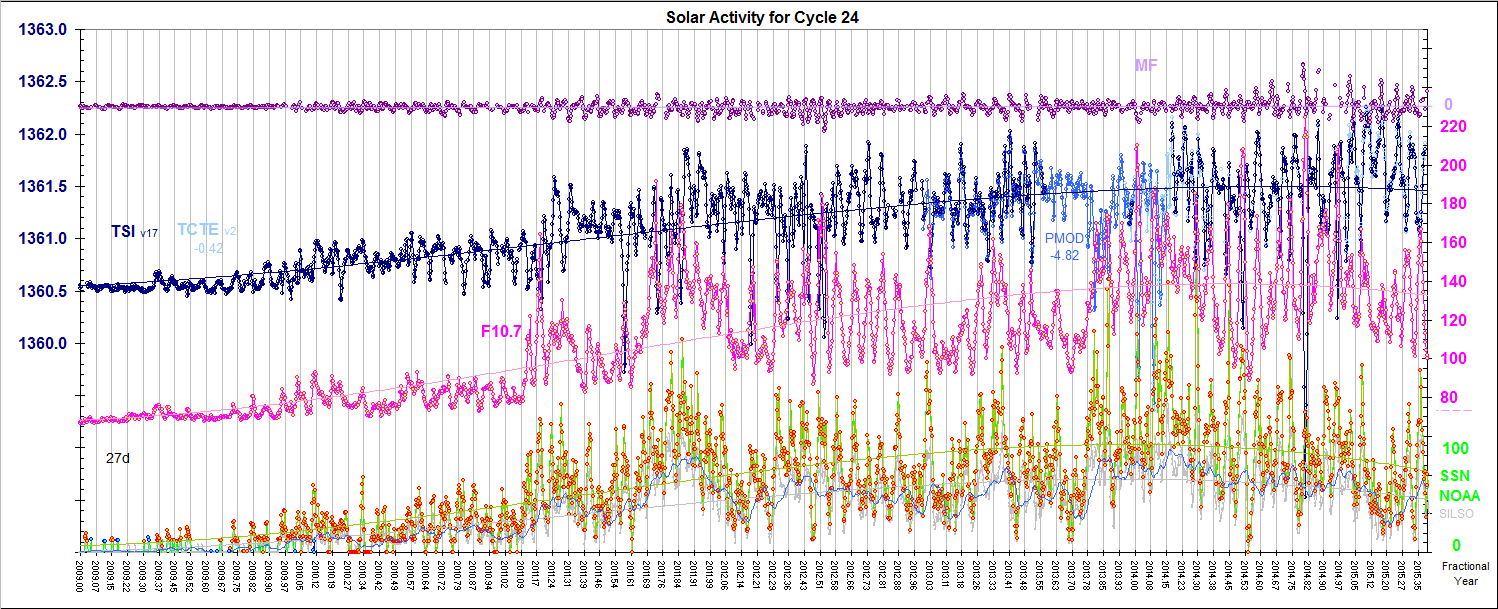
The NOAA Space Weather Prediction Center (SWPC) has released their latest charts on solar activity and the news is not encouraging for solar watchers. Today, the sun has but a couple of anemic “sunspecks”.

Last month I wrote about how May had not continued the advances seen in March and April. Now according the the latest SWPC graphs of the three major metrics of solar activity, June appears to have slipped even further.


I see NASA’s Hathaway making another adjustment to his forecast soon. He wrote on July 1st:
The current prediction for Sunspot Cycle 24 gives a smoothed sunspot number maximum of about 69 in June of 2013. We are currently over two and a half years into Cycle 24. Three consecutive months with average daily sunspot numbers above 40 has raised the predicted maximum above the 64.2 for the Cycle 14 maximum in 1907. The predicted size would make this the smallest sunspot cycle in over 100 years.
More near real-time information on the state of the sun is available on our WUWT solar reference page
UPDATE: My friend in Perth, David Archibald, sends along this information.
Solar Update July 2011
Now that the UK Met Office is half way to admitting that solar activity is the main driver in climate, it is appropriate to check up on how the Sun is going.

Two and a half years after solar minimum, the Ap Index remains below the minima of previous solar cycles.

Dr Svalgaard provides a useful daily update on the F 10.7 flux at http://www.leif.org/research/TSI-SORCE-2008-now.png What the above graph shows is the ramp up of Solar Cycle 24 F 10.7 flux relative to the previous five solar cycles, aligned on the month of minimum. The current cycle has a very flat trajectory.
 Similar to the Ap Index, the Interplanetary Magnetic Field is now up to the levels of previous solar minima.
This chart compares the development of Solar Cycle 24 with the last de Vries cycle event – the Dalton Minimum. The Solar Cycle 24 ramp up in terms of sunspot number is tracking much the same as that of Solar Cycle 5 but about a year ahead of it. All solar activity indications are for a Dalton Minimum repeat. There has been no development that precludes that outcome.

This graph shows the sum of the north and south polar magnetic fields on the Sun. It has yet to get down to the levels of previous maxima, and solar maximum may be still two to three years off.

David Archibald
July 2011
Discover more from Watts Up With That?
Subscribe to get the latest posts sent to your email.
R.Gates,
chew on this one for a while. Enjoy.
The Met Office, eyes wide open
Posted on July 9, 2011 by Anthony Watts
History of sunspot number observations showing…
There’s an extraordinary admission about solar activity and cold winters in the UK from the Met Office in an article in FT Magazine.
It is as if the blinders have been removed.
The relevant passage is below from the much larger article.
“We now believe that [the solar cycle] accounts for 50 per cent of the variability from year to year,” says Scaife. With solar physicists predicting a long-term reduction in the intensity of the solar cycle – and possibly its complete disappearance for a few decades, as happened during the so-called Maunder Minimum from 1645 to 1715 – this could be an ominous signal for icy winters ahead, despite global warming.
” Further, there is evidence that it was warmer in the arctic during the Medieval Warming Period, which occured less than 2000 years ago. ”
No !:
Recent melt rates of Canadian Arctic ice caps are the highest in four millennia – Fisher et al. (2011)
http://www.sciencedirect.com/science/article/pii/S092181811100097X
“There has been a rapid acceleration in ice-cap melt rates over the last few decades across the entire Canadian Arctic. Present melt rates exceed the past rates for many millennia. New shallow cores at old sites bring their melt series up-to-date. The melt-percentage series from the Devon Island and Agassiz (Ellesmere Island) ice caps are well correlated with the Devon net mass balance and show a large increase in melt since the middle 1990s. Arctic ice core melt series (latitude range of 67 to 81 N) show the last quarter century has seen the highest melt in two millennia and The Holocene-long Agassiz melt record shows the last 25 years has the highest melt in 4200 years. The Agassiz melt rates since the middle 1990s resemble those of the early Holocene thermal maximum over 9000 years ago.”
—————
A millennial perspective on Arctic warming from 14C in quartz and plants emerging from beneath ice caps – Anderson et al. (2008)
http://www.glyfac.buffalo.edu/Faculty/briner/buf/pubs/Anderson_et_al_2008.pdf
“Observational records show that the area of ice caps on northern Baffin Island, Arctic Canada has diminished by more than 50% since 1958. Fifty 14C dates on dead vegetation emerging beneath receding ice margins document the persistence of some of these ice caps since at least 350 AD.[…] The rapid disappearance of these ice caps over the past century, despite decreasing summer insolation, further demonstrates the unusual character of 20th Century warmth.”
————
A millennial-scale record of Arctic Ocean sea ice variability and the demise of the Ellesmere Island ice shelves – England et al. (2008)
http://dro.dur.ac.uk/6877/1/6877.pdf
“[…] Removal of the remaining ice shelves would be unprecedented in the last 5500 years. This
highlights the impact of ongoing 20th and 21st century climate warming that continues to break up the remaining ice shelves and soon may cause historically ice-filled fiords nearby to open seasonally.”
———–
Examining Arctic Ice Shelves Prior to the 2008 Breakup – Mueller et al (2008)
http://www.agu.org/pubs/crossref/2008/2008EO490002.shtml
“This past summer, Ellesmere’s 50-square-kilometer Markham Ice Shelf also broke away, and there was major fracturing throughout the eastern half and well into the western half of the Ward Hunt Ice Shelf, which is the largest remaining ice shelf in the Northern Hemisphere. Together, all of the Canadian ice shelves lost a total of 23% of their area during summer 2008, leaving only 720 square kilometers behind. Some fjords along northern Ellesmere Island are now ice free for the first time in 3000–5500 years”
“Please cite the research showing the Arctic was warmer during the MWP than now…I’d love to take a look at it.”
I love the “evidence” people pull up to “prove” this. the same yokels who dont believe todays thermometers lap up the MWP bathwater.
Here’s a clue gents.
1. it may well have been warmer in the MWP
2. That means the climate is MORE sensitive than we currently think.
The fact that it may or may not have been warmer in the past, does not change radiative physics.
More C02 means more warming. More methane means more warming. More Sun means more warming. each of these forcings has an impact on different time scales with different time lags.
The question is what PORTION of the warming is due to each forcing. C02 (according to the consensus) is less than 50% of all forcings. And, if the MWP was warmer, with less C02, then
you’ve got a more sensitive climate. It makes for a worse future.
How’s that Ice at 5.5Mkm looking as a prediction gents?
jtom says:
July 9, 2011 at 2:33 pm
Someone likened the cold winters to the door of a refrigerator (the polar regions) being left open, cooling the room (northern hemisphere). If you leave the door to a refrigerator open, it will cool a room down somewhat (assuming the heat from the refrigerator’s condensor isn’t pumped back in the room. But what happens to the temperatures inside the refrigerator?
It gets warmer. No CO2 involved.
Agree except for the “it gets warmer” part. With the sun out of the picture during the Polar Winter, the heat in the refrigerator is just like the leaking O2 aboard Apollo 13….it escapes to space. We certainly have extended winters and springs as collateral data, as well as cold fronts getting much further towards the equator. The next step is to be able to establish proof that the Sun is responsible.
steven mosher says:July 9, 2011 at 3:34 pm
“Please cite the research showing the Arctic was warmer during the MWP than now…I’d love to take a look at it.”
I love the “evidence” people pull up to “prove” this. the same yokels who dont believe todays thermometers lap up the MWP bathwater.
Here’s a clue gents.
1. it may well have been warmer in the MWP
2. That means the climate is MORE sensitive than we currently think.
An alternative to number two would be the normal variation is more than what is acknowledged.
R. Gates says: “…But here’s the larger point: Global Climate models, while far from perfect, have accurately predicted some of the earliest effects of increased CO2, namely the decline of Arctic sea ice and general warming of the Arctic.”
Just for comparison, how did they do in the Antarctic?
“And, if the MWP was warmer, with less C02, then
you’ve got a more sensitive climate. It makes for a worse future.”
====================================================
Since the MWP was as warm or warmer than now….
Followed immediately by the LIA – Little Ice Age
Which was obviously a whole lot colder, and the main reason for temps rising now………
If CO2 does 1/2 of what you think it does…..
….that means a better future
steven mosher says:
July 9, 2011 at 3:34 pm
“Please cite the research showing the Arctic was warmer during the MWP than now…I’d love to take a look at it.”…
“I love the “evidence” people pull up to “prove” this. the same yokels who dont believe todays thermometers lap up the MWP bathwater.
C02 (according to the consensus) is less than 50% of all forcings. And, if the MWP was warmer, with less C02, then you’ve got a more sensitive climate. It makes for a worse future.”
———-
????? I find no logical consistency in your argument. If the climate were so sensitive to CO2 as you claim, would we not be much warmer now than in the Medieval Warm Period, no matter what the sun was doing? What has this to do with the so-called consensus that CO2 is responsible for less than 50% of all forcings? Since the warming in the MWP has not been explained, there is nothing to say that our current warming is not due to exactly the same factors, and that CO2 plays a miniscule role at best. “Sensitive climate” refers to CO2 sensitivity, for which I have seen no compelling demonstration from the scientific community. Where is the evidence that our supposed warming is worse than ever before (which is the warmist argument)?
I know R.Gates would like us to dig up the thermostatic scientific records from the WMP, to finally convince him. Of course, the thermometer lay 400 or more years in the future. I accuse him of ‘scientism’ which privileges scientifically-derived knowledge above all other forms. Surely the historical evidence must give some pause to the alarmists – records of Norse farming and semi-successful settlements in Greenland etc.. On top of this, modern archaeology (or simple observation) is discovering new northerly sites revealing human activity previously covered in glaciers or snow. I would like to see the warmist explanation for these phenomena, to justify the contention that it was not warmer in the past. It’s in your court, Steve Mosher and R. Gates.
steven mosher says:
July 9, 2011 at 3:34 pm
In the heights of the Interglacial, warmer Polar regions and cooler Temperate regions would be a temporary thing, swinging up & down by means of thier causation being cyclic.
As one headed down from the Interglacial, the relatively ‘melted’ Polar regions would cease to be, as the Earth’s reservoir of oceanic heat would be drawn down past the point of being a factor.
I take no comfort in the Polar regions getting warmer when it means the Temperate region I inhabit gets colder.
IF… there is a 2nd (and much warmer) bump in this Interglacial, as was the case 400,000 to 412,000 yrs ago, I won’t be around to enjoy it.
“Here’s a clue gents.
1. it may well have been warmer in the MWP
2. That means the climate is MORE sensitive than we currently think”
This nonsense does not die.
How warm it was in the MWP, has nothing to do with “climate sensitivity”.
steven mosher says:
July 9, 2011 at 3:34 pm
“How’s that Ice at 5.5Mkm looking as a prediction gents?”
========
OK,
right, wrong or in between, the Sun is headed into a minimum.
In the mean time we sacrifice rare-earth metals, and silicon to appease Gaia ,
in the hope it will change the climate ?
Where has reason gone ?
steven mosher says:
July 9, 2011 at 3:34 pm
“1. it may well have been warmer in the MWP
2. That means the climate is MORE sensitive than we currently think.
The fact that it may or may not have been warmer in the past, does not change radiative physics.”
Apart from 2. have no disagreement, but in fact this actually means it is LESS sensitive than you currently think. Lets assume that CO2 during the MWP were 270 ppm from ice cores, that is 124 ppm lower than current levels. So with 124 ppm lower levels the period may even have been warmer. That means the increases in CO2 of 124 ppm have contributed no noticeable difference without changing radiative physics. Hence, that means the climate is LESS sensitive than we currently think at least from CO2. While the swings in temperatures in ice cores during interglaciers are nothing compared to glacier periods with much lower levels of CO2.
RGates,
Let me explain something to you, when you have a computer model, you have a bunch of variables that you fine-tune. This process is done with training data, or known data as in the case of GCM’s which rely on our temperature data. You can attribute ANYTHING to changes in the temperature, but there is no evidence that the forcings that are there for CO2 are correct or any other gas or substance for that matter. You see, you can test and find actual forcings, and you can also just guess. Granted, we might understand CO2 better then other variables, but if we are wrong on one variable by even a little, it makes every GCM out there worthless because they are depended on X value for that variable and without that forcing, their models are garbage. This is why extrapolation is so difficult in modeling. Even one variable being off by 1% can result in the model being garbage. You can not tell me that the models are correct to within the required parameters to predict even arctic warming…..that is just a coincidence.
First mistake as I see it …. using aerosols as the “negative forcing” and just bluntly force this into the model. Its not scientific to explain away data mismatches from theory on one variable that could possibly explain it. It does not make models correct, it just means that you can train data, which I would hate to tell you, but you can train a monkey to do that part. And now the thought that coal from China is causing us to cool is not shown by the data either. GCM’s are great at inventing stories as you can see, but data shows the truth in the end that these models all along have been wrong in reference to aerosols. We have known this since roughly 2001.
Now complete correctness, that is something else. Since all the GCM’s base their assumptions on similar equations and beliefs so to speak, I put little faith in them in predicting the future. Even for solar as in this article, if our understanding of solar is off by 1% or even less, this has drastic results on the variables that were trained (unknown). Just because all the scientists train their data and their unknown variables slightly differently and come up with different models based on the same assumptions, this tells us nothing…..
Its all the way back to the principle of exclusion which is the main problem with CAGW. CO2 does have a warming property and overall it might warm the planet, but the models are not getting even close. Theoritically, they pass the test of being “plausible” but this does not make them any better at predicting future climate then looking at your grocery list and bill over time as well and comparing it to climate. You can not extrapolate wrong data and say, see this means its correct if you then turn around and ignore data which is not predicted by those same models. That is not science, that is just abusing statistics inside of data models which are inherently worthless since the assumptions are nothing more then guesses which are based on: “We do not know what is causing the warming, so it must be CO2.” That is not correct per se. Plausable? Maybe, but not proof that we are warming due to the A in AGW.
Maybe the null hypothesis that most of the warming is natural should still apply as in the case of the scientific method? Not sure why it does not apply in climate change, but shrug.
Those wishing the ice to melt in the Arctic to prove their precious CO2 global warming need to go further back to pre-history. Human habitation in the last ice age that has recently come to light with a melting of some previous ice covered areas, would tend to suggest that the arctic in an ice age is relatively benign. The nasty bit of the ice age is further south. Thus wishing the ice to melt in the Arctic is a fools errand that may be a precursor to our next cold spell.
steven mosher says:
July 9, 2011 at 3:34 pm
How’s that Ice at 5.5Mkm looking as a prediction gents?
You’re beginning to sound like R Gates 🙂
All of The GCMs are not trained on temperature data.
1. If they were they would match the record far better than they do. AND match each other
better than they do.
2. There are typically a couple a parameters that are set. NONE has to
do with temperature. For example, in the case of one GCM
I’m familar with, a relative humidity parameter is set so that the
radiation at TOA is correct. Basically has to do with low cloud formation.
here…
“Once the components are coupled, then the only parameter settings that are usually allowed to change are the sea ice albedos and a single parameter in the atmosphere component. This is the relative humidity threshold above which low clouds are formed, and it is used to balance the coupled model at the TOA. A few 100 year coupled runs are required to find the best values for these parameters based on the Arctic sea ice thickness and a good TOA heat balance. ”
Its false that all the models are trained to the temperature series. IF YOU EVER LOOKED at the ACTUAL temperature series from the models, you’d see why this is NOT the case. i’ll leave that exercise to you. the data is out there. its NOT what you think or what you’ve read on the blogs.
We can not control the SUN. We can only observe then report the data. We can try to analysis this data to develop a theory of what is happening and what might occur in the furture. But what that data is telling us, is the sun is in a FUNK. I love it.
Actually it does. there are three sources for estimating sensitivity
NOTE: This doesnt have to be related to c02 at all. Its sensitivity to forcing.
we just happen to say sensitivity to the change in forcing that doubling c02 brings.
but it could be ANY forcing, radiation is fungible.
1. Paleo records. ( the most important data since the time spans are long enough to see
the full ECR
2. Observational studies: ( quite a number of those)
3. GCMs ( not really the best “evidence”)
basically, If you have minor changes in forcings ( it doesnt matter WHAT causes the excess
watts in, or decreased watts out) and big responses, then you have a sensitive (high gain)
system. And if you have high changes in forcings and small changes, then you have a low
gain system. A warmer MWP could very well be explained by a more sensitive climate.
Now, if a small change in the suns output ( remember we only care about the change in forcing
not the source, watts is watts) drives a big chill… well, then you better be more worried about C02. Thats a more sensitive climate.
What’s all this personal infighting crap?
How did the discussion suddenly get to Maunder minimum II when we don’t even know a repeat of the Dalton minimum is coming? I remember a couple of months ago the chatter was cycle 24 exploded, the difficulties with countering AGW hysteria, simply because there was a spike in SSN and SFI. My point then was, we aren’t looking at 13 month averages, just 30 day averages. I said what goes up will come down. Now I’m saying what goes down will go back up (eventually). Whether we surpass 60 (13 month average) in SC24, we’ll find out. Hysteria doesn’t help. Try to avoid falling into the same trap as the warmistas.
I guess I could be happy being stuck in Lodi for a while, just don’t leave me in Galt.
BenfromMO says:
July 9, 2011 at 5:08 pm
“You can not tell me that the models are correct to within the required parameters to predict even arctic warming…..that is just a coincidence.”
____
Before making such an outrageously wrong statement, I suggest you really get familiar with the complexity of global climate models. Sure they aren’t perfect, but their ability to predict Arctic warming and decreased year-to-year sea ice is hardly a coincidence. I suggest you start here:
http://www.cesm.ucar.edu/
And this statement regarding your perception of how you perceive climate scientists think::
““We do not know what is causing the warming, so it must be CO2.”
Display incredible ignorance on how this process works. Really.
wayne Job says:
July 9, 2011 at 5:09 pm
“Human habitation in the last ice age that has recently come to light with a melting of some previous ice covered areas, would tend to suggest that the arctic in an ice age is relatively benign.”
___
What human habitation existed during the “last ice age”? Considering we are still in an ice age, and the last one prior to this one was several million years ago, I doubt there are any signs of human habitation from the previous ice age. Oh, I get it, you are probably confusing ice ages with glacial periods. If that’s the case, please back up your contention that the arctic during the last glacial was relatively benign.
R. Gates tosses out a series of challenges that beg to be met. Inasmuch as R. Gates appears to have as little science background as I do, I’ll undertake to meet his simple challenges.
To begin with, R. Gates challenges skeptics to establish what their response will be if the predicted solar minimum fails to slow “decade to decade” rise in global temperatures. Next: R. Gates tells us that the “larger point” is that global climate models have “accurately predicted” a “decline of Arctic ice and general warming of the Arctic.” Moreover, if the Arctic and its sea ice have not recovered by the end of the solar minima, then climate is not warming because of natural variability, but because of CO2. After all, R. Gates says, CO2 based GCMs have been tested for decades….maybe 30 years or more! Lest we fear that GCMs do not take into account all the possible variables, R. Gates assures us, the models are continuously updated with all “forcing dynamics.” Indeed, R. Gates would head to Las Vegas if GCM, “running vastly different simulations, but using the basic physics of CO2” all indicated AGW! Moreover, CO2 is the thermostatic switch that Milankovitch cycles initiates.
My reply is: If the current solar minima turns out to be merely an unusual solar minima, then we’ve learned something. Hopefully, we’ve recorded all the lows and highs of solar variability and plugged them into our collective knowledge base. Nonetheless, I’m already in “Las Vegas” going long on orange juice futures and short on Canadian grain. I’m also thinking winter clothing is a good investment. Mr. Gates’ “larger point” that GMCs, tested for almost 30 years, “accurately predicted” the “decline of Arctic ice and general warming of the Arctic”; thus, if the Arctic ice doesn’t increase in the near future, then CO2 drives the climate! I’m not at all convinced that the Arctic is warmer and the ice there is less than frozen. Winds and currents appear to have moved the Arctic around a bit, but it still appears to be frozen. What I find interesting is that the Arctic Oscillation—discovered in the 19502—has recently turned largely negative, not to mention the NAO, PDO and ENSO. I personally am interested in seeing what that will do to not only the weather in the next few years, but to the Arctic ice as well. I personally wonder whether the prolonged diminution in solar wind has caused a “collapse” of the polar atmosphere, which in turn has caused a relative high pressure system and a negative AO. Maybe, after 30 years or so of study, R. Gates will add that into a GCM.
Given that GCMs rely on less than half a century of data and “hindcasts,” I find little comfort in R. Gates’ promises that GCMs are updated to include newly discovered “forcings dynamic” on climate and weather. Notwithstanding his assurances, heretofore, his CO2 AGW GCMs appear to marginalize TSI as a constant, which in recent years is shown to be far more variable than previously recognized. Indeed, the more energetic solar spectra vary significantly with the variability of the star.
Moreover, R. Gates is content that he is favored by a benign phase of the Milankovich cycle as well as multiple GCMs, “running vastly different simultaneous programs, but using basic physics of CO2,” so that he will head to Las Vegas at his earliest opportunity to lay down his money on global warming. I’d rather he tell us what he buys on Wall Street, so that we can take the contrarian view in the next few years and see who is the richer for the experience.
steven mosher says (July 9, 2011 at 3:34 pm):
“1. It may well have been warmer in the MWP
2. That means the climate is MORE sensitive than we currently think.”
Heh heh. Coincidentally I just read in an old WUWT article by Steve McIntyre
http://wattsupwiththat.com/2009/03/18/steve-mcintyres-iccc09-presentation-with-notes/
that Mosh’s view is shared by none other than the eminent William Connolley, that relentless “corrector” of Wikipedia climate articles. It’s nice to see that level-headed lukewarmers and bat-crap rabid warmers can still find common ground. 🙂
Now someone correct me if I’m wrong, but as I recall the CO2 in ice cores doesn’t vary more than 5-10 ppm in the thousand years before the industrial revolution. So even if the MWP was no warmer than the 21st Century you still calculate a CO2 climate sensitivity waaaaaay higher than the IPCC’s range, which already strains the bounds of credibility (and Mosh is right, if the MWP was even warmer it is indeed “even worse than we thought!!!!!” — that is, if you attribute most warming to CO2).
Hmmm, what to do? I know, let’s get rid of the MWP! But how? Wait! A hockey stick! Yeah, that’s it! For a tiny CO2 variation we get a tiny MWP and a climate sensitivity more or less in line with what we just KNOW is the 20th Century’s temperature response to CO2! Problem solved!
Mann, you just can’t make this stuff up.
Oh wait, they did…
It is hard to believe someone who has so much to say about paleotemperature would ask for evidence that the Arctic was warmer during the MWP (R. Gates says: July 9, 2011 at 1:03 pm). Nevertheless, I would encourage anyone who is in doubt about general cooling of the Arctic (and Antarctic) since 6000 BC, to graph the ice-core concentrations of 2H and 18O over this interval, during which CO2 has increased continuously from 260 ppm. For example, see Figures 4 to 6 of the note linked to my name.
steven mosher says:
July 9, 2011 at 6:17 pm
Actually it does. there are three sources for estimating sensitivity
NOTE: This doesnt have to be related to c02 at all. Its sensitivity to forcing.
we just happen to say sensitivity to the change in forcing that doubling c02 brings.
but it could be ANY forcing, radiation is fungible.
1. Paleo records. ( the most important data since the time spans are long enough to see
the full ECR
2. Observational studies: ( quite a number of those)
3. GCMs ( not really the best “evidence”)
basically, If you have minor changes in forcings ( it doesnt matter WHAT causes the excess
watts in, or decreased watts out) and big responses, then you have a sensitive (high gain)
system. And if you have high changes in forcings and small changes, then you have a low
gain system. A warmer MWP could very well be explained by a more sensitive climate.
Now, if a small change in the suns output ( remember we only care about the change in forcing
not the source, watts is watts) drives a big chill… well, then you better be more worried about C02. Thats a more sensitive climate.
This is what I call simpleton science.
How about MAJOR changes in forcings, in the MWP?