When I first saw this photo in news stories today, my first thought was “how long before somebody idiotically links this to global warming aka climate change aka climate disruption” (take your pick)?

The answer, not long. From The Atlantic we have this pronouncement:
Environmentalists remind us that the conditions that create dust storms can be linked to climate change and poor farming practices. Today, the Earth is twice as dusty as it was in the 19th-century. At least we have YouTube and Twitpic to document the incredibly terrifying consequences?
Here’s some spectacular video of what is called a Haboob in progress yesterday. I find it more interesting than “terrifying”:
I had to laugh when I saw the title of this one.
Doomsday? Really? Dust storms might be an annoyance, and may shut down things we take for granted like air travel and sometimes road travel, but they hardly equate to doomsday. I’ll save that for when the sun goes nova or some crazy political/zealot faction starts setting off nukes.
Seems that dust storms in desert cities aren’t that uncommon, such as this one in Phoenix in 2003:
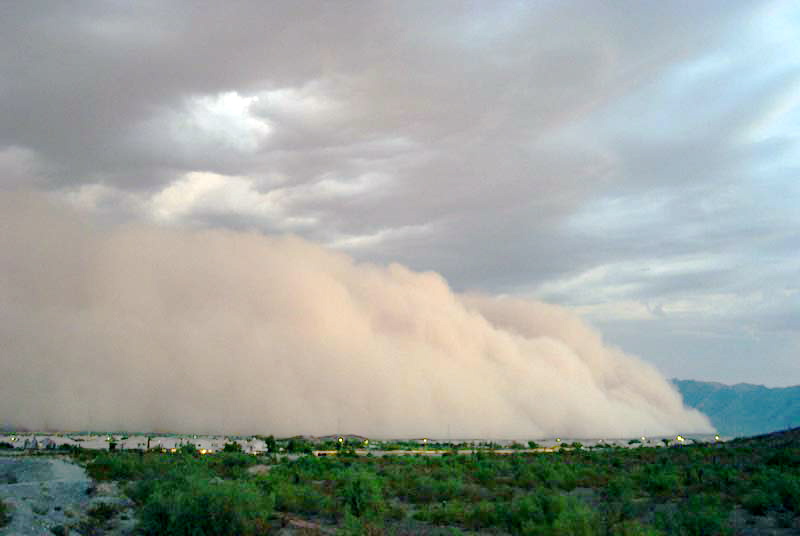
And more examples:

From Wikipedia, notable dust storms
- 1954-1991: The multi-year droughts in portions of North America of 1954-56, 1976–78, and 1987-91 were noted for dust storms of the intensity seen in the middle 1930s over some fraction of their coverage and timespan, and more sporadically during the times between. The three multi-year droughts were similar to the 1930s in storms being raised by synoptic scale weather events such as cyclones and cold fronts; otherwise the most common trigger is the outflow from convective activity, known as a haboob. Significant events of the latter variety occurred in Colorado and Kansas in May 2004 with winds to 100 mph, Minnesota and Wisconsin in June 2004 causing significant damage, and the upper Middle West in May 1988, notable for strong electrification and lightning activity and by one estimate reaching 30 000 ft or more. The first and third of this list reached black blizzard intensity, causing total blackout for some period ranging from 90 sec to 10 or more minutes, over some fraction of the ground covered. The 1987-91 drought was especially notable as in the 1930s for the large number of rain of mud events, often generated by dust in suspension and/or carried on upper-level winds.
- 1971: A dust storm that occurred near Tucson, Arizona on July 16 was extensively documented by meteorologists.
Dec 1, 1982 – High winds kicked up dust storms from near the California border, to Gila Bend, south of Phoenix. minutes,” said Keith the state’s chief National Weather Service … The San Diego Zoo was closed Tuesday for the fifth time in its 66- year history after wind blew down eucalyptus trees. …
From Mean Storm Hits Calif., Moves East .
Aug 20, 1999 – A large dust storm moves into the downtown Phoenix area causing 90-minute flight delays at the Sky Harbor International Airport. Wind gusts of up to 45 mph hampered visibility as the dust storm swept through the metro area from the southern portions of Arizona. …
From Phoenix gets down and dirty in big dust storm | Deseret News
Yeah, doomsday.
Haboob.
There’s a joke in there, somewhere.
The same study cited by The Atlantic claiming that “Today, the Earth is twice as dusty as it was in the 19th-century” more specifically found that “levels of dust around the globe doubled everywhere except above North America, where levels dropped a little bit.” (Source: http://news.discovery.com/earth/dust-atmosphere-earth-ecology-110201.html.) So much for the linkage to yesterday’s haboob in Phoenix…
Growing up in Karachi, Pakistan, which is on the southern edge of a desert, we looked forward to dust storms because they were always followed by cooler temperatures and rain. I wonder whether the same phenomena occurs in Arizona.
MJ says:
July 6, 2011 at 12:33 pm
Seriously? I have lived in Arizona for the last 15 years. I think I’ve seen a dust storm every year, and probably have been in four or five haboob. To me, it would represent a change in climate if they stopped.
Or to put it another way, why all the hubbub over a haboob?
Luther Wu says (July 6, 2011 at 2:33 pm): “Haboob. There’s a joke in there, somewhere.”
Q: What’s the plural of “haboob”?
A: The IPCC.
Yeah, yeah, back to the drawing board…
Somebody help me out here — when has the climate not changed?
Heck, I thought the climate is supposed to change. But obviously it’s not, or else it wouldn’t be such a big deal.
Mustafa says:
July 6, 2011 at 2:35 pm
Growing up in Karachi, Pakistan, which is on the southern edge of a desert, we looked forward to dust storms because they were always followed by cooler temperatures and rain. I wonder whether the same phenomena occurs in Arizona.
It varies from place to place, especially if it’s a large dust storm. For example, following yesterday’s dust storm some places got downpours while other places didn’t get a drop. Where I live in Scottsdale, we got just enough rain to turn the dust into reddish mud that quickly dried on to cars, skylights, patio furniture, etc.
If we didn’t have Weather that varied, we wouldn’t have Climate Change, and if the Climate never changed, neither would the Weather change.
Who would want to talk about Weather that never changed?
Who would bother with studying it, much less keep track of it?
I’ll take this kind of dust story as an assault on Weather itself.
Duh! It’s a DESERT! Where else do you have sand and dust storms? Talk about a bunch of morons…
As someone who has experienced mud rain a few times in my life all I can say is at least dust is dry, and any rain afterward would clean you up. If you want doomsday wait until thick brown goop covers everything you can see.
I once knew a Kansas farmer who grew up in the Dust Bowl era. If you ever have a chance to talk to such old timers, take the time to get them talking. The dust didn’t effect their lives for merely a day; it went on for years. This fellow told me the world seemed odd to him, when the rains returned and the landscape became green. It was a different world than the one he’d grown up in.
He called the dust “Dirt Storms.” He would have scorned the word “Haboob.” Either that, or he would assume you had sneezed, and would have said, “God bless you.”
I have a notebook somewhere full of the tales he told me. One theme was the strange effects dust-caused static electricity had. The spark plugs in cars wouldn’t fire correctly, and the only way to get a car to run properly was to ground the engine. So it was common to see cars driving about dragging a length of chain.
The farmers who survived that time, and stuck to their land, were some really tough men. They were rewarded by a time of bumper crops afterwards; it was one of the few times farmers drove Cadillacs.
I remember dust storms like this in south-eastern Australia during WW2. On one occasion my father got lost in our backyard.
They grounded flights at the air force flying schools, not because of visibility but because of the damage done by dust in the aircraft engines.
I have seen nothing to equal them since.
I was caught in a dust storm in 1972, outside of Spokane Washington, while traveling with my family from Vancouver B.C. The worst part was having to keep the windows up in an un-airconditioned car in very hot weather. We made it through the storm area before the highway was shut down.
I’ll note that at that time, global cooling was the concern of the day.
The clogging of air filters can be a problem for engines. Having sand worn propellers pales in comparison to stalling your aircraft because the air intake filters are clogged, for anyone foolish enough to think flying in a dust storm is no big deal.
Having grown up in Phoenix, in High School I learned that the particular type of dust storm, the haboob, that Phoenix had, occurs in the world, other than AZ, only in the Sahara, which is where it got it’s name.
It may have been named in AZ by the Arab camel handlers the Army brought in while testing whether camels would work in the Arizona desert – they didn’t work out.
I worked in Nigeria over 40 years ago (Geological Survey) and the dry season sent windborn red dust from the Sahara south over Nigeria which is called “The Harmattan”. On the ground, when you dig up the ground to inspect a mineral deposit you go through a few metres of this dust that has accumulated over centuries.
Caleb says:
July 6, 2011 at 4:02 pm
I once knew a Kansas farmer who grew up in the Dust Bowl era. If you ever have a chance to talk to such old timers, take the time to get them talking.
================================================================
Wonderful!!! I knew several. You’re correct. The experiences related to me seemed surreal, but consistent enough to know they were true. I didn’t have the sense to write any of it down. What I’d give to have just a few more days with my grandfathers and their neighbors. The old men that I knew are all gone now. Their sons are older and quickly fading from this earth.
Looking back through history, starting with WWI, there was an entire generation which knew nothing but sacrifice, heartache, poverty and hardship. Less than 10 years after WWI ended, the Great depression took hold of the world. Immediately after that, the Dust Bowl occurred. As soon as the Dust Bowl ended, the world was thrust into war, yet again, WWII. It is unfathomable to consider what a person born circa 1900-1910 in the dust bowl area would have endured or witnessed.(WWI they went, WWII they sent their children, and everything in between.) In my estimation, their metal is unparalleled. They were thrown in the hottest of blasts. Their dross quickly separated and thrown in again. The process was repeated until the finest of all metals remained. Harder than steel, more valuable than gold, finer than the finest of silver. And yet, their perseverance rewarded not them, but us.
post script. It’s interesting. I earlier had a conversation about a man I know. A son of a dough boy. A former POW of an infamous stalag. My uncle. I’m long overdue a visit to him. I think I’ll bring along a pad and paper.
PaulH says: “…there must be hockey stick dust chartists and computer dust modellers looking for a steady stream of grants” /sarc
These are known as haboobies.
James Sexton says:
July 6, 2011 at 1:37 pm
I assume…
Don’t. You assume too much.
@PaulH says:
July 6, 2011 at 12:38 pm “…Today, the Earth is twice as dusty as it was in the 19th-century.
That’s quite the factoid!…” I would call it “bulldust”.
@Bruce says:
July 6, 2011 at 1:20 pm “…Vostok Ice Cores say way more dust 20,000 years ago….”
Probably due to this:
http://www.museum.state.il.us/exhibits/larson/loess.html
Loess
“…Loess is a geologic term that refers to deposits of silt (sediment with particles 2-64 microns in diameter) that have been laid down by wind action (aeolian activity to geologists).
Extensive, thick loess deposits generally formed in areas bordering large, continental glaciers. Large volumes of meltwater flowed from the edges of these glaciers during the summer. This meltwater carried large amounts of sediments that formed as the glacier ground the bedrock over which it moved. Much of this sediment was silt-sized material known as rockflour. During the winter, when the glacier did not melt, the area where the water flowed was primarily dry. The winter winds would pick up the rockflour from these dry areas and carry it long distances in huge dust storms.
When the wind slowed, the silt would fall out and blanket the area. Frequently the resulting loess deposits are several meters thick (tens of feet). Because the source of the silt is the outwash from the glaciers, loess deposits are frequently most extensive and thickest downwind from large river valleys. An examination of a map of the thickness of surface loess deposits in Illinois confirms both of these observations….”
There are derivations of loess other than glacial outwash, but this may be the main source. If you’ve ever seen a stream fed by a glacier, often the water is a funny greenish-white color, almost opaque, due to the rock flour carried in it. The glacial maximums must have been times of enormous loess dust storms, especially in the late autumn and early winter, when everything was dry and before the winter snows set in and stuck.
Alexander Feht says:
July 6, 2011 at 7:15 pm
James Sexton says:
July 6, 2011 at 1:37 pm
I assume…
Don’t. You assume too much.
=================================
Then you write too vague.
I lived in the Phoenix area for about ten years. I’ve been through a lot of dust storms (I never heard ’em called Haboobs back then, in the 90’s).
They are a true and utter horrendous disaster! They can, in fact, make it necessary for you to wash your car! Oh, the horror….. /sarc
Anthony has it right. They are an inconvenience (that dust gets into everything). They are far less serious than, say, a hailstorm.
The only time I really hated it was when one caught me out on a bicycle ride, and it was a bad one. I took shelter under a bridge, used my shirt, plus some water, as a mask, and kept my eyes closed a lot. The bad part (blasting thick sandy dust) usually lasts just a few minutes, and this did. Within fifteen minutes I was on my way again. And that’s the worst one I remember.
Others forced me to pull over for a few minutes while driving, and later to have to blast my air intake filters with compressed air.
There is, however, one aspect of the dust storms that isn’t minor, and is largely man-caused; Valley Fever, a fungal lung infection. It comes from fungus in farmland and construction sites mainly, and by some estimates, 1/3 of Phoenix residents have had it. For most, it’s minor (many don’t even notice it). But for some, it can serious or even be fatal (less than 1% for the latter, but still, not good).
Blaming these on global warming… now that’s just insane, but utterly unsurprising.
Mustafa says:
July 6, 2011 at 2:35 pm
Growing up in Karachi, Pakistan, which is on the southern edge of a desert, we looked forward to dust storms because they were always followed by cooler temperatures and rain. I wonder whether the same phenomena occurs in Arizona.
###
Yes! I likewise have often wondered about Pakistan and similar areas of India.
The first and last photos–both of Phoenix–are awesome!
Dust storms here in Phoenix are quite common in the summer months. This one was nothing too special – kind of fun to watch from the front porch, and it was too bad that there were a couple of car crashes. Really though, nothing too catastrophic. It did cool off a bit today as it has been just starting to get nice and Arizona toasty for summer. We have had a fantastic spring this year.
Maybe it’s a typo for “Gloomsday”? 😉
;p