
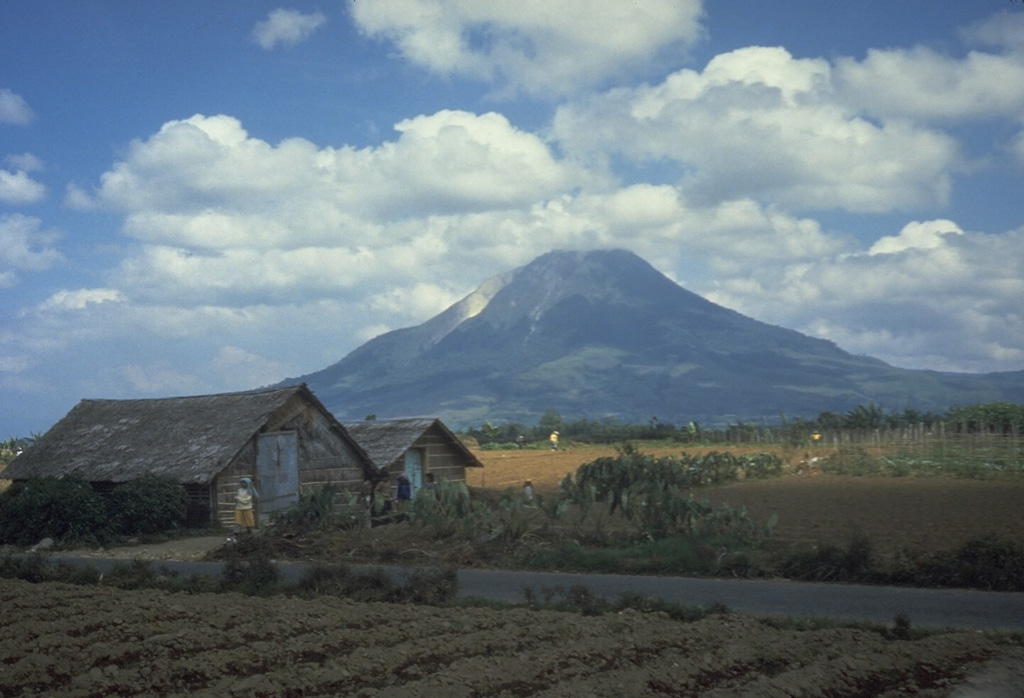
Located at 3.17°N 98.392°E the volcano erupted suddenly and without warning. The Jakarta Post and Xinhua have photos of the eruption: 
Mount Sinabung erupts: (Tribun Medan/Dedy Sinuhaji) Mount Sinabung in North Sumatra erupted on Sunday at 00.15 a.m. Antara news agency reported local villagers did not expect the eruption as the geophysics and meteorology agency just declared a normal status for the mountain. Villagers fled home to a safer location, but no police officers yet helped the evacuation process. On Saturday, the 2,400 meter-high mountain showed its volcanic activity by spewing black clouds. ===========================
From Xinhua: 
Villagers ride a motorcycle while covering their mouths at the district of Tanah Karo outside the city of Medan, North Sumatra, as the Mount Sinabung volcano spews smoke in the background August 28, 2010. (Xinhua/Reuters Photo)
Spokesman of National Disaster Management Agency Priyadi Kardono said the eruption has not been predicted much earlier like other volcanoes and authorities must conduct a quick preparation for emergency work as mount Sinabung’s seismic activity has been monitored intensively only since Friday after it showed an increase in activity.
Over 10,000 people have been internally evacuated after the eruption, Secretary of the provincial administration Edy Sofyan told Xinhua by phone.
Priyadi said that aid from Jakarta will be sent within days.
Mount Sinabung, whose last eruption occurred 400 years ago, is classified at category “B” which means it is not necessary to be monitored intensively, but other volcanoes in category “A,” must be monitored frequently, head of National Volcanology Agency named only Surono told Xinhua over phone from the province.
====================================================
The near equatorial location is in a position to have a lot of ash swept into the ITCZ and will bear watching.
h/t to WUWT reader Daniel H
Sinabung is not a dormant volcano – it’s classified as active. It has been emitting sulphur fumes for hundreds of years. It sits adjacent the Sumatran Fault.
Its situated close to Toba Caldera as well as very close to the Singkut Caldera. There are another couple of active cones only a few K’s away.
These are classified as B risk volcano’s in Indonesia. – There are plenty of A risk ones to look out for and the Indonesian Volcanic risk and geo thermal department has plenty of work on their hands and a limited budget to go around.
The B risk volcanos are listed as being active but quiet – at least not having an erutpion in the recent part of history.
Indonesia has the most active volcanos of any country. You can’t monitor them all.
The local people around Sinabung have there own dialects, calendar and written language. Local written history shows that there was an event such as the December 2004 back around 1880. Shortly after some of the local volcanos mentioned above showed activity. A few years after…… Krakatau.
Eduardo Ferreyra says:
August 29, 2010 at 1:23 am
Ivanka Charvatova´s paper:
http://www.giurfa.com/charvatova.pdf
Just wait, someone is going to say it’s from global warming, “…all those extra tonnes of co2 in the atmosphere is pressing down on the earth ….causing earthquakes…”
Can’t you feel all those tonnes? 😉
re Les Francis
Given volcano’s potential role in climate change, do you know if funding has impoved for research and monitoring?
@ur momisugly el gordo says:
August 29, 2010 at 1:36 am
“Thinking back, Tallbloke predicted an eruption right about now.”
Did he too? http://tallbloke.wordpress.com/2010/07/24/new-predictions-page/#comment-1469
I have mentioned on previous threads that there are 179yr `strings` of volcanic events within similar locations, and had said that the Philippines could be a hot spot this Autumn (re 1831);
http://www.volcano.si.edu/world/largeeruptions.cfm
So then, all of this is caused by COMGWAGDAGW?
Expanded out, that reads: CATASTROPHIC-OH-MY-GAWD-WE’RE-ALL-GONNA-DIIIEEEEE!-ANTHROPOGENIC-GLOBAL-WARMING.
Another day, another volcano. Sounds about right …
Ulric Lyons says: ‘I have mentioned on previous threads that there are 179yr `strings` of volcanic events within similar locations…’
Looking elsewhere (Climate Research News) it seems ‘the precessional rotation parameter is linked with the 179-yr cycle of the solar inertial motion previously identified by Jose (1965). A new prolonged minimum of solar activity may be imminent.’
There appears to be a very big story lurking here, but I can’t quite get my head around it.
Looks like another eruption, this time to at least 20,000 feet. See in comments
http://scienceblogs.com/eruptions/2010/08/new_eruption_at_sinabung_in_in.php
Dr. Erik Klemetti speculates that this activity is a precursor to a larger eruption.
Forget CO2, all we need is more ozone destruction, as if jet planes-space shuttles-spacecraft launches hadn’t done enough damage. That’s why we roast on moderate solar cycle max’s now, imho.
volcanic bromide bromine gas destroys ozone – Google Search
http://www.google.com/m?q=volcanic+bromide+bromine+gas+destroys+ozone
Volcanoes affect atmospheric ozone, our friend and foe
http://hvo.wr.usgs.gov/volcanowatch/2005/05_07_28.html
Volcanic Gases and Their Effects
http://volcanoes.usgs.gov/hazards/gas/index.php
Volcanic Sulfur Aerosols Affect Climate and the Earth’s Ozone Layer
http://volcanoes.usgs.gov/hazards/gas/s02aerosols.php
Boris Behncke predicted this uptick/reactivation of Etna about 5 months ago. He was reading the seismic activity.
http://scienceblogs.com/eruptions/2010/08/a_busy_day_for_etna_and_galera.php#comments
In any case there are no signs that at Etna a major destructive eruption is imminent (that would mean, a flank eruption from low elevation). What I consider the most likely scenario is that in the next few weeks to months we will see a gradual reactivation of the summit craters, and then for some time – which may be months to years – summit eruptions, which are the most beautiful thing one can imagine, and they are not a threat to populated areas and human property. They might occasionally disrupt air traffic, because they can release significant quantities of ash.
Then, as more magma usually rises into the volcano’s feeder system than exits from its summit craters, the mountain will gradually swell and become more unstable, and this will be recognized by the seismic activity and by the deformation monitoring, as well as gas emissions. In case of a major flank eruption – especially one from low on the flanks – there will possibly many weeks of premonitory deformation and seismicity, as was the case before the last eruption of this kind, in 1669.
The worst scenario we’re imagining is a flank eruption that develops extremely fast and emits lava at very high rates, as in 1981, when lava initially traveled at a speed of 3 km per hour – and the nearest population centers were 7 km away. Luckily in that case the lava passed between two villages. That was on the sparsely populated northwest side of Etna, near the town of Randazzo. An eruption of this type on the very densely populated southeast side would be an enormous challenge.
Funny anyway how I just posted that big Etna story one week ago and now the volcano is getting a bit more active.
I will keep you informed …
Posted by: Boris Behncke, Catania, Italy
b | August 26, 2010 3:27 PM
Twenty-one years ago I would have said something else, today I can only say: “The Chinese did it!”
PS: Have you noticed? The Chinese are doing everything bad these days. Well, blaming the old USSR was getting to be rather stale wasn’t it?
Eduardo, another Czech, Jaroslav Strestik, published a paper in 2003 showing a correlation of volcanic activity and longer term solar cycles (80 and 200 year cycles.)
http://articles.adsabs.harvard.edu/cgi-bin/nph-iarticle_query?2003ESASP.535..393S&data_type=PDF_HIGH&whole_paper=YES&type=PRINTER&filetype=.pdf
Sinabung still erupting, this from ABC news just in, http://www.abc.net.au/news/stories/2010/09/03/3002001.htm?section=justin .