The Heliospheric Current Sheet Tilt Angle and Implications for Friis-Christensen and Lassen Theory

Guest post by David Archibald
The Chairman of NOAA’s Solar Cycle 24 review panel, Douglas Biesecker, said back in March 2007 that the flattening of the heliospheric current sheet was one of the expected signatures of solar minimum (the Solar Cycle 23/24 transition). At times of weak solar activity, the month of transition can be relatively hard to pick, except for the flattening of the heliospheric current sheet, shown following:

This graph of the heliospheric current sheet tilt angle from 1976 shows sharp transitions from one solar cycle to the next. The data is from www.wso.stanford.edu
By comparison, Dr Svalgaard’s plot of four solar parameters from 2008, available at http://www.leif.org/research/TSI-SORCE-2008-now.png , shows a lot of latitude in picking the month of transition:
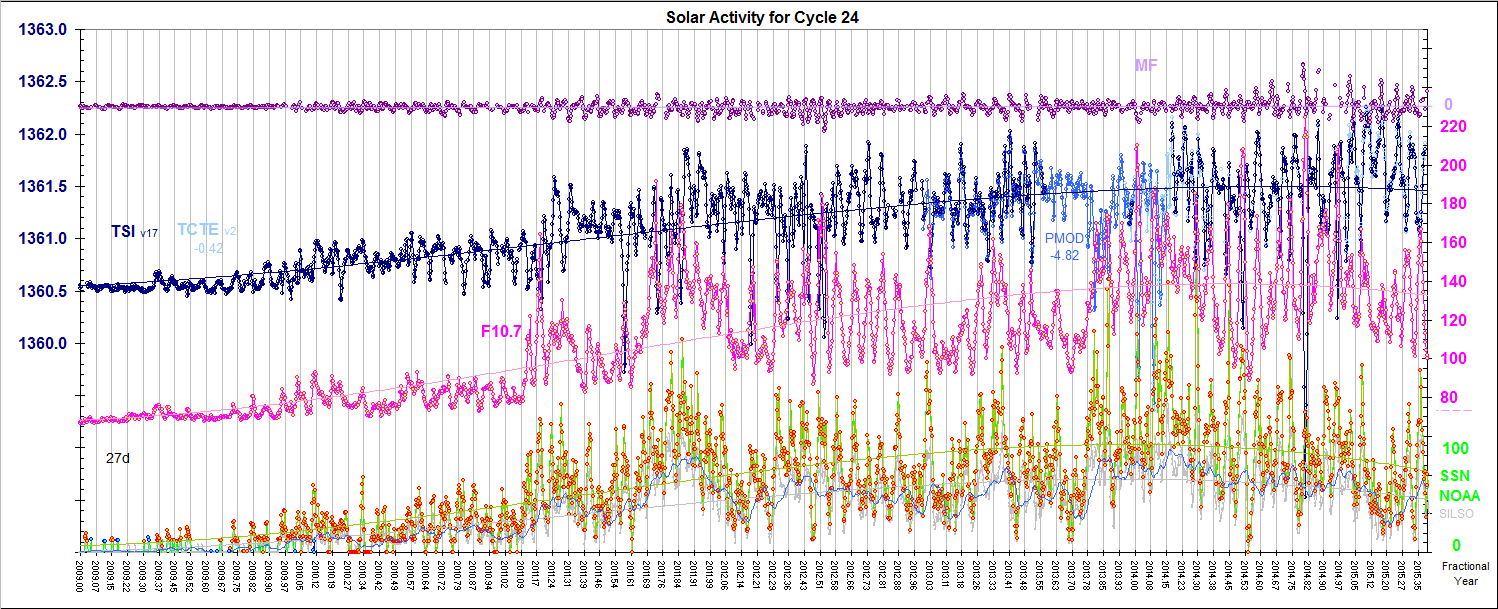

On top of his graphic I have plotted December 2008 which is commonly accepted as the month of the Solar Cycle 23/24 transition and October 2009, which was Carrington rotation 2089 and the month of transition based on flattening of the heliospheric current sheet. The MF doesn’t change character until this later date.
The big question is,”What are the implications for Friis-Christensen and Lassen theory?” Friis-Christensen and Lassen based their theory on a couple of hundred years of sunspot data, but what if the true relationship between solar cycle length and the Earth’s temperature over the following solar cycle is based on solar cycle length as measured from the flattening of the heliospheric current sheet rather than the rather subjective choice of minimum sunspot number? We will need possibly another hundred years of tilt angle data to get a definitive result, but in the meantime we can calculate the consequences.

Plotting the heliospheric current sheet-based data onto Butler and Johnson’s 1996 graphic for Armagh, Northern Ireland results in having to plot outside their graphic. These solar cycle length conditions are unprecedented in recorded Armagh history. They result in the predicted temperature decline over Solar Cycle 24 at Armagh to be 2.4°C, a full one degree cooler than the result based on commonly accepted solar cycle length data.
Applying heliospheric current sheet-based data to the plot for Hanover, New Hampshire derives a 3.1°C temperature decline, about one degree more than previously calculated. This is more than four times the purported 0.7°C temperature rise of the 20th century.

There is one way to determine whether or not Friis-Christensen and Lassen theory should be based on solar cycle length based on flattening of the heliospheric current sheet. If the average temperature decline at Hanover, New Hampshire over Solar Cycle 24 is 3.1°C rather than the previously predicted 2.2°C, then that will be early confirmation that flattening of the heliospheric current sheet should be used. We will only have to wait until early next decade for that data.
David Archibald
August, 2010
Suzanne says:
August 16, 2010 at 4:00 am
Note: para – [68] Further, our reconstructions do not confirm the existence of a magnetic floor at 4.6 nT as proposed by Svalgaard and Cliver [2007].
Steinhilber et al have a problem with the extrapolation to low HMF B-values. It shows most clearly in their Figure 9, where most of the dips reach [meaningless] negative values.
In our http://www.leif.org/research/Heliospheric%20Magnetic%20Field%201835-2009.pdf we address this problem specifically with the latest dip where we have good data. See the discussion of Figures 14 and 15.
There are indications that these dips to not really reflect a change in the HMF, but result from other [terrestrial] effect, volcanoes, climate, etc. See
“this implies that more than 50% of the 10Be flux increase around, e.g., 1700 A.D., 1810 A.D. and 1895 A.D. is due to non-production related increases!”
http://arxiv.org/ftp/arxiv/papers/1004/1004.2675.pdf
A COMPARISON OF NEW CALCULATIONS OF THE YEARLY 10Be PRODUCTION IN THE EARTH’S POLAR ATMOSPHERE BY COSMIC RAYS WITH YEARLY 10Be MEASUREMENTS IN MULTIPLE GREENLAND ICE CORES BETWEEN 1939 AND 1994 – A TROUBLING LACK OF CONCORDANCE, PAPER #2; W.R. Webber, P.R. Higbie, and C.W. Webber
Remember that a 10Be increase is a decrease of HMF B.
Leif Svalgaard says:
August 15, 2010 at 9:48 am
The IR reaches the ground and heats it. The UV does not.
Yes, this was discussed at length at the recent SORCE meeting: http://lasp.colorado.edu/sorce/news/2010ScienceMeeting/agendas.html
See that papers by Harder: http://lasp.colorado.edu/sorce/news/2010ScienceMeeting/doc/Session3/3.02_Harder_SSI.pdf
and by Calahan: http://lasp.colorado.edu/sorce/news/2010ScienceMeeting/doc/Session4/4.04_Cahalan_atmos_model.pdf
———————-
Having looked over the material Leif provided above, I note the short times series of satellite measurement of SSI stated in Cahalan et al (http://lasp.colorado.edu/sorce/news/2010ScienceMeeting/doc/Session4/4.04_Cahalan_atmos_model.pdf )
-TSI28 year history –continuous observations over ~ 3 solar cycles
-SSI 6 year history commenced with SORCE SIM
-Half a single solar cycle observed thus far
-Until SORCE, comparisons have previously been made between individual
reference spectra, not full time series at UV, VIS and IR wavelengths.
I note the overall picture of SSI magnitude is shown on Page 4 of the presentation of the paper by Harder et al (http://lasp.colorado.edu/sorce/news/2010ScienceMeeting/doc/Session3/3.02_Harder_SSI.pdf )
I take from Harder:
1) They use SSI data from SIM for period of 4 years , mid 2004 to mid 2009
2) The 4 yr period corresponds solely to the a declining portion of SC 23 as follows:
a.Begins at almost midpoint in the decline of SC 23 from maxima
b.Ends at about 1 yr before the minima between SC 23 and SC 24
3) My take over this period is the delta SSI for various solar wavelength bands are:
a. Delta SSI due to UV is approximately: -1.0 Watts per m squared
b. Delta SSI due to VIS is approximately: +0.7 “ “ “ “
c. Delta SSI due to NIR is approximately: +0.3 “ “ “ “
d. Approximate Total delta SSI: 0.0
My thoughts:
1) Overall, need several solar cycles more SIM data, we currently have only approximately half of a solar cycle of satellite measurements of SSI by SIM.
2) Delta SSI observed data by SIM for 4 months is . . . interesting enough to seek more knowledge
3) To me of interest is the implication of positive NIR delta SSI during periods lower solar activity as compared to higher periods. (Not that VIS or UV are considered less important, one thing at a time)
a. It interesting to me because NIR can directly reach the earth surface with some potentially interesting interactions with atmospheric gases on the way to the surface.
b. Can we infer that for longer cycles with lower solar activities versus shorter cycles with higher activities that the NIR SSI increases enough to have measureable impact on the earth energy balance? Especially impact on temperature at the lower troposphere and land/ocean surfaces? I don’t know the answer, thinking about it. Probably not enough info above to only be interesting.
John
John Whitman says:
August 16, 2010 at 12:28 pm
-Half a single solar cycle observed thus far
For this kind of thing that is probably enough indication of the general situation.
I think this is relevant to the variations we are talking.
There is some tentative evidence that the sun may be involved. Earlier this year astrophysicist Mike Lockwood of the University of Reading, UK, showed that winter blocking events were more likely to happen over Europe when solar activity is low – triggering freezing winters (New Scientist, 17 April, p 6).
Now he says he has evidence from 350 years of historical records to show that low solar activity is also associated with summer blocking events (Environmental Research Letters, in press). “There’s enough evidence to suspect that the jet stream behaviour is being modulated by the sun,” he says.
found it in http://www.icecap.us/
it is from http://www.newscientist.com/article/mg20727730.101-frozen-jet-stream-leads-to-flood-fire-and-famine.html as far as I can see.
Now the jet stream is a formation that affects the northern hemisphere and its fine structure is lost when temperatures are averaged over the globe or hemisphere. Nevertheless its effect is strong. It is a reasonable hypothesis that the variations seen in the Butler and Johnson plots are a function of the jet stream behavior a function of the length of the cycle, which will appear in the next cycle.
Leif Svalgaard says:
August 16, 2010 at 3:01 pm
For this kind of thing that is probably enough indication of the general situation.
————-
Leif,
I take your words as encouragement. : )
My next task is to look at the NIR delta SSI observed in comparison to the earth/ocean emitted IR dynamics. Fancy words, but perhaps you get my unformed drift.
John