The Heliospheric Current Sheet Tilt Angle and Implications for Friis-Christensen and Lassen Theory

Guest post by David Archibald
The Chairman of NOAA’s Solar Cycle 24 review panel, Douglas Biesecker, said back in March 2007 that the flattening of the heliospheric current sheet was one of the expected signatures of solar minimum (the Solar Cycle 23/24 transition). At times of weak solar activity, the month of transition can be relatively hard to pick, except for the flattening of the heliospheric current sheet, shown following:

This graph of the heliospheric current sheet tilt angle from 1976 shows sharp transitions from one solar cycle to the next. The data is from www.wso.stanford.edu
By comparison, Dr Svalgaard’s plot of four solar parameters from 2008, available at http://www.leif.org/research/TSI-SORCE-2008-now.png , shows a lot of latitude in picking the month of transition:
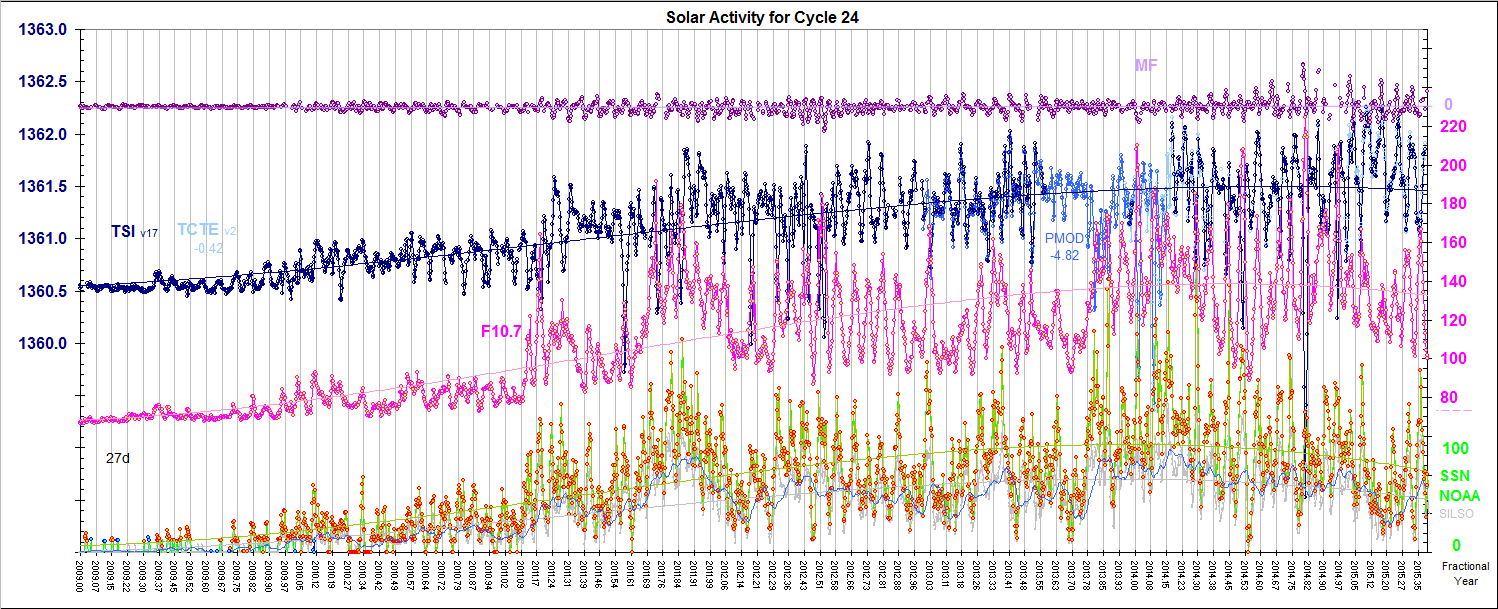

On top of his graphic I have plotted December 2008 which is commonly accepted as the month of the Solar Cycle 23/24 transition and October 2009, which was Carrington rotation 2089 and the month of transition based on flattening of the heliospheric current sheet. The MF doesn’t change character until this later date.
The big question is,”What are the implications for Friis-Christensen and Lassen theory?” Friis-Christensen and Lassen based their theory on a couple of hundred years of sunspot data, but what if the true relationship between solar cycle length and the Earth’s temperature over the following solar cycle is based on solar cycle length as measured from the flattening of the heliospheric current sheet rather than the rather subjective choice of minimum sunspot number? We will need possibly another hundred years of tilt angle data to get a definitive result, but in the meantime we can calculate the consequences.

Plotting the heliospheric current sheet-based data onto Butler and Johnson’s 1996 graphic for Armagh, Northern Ireland results in having to plot outside their graphic. These solar cycle length conditions are unprecedented in recorded Armagh history. They result in the predicted temperature decline over Solar Cycle 24 at Armagh to be 2.4°C, a full one degree cooler than the result based on commonly accepted solar cycle length data.
Applying heliospheric current sheet-based data to the plot for Hanover, New Hampshire derives a 3.1°C temperature decline, about one degree more than previously calculated. This is more than four times the purported 0.7°C temperature rise of the 20th century.

There is one way to determine whether or not Friis-Christensen and Lassen theory should be based on solar cycle length based on flattening of the heliospheric current sheet. If the average temperature decline at Hanover, New Hampshire over Solar Cycle 24 is 3.1°C rather than the previously predicted 2.2°C, then that will be early confirmation that flattening of the heliospheric current sheet should be used. We will only have to wait until early next decade for that data.
David Archibald
August, 2010
Leif Svalgaard says:
August 13, 2010 at 9:54 pm
anna v had said:
August 13, 2010 at 9:38 pm
I would like to see 100 graphs of the Buttler and Johnson type, i.e following cycle temperature versus local temperatures before I dismiss it as statistically insignificant.
I have seen a number of others from other people and they show similar correlations.
and Leif replied:
Beware of confirmation bias. Would the other people show their graphs if there was no correlation. Also, on decadal and longer time scales local temperatures tend to be similar to global ones.
See also my response to robert: Leif Svalgaard says:
August 13, 2010 at 8:54 pm rbateman says
I am well aware of confirmation bias and of the misuse of statistics.
If I were in the field, I would check for long local temperature records, ideally the world over, recording latitude and longitude, and plot next cycle temperatures against length of the cycle for each location . It may be that the five or so locations that I have seen plotted have been cherry picked to confirm the statement “long cycles are followed by colder temperatures”. This would become clear by such an analysis.
Dr. Svalgaard, I would like to reproduce the middle panel of Mursula & Zieger’s Figure 3 (filtered annual variation of aa index):
Mursula, K.; & Zieger, B. (2001). Long-term north-south asymmetry in solar wind speed inferred from geomagnetic activity: A new type of century-scale solar oscillation? Geophysical Research Letters 28(1), 95-98.
http://spaceweb.oulu.fi/~kalevi/publications/MursulaAndZieger2001.pdf
Can you outline the necessary calculations?
Leif Svalgaard says:
August 14, 2010 at 9:06 am
But it was those dips and spikes that F-C&L claimed constituted the ‘correlation’ . Take these away and the graph is flat [as it the solar cycle lengths]. They can’t have it both ways.
Not flat, less spiky. The trend line would still wave around a bit. Up to 1880, down to 1935, up to 1965, down to 1980, up to 2003, down after that.
anna v says:
August 14, 2010 at 10:26 am
It may be that the five or so locations that I have seen plotted have been cherry picked to confirm the statement “long cycles are followed by colder temperatures”. This would become clear by such an analysis.
Maybe, on the other hand the F-C&L ‘correlation’ was based on hemispheric data, not local data. On the basis of that [non-existing] correlation people consider it for established that there is such a correlation, even to the point that they would be willing to go look for it locally. This is kind of backwards. In the normal course of science, if a correlation has been shown to be spurious, one doesn’t dig much further [except the die-hard believers].
Paul Vaughan says:
August 14, 2010 at 10:45 am
Dr. Svalgaard, I would like to reproduce the middle panel of Mursula & Zieger’s Figure 3 (filtered annual variation of aa index): … Can you outline the necessary calculations?
I have no idea what they are doing. They refer to a paper 1 where they give the method. I routinely dismiss papers out of hand that are based on filtered, bandpassed data [unless they agree with my views, of course 🙂 ].
That there is a variation of the kind they are showing has been known for along time, e.g. see http://www.leif.org/research/suipr699.pdf [section 9, ~page 50].
The abstract of paper 1 says:
“Annual variation has maximum amplitude around sunspot minima. The phase of annual variation reverses soon after solar maxima”
But the conclusion states:
“The phase of annual variation changes from one solar minimum to another”
This tends to turn me off. If you can convince me that there is something to it, I might change my mind. If memory serves, data since ~2000 does not support their pattern. But strong convictions die hard and slow.
tallbloke says:
August 14, 2010 at 10:56 am
The trend line would still wave around a bit. Up to 1880, down to 1935, up to 1965, down to 1980, up to 2003, down after that.
I guess the faithful cannot be rocked in their belief, but make it quantitative and show us. I did that in my analysis. I’m not given to hand waving. And what trend line?
Paul Vaughan says:
August 14, 2010 at 10:45 am
“The phase of annual variation changes from one solar minimum to another”
Perhaps, they just expressed that clumsily [but I’m not happy with having to play guessing games], and that they mean that it is opposite at successive minima. In any event during the past minimum, solar wind speed was high in the spring, when it should have been the fall.
For what it might be worth, I filtered the data referenced by David Archibald from the Mt. Wilson Observatory with 25-term Chebyshev equivalent recursive series approximations using:
x= -Cos(pi()*(date-date_strt)/(date_end-date_strt))
The filtered data for solar cycle 23 seems to show that the sun, after a normal maximum around Y2000, might have ‘slipped a gear’ and produced a secondary maximum sometime around Y2003 that was, perhaps, 16 to 33 percent of the strength of a normal max.
Paul Vaughan says:
August 14, 2010 at 10:45 am
That there is a variation of the kind they are showing has been known for along time, e.g. see http://www.leif.org/research/suipr699.pdf [section 9, ~page 50].
this is for geomagnetic activity.Solar wind speed is another matter.
Sunspots may be wasting your time. This is the real villain:
http://www.vukcevic.talktalk.net/Driver.htm
Re: Leif Svalgaard
I agree that Mursula & Zieger haven’t got it right.
I credit them for starting an interesting investigation, but it isn’t finished. I suspect 2 other factors (contributing to the pattern in the middle panel of their figure 3). I have some work to do…
*******
Leif Svalgaard says:
August 12, 2010 at 7:34 pm
In the end, it is a question of energy. If the planets were 100 times more massive and 10 times closer, they would exert a strong tidal influence. We see that for other stars, but for today’s solar system there is not enough energy in the planetary influences to have any effect.
*******
This should be the first and only answer necessary to the “planetary alignment” or “solar torque” questions.
Leif Svalgaard says:
August 14, 2010 at 11:23 am
Maybe, on the other hand the F-C&L ‘correlation’ was based on hemispheric data, not local data. On the basis of that [non-existing] correlation people consider it for established that there is such a correlation, even to the point that they would be willing to go look for it locally. This is kind of backwards. In the normal course of science, if a correlation has been shown to be spurious, one doesn’t dig much further [except the die-hard believers].
You seem to be ignoring the microscope effect.
In the middle ages there was no correlation between dirt and diseases, (except the instinctive one built on our DNA). Then the microscope was invented and doctors started washing their hands and and demand boiling of the rags used in births, and women started surviving birthing.
In this particular case , that there is no global correlation does not exclude local ones that will be averaged out in globalizing. And it does not matter if people started from a wrong paper. Columbus thought he found India.
anna v says:
August 14, 2010 at 9:33 pm
And it does not matter if people started from a wrong paper. Columbus thought he found India.
so one should seek out all correlations that have failed and vigorously pursue them in further detail… The day does not enough hours for that. The funding agencies [and taxpayers] rightly mostly take a dim view of such proposals.
Leif, I am not seeking a long sophist argument.
I am saying that the Butler and Johnson plot is intriguing, even if it started from a wrong premise, and as such it would be interesting to see if it is a fortuitous correlation, or cherry picking , or what.
Scientific literature is full of such chases that most of the time end in “the treasure was coals”.
Fom another thread I was reminded of cold fusion, all the physicists I knew were intrigued, and many solid state ones tried to reproduce the results.
Nevertheless, looking for the pot of gold at the bottom of the rainbow is the impetus for scientific research, that is how discoveries are made .
RE: Spector: (August 14, 2010 at 1:09 pm)
Correction: I see I misidendified the source of the information in my previous post.
The correct source that I should have cited is the Wilcox Solar Observatory. “The observatory is located in the foothills just west of the Stanford University campus.”
The www link in the main article above does not appear to be functional. The current working link appears to be:
http://wso.stanford.edu/
Leif,
This Archibald post caused me to reflect on where we have wandered in the past year here at WUWT on the subject of solar variation effects [as opposed to the “solar constant] on the earth system energy.
So, I went back over some WUWT solar posts for last year.
Of all the candidates discussed, it appears to me that there is one candidate that stands out for more focus on. It is the difference in the energy distribution of TSI during solar cycle minima as compared to maxima. That is, if I recall correctly, it has been observed that the TSI associated with solar cycle minima have an increased energy in the IR region and lowered energy in the UV region. Note, I am not focusing here on the very small delta TSI variation between minima and maxima, but focusing on how the TSI is delivered during minima versus maxima.
Question: Any recent studies of this that you can point me to that would shed light on the possibility of the above having a significant impact on earth system?
John
Moderators,
If this post goes ballistic, as it has started . . . . . you guys better cancel some dates and stock up on Red Bull and popcorn.
Good moderating to ya . . .
John
Moderators,
Ooops, wrong WUWT post!!!! I meant to post at the “BREAKING: New paper makes a hockey sticky wicket of Mann et al 98/99/08” post.
Tooooo eager on the ENTER key, again. Sorry about that.
John
John Whitman says:
August 15, 2010 at 7:55 am
if I recall correctly, it has been observed that the TSI associated with solar cycle minima have an increased energy in the IR region and lowered energy in the UV region. Note, I am not focusing here on the very small delta TSI variation between minima and maxima, but focusing on how the TSI is delivered during minima versus maxima.
The IR reaches the ground and heats it. The UV does not.
Question: Any recent studies of this that you can point me to that would shed light on the possibility of the above having a significant impact on earth system?
Yes, this was discussed at length at the recent SORCE meeting: http://lasp.colorado.edu/sorce/news/2010ScienceMeeting/agendas.html
See that papers by Harder: http://lasp.colorado.edu/sorce/news/2010ScienceMeeting/doc/Session3/3.02_Harder_SSI.pdf
and by Calahan: http://lasp.colorado.edu/sorce/news/2010ScienceMeeting/doc/Session4/4.04_Cahalan_atmos_model.pdf
John
Jeff L says:
August 12, 2010 at 8:27 pm
I apologise for the delayed response. I am currently en route to Houston for an oil exploration conference. On the subject of plots of other sites, I have done plenty. There are good correlations for de Bilt, Archangel, the CET. Generally, the more northerly in Europe, the better the correlation. There is no correlation for Milan, Athens etc. A month or so ago, I put up a post on a report by a Norwegian solar physicist who showed very good correlations for most of Norway. In the US, I found good correlations in four sites in the northeast, including Providence, Rhode Island, West Chester PA.
It is my duty to warn of the cooling underway.
Leif,
Appreciate the references. Homework . . . . oh boy.
Now maybe I will retire just to try keep up with all this.
Also, I apologize for any incidental embarrassment to you caused by my emotional blow-up at Ninderthana on this thread the other day.
John
David Archibald says: August 15, 2010 at 10:03 am
I would agree with two of points:
– Generally, the more northerly in Europe, the better the correlation (magnetic field gets stronger).
– to warn of the cooling underway
I would suggest, when you do have some time to spare, to take a good look at
http://www.vukcevic.talktalk.net/LFC1.htm
The CET driver I have identified has a written and unquestionable record going back to 1600AD, but it is most unlikely to be directly linked to the solar activity.
Here’s a paper some may find of interest:
Interplanetary magnetic field during the past 9300 years inferred from cosmogenic radionuclides
Steinhilber, F., J. A. Abreu, J. Beer, and K. G. McCracken (2010), Interplanetary magnetic field during the past 9300 years inferred from cosmogenic radionuclides, J. Geophys. Res., 115, A01104, doi:10.1029/2009JA014193.
http://www.eawag.ch/organisation/abteilungen/surf/publikationen/2010_steinhilber.pdf
Abstract: [1] We have reconstructed the interplanetary magnetic field (IMF), its radial component, and the open solar magnetic flux using the solar modulation potential derived from cosmogenic 10Be radionuclide data for a period covering the past 9300 years. Reconstructions using the assumption of both constant and variable solar wind speeds yielded closely similar results. During the Maunder Minimum, the strength of the IMF was approximately 2 nT compared to a mean value of 6.6 nT for the past 40 years, corresponding to an increase of the open solar magnetic flux of about 350%. We examine four cycles of the Hallstatt periodicity in the IMF with a mean period of 2250 years and an amplitude of 0.75 nT. Grand solar minima have largely occurred in clusters during the Hallstatt cycle minima around the years 5300, 3400, 1100, and +1500 A.D. The last cluster includes the Dalton, Maunder, and Sporer minima. We predict that the next such cluster will occur in about 1500 years. The long-term IMF has varied between 2 nT and 8 nT and does not confirm a proposed floor (lower limit). There is a slowly changing long-term trend of amplitude 1.5 nT, with a minimum around the year 4600 and a maximum around 0 A.D. that may be of solar origin but which also may be due to unknown long-term changes in the atmospheric effects or geomagnetic field intensity.
Note: para – [68] Further, our reconstructions do not confirm the existence of a magnetic floor at 4.6 nT as proposed by Svalgaard and Cliver [2007]. During the past 9300 years our reconstructions of 40 year averaged IMF have not exceeded values of about 8 nT, which points to an upper limit of the IMF.
Suzanne says:
August 16, 2010 at 4:00 am
Here’s a paper some may find of interest:
Interplanetary magnetic field during the past 9300 years inferred from cosmogenic radionuclides
Steinhilber, F., J. A. Abreu, J. Beer, and K. G. McCracken (2010), Interplanetary magnetic field during the past 9300 years inferred from cosmogenic radionuclides, J. Geophys. Res., 115, A01104, doi:10.1029/2009JA014193.
http://www.eawag.ch/organisation/abteilungen/surf/publikationen/2010_steinhilber.pdf
…………………………………
Thanks for the link.
Leif, you’re on top of this? Just making sure.
Need to get back to the confounding ribbon config., which seems to be obscuring this bigger picture.
Lebedev Physics Institute, Soalr Maximum may be postponed again.
http://notrickszone.com/2010/08/16/lebedev-physics-institute-solar-maximum-may-be-postponed-again-says/#more-3008