The Heliospheric Current Sheet Tilt Angle and Implications for Friis-Christensen and Lassen Theory

Guest post by David Archibald
The Chairman of NOAA’s Solar Cycle 24 review panel, Douglas Biesecker, said back in March 2007 that the flattening of the heliospheric current sheet was one of the expected signatures of solar minimum (the Solar Cycle 23/24 transition). At times of weak solar activity, the month of transition can be relatively hard to pick, except for the flattening of the heliospheric current sheet, shown following:

This graph of the heliospheric current sheet tilt angle from 1976 shows sharp transitions from one solar cycle to the next. The data is from www.wso.stanford.edu
By comparison, Dr Svalgaard’s plot of four solar parameters from 2008, available at http://www.leif.org/research/TSI-SORCE-2008-now.png , shows a lot of latitude in picking the month of transition:
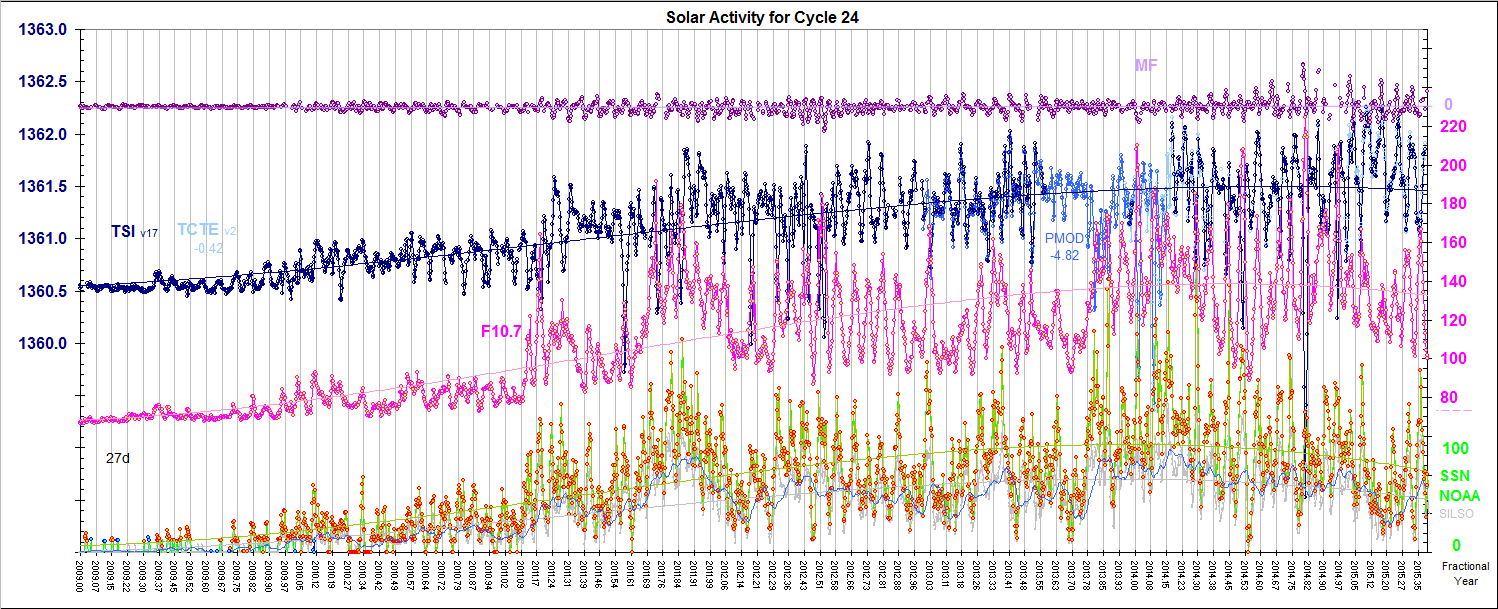

On top of his graphic I have plotted December 2008 which is commonly accepted as the month of the Solar Cycle 23/24 transition and October 2009, which was Carrington rotation 2089 and the month of transition based on flattening of the heliospheric current sheet. The MF doesn’t change character until this later date.
The big question is,”What are the implications for Friis-Christensen and Lassen theory?” Friis-Christensen and Lassen based their theory on a couple of hundred years of sunspot data, but what if the true relationship between solar cycle length and the Earth’s temperature over the following solar cycle is based on solar cycle length as measured from the flattening of the heliospheric current sheet rather than the rather subjective choice of minimum sunspot number? We will need possibly another hundred years of tilt angle data to get a definitive result, but in the meantime we can calculate the consequences.

Plotting the heliospheric current sheet-based data onto Butler and Johnson’s 1996 graphic for Armagh, Northern Ireland results in having to plot outside their graphic. These solar cycle length conditions are unprecedented in recorded Armagh history. They result in the predicted temperature decline over Solar Cycle 24 at Armagh to be 2.4°C, a full one degree cooler than the result based on commonly accepted solar cycle length data.
Applying heliospheric current sheet-based data to the plot for Hanover, New Hampshire derives a 3.1°C temperature decline, about one degree more than previously calculated. This is more than four times the purported 0.7°C temperature rise of the 20th century.

There is one way to determine whether or not Friis-Christensen and Lassen theory should be based on solar cycle length based on flattening of the heliospheric current sheet. If the average temperature decline at Hanover, New Hampshire over Solar Cycle 24 is 3.1°C rather than the previously predicted 2.2°C, then that will be early confirmation that flattening of the heliospheric current sheet should be used. We will only have to wait until early next decade for that data.
David Archibald
August, 2010
Leif Svalgaard says: August 13, 2010 at 7:48 am
……………………………..
talking trough your hat again. You managed to ban me from that SC24 a year ago. It was obvious from day no.1 (as Geoff S. immediately realised) I was posting under pseudonym, as here lot of people are doing the same, eg. Dr. Bill, Dave etc, would you have any idea who they might be?
You even suggested I was ‘danger to society’ not to mention countless insults, which a wise man usually ignores.
I shall not bother with your deliberate distortion of my ideas and all other nonsense you come up with.
The rest of this post is for those 450+ readers (including University Of Exeter, Woods Hole Oceanographic Institution, Massachusetts Institute Of Technology, Johns Hopkins University Applied Physics Laboratory, Usaisc Headquarters, Leeds University, Universitaet Bonn, National Center For Atmospheric Research Lafayette, Nanyang Technological University Singapore, University Of Washington, The Boeing Company, The Aerospace Corporation Torrance, and many others) who during the last 24 hours have found it of sufficient interest to look at graphs.
I think paleomagnetic dating (intensity and actual dates) is just as uncertain as is the temperature reconstruction from various proxies, so the coincidence between them for the last two millennia is more than remarkable.
This time whole period 100-1700AD is a single graph, while 1600-2000 is plotted separately since it is from different and a higher resolution geomagnetic data base.
http://www.vukcevic.talktalk.net/LFC-B.htm
To understand what is suggested, the insets should be considered in detail.
I assume that warm currents flowing into the Arctic do not have the same temperature transfer factor as the cold currents flowing out of it (hence discontinuity in the graph around 1100AD). There is also about 30+ year time shift between the temperature and geomagnetic data for period 100 -1100AD.
Leif Svalgaard says:
August 13, 2010 at 7:23 am
I don’t think that the sodiums ions in our oceans play any role in creating sunspots…
It was a simple metaphor. Not simple enough apparently. 😉
How about getting back on topic and discussing what I said about the Christiansen-Lassen correlation between solar cycle length and global temperature?
Do you agree it was working quite well up until the 1950’s?
Ref – John Whitman says:
August 13, 2010 at 10:17 am
Me too. Only us real sinners know what real sin is, and is not. Sometimes it feels good to not, sometimes it feels better to not not and to just ‘let ‘er rip’ as the saying goes.
I fear no dragons or turtles?
I think that the broader theme of this post is something like: energy sources external to the earth and potential impact on earth system.
Therefore, I offer the following two categories, that once reviewed and refined, we can start to populate. It could evolve to more than two categories, perhaps.
A) Phenomena external to the earth system that are established to have a physical mechanism(s) which add energy to the earth system and that energy is being measured currently, regardless of the magnitude of the energy.
B) Phenomena external to the earth system which could potentially add energy to the earth system but for which a physical mechanism has not yet been widely established.
John
“peterhodges says:
August 13, 2010 at 11:48 am
here is archibald, with armagh etc actual temp records, which IMHO is much more efficacious than using the dubious crutem etc manufactured records anyway”
Huh!!!!
( http://) star.arm.ac.uk/preprints/445.pdf
Series IV, twicedaily temperatures from inside an unheated room from a thermometer attached to the barometer (1795 to circa 1950), (not sure this series was used)
“gap from June 1825 to December 1833 in the Series I… early 19th century, Dunsink Observatory near Dublin maintained a climate series. However, though the readings were often made twice daily, as required for our exercise, they are sporadic with occasional gaps of several months. Irregular timing would normally have made the observations useless, but in this case, as the time of each individual observation was recorded, we can make an appropriate correction.”
“namely Series I, II and III, we have investigated the various instrumental and exposure effects and, where necessary, we have made corrections.”
“(1) instrumental corrections relating to the particular thermometer in use at any one time; (2) corrections which relate to the time of observation; (3) corrections relating to the exposure of the thermometers”
“The bright metal casing referred to by Robinson was supported by brackets fixed to the window frame so that the thermometer could be viewed from inside the building through a central pane of glass which was hinged so that it could be opened when required. The height of the thermometer casing is 3.35 m above current ground level”
Fig 4 is worth a look!!!!
“1846 and 1865, we can surmise that the maximum and minimum thermometers in use at those times were fixed in a horizontal position close to, or possibly on the sill of, the north window of the East (1827) Tower”
etc!
This must be a better record that cru’s !!!!!! You’re kidding
/harry
Brego says:
August 13, 2010 at 9:32 am
My question is, if sunspots cause a transient decline in TSI, why is the TSI greatest when the SSN the highest and average sunspot area the highest? That seems backwards. Or is the decline diagrammed in the above image an unusual event?
A sunspot is surrounded by bright ‘faculae’. These are more visible near the limb while the spot is most visible near the center of the disk. So when a large sunspot with attendant faculae crosses the disk, you first see the increases TSI from the faculae, then the dip caused by the spot, and finally the increased radiation from the faculae again. Overall the faculae are twice as bright as the sunspot, so the net effect is a brightening, hence an increase of TSI when there are many spots [with their brighter faculae].
peterhodges says:
August 13, 2010 at 11:49 am
also, i would like to know if leif, archibald, and f-c&l use the same solar cycle length record
There is no ‘official’ cycle length record, but it is trivial to take the [smoothed] official sunspot number and determine the times from minimum to minimum and from maximum to maximum. In the few cases of double minima or double maxima, you use both and just take the average.
anna v says:
August 13, 2010 at 12:39 pm
you referenced above is the same as fig 7, bottom ? They do not look the same.
Upon close reading you’ll discover that Lassen’s curve an eleven-year running mean of the Northern Hemisphere anomalies. Lassen [who was my advisor at the University of Copenhagen way back when] does not clearly identify the source, but with Jones mentioned, one might surmise HADCRU or something close.
vukcevic says:
August 13, 2010 at 12:57 pm
You managed to ban me from that SC24 a year ago.
People get banished for bad behaviour.
I was posting under pseudonym, as here lot of people are doing the same
The difference is that they do not games, such as refer to their own glorified work as ‘superior work’, ‘convincing analysis’, etc.
You even suggested I was ‘danger to society’
People that peddle pseudo-science are a danger [you can rest comfortably in the fact that you are not the only one] in this age where it is important that the public understand [or at least are aware of] the real science.
who during the last 24 hours have found it of sufficient interest to look at graphs.
You forgot me. I looked too. I’m sure they all shook their head in disbelief or sadness.
This time whole period 100-1700AD is a single graph, while 1600-2000 is plotted separately since it is from different and a higher resolution geomagnetic data base.
You still plot data upside-down.
tallbloke says:
August 13, 2010 at 1:04 pm
Do you agree it was working quite well up until the 1950′s?
Not at all, just look at: http://www.leif.org/research/Cycle%20Length%20Temperature%20Correlation.pdf
How you can entertain such a silly thing is beyond comprehension.
Here is the comparison back to 1750: http://www.leif.org/research/Cycle%20Lengths%20and%20Temperatures.png
There is no correlation to speak of.
Leif Svalgaard says:
August 13, 2010 at 7:25 pm
Here is the comparison back to 1750: http://www.leif.org/research/Cycle%20Lengths%20and%20Temperatures.png
There is no correlation to speak of.
Did anyone try the diurnal as a proxy for humidity?
rbateman says:
August 13, 2010 at 8:38 pm
Did anyone try the diurnal as a proxy for humidity?
Don’t know [don’t think so]. There is always a danger that if one keeps fishing around, sooner or later one will chance upon a spurious correlation. The standard problem: “this is significant at the 95% level”, meaning that one in twenty such correlations could happen by chance. A student of mine once claimed to have looked at a hundred different ‘tries’ of various things and found one that was significant. She couldn’t understand why I was surprised she only found one, I would have expected about 5.
You may be right, Leif, about this Lassen plot.
I would like to see 100 graphs of the Buttler and Johnson type, i.e following cycle temperature versus local temperatures before I dismiss it as statistically insignificant.
I have seen a number of others from other people and they show similar correlations.
Leif Svalgaard says:
August 13, 2010 at 8:54 pm
You do know that curiosity killed the cat. In this case, there may be two significants (annual precip. & annual diurnal).
I do see your point, and it’s good advice. Thank you.
anna v says:
August 13, 2010 at 9:38 pm
I would like to see 100 graphs of the Buttler and Johnson type, i.e following cycle temperature versus local temperatures before I dismiss it as statistically insignificant.
I have seen a number of others from other people and they show similar correlations.
Beware of confirmation bias. Would the other people show their graphs if there was no correlation. Also, on decadal and longer time scales local temperatures tend to be similar to global ones.
See also my response to robert: Leif Svalgaard says:
August 13, 2010 at 8:54 pm rbateman says
Leif Svalgaard says: August 13, 2010 at 7:25 pm
———————
For the scientist of high calibre occasionally you display high degree of ignorance, but I shall explain:
The Denmark strait has bidirectional flow. If we assume that the flow from the Arctic is predominant than there is resultant flow of +V into Atlantic having effect on temperature by –T. If for some reason there is excess flow in the opposite direction than flow in the Atlantic can be denoted as –V, this would mean temps there are going up (less cold water) by +T.
+V&-V and -T & +T are not ‘upside down’ as you would have it, but simplest expressions of maths or physics.
Of course you know that, but to you it is far more important to suppress my idea than the reality of events. And my analysis if you whish is ‘superior’ since through correlation is pointing to possible (not proven) causation.
As pseudonyms are concerned you and I know, and many others know who are radun, Dr Bill , and was it Dave?
I am danger to society for writing about natural events?
Perhaps you forgot the prime covenant of the founding fathers of your adopted country:
free speech , you probably would ban that as well.
Truth is, if you can comprehend it: I was banned from SC24 due to YOUR ‘bad behaviour’ and hips of insults, since they could not ban you (that blog hangs on your solar expertise) but moderator gave you this warning:
Leif…..You are not to address anything that Vukcevic says. If he attempts to engage you you are to inform one of the Mods or the Administrator immediately.
Correlation may point to possible (not as yet proven) causation.
http://www.vukcevic.talktalk.net/LFC-B.htm
Leif Svalgaard says:
August 13, 2010 at 7:25 pm
Here is the comparison back to 1750: http://www.leif.org/research/Cycle%20Lengths%20and%20Temperatures.png
There is no correlation to speak of.
Blimey Leif, the vertical scale on the temperature data is worthy of Michael Mann!
If you made a more appropriate scaling, and subtracted out the effect of the oceanic cycles, you find the match is actually pretty good.
But of course, that’s not what you’d want to find.
tallbloke says: August 14, 2010 at 1:41 am
……………..
I am not up to speed on this one , but I suggest the graphics you just referred to
http://www.leif.org/research/Cycle%20Lengths%20and%20Temperatures.png
is a bit of a joke.
Dr. S. normally uses the Loehle’s reconstruction http://www.ncasi.org/programs/areas/climate/LoehleE&E2007.csv
You could use 1750 – 1980 to avoid most recent fiddling of data.
peterhodges says:
August 13, 2010 at 11:48 am
here is archibald, with armagh etc actual temp records, which IMHO is much more efficacious than using the dubious crutem etc manufactured records anyway
Fair enough- let’s use the Armagh record. Be warned, though, that the recent (~30 year) warming trend at Armagh is more than twice the Crutem/GISS trends.
tallbloke says:
August 14, 2010 at 1:41 am
If you made a more appropriate scaling, and subtracted out the effect of the oceanic cycles, you find the match is actually pretty good.
But of course, that’s not what you’d want to find.
I don’t know what the ‘oceanic cycles’ are, so cannot subtract anything. If you mean the linear trend [not cycles?], then I did that in http://www.leif.org/research/Cycle%20Length%20Temperature%20Correlation.pdf and did obtain an R^2 of 0.2, or correlation coefficient R=0.45. If you consider that ‘pretty good’ [I do not], then note that it is positive, i.e. in the opposite direction of F-C&L.
vukcevic says:
August 14, 2010 at 1:36 am
Correlation may point to possible (not as yet proven) causation.
http://www.vukcevic.talktalk.net/LFC-B.htm
You play loose and fast with the data. There are no measurements of the magnetic field in the Arctic before 1882. The GUFM1 curve from 1600 to 1882 is based on paleomagnetic data as is CALS7K, except that the latter is based on much more such data and therefore should be used throughout. Here is how the two geomagnetic records match: http://www.leif.org/research/GEO-F-CALS7K.png . So, plot all the data from the same source and on the same scale [no upside-downs]. Inverting scales, using different datasets, etc all for the sake of obtaining what you [or radun] called a ‘full correlation’ is deceptive. Now, you can claim what you want [free speech and all]. I just point out that in my humble opinion, it is junk [free speech again].
vukcevic says:
August 14, 2010 at 1:36 am
I am danger to society for writing about natural events?
Al Gore is too….
I will try to update this category listing with each new solar/galactic post.
With this Archibald post I have made the first entry in populating the below categories:
A) Phenomena external to the earth system that are established to have a physical mechanism(s) which add energy to the earth system and that energy is being measured currently, regardless of the magnitude of the energy.
B) Phenomena external to the earth system which could potentially add energy to the earth system but for which a physical mechanism has not yet been widely established.
1) 1st entry – Friis-Christensen and Lassen published correlation between solar cycle length and earth atmospheric temps
John
Leif Svalgaard says: August 14, 2010 at 4:33 am
vukcevic…You play loose and fast with the data
Hmmm, playing loose and fast, your manners are improving or is this an aberration, last time you accused me of a deception.
I use data as they are available, no resources of big establishments, no financiers, just a keyboard and an out of date pc, with a good progress up to now.
Sun’s polar field – planetary resonance correlation
http://www.vukcevic.talktalk.net/LFC2.htm
Arctic GMF – Atlantic Oscillation correlation
http://www.vukcevic.talktalk.net/NFC1.htm
Pacific GMF – Pacific Oscilation correlation
http://www.vukcevic.talktalk.net/PDO.htm
Dnmk St GMF – Loehle reconstruction correlation
http://www.vukcevic.talktalk.net/LFC-B.htm
and one or two more I have not completed yet.
I am pickin good correlations
They’re giving me excitations
Good good good good correlations
(or you are too young to remember beach boys ?)
You are oddly absent onany of the Lord Monckton’s threads, plenty of data there, I am sure you can find something there to tackle, or you are afraid to take on a big boy?
Leif Svalgaard says:
August 14, 2010 at 4:33 am (Edit)
tallbloke says:
August 14, 2010 at 1:41 am
If you made a more appropriate scaling, and subtracted out the effect of the oceanic cycles, you find the match is actually pretty good.
But of course, that’s not what you’d want to find.
I don’t know what the ‘oceanic cycles’ are, so cannot subtract anything.
Hi Leif, your analysis is correctly done. Bob Tisdale had a go at removing the AMO from the temperature data, so I think it can be done, though not with absolute certainty. The big dip at 1900, the big spike at 1940, dip at 1970 and the modern spike at 2000 coincident with the negative and positive phases of the big oceanic oscillations over the C20th skew the picture. The correlation would look a lot better if we allowed for them. Exactly how we would quantify them so we could attach a ‘robust significance’ to the result I’m not sure.
tallbloke says:
August 14, 2010 at 9:03 am
Hi Leif, your analysis is correctly done. Bob Tisdale had a go at removing the AMO from the temperature data, so I think it can be done, though not with absolute certainty. The big dip at 1900, the big spike at 1940, dip at 1970
But it was those dips and spikes that F-C&L claimed constituted the ‘correlation’ . Take these away and the graph is flat [as it the solar cycle lengths]. They can’t have it both ways.
vukcevic says:
August 14, 2010 at 9:01 am
Hmmm, playing loose and fast, your manners are improving or is this an aberration, last time you accused me of a deception.
In my book there is no distinction. You might find some discussion on using upside-down data on http://climateaudit.org/2009/11/27/yet-another-upside-down-mann-out/
They’re giving me excitations<
You antics certainly have entertainment value, science they ain't. That is all..
You are oddly absent onany of the Lord Monckton’s threads, plenty of data there, I am sure you can find something there to tackle, or you are afraid to take on a big boy?
Monckton can take care of himself.
Talkbloke said: “Blimey Leif, the vertical scale on the temperature data is worthy of Michael Mann! If you made a more appropriate scaling, and subtracted out the effect of the oceanic cycles, you find the match is actually pretty good.”
Now that he points it out, the cycle length and temperature change do appear to correlate, with some non-linear, time-shifted relationship. You guys have the programs to show what it is (Tallbloke?). Previously I had wondered if there were some paired relationship going on, an in-phase/out-of-phase thing, to account for the lack of cooling since (as predicted) 2008.
I agree with Leif. If the Earth’s internal oscillations are thought to be associated with solar influences (and that has been posited several times by those that believe ol’ sole is the driver of the variations), you cannot remove them from the temperature data in order to find a solar correlation. You are cutting off your nose to spite your face.
Doug Proctor says:
August 14, 2010 at 9:54 am
Now that he points it out, the cycle length and temperature change do appear to correlate
F-C&L have them anti-correlate.