Readers may recall a story on WUWT from April titled: Solar Dynamics Observatory – STUNNING first images and movies
Now, SDO imagery of the sun is online. This week spaceweather.com has started using SDO sunspot imagery in place of the familiar SOHO MDI image on their left sidebar. See all resolutions: 4096, 1024, 256 The upside of the 4096 pixel image is that the detail is striking, the downside is that even tiny sunspecks are now visible in exquisite detail.

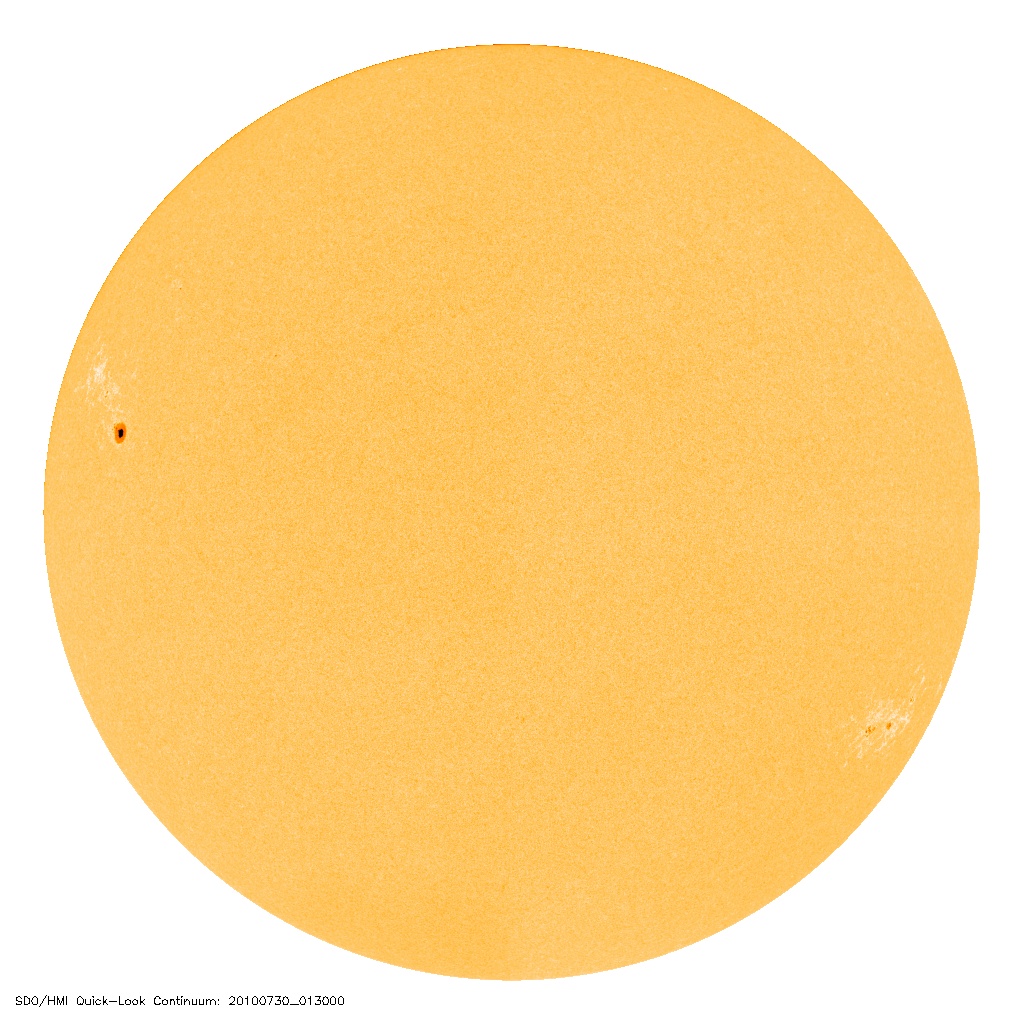

The real question now is; what will this new detail do to sunspot counts. As we saw in August 2008, when SIDC retroactively counted a sunspeck to snatch away a spotless month, will the SDO now be the new speckometer? Older telescopes and projection methods would never have seen the sunspecks we see today.
As we see with Geoff Sharp’s Layman’s Sunspot Count, both SIDC and NOAA’s counts are higher than the layman’s count. Now with SDO imagery, will even more miniscule sunspecks widen the gap between them? See the graph below comparing SIDC, NOAA, and LSC:

From Geoff Sharp’s website, here’s how the new Layman’s count works:
THE LAYMAN’S COUNT METHOD & HISTORY
There has been a lot of comments recently about the tiny specks that have been counted as sunspots. A tiny speck can get a daily count of 11 which severely skews the record. Also I have noticed on the SIDC record some days where the Sun is completely blank but the records show a sunspot count. NOAA is another magnitude higher than the SIDC, NOAA using a different method not meant to compare with the historical count. During times of high speck count we need a new standard to record sunspots that gives us a realistic measure of today’s activity verses the last Grand Minimum.
Robert Bateman a very motivated amateur solar enthusiast and myself started a thread at www.solarcycle24.com (which has unfortunately developed into an anti Landscheidt, Pro AGW forum) and soon devised a plan to come up with a reliable standard. We would use the existing SOHO 1024 x 1024 Continuum images and measure the pixels involved in a Sunspot. Initially it had to be determined what a standard sunspot should represent in size and density, to try and represent a minimum counter like Wolf may have done 200 years ago. After some deliberation and advise from Robert who also dabbles in Astronomy with his own equipment, we came up with a minimum standard.

To be counted, a sunspot or group must have 23 pixels which have a reading in the green channel of 0-70 for at least 24 hours.
All pixels in a digital image have a RGB reading which split out into separate Red, Blue, Green channels and can be easily measured and counted in one action using a freeware graphics program called GIMP.
So the standard was set, which now enabled us to go back over the records and weed out the offending specks and blank days.
The official Layman’s Sunspot Count is compared against the SIDC record which is considered conservative when compared with other institutions involved. Basically we use the same sunspot number as SIDC but replace them with zero on days that don’t make the grade. When the SIDC count is made up of two or more areas and if any of the area’s do not make the Layman’s Count, the overall SIDC daily count will be reduced by the areas that fail. Spots that count 23 pixels and over before midnight and then continue on to pass the 24 hour rule will take the SIDC value of that day. Existing Spots that have made the grade but measure less than 23 pixels at midnight are not counted on the next day.
===================================================
Unless solar science comes up with a way to deal with the advances in technology and properly merge it into the older human-optical record, the sunspot record will start looking like the surface temperature record, with upwards trends due to adjustments (or lack thereof).
I think Sharp and Bateman are on to something, and if you’ll provide me a graphic that isn’t drop shadowed onto a dark background, I’ll add it to the upcoming WUWT solar page with a link to yours. – Anthony
rbateman says:
August 2, 2010 at 2:43 pm
You have lost me. The story on Wolf vs Wolferer is not standing still.
Either Wolf preferred to measure rather than count, or he did not.
Either Wolf was right (as you have repeatedly told us) or he was not.
Now Wolferer is right.
Please clarify.
1) Wolf did not measure [he could not because he wanted to use older observations that were not his own], so he counted. He decided not to count pores and specks [mostly because older observers (e.g. Swabe) didn’t]. To compare other observers with his own for times prior to 1849 he compared them to the magnetic needle [that was the ‘being right’ part] and compared his own to the magnetic needle as well. Having the common standard [the magnetic needle] allowed him to bring everybody else on to his standard.
2) Determination of what is a pore or a speck is too vague just based on a verbal description [“it is smallish”], so Wolfer adopted to count everything. This is a clearcut definition that everybody can follow. And everybody has since then agreed that this was the better method. [so Wolfer was right on that].
3) Counting everything obviously leads to a count that is higher than you would get if you don’t count the small fry. Using the same telescope and site [seeing] as Wolf, Wolfer determined [from ten years of overlapping data at both high and low solar activity] that to bring his all-inclusive counts onto the same scale as Wolf’s, he had to multiply by 0.6. This is just a scale factor, in the same way as measuring temperature differences in Fahrenheit gives you numbers that you have to rescale [multiply by 5/9] to get Centigrade. Both temperature scales are ‘right’, but when comparing you have to rescale, of course. For some reason, some people have a hard time understanding this.
4) NOAA decided to keep the simple Wolf formula because it is just that: ‘simple’, three groups with 25 spots give you a SSN of 10*3+25=55. Straightforward. Some people think this is somehow ‘going their own way’. It is not, it is just using a different scale, like degrees F vs. degrees C. My plot at http://www.leif.org/research/NOAA-vs-SIDC.png shows the 0.6 factor in action and that it applies across the board.
5) The simplicity of all this is so overwhelming that it pains me to have to spell out the obvious again and again.
6) so, to get onto a common scale [otherwise you cannot make any comparisons]m multiply counts of everything by 0.6 to be able to compare them to counts omitting pores. NOAA does not do this [as SIDC does], so we must do it for them if we want to compare NOAA with SIDC. Therefore plotting raw NOAA and SIDC values on the same graph in order to ‘compare’ them to see which is ‘better’ is at best silly and at worst deceptive. To plot them in order to show that there is just on average a constant [within the noise] factor between them is, of course, legit.
rbateman says:
August 2, 2010 at 3:08 pm
Does resolution matter when contrast is low?
http://www.robertb.darkhorizons.org/Count.jpg
Taken from SDO/ AIA-4500 20100802_160008
As long as you count what you see, it doesn’t matter. But any difference can be accounted for by the ‘personal’ factor. The correct Wolf formula should really be:
SSN = k * (s * (10*G+S)), where s is 1 or 0.6 depending on what scale you want the SSN to be on. And k takes into account the telescope and the person doing the counting.
As pores and specks can be no smaller than a granule [about 1.5″], otherwise they could be destroyed by the vigorous convection, driving the resolution higher will not reveal any more spots, pores, or specks. Now, there are probably ever smaller granules between [and within] the ones we can readily see with no minimum size, but these are too short-lived to harbor magnetic fields strong enough to make the appear dark. So, higher resolution should not increase the SSN. Of course, if the contrast becomes too low [e.g. a la L&P] we can’t see anything, but the important thing it that this limit would be quantifiable and could be accounted for, or least be a known factor in evaluating the index.
Geoff Sharp says:
August 2, 2010 at 7:58 am
but what you are missing is that the 0.6 factor post Wolfer might be in the ballpark during normal solar activity but fails miserably when the speck ratio changes in times of solar downturn.
now, you could mean that in general, the speck to group ratio changes a lot with solar activity. Wolfer [and Wolf self] was initially of the opinion that the ratio should increase slightly with the size of the sunspot number. Wolfer’s careful analysis in 1894 showed, however, the following result: [year, SSN, ratio]
1877, 12, 0.84

1878, 3, 0.78

1879, 6, 0.67

1880, 32, 0.75

1881, 54, 0.68

1882, 60, 0.65

1883, 64, 0.59

1884, 63, 0.53

1885, 52, 0.55

1886, 25, 0.56

1887, 13, 0.51

1888, 7, 0.46

1889, 6, 0.62

1890, 7, 0.48

1891, 36, 0.55

1892, 73, 0.63

1893, 85, 0.53

mean, 35, 0.61
There is no correlation (a slight decrease, but with R^2=0.025) between SSN and the scale factor. So Wolfer felt justified in using the constant factor 0.6 [the dropping of the second decimal in conformance with the uncertainty].
Now, very recently, it is quite likely that the L&P effect will wreak havoc with all this and invalidate the many ‘facts’ that have been taken for granted over the years.
Bottom line: you can benefit a lot from taking to heart the detailed knowledge I have of these things.
Leif Svalgaard says:
August 2, 2010 at 4:15 pm
So, higher resolution should not increase the SSN
It shouldn’t, but due to use of further technological aids, what one sees is not uniform, given that some with far superior optics are routinely outdone by those with inferior optics (and no change in seeing).
If a teacher caught a student using an electronic device to answer questions on a test, that student would and should be failed.
I am not alone in noticing evidence of resorting to undisclosed means, when it comes to counting what is “seen”.
You say L&P, I say grand minimum, and glad you recognize the havoc caused by the speck ratio change. Wolfer never experienced a grand minimum.
rbateman says:
August 2, 2010 at 8:05 pm
I am not alone in noticing evidence of resorting to undisclosed means, when it comes to counting what is “seen”.
Now you lost me. Everybody sees the same thing. There is nothing ‘undisclosed’.
Geoff Sharp says:
August 2, 2010 at 8:18 pm
You say L&P, I say grand minimum, and glad you recognize the havoc caused by the speck ratio change. Wolfer never experienced a grand minimum.
Yeah, all the spots will turn into specks, but because a spot and the speck count for the same, nothing might change, until the specks fall below 1500 Gauss, and go ‘poof’. This is was makes you glad? Good to hear.
rbateman says:
August 2, 2010 at 8:05 pm
Leif Svalgaard says:
It shouldn’t, but due to use of further technological aids, what one sees is not uniform
this has always been the case, and is taken care of by the constant ‘k’, so the sunspot number stays technology independent.
Geoff Sharp says:
August 2, 2010 at 8:18 pm
You say L&P, I say grand minimum.
With L&P the ratio between large spots and specks [Large/Specks] will grow larger and larger, as the specks will disappear, until in the end only large spots remain and the sunspot number will be very small. This is what you call a Grand Minimum. I’ll agree with that.
Leif Svalgaard says:
August 2, 2010 at 9:08 pm
this has always been the case, and is taken care of by the constant ‘k’, so the sunspot number stays technology independent.
Don’t think so. Sorry, Leif, but there are those out there who play shell games under cover of ‘k’.
It is most distressing to see these things go on, and very sad. Most are honest.
You know what they say about a few bad apples in a barrel.
rbateman says:
August 2, 2010 at 11:12 pm
Don’t think so. Sorry, Leif, but there are those out there who play shell games under cover of ‘k’. It is most distressing to see these things go on, and very sad. Most are honest. You know what they say about a few bad apples in a barrel.
I don’t believe in conspiracy theories. There are enough amateur organizations counting spots [including myself] that it is impossible to play any shell games. There may now and then be human errors or factors, but these are invariably uncovered and corrected. For example, SIDC have changed their algorithm slightly in August 2001 with the result that they now undercount the sunspots by 12%. This will be corrected in due time, unless I run into a ‘the historical record stands’ mentality.
Don’t assume that malice is at play when simple incompetence is enough.