Guest Post by Steven Goddard
We are all aware that Arctic ice extent has increased over the last two months, and is now about one million km2 larger than it was in 2007. But where has the ice growth occurred? I generated an image which makes this easy to visualize.

http://nsidc.org/data/seaice_index/images/daily_images/N_timeseries.png
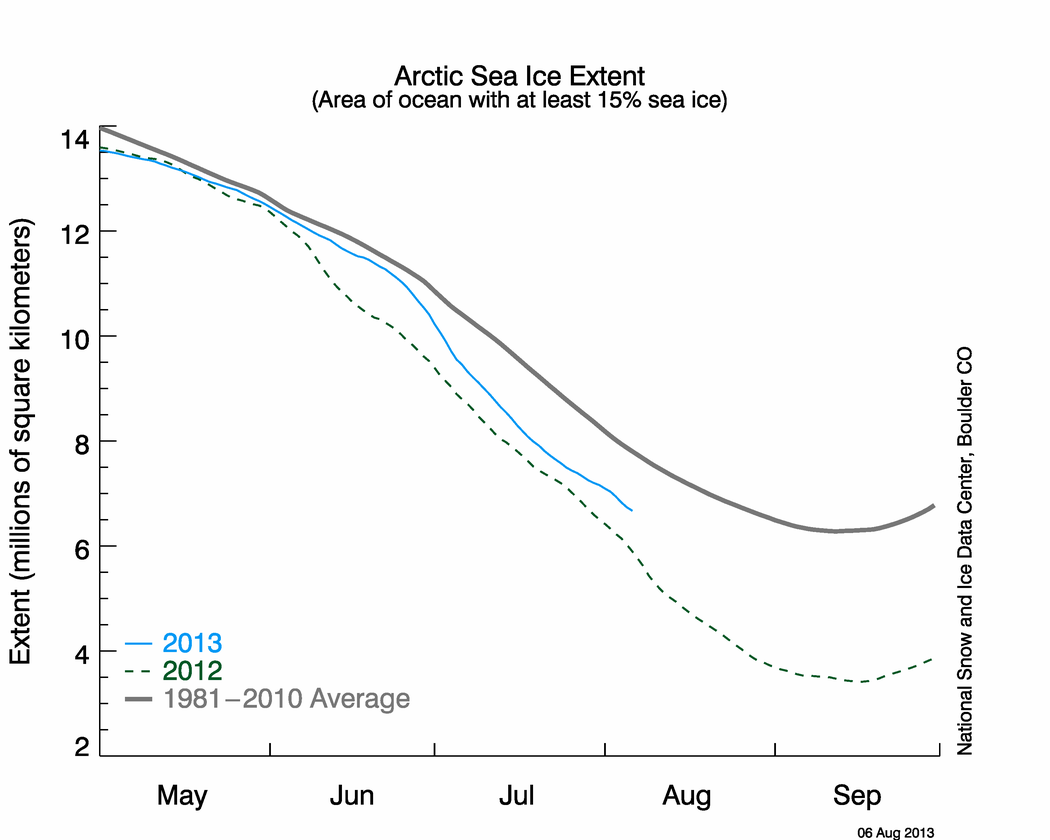
In the composite image I prepared below, green colors represent 2010 ice that was not present in 2007, and red colors show where 2007 ice existed on this date but is not currently present.

A couple of interesting items.
- There is excess ice in the Baltic Sea, due to the cold winter there.
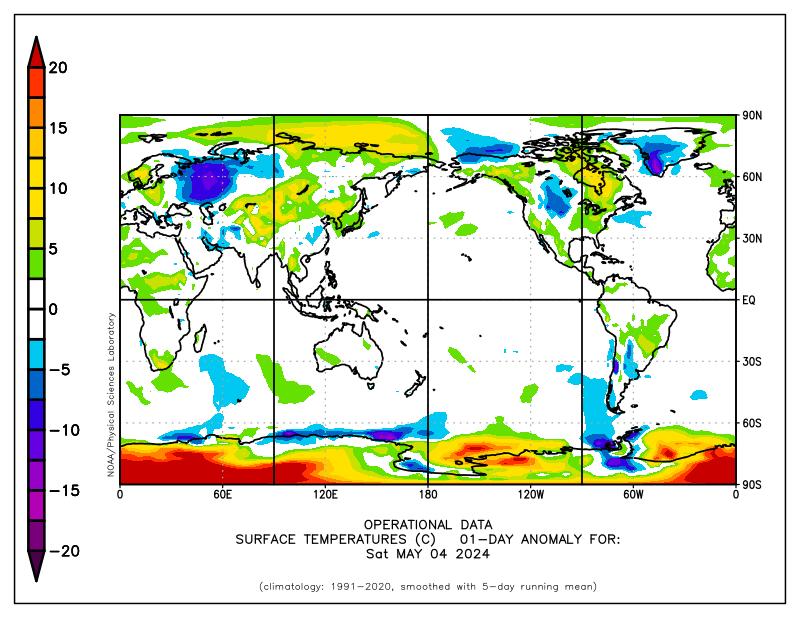
- There has been a lot of cold air over the Bering Sea and Sea of Okhotsk (as seen below) causing excess ice on the Pacific side.

http://www.esrl.noaa.gov/psd/map/ANIM/sfctmpmer_01a.fnl.25.gif
GRACE satellite gravitometer data 2002-2010 shows ice building in northeastern Canada at almost the same rate (and area) as ice loss from Greenland, and ice increase across Siberia:
http://1.bp.blogspot.com/_nOY5jaKJXHM/S4sLHq45S0I/AAAAAAAAA3g/qCHcv8YL974/s1600-h/GRACE+n+amer.jpg
It does not matter. The democrats are determined to raise the price of energy and increase unemployment in a futile chase of a socialistic utopia.
Thanks Steven for a nice clear picture of the sea ice changes.
I wish our understanding of the freeze/melt cycle was as clear!
The arctic ice coverage this fall will be above normal.
@R. de Haan (11:43:29) :
‘Mike Sander (11:30:40) :
“The fact that we can have so much more ice in 2010 than in 2007 but still have “red” areas where 2007 had ice when 2010 does not evidences further the inpact of wind, flow and many other factors. This kind of analysis, while quite basic, adds a lot to the bigger picture and general understanding of our oh so complex climate.”
That depends what the red represents.
If you think red in term of hot, you’re wrong.’
Can you read at all? What actually do you base your observation on that he thinks red is hot? :p
Can you visualize a median for the whole 1979-2009 and put it in a pretty image on this here blog? Just for fun.
Steven, that is a most impressive graphic. It shows quite clearly the trivial nature of the difference between April 2010 and April 2007. Well done.
Do you have a corresponding plot for the difference in the minimum ice? Also, is that polar plot equal area?
Thanks,
w.
Well, for one thing, we can deal with ensuring that everyone alive has access to food and water. And shelter. Just imagine how much could be done with the budget currently wasted on AGW alarmism. And I personally would LOVE to see some more military assets assigned to removing communist and dictatorial regimes from power, since they are the primary environmental problems.
Another thing, we all say “we’re still recovering from the LIA”, but to this point nobody has demonstrated a mechanism that caused the LIA or the recovery from it. Now, we have all these “climate scientists”, who probably have at least some of the qualifications required to tackle this essential question, if only they could be diverted from their current assignment of alarming the populace.
Apparently this is the “talking point” assigned to the alarmist supporters to deal with this question. It’s actually sad to me, watching all these people parrot out what someone else tells them instead of creating an original thought somehow.
It’s a big big world out there. Those changes look miniscule at the big picture scale.
R. Gates (12:15:20) :
What are those “real” issues you’re referring to?
I think S/he meant returning to an emphasis on the science and a lessening of the emphasis on alarmism.
YMMV
It appears that Arctic Sea Ice is more variable than most realize.
Map link below shows maximum (April) sea ice extension in the Atlantic sector of the Arctic. Lines are for 1769, 1866, 1966, and 1995.
The map is based on a database on sea ice extension in the area shown during the past 400 years, to a high degree based on written records found in ships logbooks. (Norwegian Polar Institute 2000).
http://www.climate4you.com/SeaIce.htm
See last picture on page.
lazor (12:37:53) :
“Maybe you all should go back to basic math classes and learn the difference between surface area and volume”
and you should read Willis post and look at Steven’s map again.
Willis Eschenbach (15:00:14) :
“Steven, that is a most impressive graphic. It shows quite clearly the trivial nature of the difference between April 2010 and April 2007”
“There is excess ice in the Baltic Sea, due to the cold winter there.”
No, thats the “normal” picture.
And the Baltic is not part of the Arctic.
It would be interesting to show the prevailing wind patterns on the composite image now and back in 2007.
Thank you for the article.
Mike Ramsey
“There’s thought to be a lot of currently inaccessable, unknown size oil fields under the ice”
gasp
In that case, we definitely need to stop global warming. Keep the ice cap on that oil!
Willis Eschenbach (15:00:14) :
Thanks. I came up with idea while messing around with an OpenGL app I wrote a few years ago.
What I did was take the NSIDC April 10, 2007 map and converted all the white to red. Then I textured mapped it on to an OpenGL quad. Then did the same thing with the 2010 map, only using green. Finally, I used OpenGL GL_SOURCE_COLOR to blend the two quads. Overlapping ice areas show up as yellow, and non overlapping show up as red or green.
Unfortunately NSIDC does not archive their images, so I can only do the current day and the corresponding day in the “record low” year.
John Silver (16:47:31) :
NSIDC shows Baltic cce extending well past the median line.
http://nsidc.org/data/seaice_index/images/daily_images/N_daily_extent.png
Taken from the Catlin Expedition website:
http://www.catlinarcticsurvey.com/
Marooned
11/04/2010
“Marooned
It’s been an eventful few days for the Explorer Team, courtesy of some extremely dynamic ice. Following their narrow escape from the crack in the sea ice that threatened to swallow up them and the tent, they now find themselves effectively marooned on an island of ice, unable to travel in any direction due to surrounding ice that’s too thin to walk across but too thick to swim through.
Although in a fairly precarious situation the team are calm and have typically managed to not only keep their composure but actually make the best of the situation by catching up on some well earned rest. The fact that they all slept for the best part of 24 hours is indicative of the physical stresses and strains the last 25 days has had on Martin, Ann and Charlie. Ann is optimistic that the ice will have thickened overnight and that it will be strong enough to grant them a smooth passage Northwards in the morning.”
Now another lot (The Students on Ice Arctic Youth Expedition 2010) will be tramping across the “rapidly melting ice” to see for themselves that the “Arctic climate is now warming rapidly and much larger changes are projected”. Golly! The Arctic is getting crowded these days.
http://www.studentsonice.com/index.php?content=arctic_expeditions
Only costs $9,750 CAD. Anything for a buck!
And what about Parker Liautaud, the teenage adventurer, trying to earn his foursquare badge?
“During his journey, Liautaud faced obstacles — including shifting glaciers” (?) “that set him back several miles.”
http://blog.ctnews.com/deloma/2010/04/09/teen-treks-to-top-of-world-to-raise-awareness-earn-foursquare-badge/
““It’s been very tough, white-out conditions for a few days,” Parker said. “He’s been skiing and trekking through worse conditions than many of us could even imagine.”
Some 20 miles of open water separated Parker from his goal of reaching the North Pole on Friday evening, so a helicopter was deployed to transport him to the top of the world and his goal.”
$100 billion wasted on global warming alarmism, and the alarmists have the temerity to query, “What are the real issues?”.
Poverty, hunger, disease, famine, pestilence, floods, fires, war, ignorance, servitude, immorality, homelessness, drug addiction, corruption, pollution, brutality, fascism, crime, economic collapse, hardships and suffering, etc. etc. etc. etc. etc.
In contrast, global warming is not significant and/or not a problem. The historical variation in Arctic ice is tiny and irrelevant. The entire “climare change” issue is irrelevant, or worse, yet another manifestation of gross inhumanity inflicted on society by megalomanical sociopaths.
One of the supposedly alarming things about receding Arctic sea ice is the reduction in albedo.
I maintain that, as in high Summer, the incidence at the pole never exceeds circa 23.5°, the angle of incidence results in a large proportion of reflection anyway. The reduction in ice cover would also lead to extra exposure of open ocean to the atmosphere leading to additional energy loss in excess of any gain due to albedo change.
I see this as a possible extension to Willis’ thermostat hypothesis.
Dave>
stevengoddard (17:23:48) :
Willis Eschenbach (15:00:14) :
Thanks. I came up with idea while messing around with an OpenGL app I wrote a few years ago.
What I did was take the NSIDC April 10, 2007 map and converted all the white to red. Then I textured mapped it on to an OpenGL quad. Then did the same thing with the 2010 map, only using green. Finally, I used OpenGL GL_SOURCE_COLOR to blend the two quads. Overlapping ice areas show up as yellow, and non overlapping show up as red or green.
Unfortunately NSIDC does not archive their images, so I can only do the current day and the corresponding day in the “record low” year.
I use similar techniques with Photoshop and imageJ to process images it’s very effective. Why not do the same approach with the ‘visual’ images from iup/jaxa:
http://iup.physik.uni-bremen.de:8084/amsr/arctic_AMSRE_visual.png
Their archive goes back to 2003:
http://iup.physik.uni-bremen.de:8084/amsredata/asi_daygrid_swath/l1a/n6250/
Mike Ramsey (17:07:46) :
It would be interesting to show the prevailing wind patterns on the composite image now and back in 2007.
Certainly can be done with the drift maps, here’s an example:
http://i302.photobucket.com/albums/nn107/Sprintstar400/Drift2010vs07.jpg
That is from jan 2010 and jan 2007.
Pamela Gray said:
“There’s nothing unusual happening…”
————–
Other than AGW you mean of course. I shall remind you of this quote at some point in the future…
Just for an update: According the IJIS/Jaxa, the Arctic sea ice is now below where it was in 2003 on this date, April 11, and we’ve dropped over 450,000 sq. km since the peak on March 31.
David Alan Evans (18:33:26) :
The Arctic minimum occurs in September when the Sun is just above the horizon. The albedo effect is minimal.
http://wattsupwiththat.com/2009/01/10/polar-sea-ice-changes-are-having-a-net-cooling-effect-on-the-climate/
“R. Gates (20:16:33) :
Just for an update: According the IJIS/Jaxa, the Arctic sea ice is now below where it was in 2003 on this date, April 11, and we’ve dropped over 450,000 sq. km since the peak on March 31.”
I know, I’m working on a hypothesis that there is some sort of seasonal variation at work here. Unlikely I realise but all great men were thought mad by their contemporaries;-)