By Steven Goddard
Last month we discussed how NASA continues to spread worries about the Antarctic warming and melting.
A January 12, 2010 Earth Observatory article warns that Antarctica
“has been losing more than a hundred cubic kilometers (24 cubic miles) of ice each year since 2002” and that “if all of this ice melted, it would raise global sea level by about 60 meter (197 feet).“
[Note that is continental ice, not sea ice, – Anthony]

NASA’s 1982-2007 map showing Antarctica warming

But NSIDC seems to be thinking differently in their March 3, 2010 newsletter. They say Antarctica is cooling and sea ice is increasing (makes sense – ice is associated with cold.)
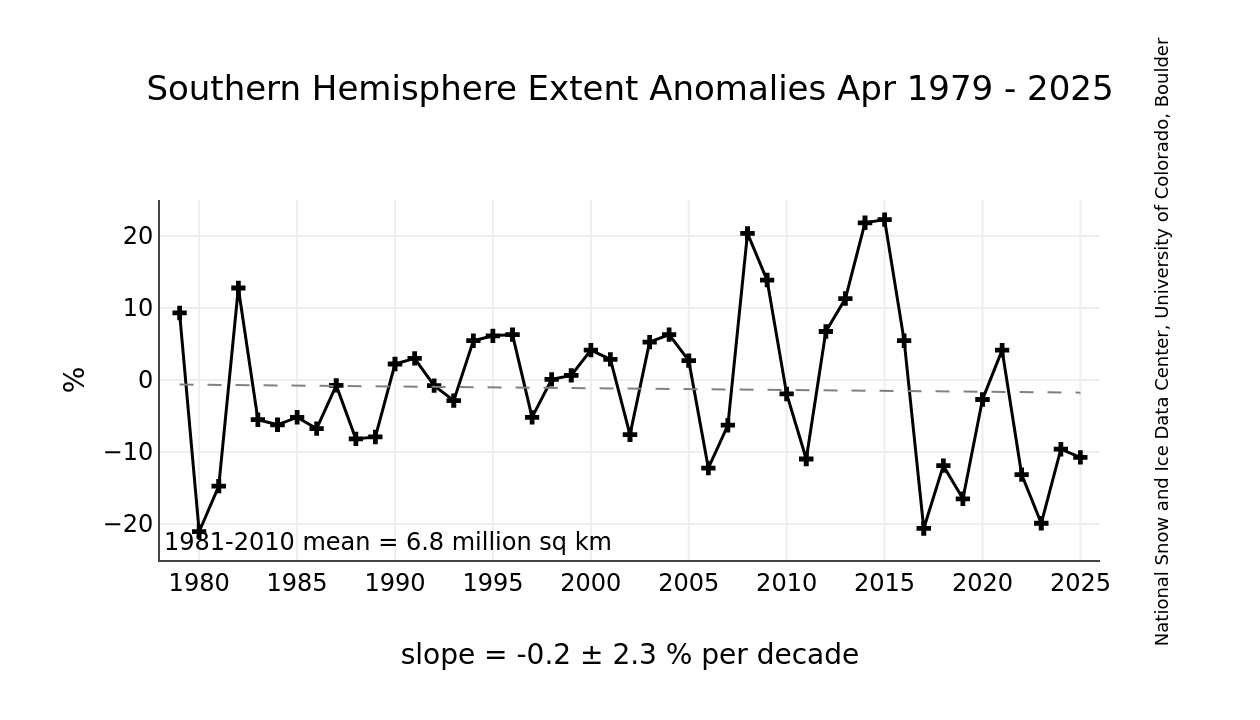
Sea ice extent in the Antarctic has been unusually high in recent years, both in summer and winter. Overall, the Antarctic is showing small positive trends in total extent. For example, the trend in February extent is now +3.1% per decade. However, the Amundsen and Bellingshausen Seas show a strong negative trend in extent. These overall positive trends may seem counterintuitive in light of what is happening in the Arctic. Our Frequently Asked Questions section briefly explains the general differences between the two polar environments. A recent report (Turner, et. al., 2009) suggests that the ozone hole has resulted in changes in atmospheric circulation leading to cooling and increasing sea ice extents over much of the Antarctic region.
The NSIDC graph below shows the upwards trend in Antarctic Sea Ice. Some recent years have shown anomalies as high as +30%.

http://nsidc.org/data/seaice_index/images/s_plot_hires.png
UAH satellite data also shows Antarctica cooling, as seen in their map below. (This map is dated November, 2006 – if anyone knows where to get a more recent version, please let me know.)


UAH 25 Year Temperature Trends
Perhaps NASA should have stuck with their original 2004 map below, showing Antarctica’s interior cooling?

NASA’s 1982-2004 map showing Antarctica cooling

While there’s no dispute that there’s some sea ice loss in the Antarctic peninsula, all signs seem to point in the opposite direction of what some what have you believe about Antarctica as a continent.
Sponsored IT training links:
We offer self paced 312-50 training with up to date 642-611 dumps and 70-450 practice test to provide guaranteed success in first dive.
Discover more from Watts Up With That?
Subscribe to get the latest posts sent to your email.
Anu,
The glacial cycle in Antarctica is in steady state equilibrium. Snow falls at higher elevations. The weight of the snow causes elastic deformation and glacial movement towards the ocean. Eventually the ice reaches the ocean and melts. Water in turn evaporates and causes snow to fall at the higher elevations. etc.
This media recycles the same ice shelf story very year, as if it meant anything important the first time around.
http://wattsupwiththat.com/2009/04/17/the-antarctic-wilkins-ice-shelf-collapse-media-recycles-photos-and-storylines-from-previous-years/
Gary,
Arctic ice has declined in it’s “death spiral” at “unprecedented rates” to the 30 year mean. Statistics can prove it.
R. Gates (11:50:31)
What do you make of this then ?
http://www.jstage.jst.go.jp/article/sola/5/0/53/_pdf
“The evidence for the cooling trend in the stratosphere may need to be
revisited. This study presents evidence that the stratosphere has been
slightly warming since 1996.”
The stratosphere seems to cool when the sun is more active and warm when it is less active. At the same time the thermosphere seems to warm when the sun is more active and cool when it is less active.
Clearly something about changes in solar surface activity affects the thermosphere and stratosphere in opposite ways.
I seem to recall you conceding that such a phenomenon in the face of increasing CO2 would be a problem for the AGW theory.
Anu (13:39:47) :
Just what do you think is causing the measured sea level rise these days ?
The oceans of the world, as measured by satellite, are rising about 3 mm/year in the last 16 years. These melting ice shelfs, which release continental, non-floating ice into the oceans to melt, are certainly part of this measured rise.
The TOPEX satellites responsible for the early years of sea level measurement were subject to rather significant problems of orbital uncertainty and atmospheric correction. When the JASON sat went up it included improvements, that by reports I’ve seen seem to have done a fairly incredible job of addressing those problems. Perhaps coincidentally or not, at the point where the JASON data kickin the annual increase in sea level drops from +3mm/yr to numbers that are actually below the long term trend.
There is also the problem that, even if you take millions of measurements from a satellite >1300kms up to a highly variable surface and the error per measurement is a close match for that variablity, when you try to analyze the data it’s apt to resolve to a fairly precise number which may not reflect the uncertainty of the actual range you’re trying to determine.
Steric changes due to ocean temperatures are also a problem because those temps are so poorly quantified.
And even if the +3mm/yr trend should continue, the extra increase by the turn of the next century would be less than the length of a dollar bill.
“The Prince Gustav Channel, Larsen Inlet, Larsen A, Wordie, Muller, and the Jones Ice Shelf collapses also underscore the unprecedented warming in this region of Antarctica.”
The problem with declaring the warming unprecedented is that the temp data in the Antarctic is not particularly robust and our knowledge of prior precedent even less so.
Stephen Wilde (14:41:31) :
Clearly something about changes in solar surface activity affects the thermosphere and stratosphere in opposite ways.
Whatever happens in the thermosphere has no effect anywhere else. The stratospheric temperature seems to be controlled more by the change in Fluorocarbons than anything else.
vukcevic (12:04:04) :
http://wattsupwiththat.com/2009/07/28/nasa-now-saying-that-a-dalton-minimum-repeat-is-possible/
Now that you reminded me of that topic, let me repeat from my reply:
Leif Svalgaard (10:04:31) :
Let’s do the numbers. I asked the engineer in you to do it and you refused [for good reason as we shall see]. Here goes:
The emf from a conductor moving at velocity v in a magnetic field B is E = vB [as v and B are nearly perpendicular] per unit length. Let the speed of the circualtion be v = 1 m/s, B = 50,000 nT = 5E-5 T, and the length L of the gyre path be 6000 km = 6E6 m, then the total emf becomes V = E*L = 300 Volt [check my math as we go along as I’m just typing this in as I go]. The resistivity R of sea water is 0.2 ohm, hence the current I = V/R = 1500 amps. The power is then P = V*I = 300*1500 = 450,000 W. The solar input is perhaps 45 W/m2 over the polar cap [low angle, high albedo, etc], so the total power P is the same as the solar input to an area of P/45 = 10,000 square meter, which is 100,000,000 times less than the solar power to the polar region. Since the secular movement of B is not the whole of B, but much smaller, say a generous 10%, the effect of magnetic polar wander is 1000,000,000 times smaller than the ordinary solar input, hence totally insignificant. I had assumed that this took place in the upper 1 meter. If we let the ocean current go down 1000 meter [much too much as the speed of the gyre at depth is small] the one billion becomes 1 million, still negligible.
As I said, there is not enough energy in this to do anything [apart from the force being in the wrong direction]
————
Let me reiterate why you qualify as a nutty crank [apart from your self-professed admission thereof]. It is this:
vukcevic (11:29:51) :
but however much he tries, I do not give up
A scientist is prepared to give up when the evidence goes against him. He never says: “I do not give up”. That is the difference.
Leif Svalgaard (14:51:39)
My point is NOT that the thermosphere projects effects downwards. That has never been my position. I said that previously but you did not register it. I agree that in general the atmosphere cannot project changes in energy content downward because of the decreasing densities as one goes higher. We are agreed on that.
My point is that changes in the level of solar surface activity DO seem to have effects on various layers if not on ALL the layers of the atmosphere and possibly also the upper layers of the ocean with a subsequent effect on the RATE of energy flow from one layer to another.
That results in DIFFERENTIAL effects on different layers so that one layer cools in relation to another layer which warms in relation to yet another layer.
Your point about Fluorocarbons is fine. Chemical reactions seem to be involved at the levels where ozone is found but again that is a consequence of SOLAR surface variability and not a consequence of variations in total solar power output which I accept seem too small to do anything much except on long timescales.
You have never addressed my fundamental point which is that there is independent variability in rates of upward energy transfer at each layer in the air and oceans. The irregularity of the flow of energy from the sun (NOT the absolute power output) does seem to affect the RATES of energy flow from layer to layer of oceans and air depending on a combination of the solar wavelengths involved and the physical characteristics of each particular layer.
Thus the troposphere can warm or cool as the ocean surfaces cool and warm from internal ocean variability and the troposphere can warm or cool as the stratosphere cools and warms from solar surface variability.
The temperature of the troposphere is at the mercy of changes in the RATES of energy flow from the oceans below and to space above.
Internal oceanic cycles dictate the former and solar surface variability dictates the latter.
I’ve noted your comments about your past meteorological experience but would respectfully suggest that the meteorology you learned does not provide useful answers.
I heard it said that an unexpected correlation suggests that something has been missed.
Perhaps you could explain to me the following observations:
i) From 1975 to 2000 there were lots of strong El Ninos but they did NOT result in any strengthening of the Arctic and Antarctic Oscillations.
ii) During the cooling of the 1950’s and 1960’s and again now El Nino events have been associated with stronger Arctic and Antarctic Oscillations.
iii) In the 1950’s and 1960’s we had relatively weak solar cycle 20 and now we have a weak cycle 24. In contrast from 1975 to 2000 we had relatively strong cycles 21, 22 and 23.
The obvious conclusion is that from 1975 to 2000 the stronger solar cycles facilitated the venting to space of the excess energy from all those El Ninos by ensuring that the Arctic and Antarctic Oscillations remained relatively weak.
An unexpected correlation such as that needs careful examination because it points to a possible defect in general climate theory and I have suggested the answer but you have not yet provided an alternative explanation.
Thank you for directing my attention to the aspects of my climate description which you and others find difficult to follow.
Stephen Wilde (15:33:50) :
Thank you for directing my attention to the aspects of my climate description which you and others find difficult to follow.
With all due respect, I have given up on explaining the facts to you.
The temperature of the troposphere is at the mercy of changes in the RATES of energy flow from the oceans below and to space above. makes no sense at all. What is the RATE of energy flow? I can understand energy flow, so many Joules per second [=Watts] per square meter. The RATE of something is the first derivative of that something, so the ‘change of the RATE’ is the second derivative of that something. And here is where my understanding of what you are trying to say slips away.
Stephen Wilde (15:33:50) :
The temperature of the troposphere is at the mercy of changes in the RATES of energy flow from the oceans below and to space above.
Assuming that the CAPITALIZED ‘rates’ is just a filler with no real meaning and that you simply mean ‘the temperature of the troposphere is at mercy of the energy flow from the oceans below and to space above’, I have these comments:
1) The troposphere is heated from below
2) The energy flow to space precisely equals the inflow from the Sun [allowing for albedo]. Greenhouse effects determine the altitude of the layer that radiates to space [where the temperature equals that of a blackbody radiating away all incoming radiation]. Currently that is about 5 km up where the temperature is -19C. If there were no atmosphere, that altitude would be 0 km. If you make our atmosphere ten times as dense, that altitude would move up dramatically and the surface temperature would be much higher, but the radiation to space would be exactly the same, namely equal to what comes in from the Sun.
Gary Pearse (13:36:59) :
The Nansen Sea Ice Area and Sea Ice Extent graphs for the Arctic have swung up through the average, so both polar caps are cooling nicely.
http://arctic-roos.org/observations/satellite-data/sea-ice/ice-area-and-extent-in-arctic
———–
You’re confusing the 2009 curve with the 1979-2006 “average”. Look again at the bottom curves – the black line is “Monthly average 1979-2006”.
Since the Arctic is warming, the 1979-2006 curve is even lower than the 1979-2000 average curve (since 2001-2006 are all below the 1979-2000 average curve), given here:
http://nsidc.org/images/arcticseaicenews/20100303_Figure2.png
Look at August, September, October – that’s where the Summer Melt is greatest, and recent years have really fallen below the average (2007, 2008, 2009).
We’ll see if the Arctic is “cooling nicely” this September.
Gail Combs (03:17:15) :
REPLY:
That was taken out of context. Read the WHOLE exchange. Oh wait you are a AGW type so taking it out of context to make fun of someone is the politically correct move. Excuse me for thinking you might be interested in the science.
———-
Shouldn’t that be “an AGW type” ?
You’re quite right, context is very important for data points and emails.
Anu,
Gary wasn’t confusing anything. Nansen changed the graph as they often do. BTW -you linked to the wrong NSIDC graph.
You are coming in to this discussion quite late.
http://wattsupwiththat.com/2010/03/04/nsidc-confirms-wuwt-ice-forecast/
Don’t know why my post was deleted, but this according to this website we are (and it specifically mentions Goddard) “ignorant” on Antarctic ice issues:
http://skepticalscience.com/Watts-Up-With-That-ignorance-regarding-Antarctic-sea-ice.html
REPLY: Refresh. It’s there. – Anthony
Sorry for the double-post, but just for the record Steven Goddard, you are by far my favorite contributor here at WUWT and wish you would do so more often – I know you have a life, though.
Joey,
The article you linked to carefully excluded any mention of the fact that I was quoting NSIDC about declining temperatures and increasing sea ice.
Joey,
Thx for the feedback. I used to be a global warming true believer for many decades until I started checking the facts for myself.
In my field of computer science/engineering, we just don’t see incompetence like is prevalent in climate science. The key IPCC players would lose their jobs in a matter of weeks if they turned out cr@p like that in the engineering world.
Sometimes this feels like shooting fish in a barrel.
Steve Goddard (21:28:05) :
Anu,
Gary wasn’t confusing anything. Nansen changed the graph as they often do. BTW -you linked to the wrong NSIDC graph.
You are coming in to this discussion quite late.
http://wattsupwiththat.com/2010/03/04/nsidc-confirms-wuwt-ice-forecast/
———-
OK, thanks.
I saw somebody on another thread wondering about Nansen graphs, too – I didn’t realize Norwegians were so haphazard.
My NSIDC graph is a few days old, but I like the +/- 2 standard-deviations feature.
Yes, it’s pretty late.
People can argue back and forth until they’re blue in the face, or red in the face (depending upon what the climate does do). But I ask this….
If the naysayers are right and we go through all of the turmoil of adapting our way of life so that we produce minimal greenhouse gases and manage to obtain energy without fossil fuel or nuclear pollution, and it turns out to be unnecessary, isn’t that still a better place to be than if…….they’re wrong, and the damage we continue to wrought is irreversible? Only time will tell. Do our children’s children deserve the legacy resulting from living only for today’s profits?
R. Gates (07:08:42) : Arctic sea ice is not normal, still showing a negative anomaly, and has not been at or above normal since 2004. Where do you get your data?
From the IJIS site. On the 10th of March 2004 the Arctic Ice was 14.36 million sq Kms and on the 10th of March 2010 14.33 million sq kms.
The main point is you claim two months (Jan and Feb 2010) of tropospheric hotspots indicate AGW, but the absence of this hotspot for 360 months previous to this does not disprove the AGW theory. If you predict it will rain in the Atacama desert, once in a century you will be correct.
Leif Svalgaard (16:30:00)
“The energy flow to space precisely equals the inflow from the Sun [allowing for albedo]. Greenhouse effects determine the altitude of the layer that radiates to space [where the temperature equals that of a blackbody radiating away all incoming radiation]. Currently that is about 5 km up where the temperature is -19C. If there were no atmosphere, that altitude would be 0 km. If you make our atmosphere ten times as dense, that altitude would move up dramatically and the surface temperature would be much higher, but the radiation to space would be exactly the same, namely equal to what comes in from the Sun.”
Is the energy flow to space so perfectly and precisely balanced or does it vary slightly ?
Even if it is precise do you accept that the speed of energy transfer (in Joules per second) can vary over time within and between the different layers of air and ocean ?
If not then how do you explain the differential warming and cooling of separate layers ?
The movement up and down of the layer that radiates to space is a given. What we are considering is the processes that dictate that movement. I have elsewhere said that not only do the air circulation systems move latitudinally to maintain stability but also the tropopause (and by implication the other layers of the atmosphere) move up and down.
I don’t think you have any problem with changes in sea surface temperatures having the required effect. Where you seem to stick is in saying that no changes in solar input can have a similar effect from above.
The trouble is that real world phenomena are telling us that the variability from below is insufficient on it’s own to explain phenomena such as the variations in the strength of the Arctic and Antarctic Oscillations. Others have suggested an effect from above so I am not alone on that.
Each layer of the Earth’s system appears to respond differently to changes in the flow of energy from the sun (irregularity, not absolute power output) depending on the physical characteristics of that layer and the solar wavelengths that affect that layer.
The thermosphere responds very differently to the stratosphere which responds very differently to the troposphere and the layers of the ocean penetrated by incoming solar energy respond very differently again.
That is where the answer to the conundrum must lie.
“where the temperature equals that of a blackbody radiating away all incoming radiation.”
Surely that shoud be:
‘where the temperature equals that of a greybody radiating away all incoming radiation.’
And the greyness of the body would be constantly varying would it not ?
Leif Svalgaard (15:09:30) :
Your rehashed calculation is based on a wrong premise of then suggested polar movement. In the present approach dFlux/dt = ~0 (10 micro Tesla over period of 350years365x86400= 11,037,600,000sec giving delta ~ 5*10^-15, in practice no current). To calculate current one should apply Faraday’s paradox principle.
However, sea water is ionised and is under influence of magnetic field, (case of a charged particle of a velocity v injected in perpendicular constant field B, the Lorentz force F = qv × B is outward radial, which in theory should be varying the existing radius of gyre trajectory as function of B, if angular momentum conservation is evoked, results in speeding and slowing down of the gyre.
However I suspect ions trajectory is not a simple circle, but a kind of e squashed (two-dimensional) enclosed spiral (kind of a geo-equatorial satellite would make in its solar orbit). In reality matters are always far more complicated.
I say bring in Gregory Ryskin!
“Using this simple way of viewing things, it is quite easy to image a drought causing the mass of Antarctica to shrink, even with the weather turning colder and drier.”
But there isn’t a drought. Antartica is officially classed as a “desert” but in fact 17cm of new ice forms every year due to falling snow being compacted. This is interesting, because Antartica has a surface area which is 23 times smaller than the entire surface area of the oceans. So in theory we can calculate just how much water is being evaporated from the oceans to end up as ice in Antartica. 17/23 =0.7cm. So every year the oceans are reduced by 0.7cm to end up as ice in Antartica.
It is perhaps as well that Antartica is now full to overflowing with ice and some is flowing back into the ocean, or we would find that every 100 years the oceans would have receded by 0.7meters due to this one-way traffic, which would leave some major coastal cities high and dry.
The fact is that the fresh snowfall in Antartica every year results in a similar amount of ice flowing into the sea, such that the system is entirely stable. The levels of snowfall could change very appreciably without any impact on the levels of the ocean, so AGW is unlikely to have any effect. It is like a beaker that is already full of water – the water can stop pouring in or pour in faster, but the level of water in the beaker will remain the same.
Stephen Wilde: Your hypothesis needs some work.
You wrote, “Normally the Arctic will warm and the Antarctic will cool during a period when the climate system is gaining energy. Vice versa when the climate system is losing energy as now. Pointing to a relatively warm troposphere is not relevant here because a warm troposphere is generally an indication of net overall system cooling as energy leaves the oceans faster on it’s way to space.”
You need to consider periods when the Arctic and Antarctic can be warming or cooling in unison, which appears to be quite often.
http://i43.tinypic.com/a4wiu8.png
You wrote, “And also only while the sun’s surface remains quiescent. From 1975 to 2000 the run of strong El Ninos was largely offset by the active sun which allowed a faster venting of the oceanic energy to space. Now with a quiet sun and an El Nino the excess energy from the oceans is restrained from being vented fast enough and some of that energy is being redirected downward in the Arctic and Antarctic Oscillations to give cold mid latitudes and heavy snowfalls.”
First, the ocean basin that contributed the most to the rise in Global OHC since 1955 was the North Atlantic (~30%). It could be argued that this is a result of AMOC. And it’s also the ocean basin with the greatest decline in OHC since 2005, so it could be argued that the recent decline is also a function of AMOC. What we then see, if we remove the North Atlantic from the OHC data, is that the OHC of the remainder of the ocean basins is actually increasing.
http://i42.tinypic.com/282grr5.png
Second, I’ve posted a similar graph before in response to another of your comments. That time I used the tropical Pacific OHC. This time it’s global OHC versus NINO3.4 SST anomalies versus scaled Sunspot Number. Can you find any correlation between OHC and the solar cycle?
http://i44.tinypic.com/eknwh5.png
Third, you also need to consider cloud cover.
Bob Tisdale (03:51:19) :
“First, the ocean basin that contributed the most to the rise in Global OHC since 1955 was the North Atlantic (~30%). It could be argued that this is a result of AMOC. And it’s also the ocean basin with the greatest decline in OHC since 2005, so it could be argued that the recent decline is also a function of AMOC.”
The above is in a good agreement with my (however ‘non-expert’) research into these matters. If Geomagnetic field GMF has any role in the climatic processes (either as a cause, consequence-G. Ryskin, or an unresolved proxy) than correlation between the GMF and temperature anomaly (either meaningful or coincidental), only exists to any significant degree, for the area of the far North Atlantic and the Arctic.
http://www.vukcevic.talktalk.net/LFC16.htm