By Steven Goddard
Last month we discussed how NASA continues to spread worries about the Antarctic warming and melting.
A January 12, 2010 Earth Observatory article warns that Antarctica
“has been losing more than a hundred cubic kilometers (24 cubic miles) of ice each year since 2002” and that “if all of this ice melted, it would raise global sea level by about 60 meter (197 feet).“
[Note that is continental ice, not sea ice, – Anthony]

NASA’s 1982-2007 map showing Antarctica warming

But NSIDC seems to be thinking differently in their March 3, 2010 newsletter. They say Antarctica is cooling and sea ice is increasing (makes sense – ice is associated with cold.)
Sea ice extent in the Antarctic has been unusually high in recent years, both in summer and winter. Overall, the Antarctic is showing small positive trends in total extent. For example, the trend in February extent is now +3.1% per decade. However, the Amundsen and Bellingshausen Seas show a strong negative trend in extent. These overall positive trends may seem counterintuitive in light of what is happening in the Arctic. Our Frequently Asked Questions section briefly explains the general differences between the two polar environments. A recent report (Turner, et. al., 2009) suggests that the ozone hole has resulted in changes in atmospheric circulation leading to cooling and increasing sea ice extents over much of the Antarctic region.
The NSIDC graph below shows the upwards trend in Antarctic Sea Ice. Some recent years have shown anomalies as high as +30%.

http://nsidc.org/data/seaice_index/images/s_plot_hires.png
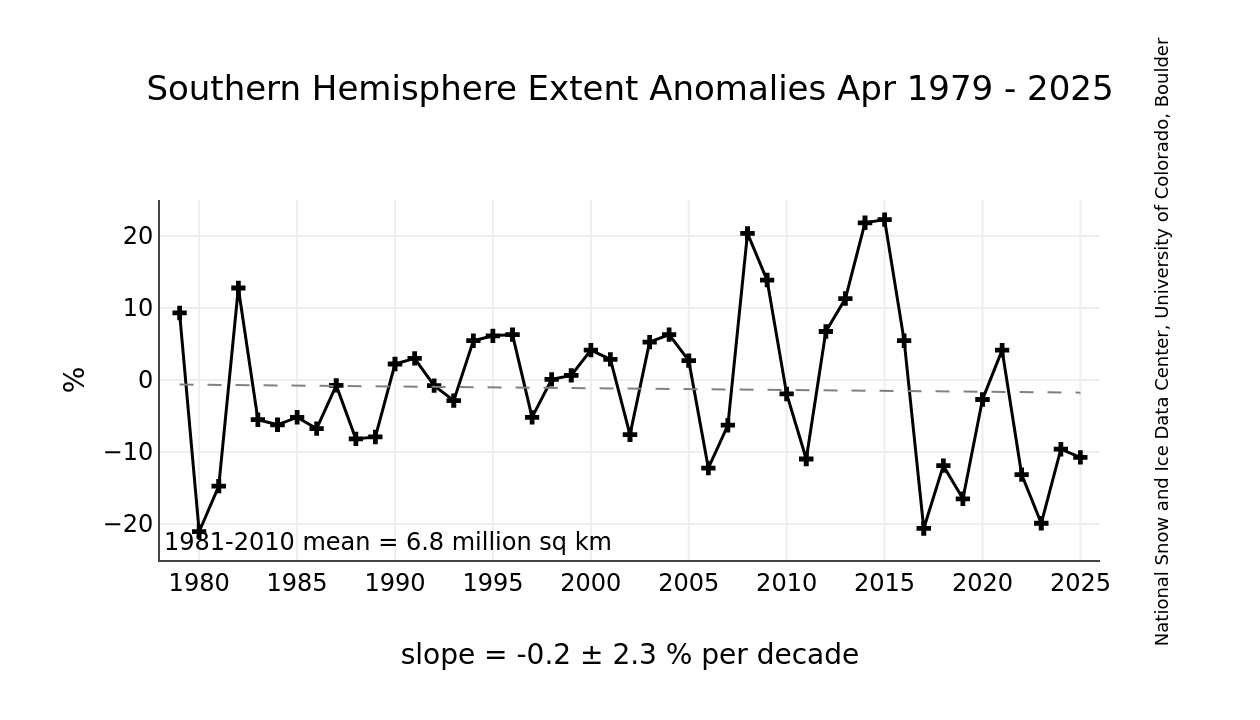
UAH satellite data also shows Antarctica cooling, as seen in their map below. (This map is dated November, 2006 – if anyone knows where to get a more recent version, please let me know.)


UAH 25 Year Temperature Trends
Perhaps NASA should have stuck with their original 2004 map below, showing Antarctica’s interior cooling?

NASA’s 1982-2004 map showing Antarctica cooling

While there’s no dispute that there’s some sea ice loss in the Antarctic peninsula, all signs seem to point in the opposite direction of what some what have you believe about Antarctica as a continent.
Sponsored IT training links:
We offer self paced 312-50 training with up to date 642-611 dumps and 70-450 practice test to provide guaranteed success in first dive.
“If the naysayers are right and we go through all of the turmoil of adapting our way of life so that we produce minimal greenhouse gases and manage to obtain energy without fossil fuel or nuclear pollution, and it turns out to be unnecessary, isn’t that still a better place to be”
You are making the assumption that the solutions proposed will actually be generally benign. In fact since a rapid expansion of nuclear power is the most likely outcome of the Western desire to reduce CO2 emissions, the outcome is unlikely to be anything but benign. Furthermore, it is unlikely to be succesful, since countries outside the Western world like China and India have realised that harnessing the enormous power of coal makes their populations more productive, and hence less poor. They see a different equation where hoisting large parts of their population out of poverty by rapid industrialisation results in a far more promising future than minor concerns about rising sea levels, and comes with a cast-iron guarantee of success.
Sorry, that line should say “likely to be anything but benign”.
Peter McBride (23:46:06) :
“People can argue back and forth until they’re blue in the face, or red in the face (depending upon what the climate does do). But I ask this….
If the naysayers are right and we go through all of the turmoil of adapting our way of life so that we produce minimal greenhouse gases and manage to obtain energy without fossil fuel or nuclear pollution, and it turns out to be unnecessary, isn’t that still a better place to be than if…….they’re wrong, and the damage we continue to wrought is irreversible? Only time will tell. Do our children’s children deserve the legacy resulting from living only for today’s profits?”
Your logic is flawed.
There are three possible outcomes for climate change, and each requires a different strategy to optimise standard of living and ultimately the number of people the Earth can sustain.
1. Climate warms significantly – Level of anthropomorphic CO2 proved to be the cause.
Strategy:- Cut down on levels of CO2 emitted by using expensive clean energy.
Extra cost to each human-being high – Standard of living much lower than present.
2. Climate stays within +/- a couple of degrees Celsius of present:-
Strategy:- Continue to use fossil fuel until it’s cost makes alternative energy sources cheaper than fossil fuel.
Extra cost to each human-being low – Standard of living similar to present.
3. Climate cools significantly.
Strategy:- Continue to use fossil fuel until it’s cost makes alternative energy sources cheaper than fossil fuel.
Extra cost to each human-being high – Standard of living much lower than present.
As the cost of 1 and 3 are high and there is no factual evidence for either scenario, the precautionary principle says 2 is the best option to ensure that we, and our children’s children have the best chance of a good future.
Leif Svalgaard (11:06:11) :
“Perhaps you could reverse your suggested direction of causation and join Ryskin’s bandwagon…”
I had a quick scan through Ryskin’s paper, I think there are some interesting part-ideas there, maths is at a level I can cope with, I just might be tempted to spend some time reading it.
G.R: “Data analysis exhibits striking temporal correlation between the intensity of the North Atlantic oceanic circulation and secular variation in Western Europe; this explains, in particular, the geomagnetic jerks, and the recently discovered correlation between secular variation and climate. Spatial correlation between ocean currents and secular variation is also strong.”
Stephen Wilde (00:44:29) :
Is the energy flow to space so perfectly and precisely balanced or does it vary slightly ?
It varies in concert with the variation of the incoming radiation [TSI] and with changes in the albedo, but is always balanced.
Even if it is precise do you accept that the speed of energy transfer (in Joules per second) can vary over time within and between the different layers of air and ocean ?
If you consider a given layer, then what enters at one boundary must equal what exits at the other. Energy spends a [very] short time within the layer.
also the tropopause (and by implication the other layers of the atmosphere) move up and down.
The movements are dictated by the temperature, not the temperature dictated by the movement.
the variability from below is insufficient on it’s own to explain phenomena such as the variations in the strength of the Arctic and Antarctic Oscillations.
The variation from above is much smaller than that from below. So if from below is insufficient …
Others have suggested an effect from above so I am not alone on that.
Like the argument that smoking must be good for you since so many do it.
The thermosphere responds very differently to the stratosphere which responds very differently to the troposphere and the layers of the ocean penetrated by incoming solar energy respond very differently again.
They respond to different physical processes and stimuli [and the thermosphere has nothing to do with anything]
That is where the answer to the conundrum must lie.
What conundrum? A complicated system has variations all on its own. It only becomes a problem if you want to shoehorn them into a preconceived hypothesis.
Stephen Wilde (01:32:13) :
Surely that shoud be:
‘where the temperature equals that of a greybody radiating away all incoming radiation.’
A grey body is defined as a body with constant emissivity over all wavelengths and temperatures, surely that is not our Earth.
By taking into account the albedo, we have taken care of most of the emissivity changes. Greenhouse gases take care of the rest. The grey/black thing is a typical straw man in these discussions.
vukcevic (03:04:22) :
However, sea water is ionised
The ‘however’ is misplaced since I stated that sea water is a conductor.
which in theory should be varying the existing radius of gyre trajectory as function of B, if angular momentum conservation is evoked, results in speeding and slowing down of the gyre.
As the gyre expands v decreases so the Lorentz force decreases with it such as the stop the expansion.
But all this matters not, as the mechanical forces resulting are much too small to have any effects. The force/energy argument is so compelling that all the details don’t matter at all.
There is always some risk in everything we do. Does it make sense to not go to work or school because you might catch the flu or get in an accident? People who have breasts often get breast cancer later in life and die. Does it make sense to give widespread radical mastectomies, in order to mitigate the risk?
Populations have a way of controlling themselves one way or another, but it isn’t going to be global warming that kills us – though I would love to see the climate warm up a few degrees where I live.
Leif Svalgaard (06:48:21) :
It varies in concert with the variation of the incoming radiation [TSI] and with changes in the albedo, but is always balanced.
Leif, if this statement is totally correct how do we get Ice Ages and very warm periods?
Why is the Climate not always Balanced?
Surely there has to be a Time element involved in the Balancing mechanism?
vukcevic (06:34:19) :
I had a quick scan through Ryskin’s paper, I think there are some interesting part-ideas there
I knew you would like it. The correlations are, of course, just as spurious.
A C Osborn (07:44:06) :
Leif, if this statement is totally correct how do we get Ice Ages and very warm periods?
Answering your question [take note of that]: because the orbit of the Earth and its axis tilt change with time. Interestingly enough, those changes are mediated by the planets and the Moon: Jupiter is the main reason the orbit/tilt varies and the Moon is the main reason that the variation of the tilt does not get too large. So, Jupiter varies our climate and the Moon stabilizes it. All this would happen even if the sun were absolutely constant, which it is not. There are very small [0.1%] solar changes on the scale of decades and centuries and very large changes on the scale of millions to billions of years.
Leif Svalgaard (08:55:24) :
Thank you for the direct answer, it is well noted.
But it does lead to another one, which is, I assume that you have, or can point me to the Solar System Mechanics that directly match up to the Historic Ice Ages and warm periods then, so that I can enrich my understanding and that of the other posters on here?
Tenuc (04:49:09) :
… to optimise standard of living and ultimately the number of people the Earth can sustain.
Who in the US is working to optimize the standard of living of people in Burundi?
Who’s goal is it to optimize the number of people the Earth can sustain? What number is “optimum” ?
…using expensive clean energy.
Extra cost to each human-being high – Standard of living much lower than present.
Prove that “clean energy” will be expensive in 2060.
Prove that villagers in India will have a standard of living “much lower” than they do now.
Leif Svalgaard (06:48:21) :
“As the gyre expands v decreases so the Lorentz force decreases with it such as the stop the expansion.”
I am not sure about that. Omega (2pi/T) decreases with expansion, while (v = 2piR/T * cos (very, very small angle) should stay constant (longer circumference traversed in more time) if input energy driving the gyre is constant since energy is constant ke=(mv^2)/2
Anu (09:34:46) :
How much good could the money spent on Climate Research, it’s Promotion and Propaganda have done those “people in Burundi” and “villagers in India”.
Leif Svalgaard (08:55:24) : @ur momisugly A C Osborn (07:44:06) :
….because the orbit of the Earth and its axis tilt change with time… Jupiter is the main reason the orbit/tilt varies…..
This would be Milutin Milankovic
Don’t forget Saturn, it does its bit as well.
http://www.vukcevic.talktalk.net/solar-formula.gif
This would be Milivoje Vukcevic
A C Osborn (09:28:50) :
Solar System Mechanics that directly match up to the Historic Ice Ages and warm periods then, so that I can enrich my understanding and that of the other posters on here?
A Google search on Milankovitch yields 50,000 hits. not all are good, of course. This one is clear: http://www.authorstream.com/Presentation/Berenger-27337-Lecture-17-Milankovitch-cycles-17Milankovitch-makes-eccentricity-vary-gravitational-pull-as-Entertainment-ppt-powerpoint/
and this one
http://antipasto.union.edu/engineering/Archives/SeniorProjects/2005/CS.2005/presentations/Fox_Derek_Presentation.ppt
or this one:
http://www.physics.ohio-state.edu/~wilkins/energy/Companion/E16.7.pdf.xpdf
vukcevic (10:09:23) :
I am not sure about that.
If you are not sure, how can you say anything reasonable?
Omega (2pi/T) decreases with expansion, while (v = 2piR/T * cos (very, very small angle)
What small angle? And if small the ‘cos’ is just 1 and can be neglected. And you have this backwards. Omega does not involve R. v does. And it is v that goes into v x B, not omega. Anyway, calculate the energies involved and you’ll see that the details doesn’t matter.
vukcevic (10:32:23) :
Don’t forget Saturn, it does its bit as well.
Nonsense [again]. We are talking about influence on Earth’s orbit and you show your goofy solar ‘activity’ chart, which is irrelevant for the orbital changes.
Poor Milutin would rotate in his grave if he knew what other Serbs spew.
Anu,
NCAR is building their climate supercomputer in coal-fired Wyoming, because Colorado alternative energy makes electricity too expensive.
http://wattsupwiththat.com/2010/01/16/ncars-dirty-little-secret/
Leif Svalgaard (11:39:13) :
“…What small angle?… Omega does not involve R. v does…”
Omega=const/R (if energy conserved). Proof:
Periodic revolution of a particle around centre can be described as:
A*sin (omega * t) where omega =2*pi*f , frequency f=1/T and T is period of revolution. When revolution slows down omega decreases (larger T gives smaller omega).
Omega is same for all particles within a geodetic plane, while velocity v is a vector made of radial and tangential component and a factor of a radius R (v~ 2piR/T ) at which particle is located. Tangential part is v*cos (very small angle x) , if you ignore the angle (cosx =1), than you have to have sinx=0, hence loosing radial acceleration and particle is not revolving but moving in a straight line. This is equally valid for an ion revolving in a perpendicular and constant B.
If the particle’s orbit radius is changing and if kinetic energy of the particle is not dissipated then:
ke=mv^2=const
v=const
v~ 2piR/T
R/T =const R&T are in reversed proportionality
T = 2piR/v
omega = 2pi*f = 2pi/T = 2pi/ (2piR/v)= v/R
v=const
omega=const/R
Milutin sorted the Earth’s woble, the other great Serb Nikola Tesla sorted out large part of the electromagnetic stuf, so it should not be surprise if a modest atempt is made (by any self respecting Montenegrian Serb) to link two and aply it to the solar woble, at the moment I not know of a better one.
vukcevic (13:31:46) :
omega=const/R
So you prove what I say: “omega is not constant”, but decreases as R increases, so the Lorentz force pushing to make R larger decreases in concert resulting in no effect.
But you still did not calculate the energy or work involved. Consider the work done by the Lorentz force. Add that up to an amount of energy and compare that with the kinetic energy in the gyre.
at the moment I not know of a better one.
You willful ignorance does you no service and [snip]
vukcevic (13:31:46) :
Correction :
Should be R&T are in direct proportionality
vukcevic (14:33:23) :
Correction :
Should be R&T are in direct proportionality
Makes no difference.
Leif Svalgaard (14:19:43) :
“…….calculate the energy or work involved.”
He has indeed calculated, and on face of it, if one was to be too pedantic, one would be obliged to ascertain that energy levels required to satisfactorily past the test, as required by the most rigorous of scientific standards, are to a degree numerically challenged.
Steve Goddard (12:33:54) :
Anu,
NCAR is building their climate supercomputer in coal-fired Wyoming, because Colorado alternative energy makes electricity too expensive.
http://wattsupwiththat.com/2010/01/16/ncars-dirty-little-secret/
——–
Interesting.
Although Elizabeth Cheney, Principal Assistant Secretary for Near East Affairs at the State Department claims that her father Dick Cheney never threw around his political weight to get favors for friends and family (especially Halliburton, where Cheney was former CEO), some say that the choice of the University of Wyoming, where VP Cheney got his Bachelors and Masters Degree in Political Science (after flunking out of Yale University) was political.
“Having an NCAR supercomputing facility in Wyoming will be transformative for the University of Wyoming, will represent a significant step forward in the state’s economic development, and will provide exceptional opportunities for NCAR to make positive contributions to the educational infrastructure of an entire state,” says William Gern, the university’s vice president for research and economic development.
Gosh, what an opportunity for Wyoming. But why give the opportunity away? Colorado doesn’t want this opportunity? None of the politicians in Colorado want to be able to say to their constituents that they brought “economic development” and “positive contributions to the educational infrastructure of an entire state”? That doesn’t seem right.
Exactly.
Next time, Colorado should produce the single most powerful VP in recent American history, and see how it makes out.
I’m not really shocked that this large construction project, approved during the Bush/Cheney Administration, using federal funds, and run by Cheney’s alma mater, is using so much coal power initially. I’m sure the former VP has all kinds of favors owed to him and his family now in Cheyenne, capital and largest city of his home state:
http://www.trib.com/news/state-and-regional/article_cd536e6d-10c0-5cef-8874-bebe63db72e8.html
Once Wyoming wants to make use of its abundant wind energy (some of the best sustained winds in the country), it will be waiting:
http://www.windpoweringamerica.gov/wind_maps.asp
http://www.windpoweringamerica.gov/wind_resource_maps.asp?stateab=wy
http://www.awea.org/faq/wwt_costs.html
According to the American Wind Energy Association, windpower costs less than 5 cents/kWh to produce in the northern Plains, which includes Cheyenne. I’m sure NCAR would be happy to increase that initial 10% wind/solar power level when such cheap windpower in Wyoming is available.
Steve Goddard (12:15:19) :
Steve, for accuracy, the last three lines of “White Rabbit” are not “Keep your head…”
They are, “FEED your head…” As the Airplane was given to encouraging psychotropic sustenance.
Vuk etc (14:54:58) :
He has indeed calculated
I was asking you to do it. You are an engineer, right?